
Finding your way around the blog
I have written over 100 blog posts about our travels on Calliope. The latest post is below, followed in reverse chronology by the others. Search for the waterways in which you are interested.
Finding your way around the blog
I have written over 100 blog posts about our travels on Calliope. The latest post is below, followed in reverse chronology by the others. Search for the waterways in which you are interested.
After 10 fabulous years of cruising enjoyment our lovely Piper barge is moving to new crew.

After the most fantastic 10 years cruising French, Belgium, Luxembourg, and a year on the Thames we offered our Piper Barge for sale through Simon Piper, her builder, on his pre-loved Piper website.
UPDATE – In January 2026 Dana and Ronny, Calliope’s new crew, took over. Say hello, or bon jour, if you pass them by!
But for those who want to know what she was like, here is a full description before we sold her. I ma sure Dana and Ronny will be making changes to make her their own.
Calliope sleeps 4-8 people and has some features that make her a little different to some of the other barges from the fantastic Piper Boats company. For example, the two cabins are situated fore and aft, providing greater privacy for guests.

Broad Facts:
~ Launched 2015; steel construction
~ 150hp BetaMarine engine, keel cooled and serviced annually
~ Vetus bow thruster
~ 8 x 100 watt PV panels
~ Hull re-painted 2024
~ Central heating and double glazed throughout

She is currently at Saint-Jean-de-Losne, 21170, France – but look through the blog to see her in all her many happy cruises, sometimes with friends or family.
For now, here is a Calliope taster. A picture paints a thousand words, so here goes.

Here she is, in Belgium, showing off her extra-large front deck – great for crew to manage rope throwing, and then to relax, with plenty of space to sit.
Down below Calliope’s 3 large windows each side and dog box above ensure that below decks is light and airy for the living areas – the engine room and technical data follow. If that is more your interest just scroll down.

The saloon, leading into the galley, with its Reflex stove for extra warmth in winter.

In the summer we open up the dog box for cooling breezes and blue skies.

There is an external shade for really hot days as well.

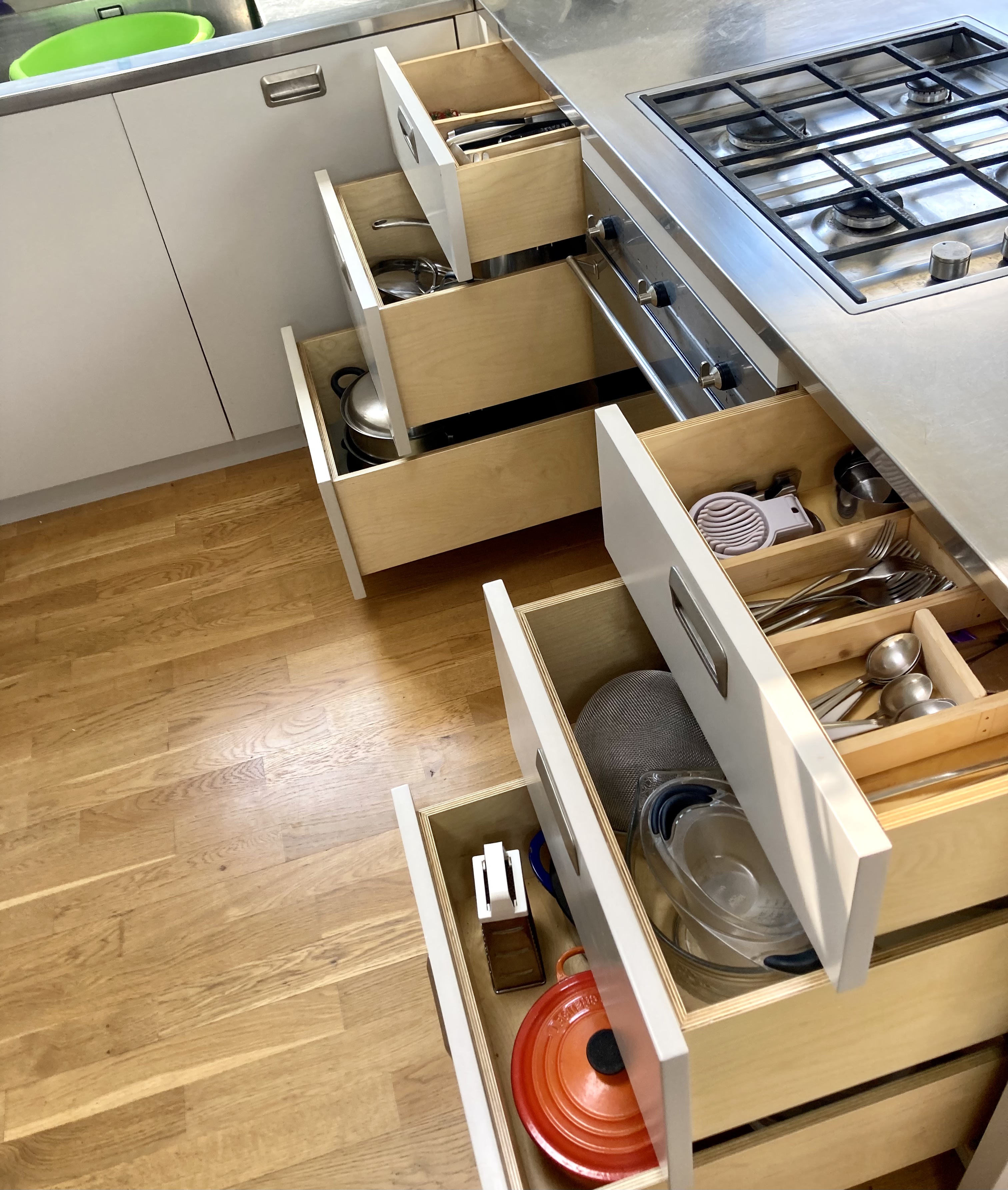
The galley is specially designed for people who like to cook, with gas hob and oven, and big full height fridge with freezer box …..
…. plus a washer/drier.
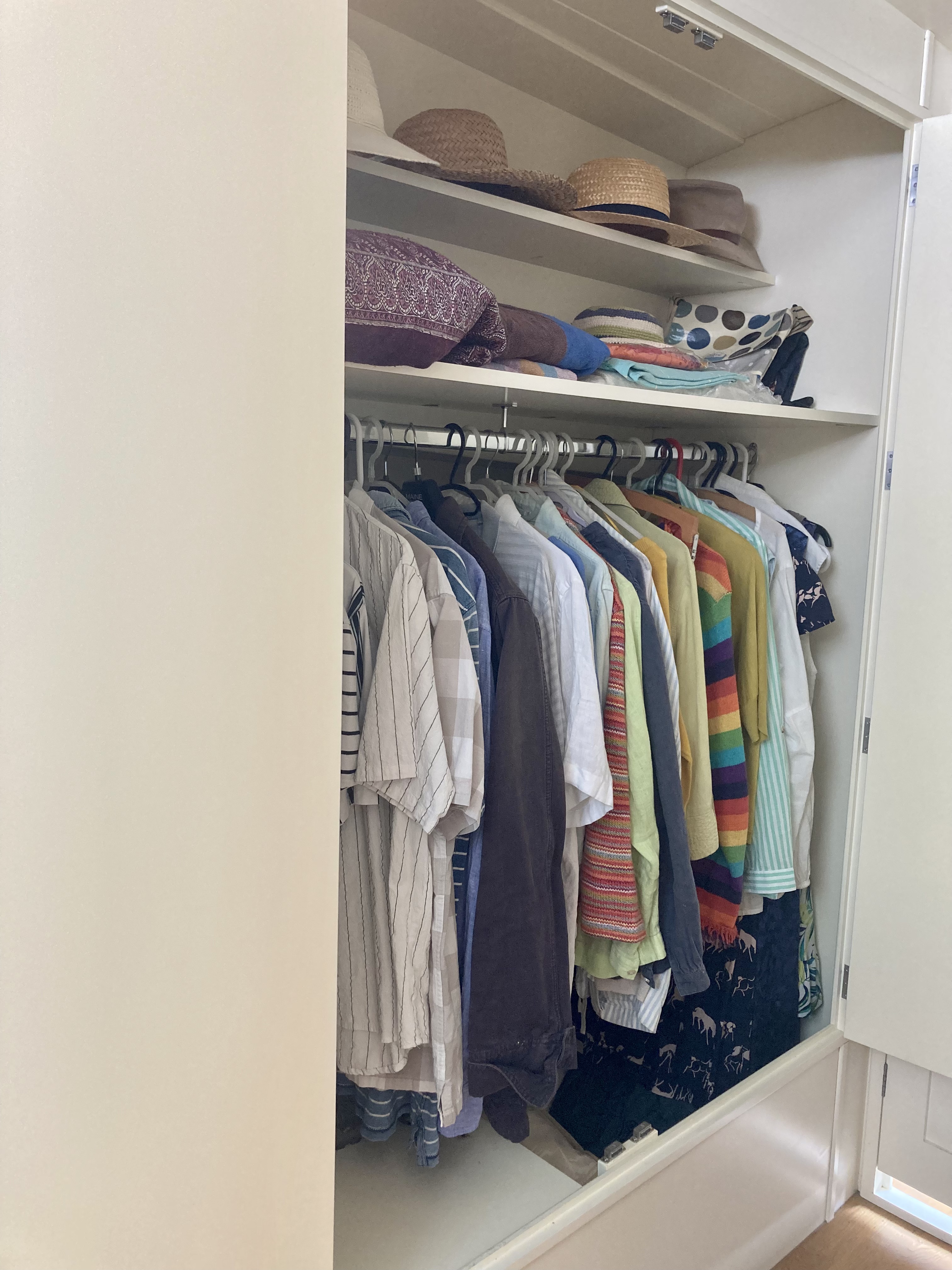
And there is loads of storage!


For sleeping there are two cabins, each with its own en-suite.
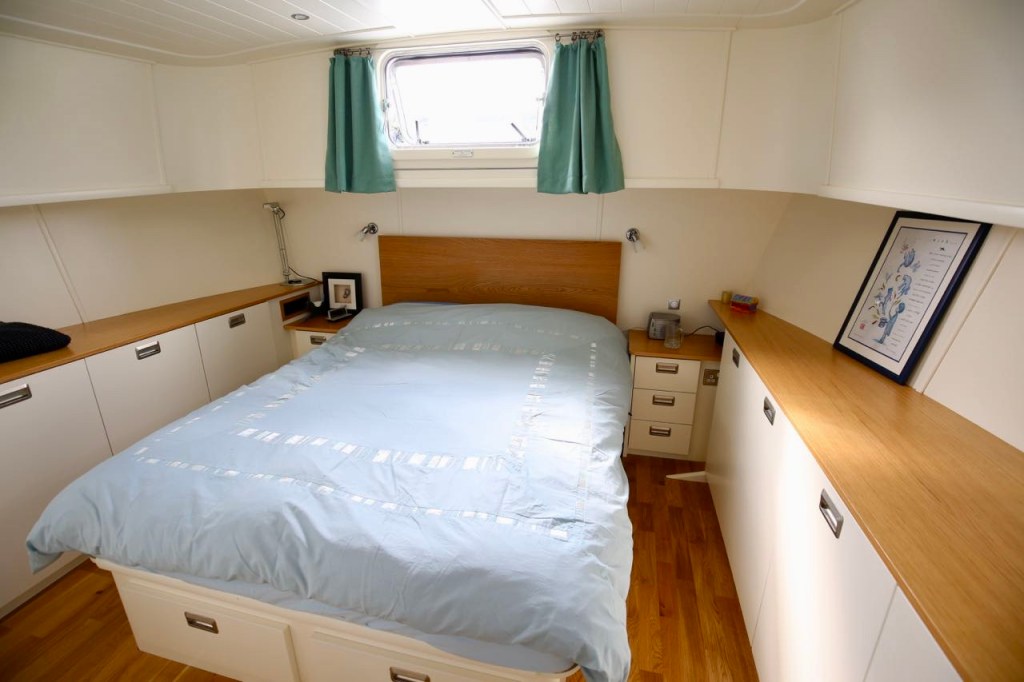
The main cabin is towards the bow with a UK king-sized bed with lots of drawers and cupboards
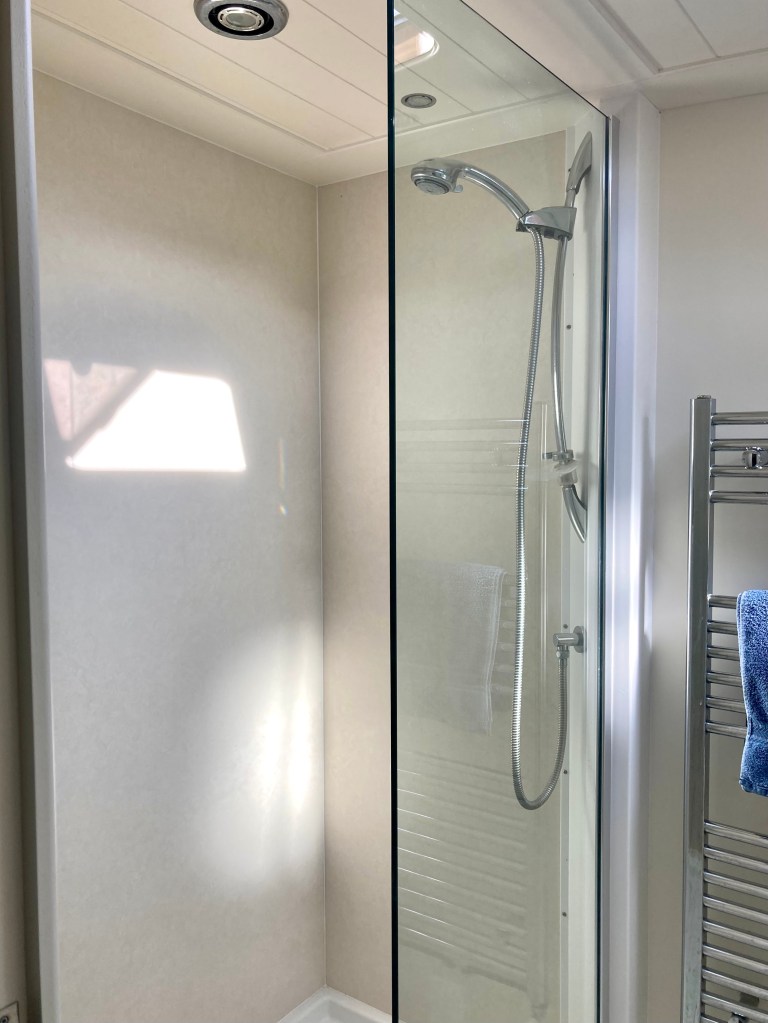
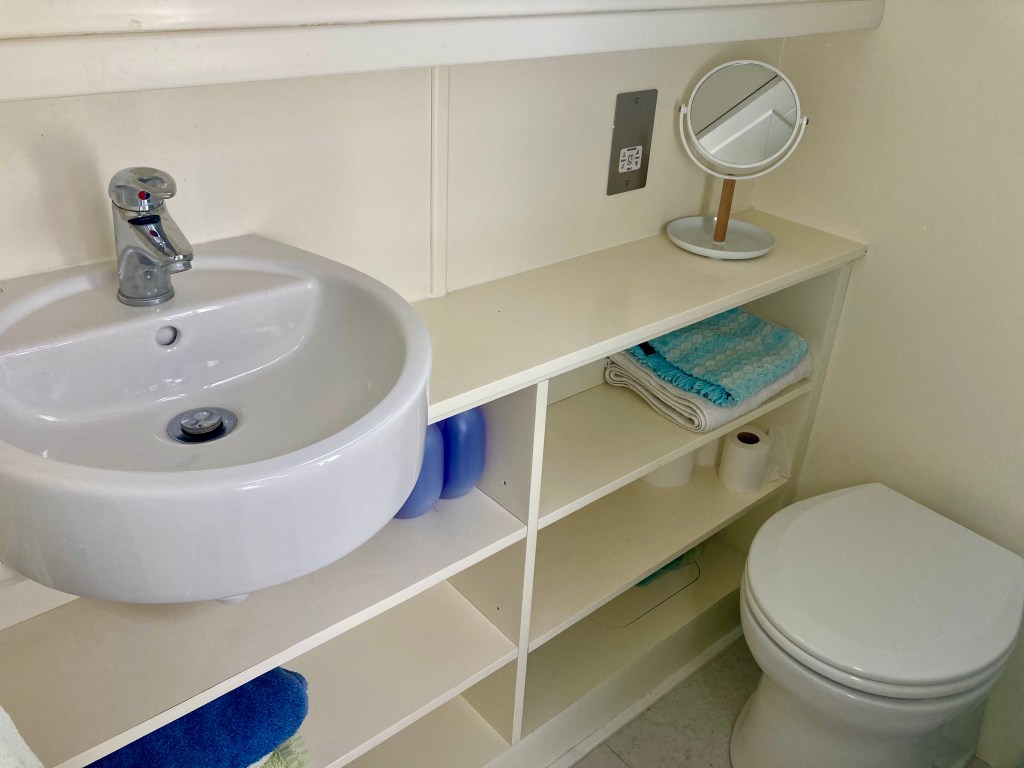
The en suite has a lovely big shower, basin and toilet, with roof hatch above for extra light.
The toilet is below the porthole.
[Sorry my reflection is in the next photo!]

Cabin 2 is towards the stern and ideal for friends or family with its comfortable, long, twin bunks and its own ensuite with shower.
These photos show the bunks, some storage, the big mirror and the door to ensuite.

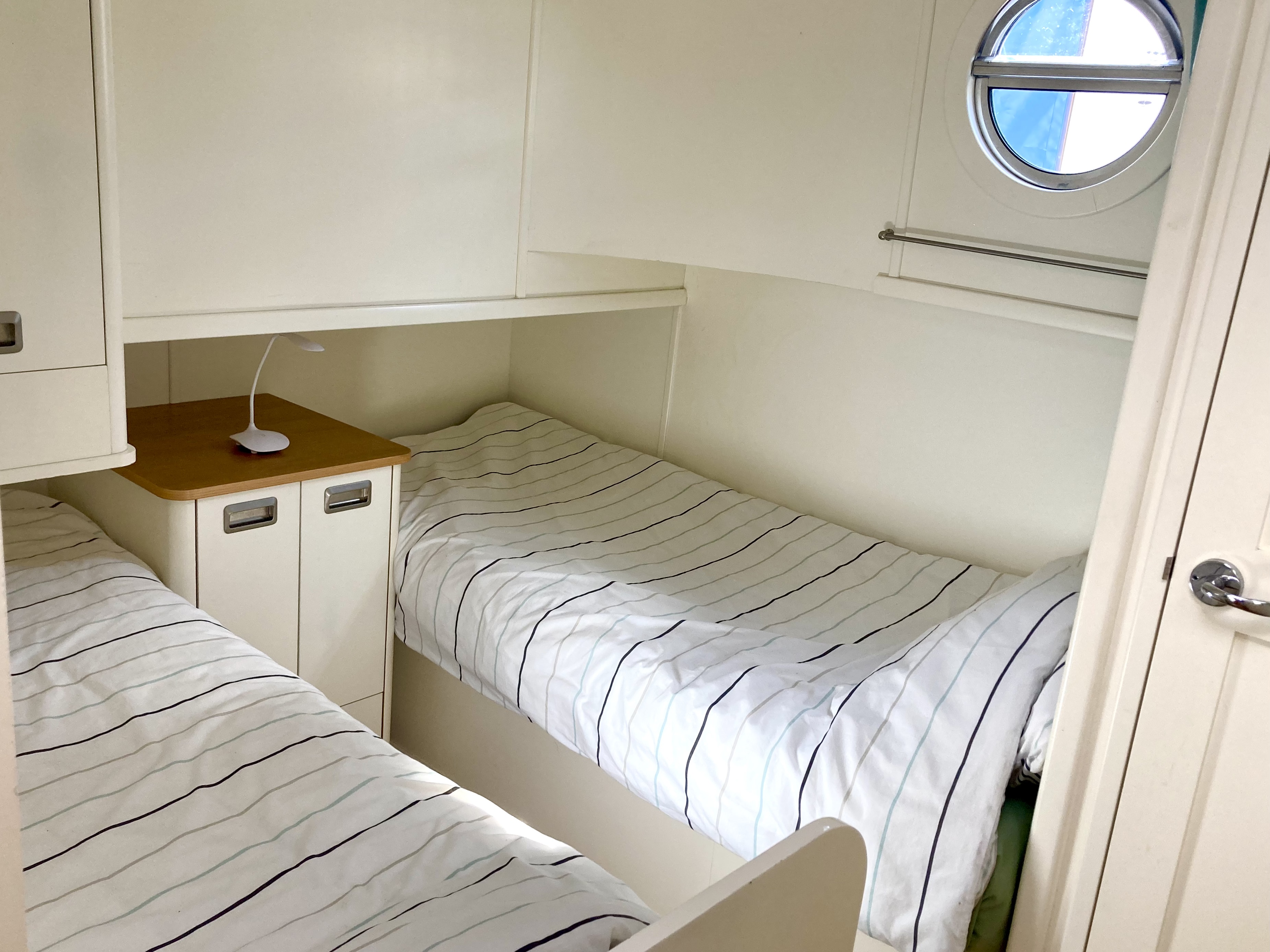

So the second cabin and its ensuite are a saloon away from the Main Cabin.
Most snoring doesn’t travel that far!

So that is where the first 4 people can sleep.

We also often use the double sofa bed in the saloon as an extra cabin. The windows, hatch and dog box all have covers for night time.
And the seats in the wheelhouse convert to a double bed to make total indoor sleeping space for 8.
The other main ‘living spaces’ are the wheelhouse, with its dining table, and the back deck, with its chairs and, for us, glasses of rosé at sundown.

The wheelhouse has stable doors at sides and back. The upper wood section is totally collapsible, but we have never needed to do this and have passed safely under the lowest bridges on the French navigable waterways.
On top of the wheelhousse are 8 PV panels giving 800 watts of power. They allow Calliope to stay away from shore power for weeks at a time.
Inside is a great place to sit, even when not cruising, with all round vision.

This gives a good feel of the space, with my apologies that I took the photo before we renewed seat cushions and blinds in 2024.
Now it looks more like this ….. although on a bit of a rainy day.

And on hot sunny days the whole windscreen drops down! It is one of our delights to be moving on the water with the fresh air flowing through the wheelhouse.
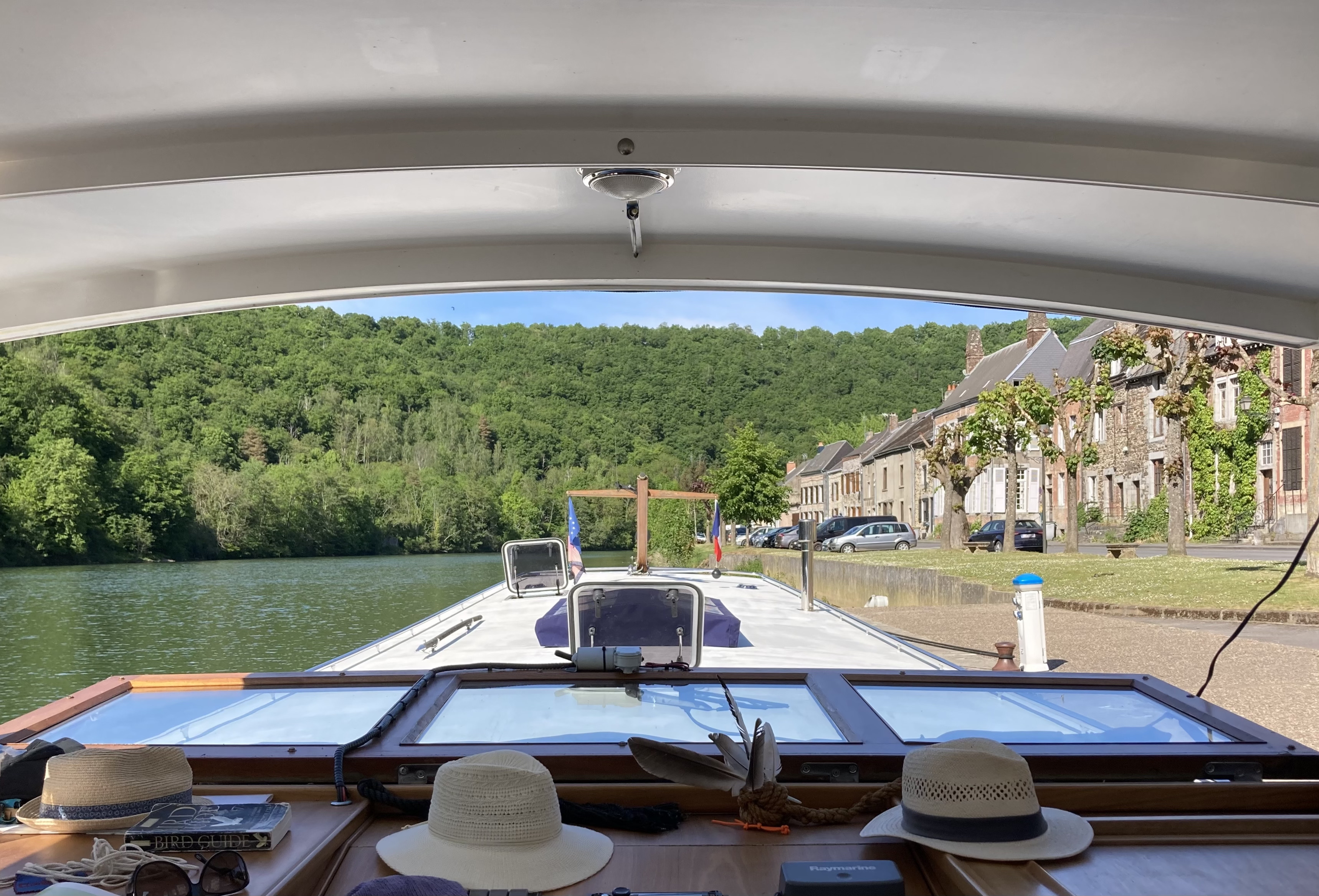
Being out in the open air is a big part of life on Calliope.

Naturally the back deck is a popular place to sit and relax, quietly alone or with friends.
And Calliope is unusual in having plenty of space on the front deck too.

The front deck also houses one of Calliope’s special features – a huge locker to store bikes, tools etc.
There are two other lockers on deck – a ‘rope locker’ on the back deck and a gas locker at the side.

And now on to the technical information.
The engine room is accessed from the wheelhouse.
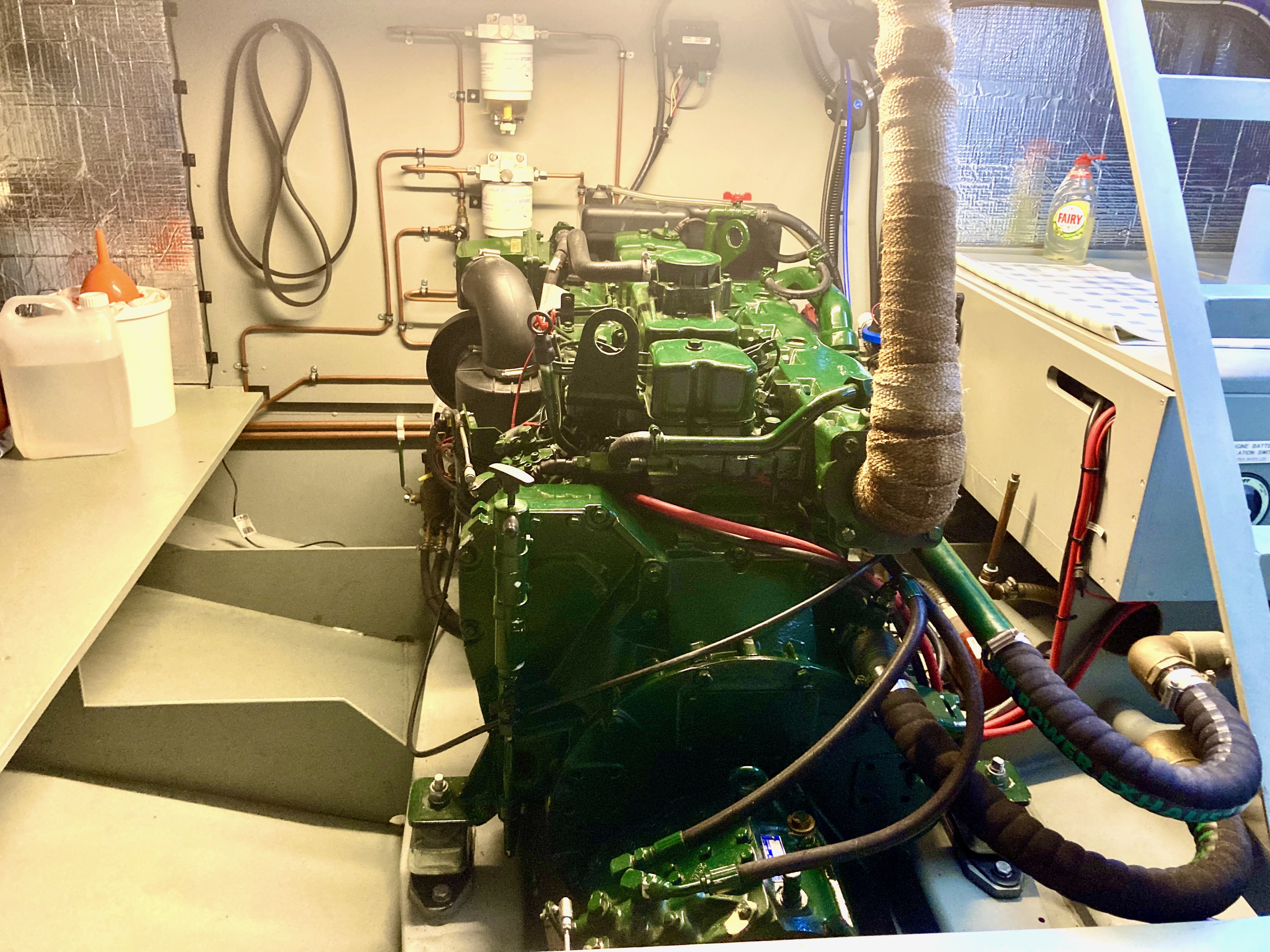
In addition to the 150hp BetaMarine engine it houses the Bubble PJ diesel powered boiler, hot water tank, DAB Easybox pump for domestic water (new 2024) and the pumps for black and grey water waste.
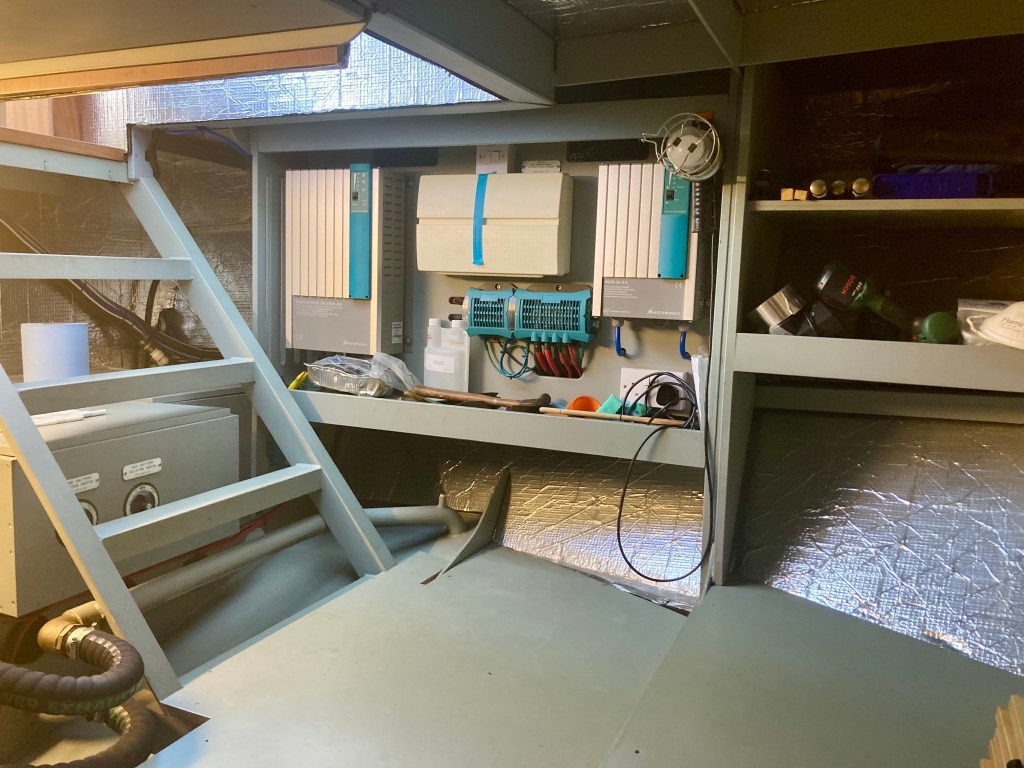
The panel of Mastervolt electrical instruments is at the base of the stairs into the spacious room.

Calliope is keel cooled meaning she can cruise without concern of weed entering the cooling system. She only draws 0.9m.
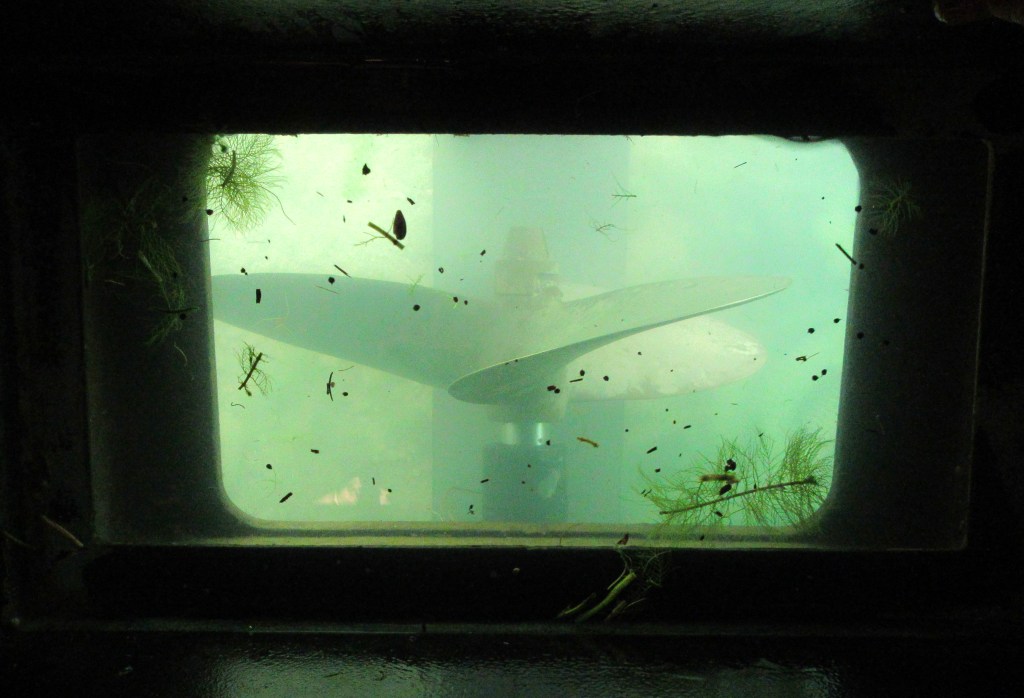
If anything gets caught on the propellor, (a rarity), easy access to the weed hatch in the engine room allows it to be removed.
Strangely to many this is one of my favourite tasks.
Perhaps the other favourite past time is enjoying the back deck together at the end of a summers day.

Want to know more about Piper boats?
If you think you might like to be the owner, of a Piper boat, pre-loved or brand new, it’s best to contact Simon Piper through https://www.prelovedpiper.com or 0044 7769 702521.
And who knows … there might be one more short cruise to blog about before we hand her over.
Canal Entre Champagne et Bourgogne (and La Saône)
3rd to 23rd October 2024
This is one of our favourite canals, despite the 71 ascending locks and 43 descending locks over its 224km length. The first section out of Vitry-le-François is rather straight and although mostly through countryside it is not as scenic as the kilometres after Saint Dizier – but I am getting ahead of myself.

We arrived at the northern end of the canal from the Canal Lateral à La Marne with additional crew on board. Our son had come to help us put in some long days south after a 5 week hold up on the Canal L’Aisne à La Marne; a lock was undergoing modernisation.
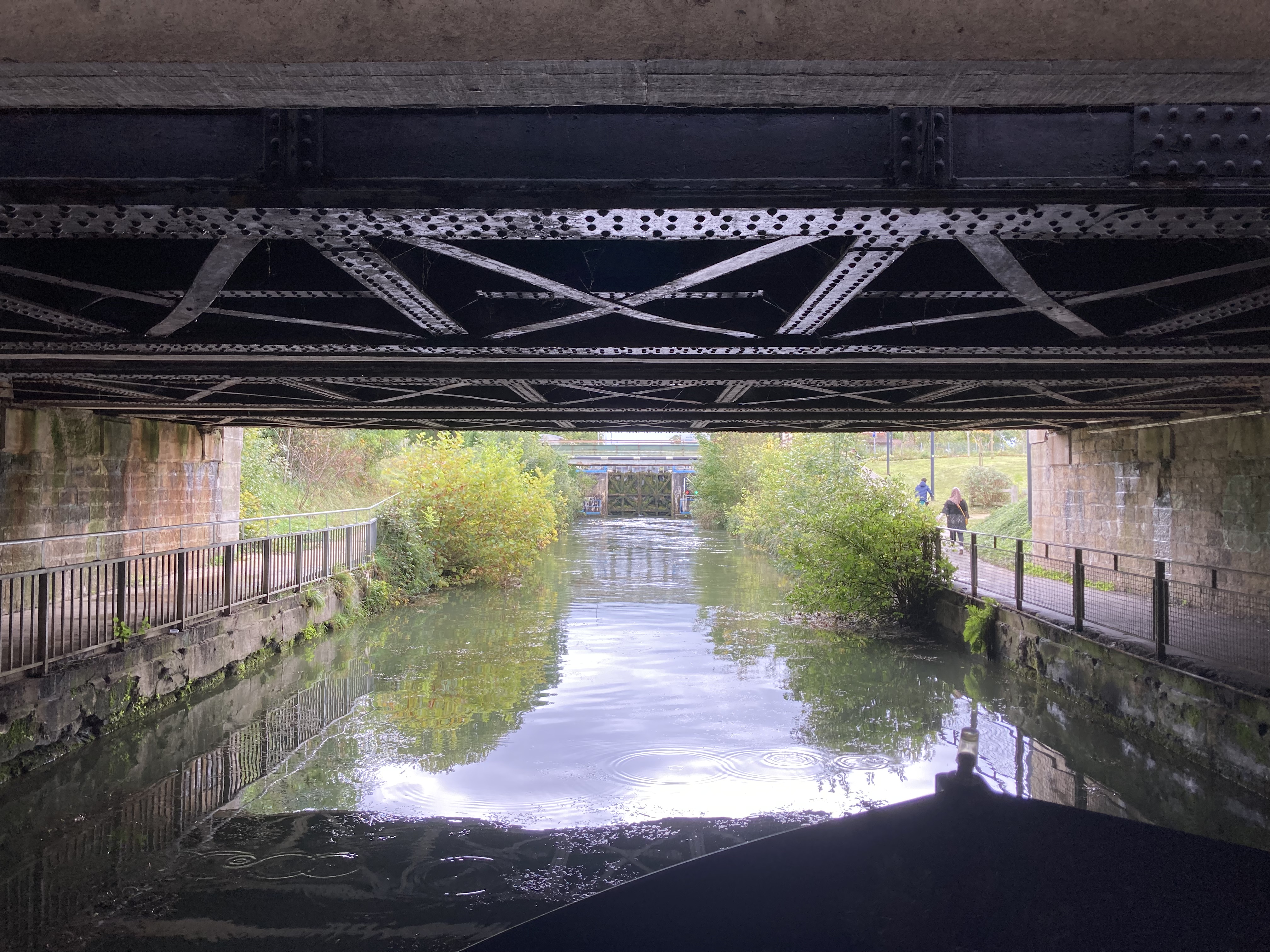
Turning into the Champagne et Bourgogne at Vitry we passed under several close-together foot, road and rail bridges and into Écluse (Lock) 71. Only another 70 to go to the top!
Lock 71 Desert, has some interesting features. We came in at the bottom of an empty c3m lock and needed to throw our ropes up over the bright blue bollards. These are set into angled indents just below the top of the lock wall; once the lock fills up the water level is above the base of the bollards.

So crew must be alert for both ‘roping’ the bollards at the start, and then keeping the boat off the side at the top; we did it!
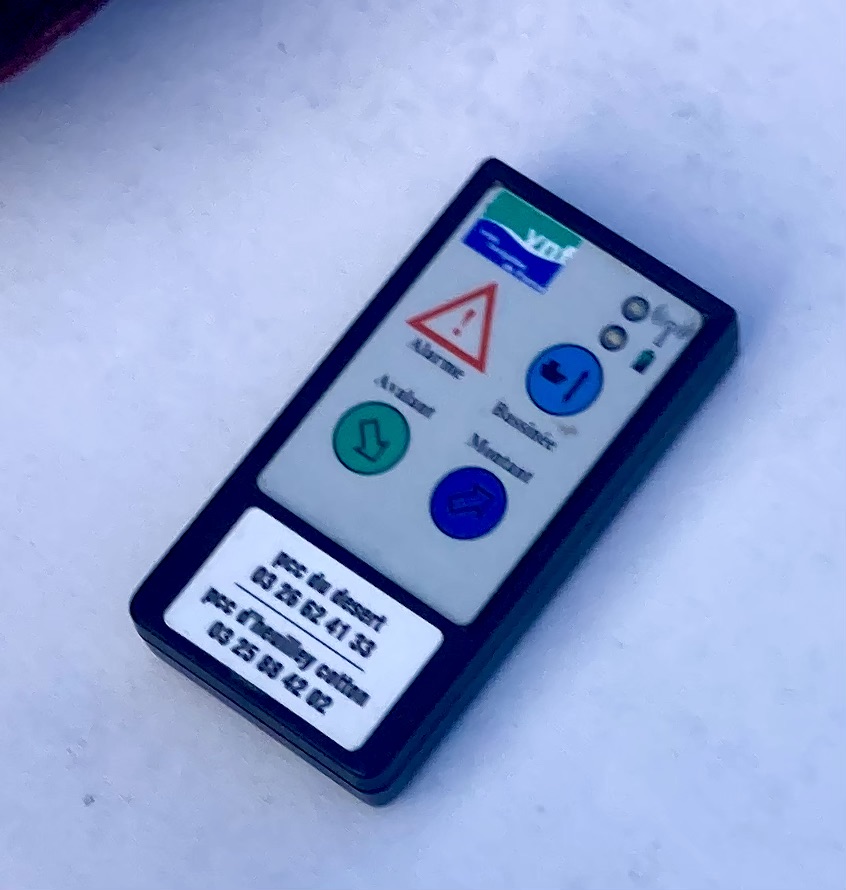
When the lock is full of water there is only one way to get the gates to open. We had to collect the ‘telecommand’ that will operate the remaining locks.
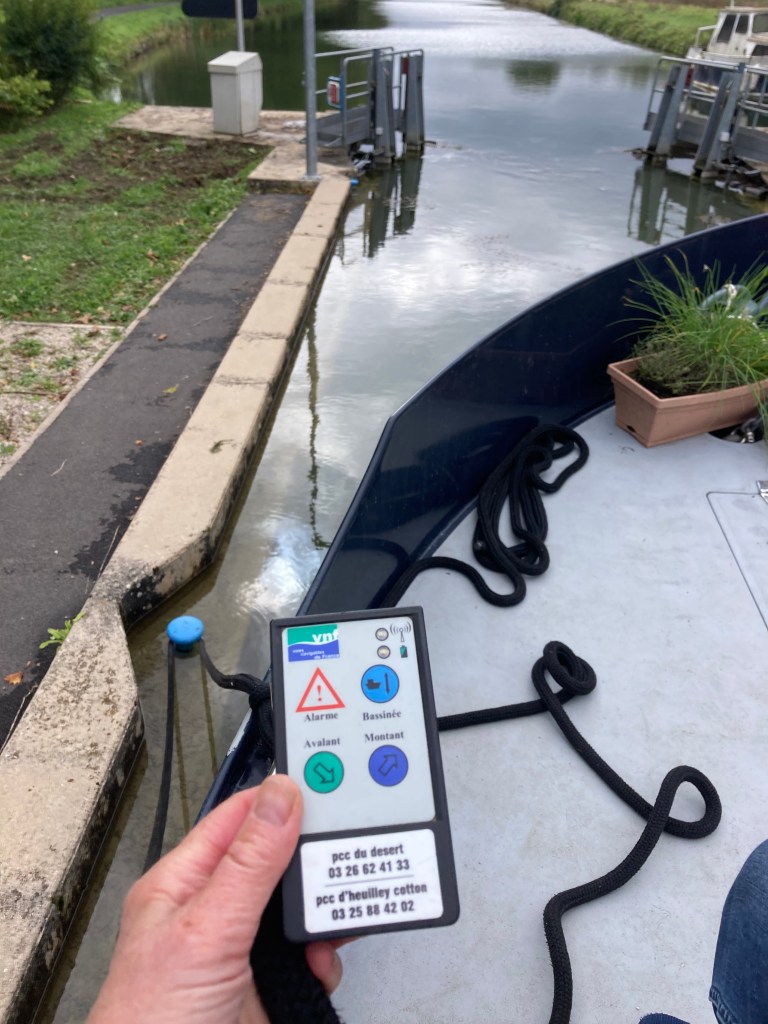
Once we had called up the local control centre and given information about Calliope and crew the telecommand was released from a dispenser next to the lock.The control centre like to know our size, depth. destination etc. The two centres, one nearby at Desert, and one at the summit at d’Heuilley Cotton, then kept an eye on our progress through a mix of cameras and peripatetic éclusiers (lock keepers).
I suppose éclusiers have a new job title now that they are driving around in vans labelled Service, and rarely actually operating a lock …….. I must ask.
Matignicourt, near Orconte
We had considered going through another 14 locks that day, while we still had son Ashley on board to help, but as we reached Matignicourt we all decided that this was a nice place to stop – expecially as there was one of our favourite Just Queen pizza kiosks nearby!
That made supper nice and easy!
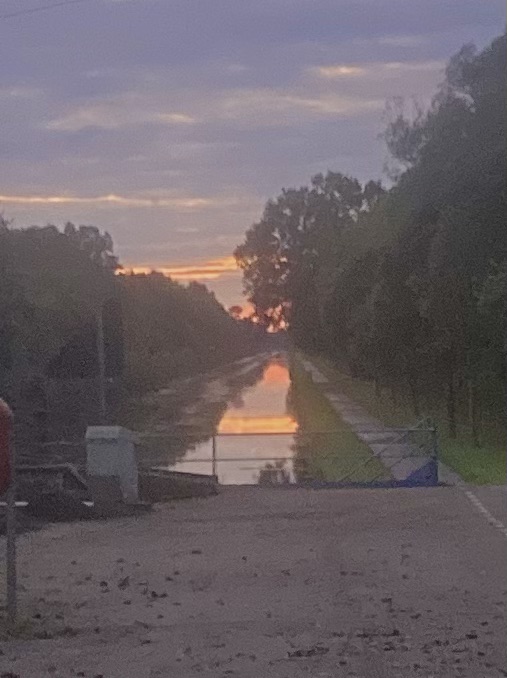
Pizzas were soon bought and brought back strapped onto my bike. Now to enjoy a last evening with Ashley with another lovely sunset in the background.

The next morning showed the canal at its Autumnal best. We took our time with breakfast and an early lunch, and by 1230 we were on our way.
Saint Dizier
On we went towards Saint Dizier, along a section of almost entirely straight canal. The first three ècluses (locks) were as expected and uneventful, and we knew to expect something different at the fourth, Perthes.
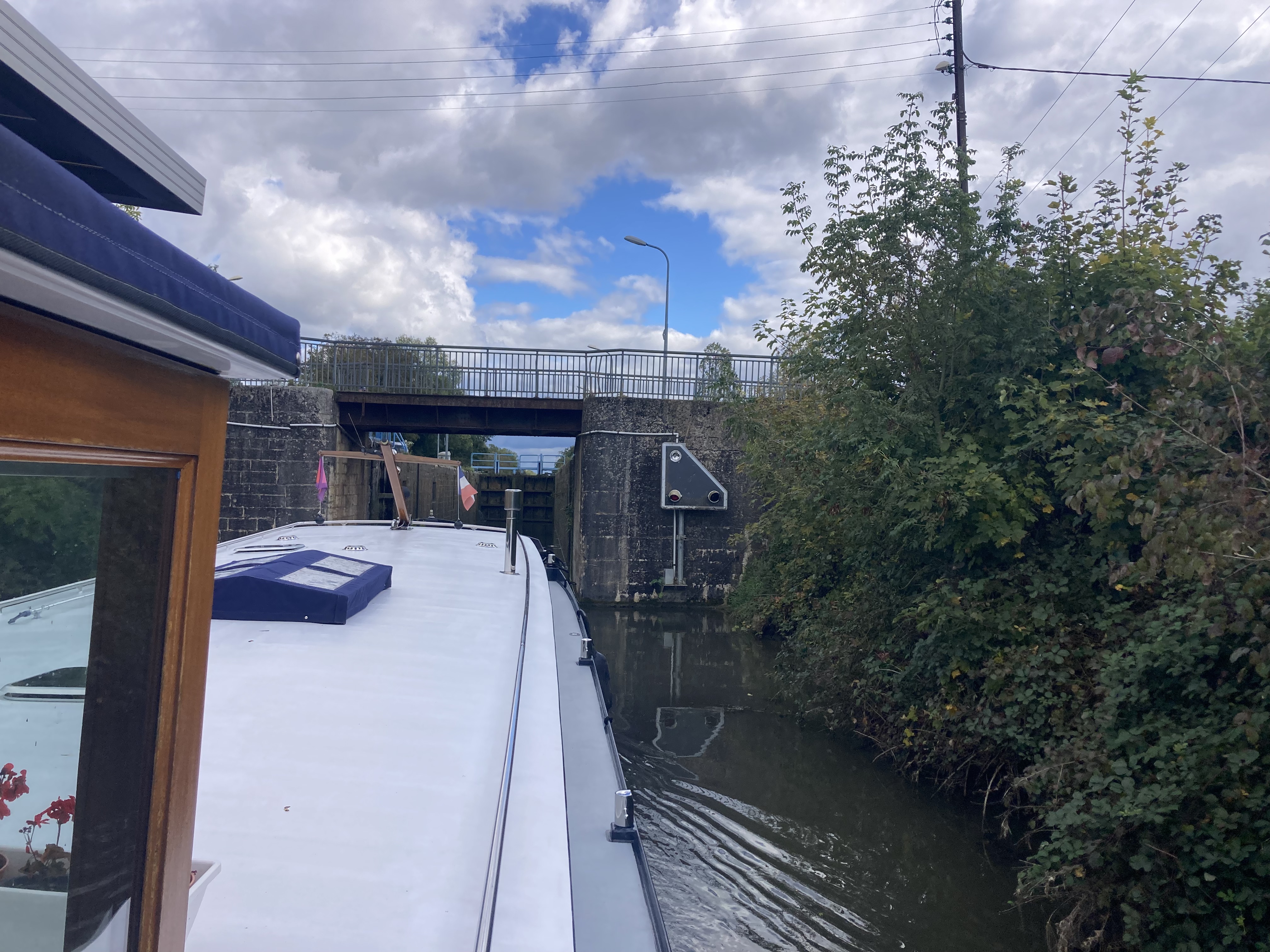

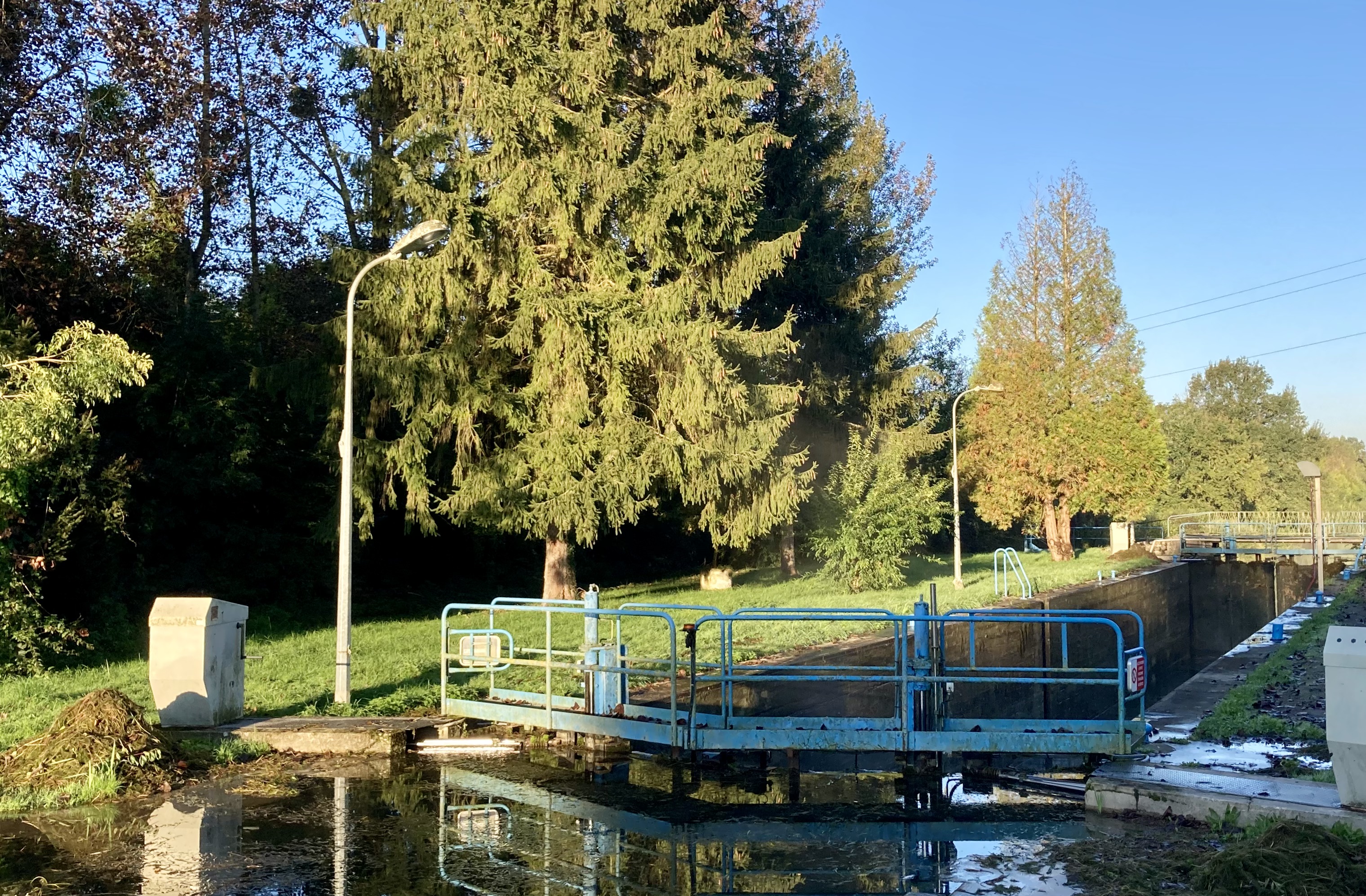
This lock has been a bit of a problem to the VNF (Voies Navigable de France – or French Waterways) for several years after some local ‘bad boys’ decided to take out the ‘traffic’ lights next to the lock. These let boaters know when they can enter the lock. We had been told to call the VNF as we got close to Perthes, and on cue a VNF service man turned up to operate the lock for us. A smooth passage was effected.
As we left the lock we were asked when we would leave Saint Dizier as we would also need to meet a VNF person at a lift bridge just beyond the town; we gave him the time we would be there the next day.
The next three locks took us up past a big airfield, home to the French Air Force fighter jets. As usual they were out practising their noisy take offs and landings – an awesome sight.

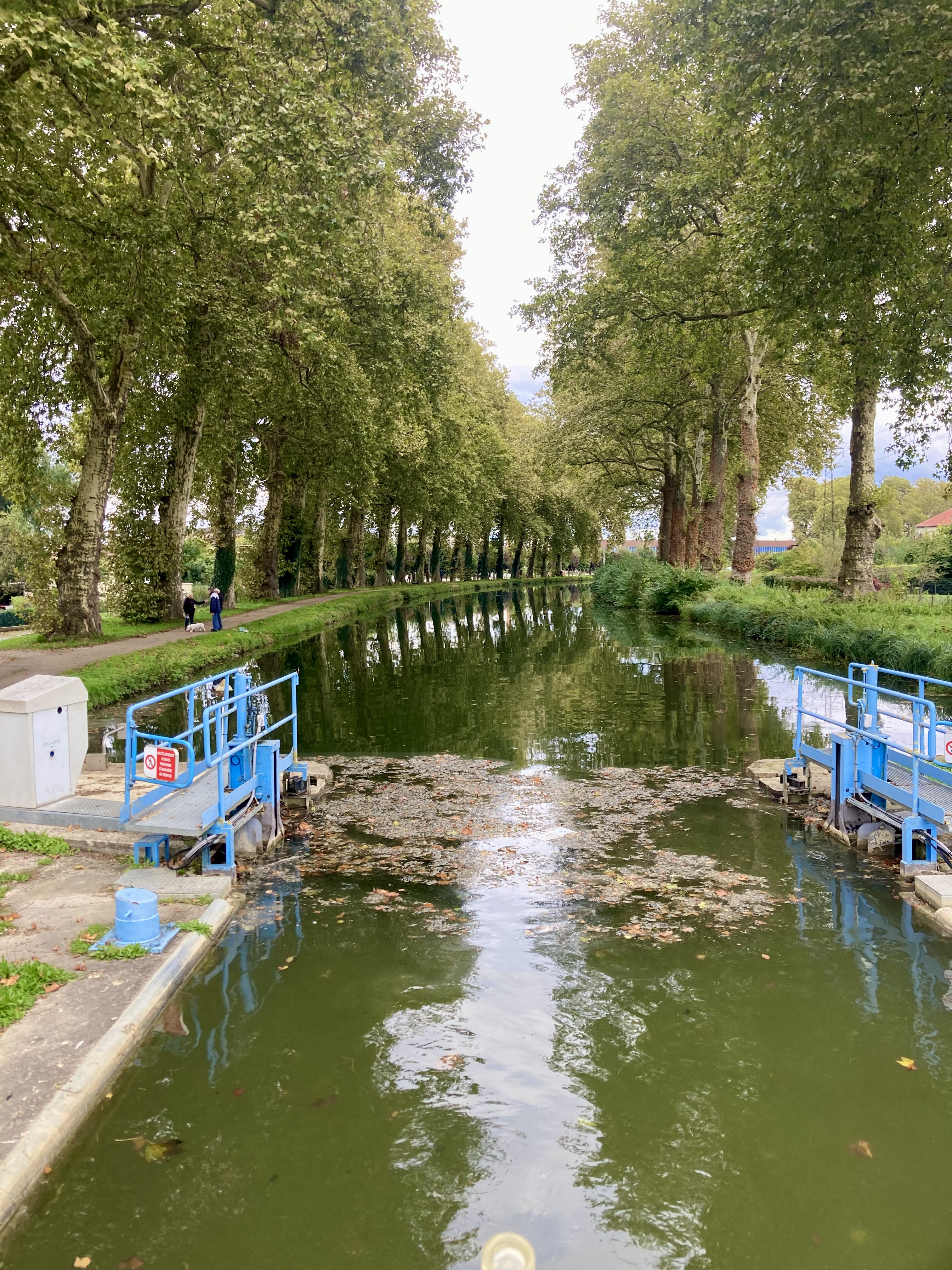
Then as we drew close to Saint Dizier the canal takes a sharp turn to port, under a bridge into lock 59, Noue. After the rather plain and industrial stretch leading up to here it was nice to see a tree lined avenue of a waterway ahead, still green despite the time of year.
The last 2 kms of the day took us between an interesting array of buildings on one side and the station, where Ashley would be heading, on the other. Then we went through the final lock and onto the St Dizier quay for mooring.
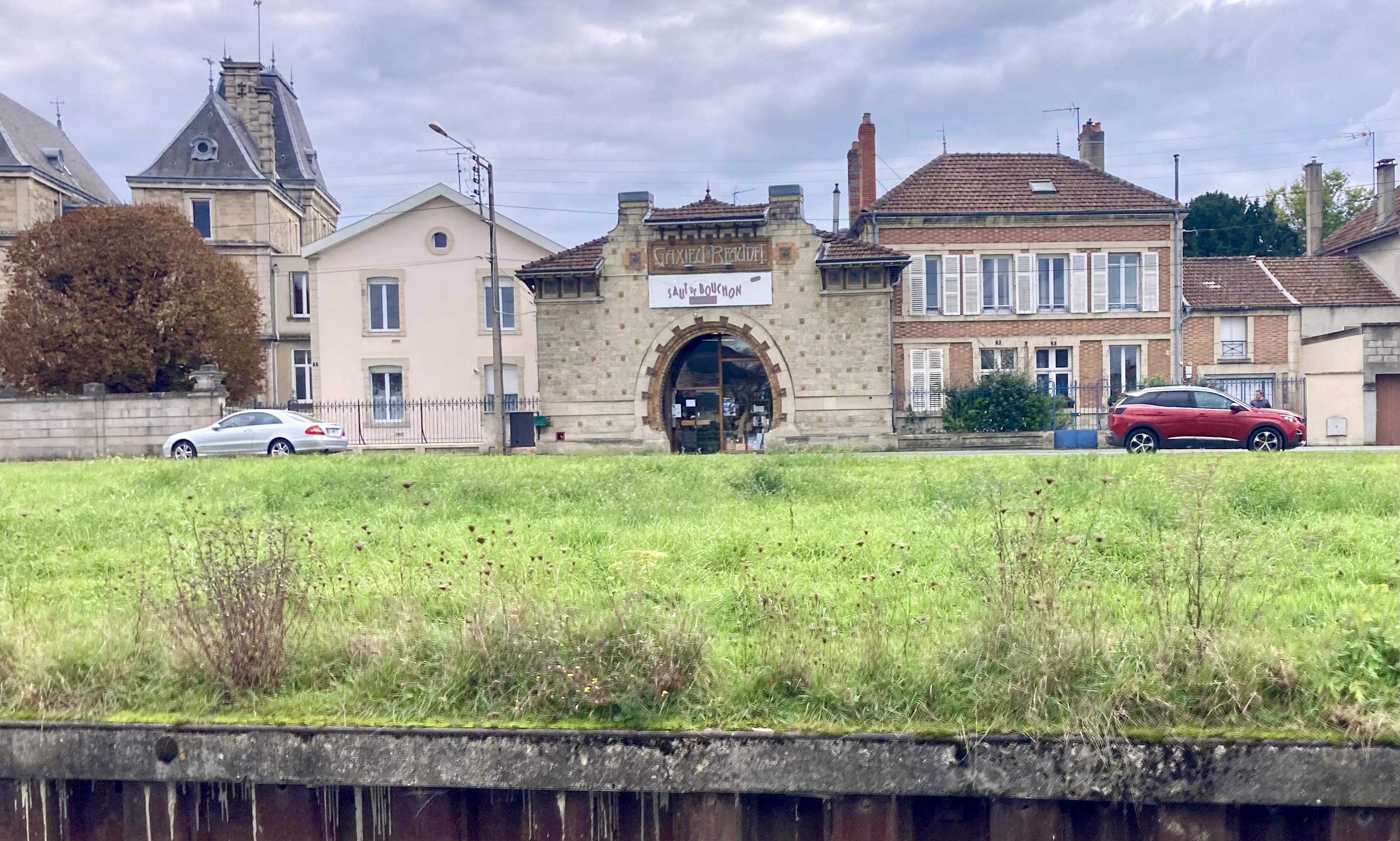
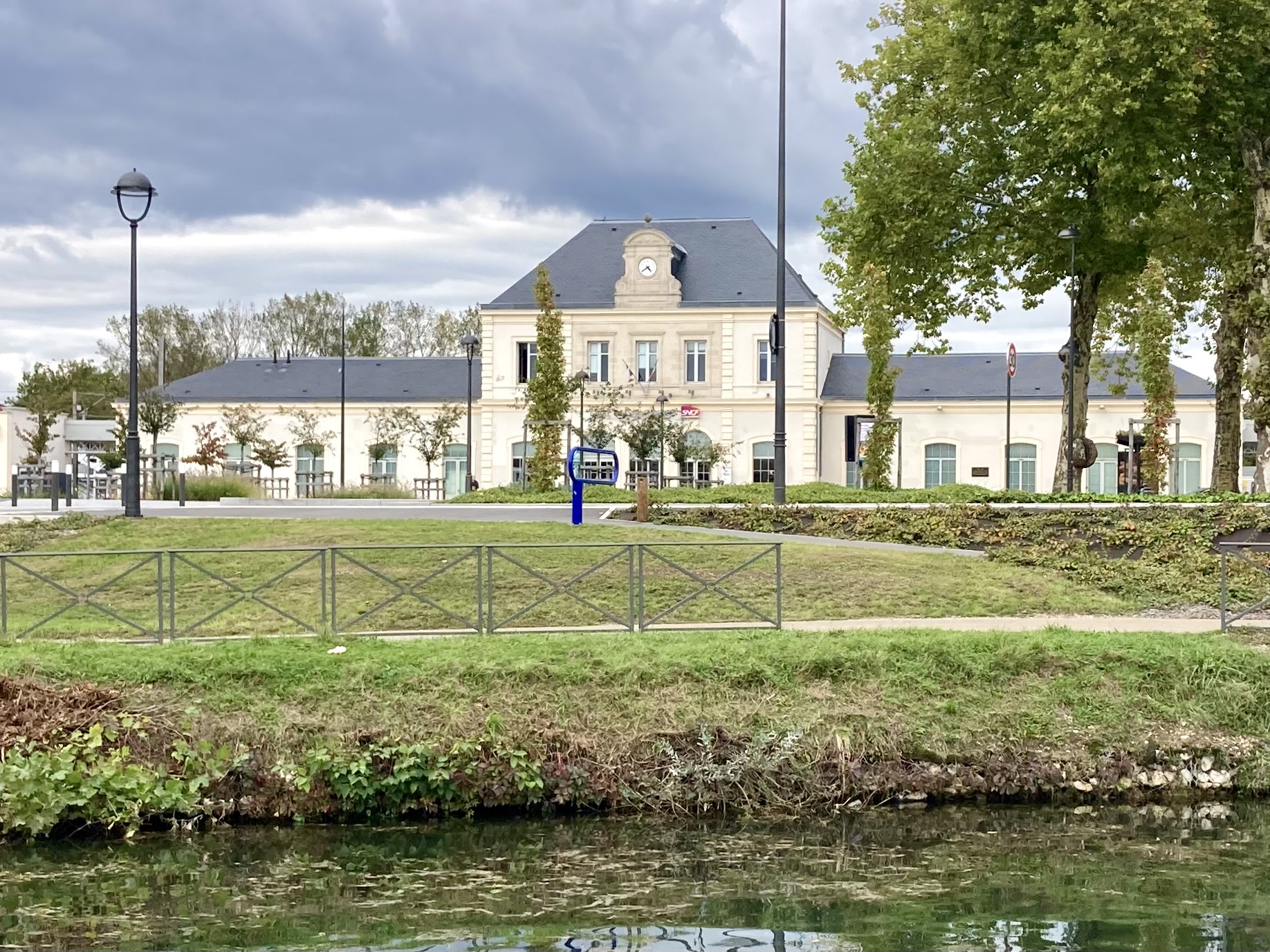

We have moored here a number of times, opposite the swimming pool and close to all the amenities of the town. There is electricity and water, should it be needed, available by asking for jetons at the swimming pool.

We said goodbye to Ashley and settled into passed a contented night there.
Nearby the famous Miko tower shone out, actually more blue than the mauve showing in the photo.
Miko is a famous ice cream brand in France. It started here in Saint Dizier supplying ice cream to the cinema.
Bayard
Just one night at Saint Divider this time as we still needed to make up for lost time over the last few weeks, so in the morning on we went up the canal.
We thought we had agreed with the VNF the time that we would arrive at the next ‘obstacle’ along our way the lift bridge at Marnaval ……. but when we arrived there was no sign of anyone to operate it.
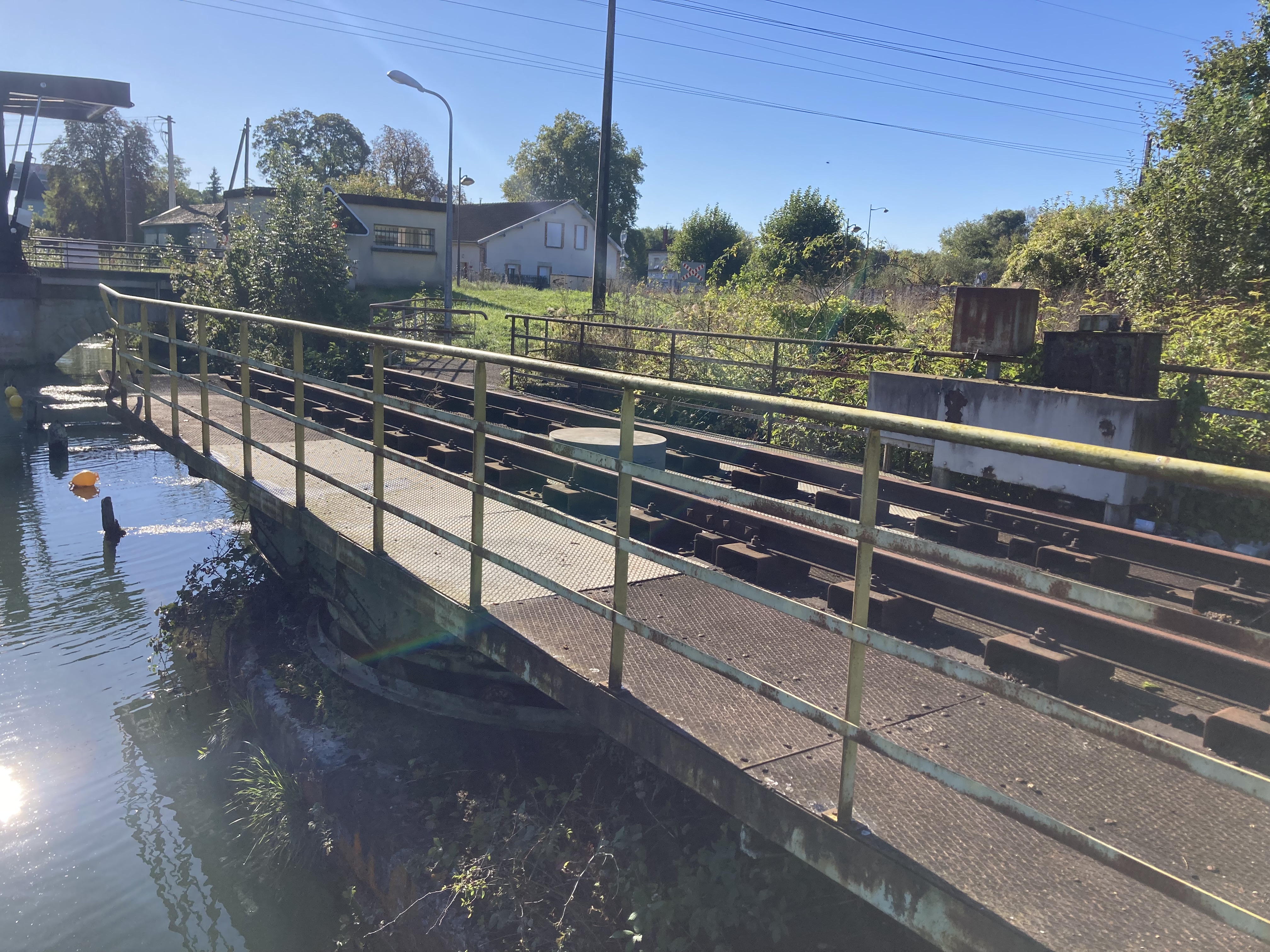
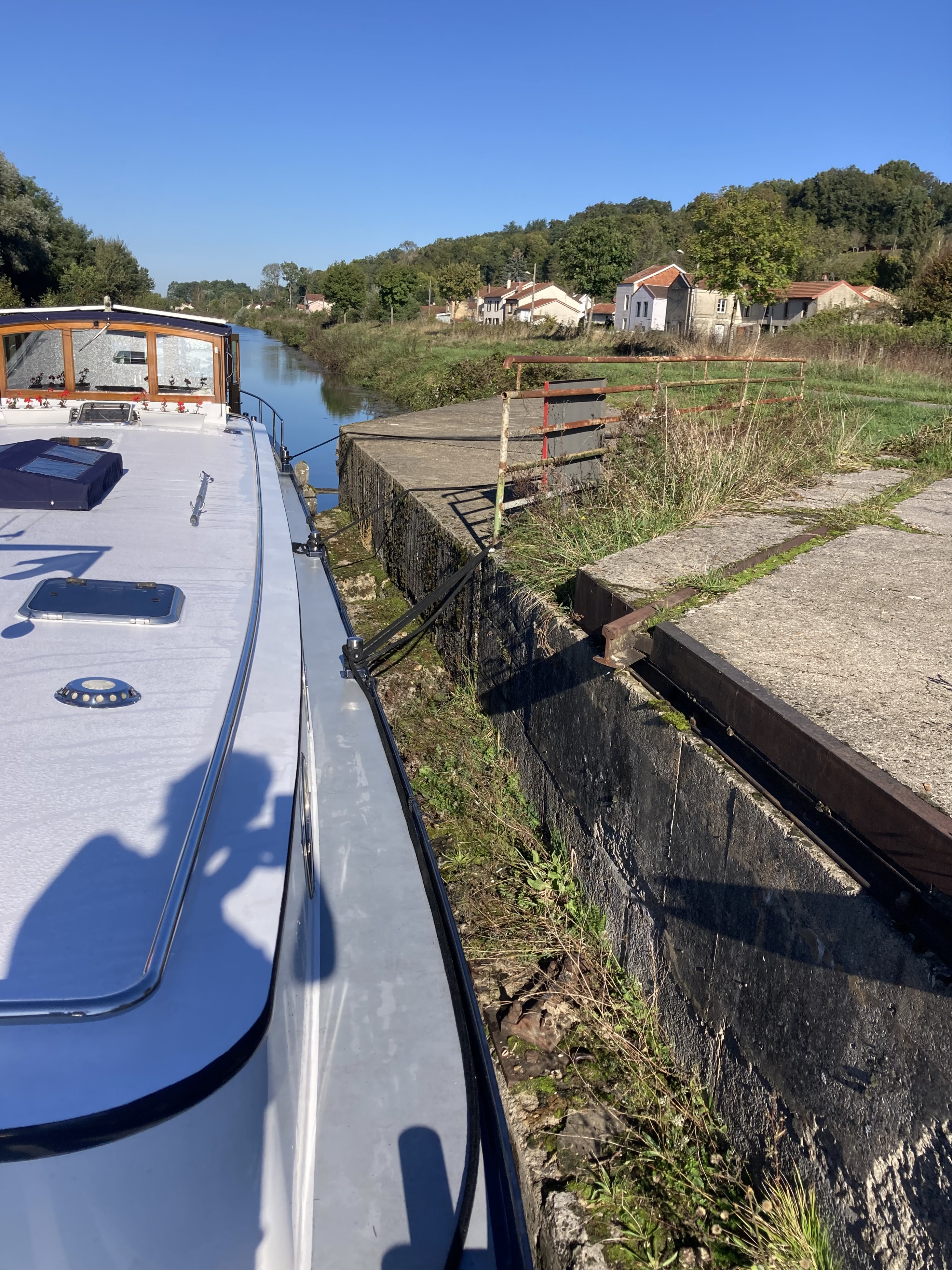
It is not easy to wait on the Saint Dizier side of this bridge because there are the remains of an old railway swing bridge immediately before (left photo). Using a mix of carefully placed fenders and ropes we did tie up, call the VNF and prepare to wait for a while. It was a Sunday morning and it was likely that the duty person would have a little way to travel.
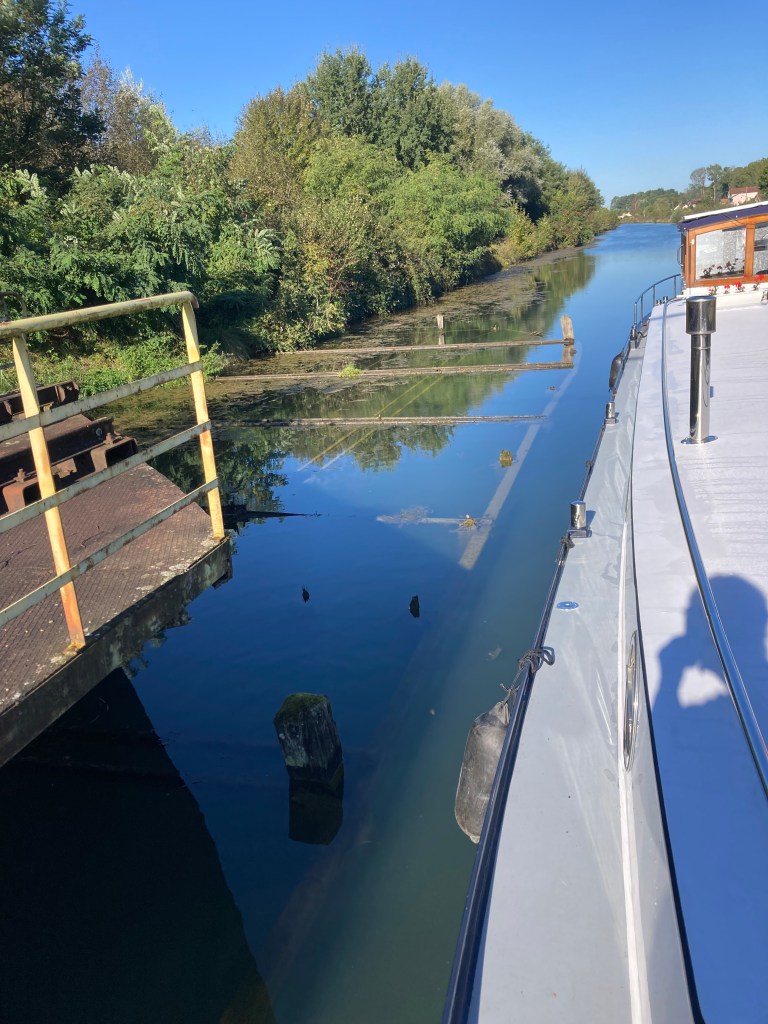
We waited less than half an hour in the sun shine, and then saw the welcome man and van arrive. He went into the bridge hut, stopped the traffic and lifted the bridge.
Then Calliope crept forwards gently. We are aware of the need to watch out below the water line at this point. Some of the railway bridge structure is under the surface; other less fortunate boats have received a bit of a scratch to the hull here.
But we were safely through and enjoying a lovely cruise onwards towards an interesting ‘wiggly bit’, controlled by traffic lights. The canal turns sharp left under s bridge and then fairly quickly sharp right into Gue lock. Below is a very-much speeded up video of the wiggle, steered through beautifully by Captain Stu. It’s about the fourth time through this section for Calliope, and far easier when you know what to expect, including an understanding that the green traffic signal means that you will not meet another boat heading towards you.
It was such a beautiful day’s cruise and so many scenic moments; I feel that I must share some of the images that took us along from Gué to Bayard, where we stopped for the night.1


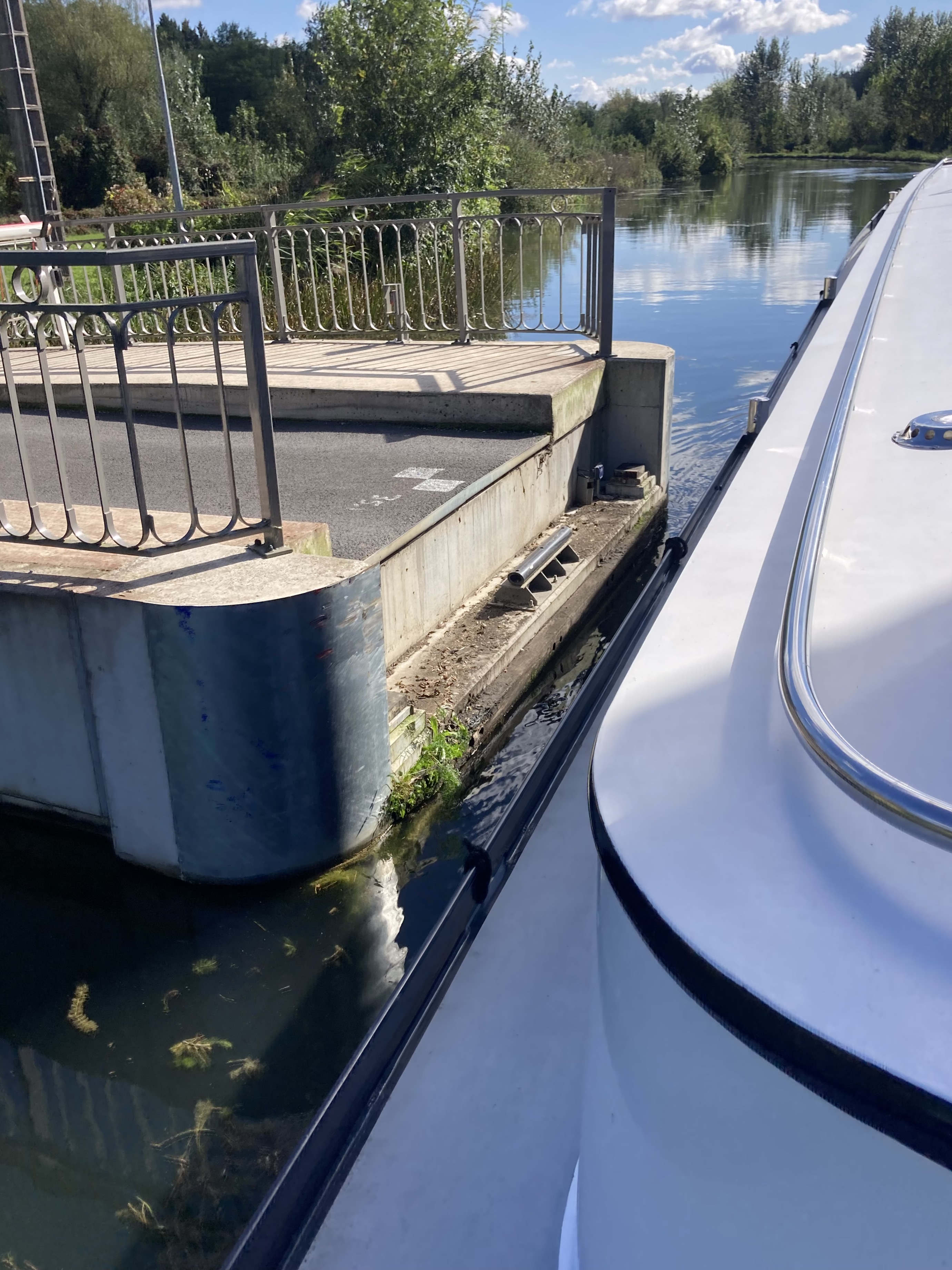
By mid afternoon we had moored up at Bayard, one of our favourite little moorings, gently sandwiched in a 500m stretch between a lock and a lift bridge, and nearby is a small supermarket should we need it.
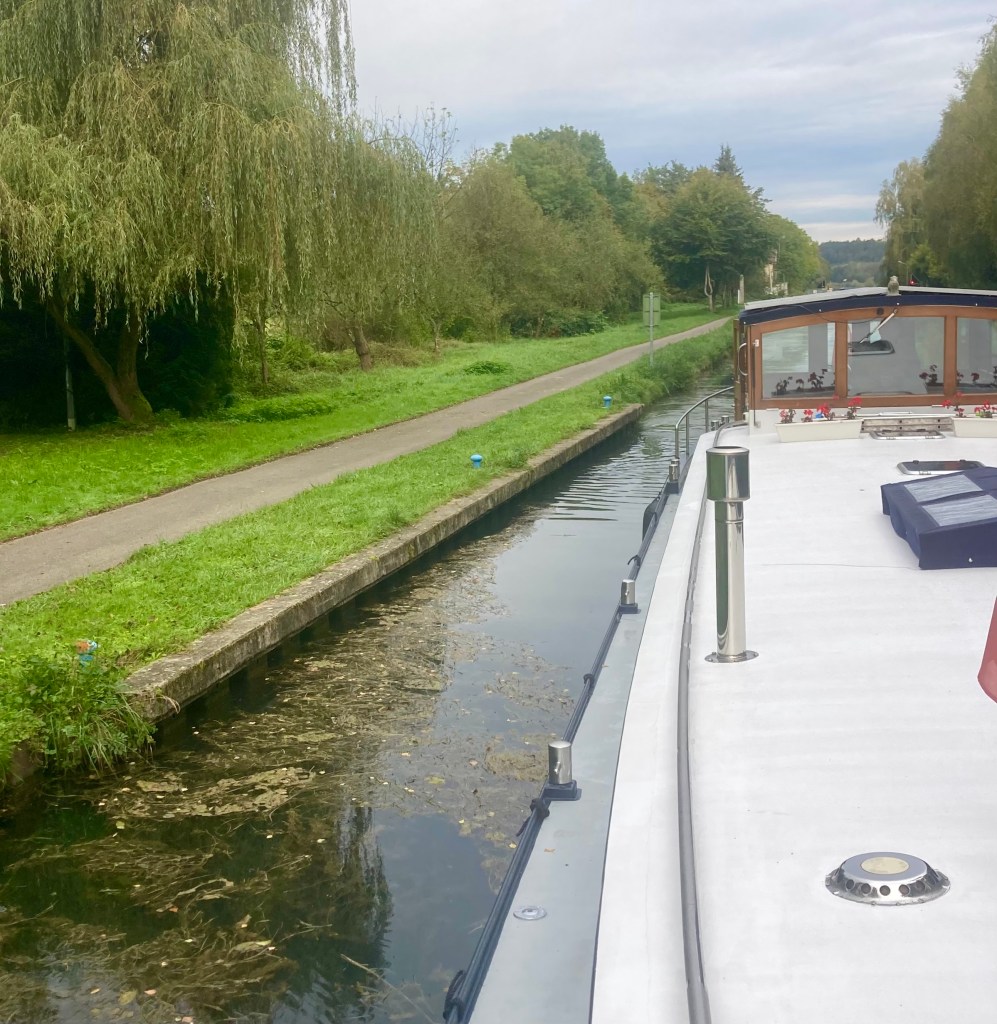
I didn’t take a photo of our peaceful evening there, but quickly captured the mooring as we left it next day.
Not as bright day a day as the day before. It was warm enough and not raining, so all in all no complaints.
Dolphin above Lock 50, Chevillon
We had good plans to reach Joinville that day, only 16 kms and 7 locks ahead, but as we all know the best laid of plans can easily be derailed. In many ways it is part of the enjoyment of the waterway, rising to the little challenges, and through that discovering new places and skills.

We made a good start, waiting initially for Bayard lift bridge to ‘prepare’, so that road traffic could stop and we could pass through.

Half an hour later we were passing Fontaines-sur-Marne, where the canal passes close to the river. At this point there is a lovely wide weir down to a branch of the river that runs past Bayard. The river map here is quite complex!
The sluice gear and the railings will let you know that Calliope was passing over a ‘pont canal’. This is a bridge takes the canal over the main part of the Marne.
Two kilometres further we received notice that a lock ahead was closed and that we must stop after lock 50, Chevillon …. where there was almost nothing to tie up to.


The map showed two ‘dolphins*’ about 25m apart. We are about 20m long, so it would take some kind of juggling act to secure bow and stern ropes. Stu drove close to the front dolphin and I got a rope on, plus myself ashore. Then Stu went astern gently until the bow rope was taut, threw me a stern rope and I looped it on the back dolphin before throwing back the loose end.
[* A dolphin, in this context, is a strange ‘Anglicisation’ of Duc D’Albe. There is a myth that they date back to the 16th century Duke D’Albe who apparently ‘invented’ wooden moorings in the water, rather than on the land. Other sources suggest they are from the Netherlands where groups of wooden stakes in the water were known as Dukdalf. They are a lot more sophisticated now.]
We were moored! Only one problem – I was ashore; Calliope was 2m off shore, and strung between the dolphins! The Captain soon managed this, paying rope out at the stern and driving up to the front dolphin where I hopped aboard.
It is lucky that we made ourselves secure as we ended up there all night, but feeling safe as no other boat would be able to come by and create a wash.
Joinville

In the morning I was glued to the radio waiting for news that we could continue.
Instead a VNF man arrived alongside in his van to let us know that all ahead was now ahead and we set off.
It was rainy as we left our dolphin mooring, but the clouds gradually cleared as we cruised on through the next lock, no longer a problem.
The map showed another 12kms to Joinville – too short a day really, given our desire to reach our winter mooring, but we like the Joinville mooring and the local Brico (DIY store) and supermarket. So Joinville remained our plan.
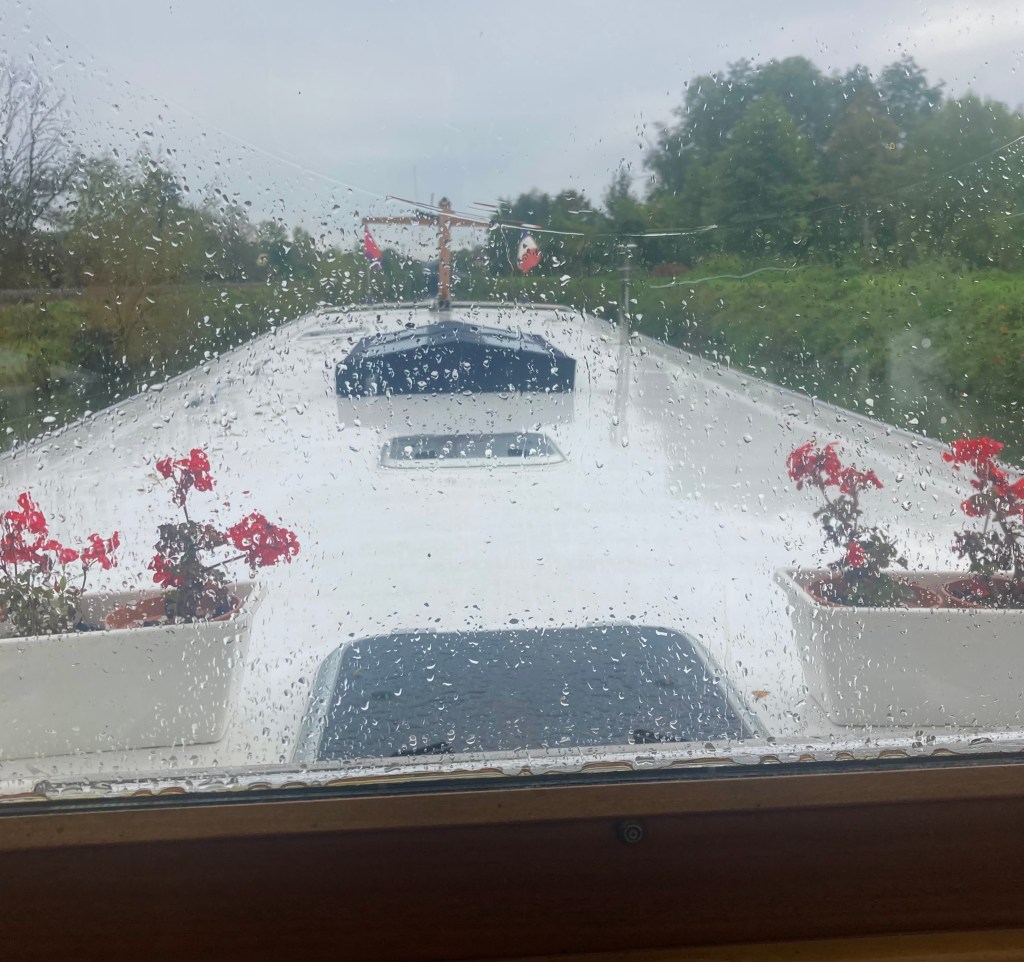
The next lock, Curel, has an attractive garden around the lock house. We are always pleased to see the lock houses, no longer occupied by éclusiers (lock keepers), being used by someone else.
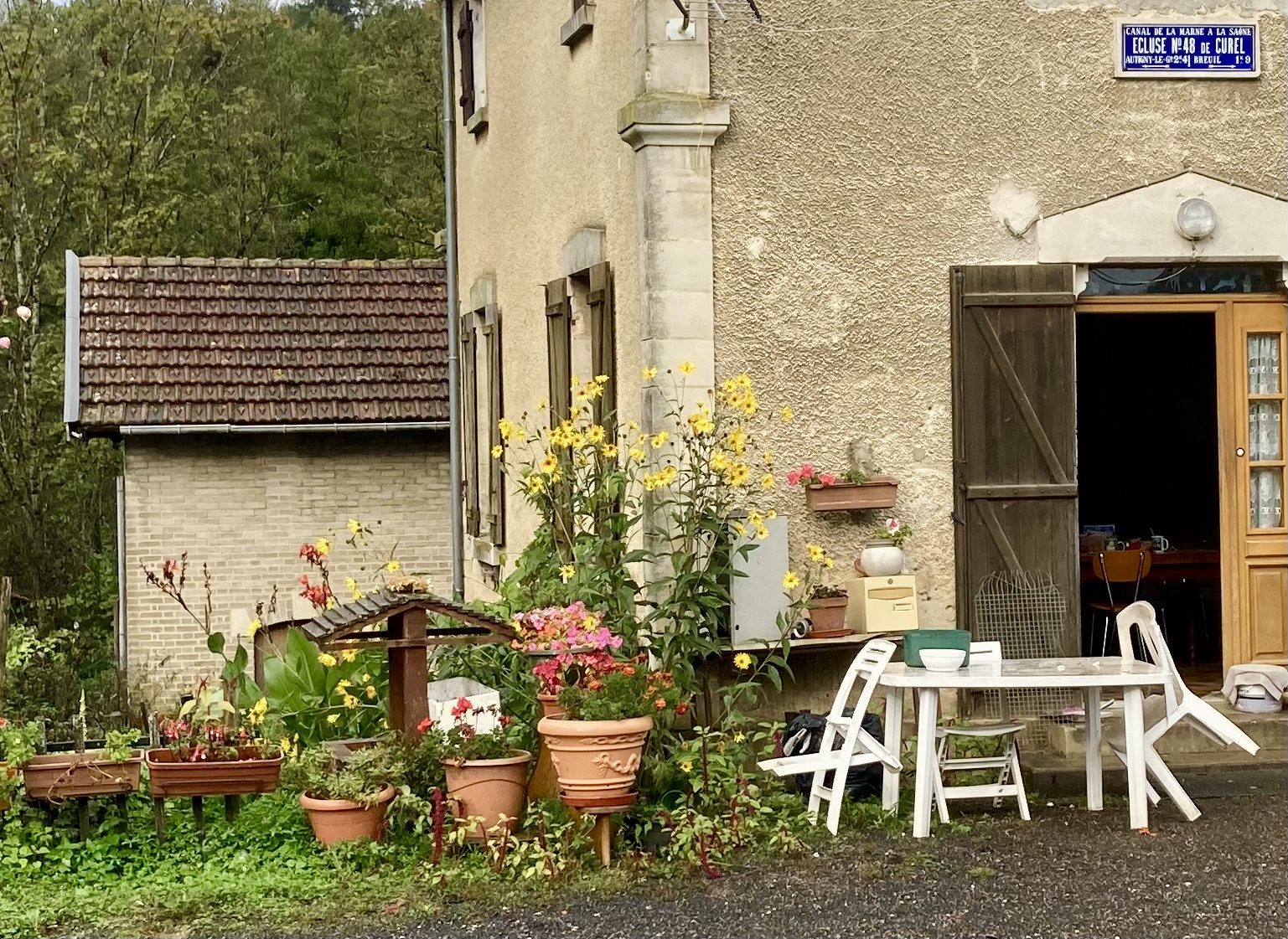

Who ever lives here is making the most of the space around them.
Straight after the lock is a lift bridge, lifting automatically as the lock gates opened. A third of the day’s short cruise behind us already.
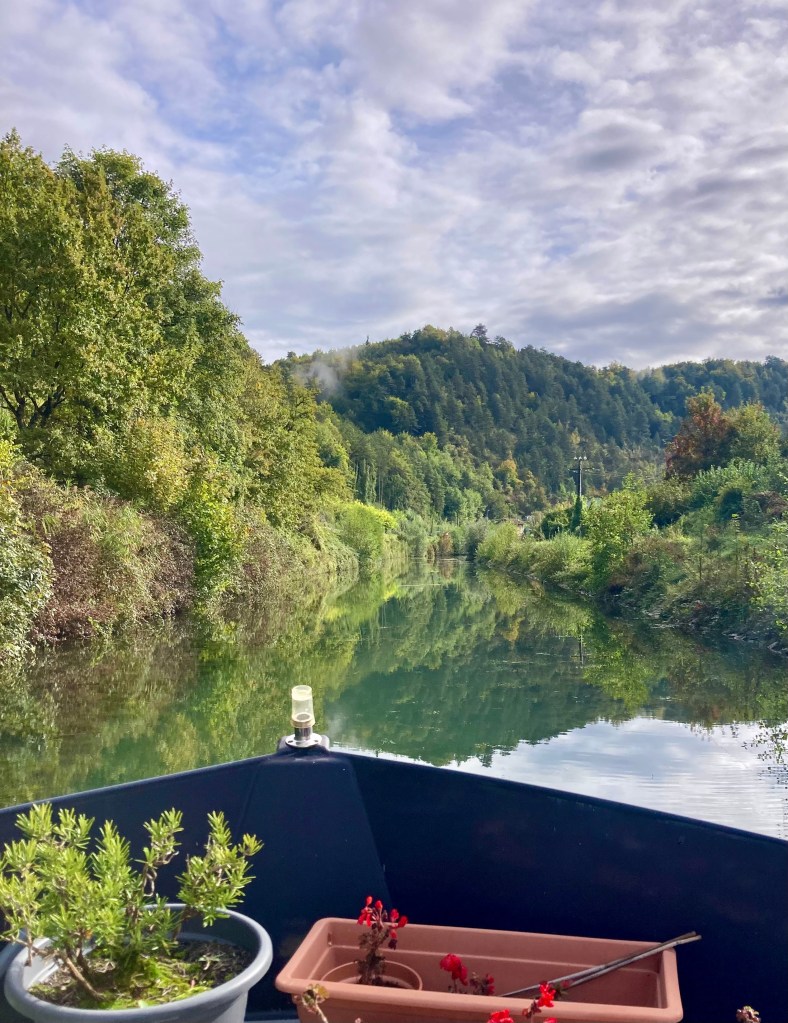
The topography approaching Joinville changed, with the river and canal winding round a tall wooded hill.
It is a beautiful scene at any time of year, but maybe Autumn is best as the trees start to change their colours and the still waters reflect back the October palette.
It was less calm 10 minutes later around the bend!
Just ahead was Bussy lock and things were busier there than other times we have passed by this quiet little hamlet. But it was all good stuff.
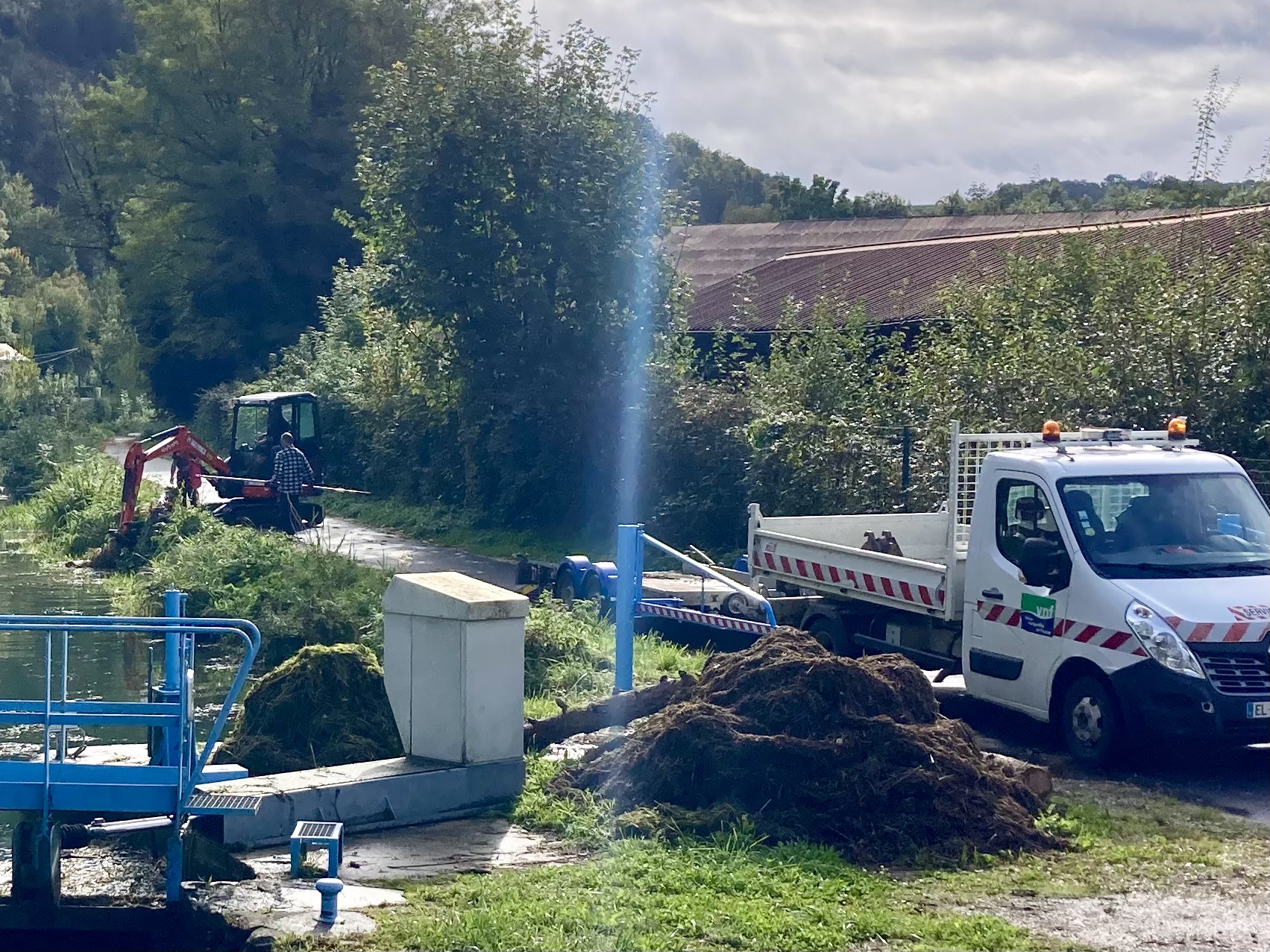
Forgive the quality of the photo. It is attempting to show a VNF team hard at work clearing the canal of weed and logs. There had been high winds a couple of days before resulting in quite a few trees falling into the water.
This team, with saws, rakes, diggers and pure muscle power, had been clearing the stretch up to Joinville. We were held up for a few minutes, but these are minutes we are always pleased to wait as they lead to clear waterways, making it easier and safer to cruise.
And then it was plain sailing into Joinville where we had the choice of the full quay.
Somehow I didn’t take any photos of the mooring on this occasion so I have borrowed one from a previous visit in 2016.
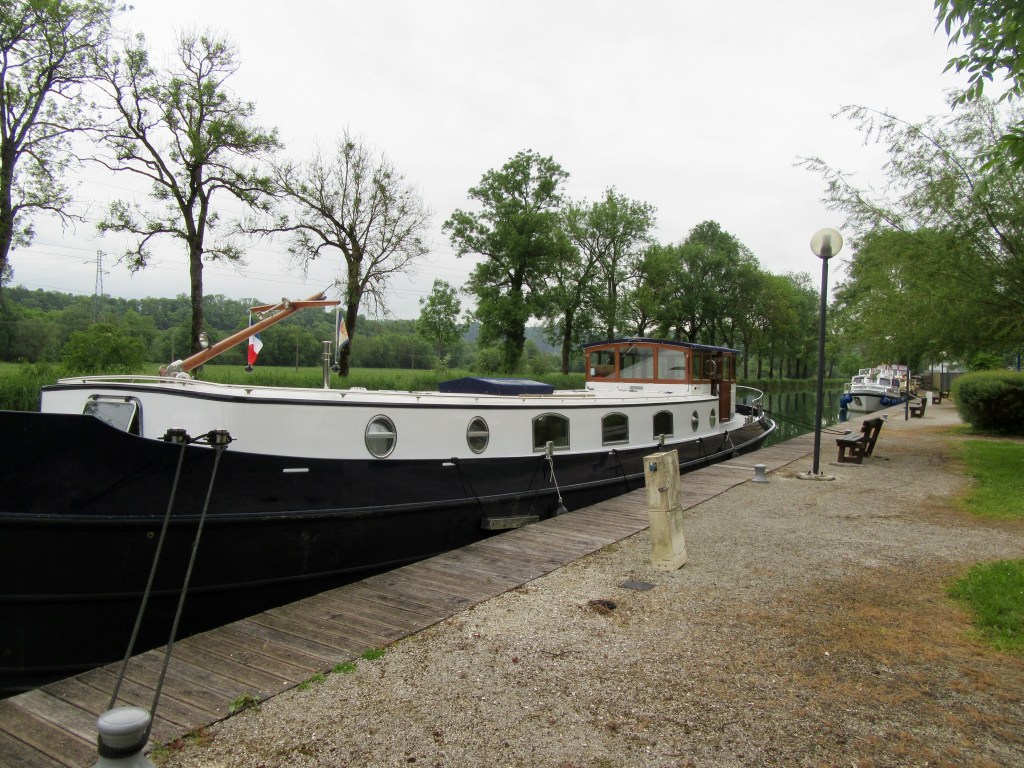
We did just stay the one night, using the afternoon to go shopping for essentials. Unfortunately the aforementioned brico was closed due to a flood a few weeks before, but luckily there was nothing on the list that couldn’t be waited for.
We did stock up on some fresh food, knowing that after Froncles there were few opportunities close to the canal to buy food.
Froncles
I love the name Froncles, and we love the mooring there, so although it meant another short 12km day we had decided to definitely stop there. It was going to be 9 upward locks on a windy day so we knew it would take a few hours anyway.
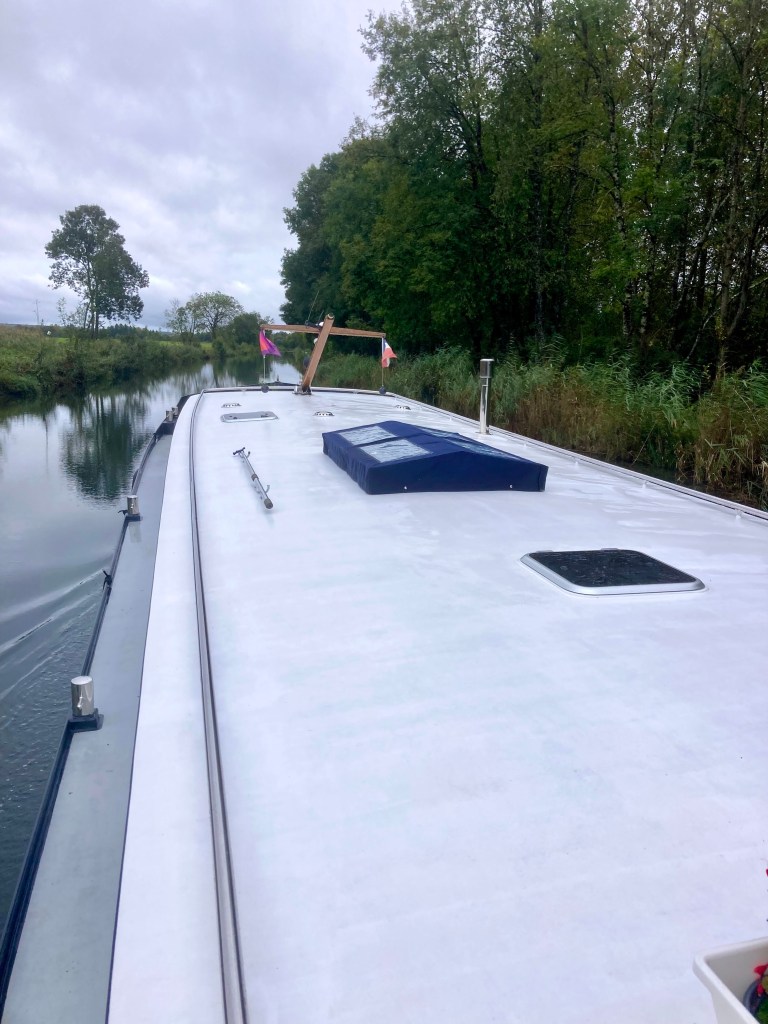
Overnight the wind had shifted a lot of those Autumn leaves from their branches to Calliope’s roof and decks.
I decided to use the time between locks to clear them all and expose Stewart’s lovely clean newly painted roof once more ……. knowing that it would not be long until the next load fell and I was clearing again!.
An hour later we were warned by some friends on a boat a couple of locks ahead that there was another little hold-up; a repair required on the canal.
This timed nicely with lunch time and with one of our favourite lunch stops, dating back to 2016 – our first trip on this canal.

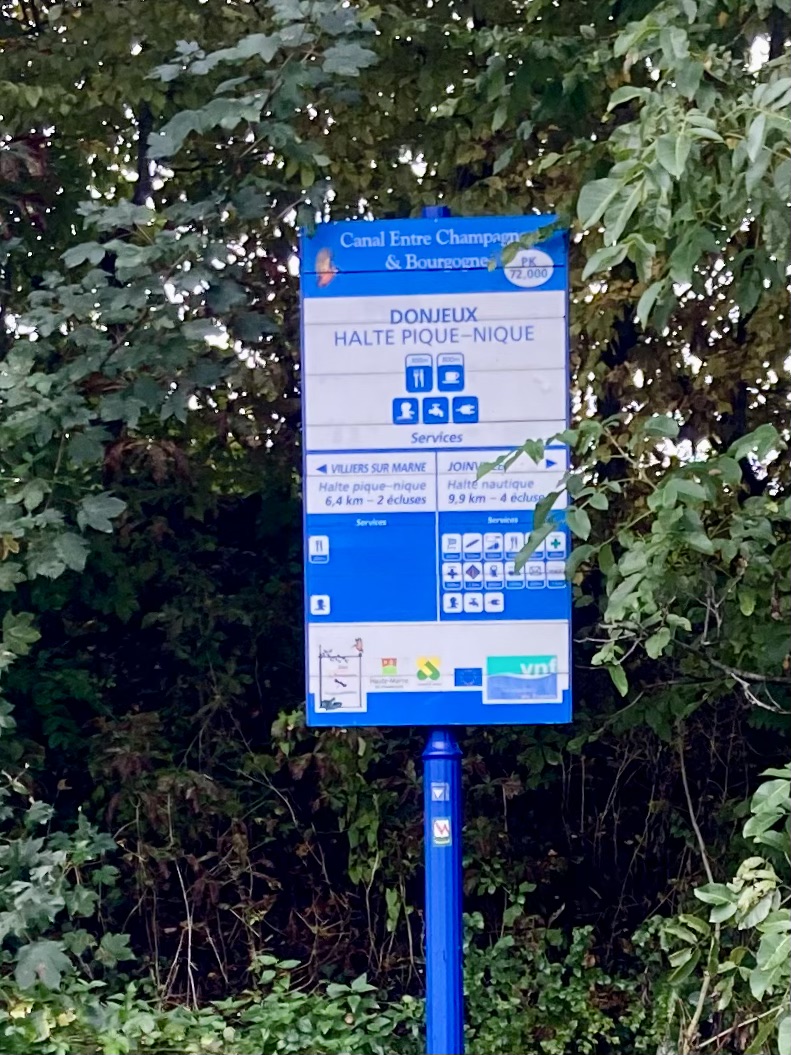
Here is the Halte Pique-Nique of Donjeux. We have sat at that picnic table at least twice before, and even stayed overnight at this little halte. But this time it was just for a couple of hours until the canal was open again.
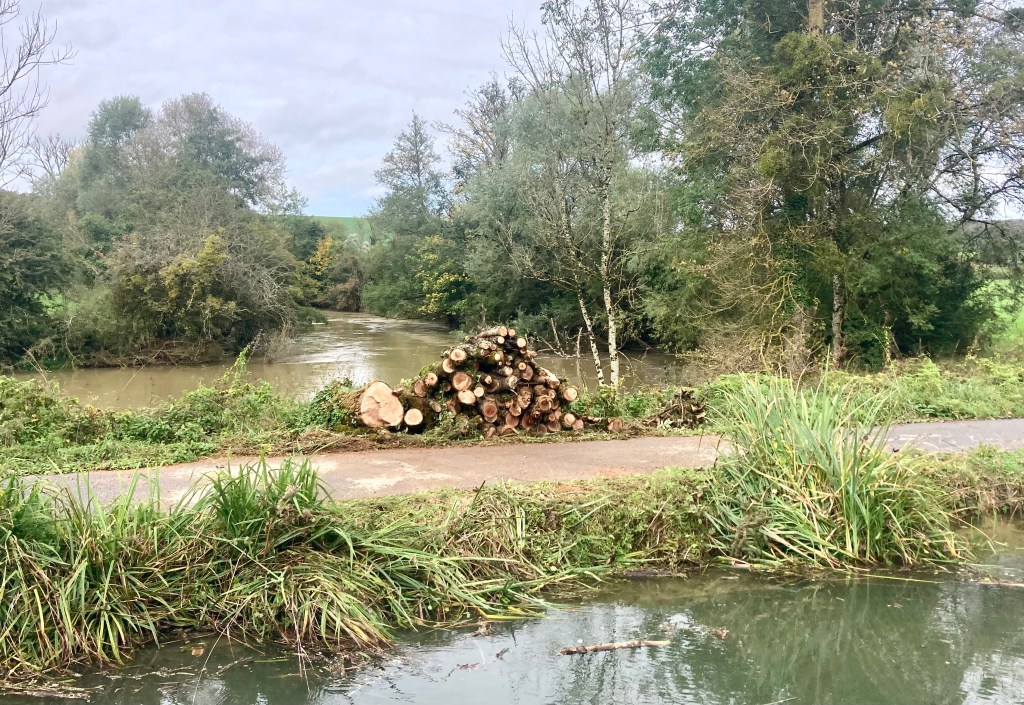
We soon came across the evidence of our delay – a pile of logs neatly sawn up on the bank at a point where river and canal coincided again.
Obviously another tree had fallen into the waterway, and had now been removed by the VNF.


It felt good to reach Froncles – partly because we like it, and partly because it is half way up. It was also good to have a rest from the concentration needed to manage the sidewinds and currents across the front of each lock entrance.
We moored up on an almost empty quay – just a couple of deserted boats to share the scenery with us. I guess you can see why we like it here.

As soon as we settled into the calm of Froncles we found ourselves adding on more days to stay there!


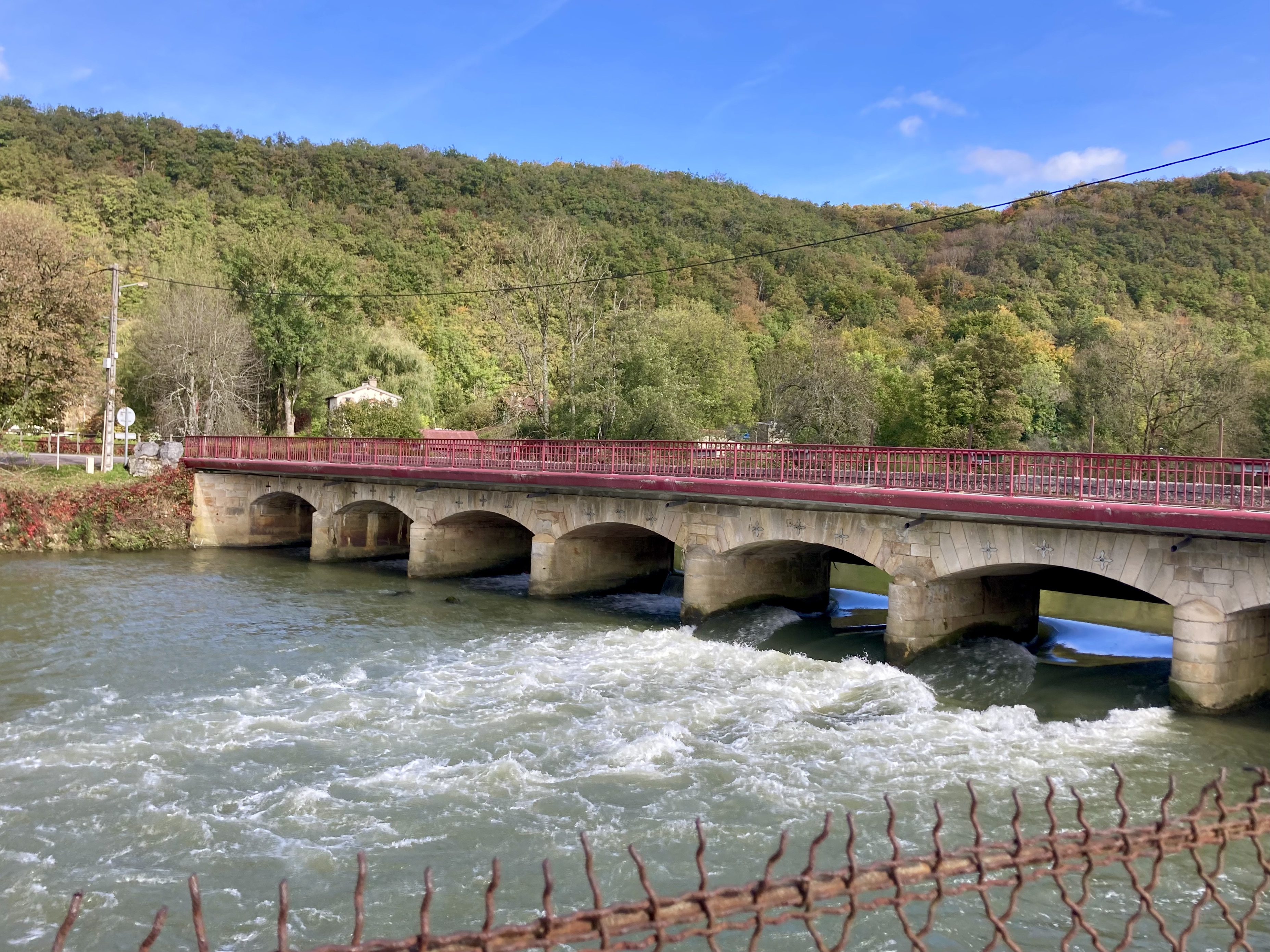
In fact we ended up spending a whole week in Froncles, getting to know its streets, lavoir and the river quite well. We also enjoyed daily walks to the excellent boulangerie, the useful little supermarket, and the station.
The latter gave us a means to travel to the nearby city of Chaumont. This is just 8 hours (26kms) away by canal, but 40 minutes by train. Suddenly we had all the shops we needed, including the bronco that was missing in Joinville, and a selection of restaurants for lunch – we chose galettes!
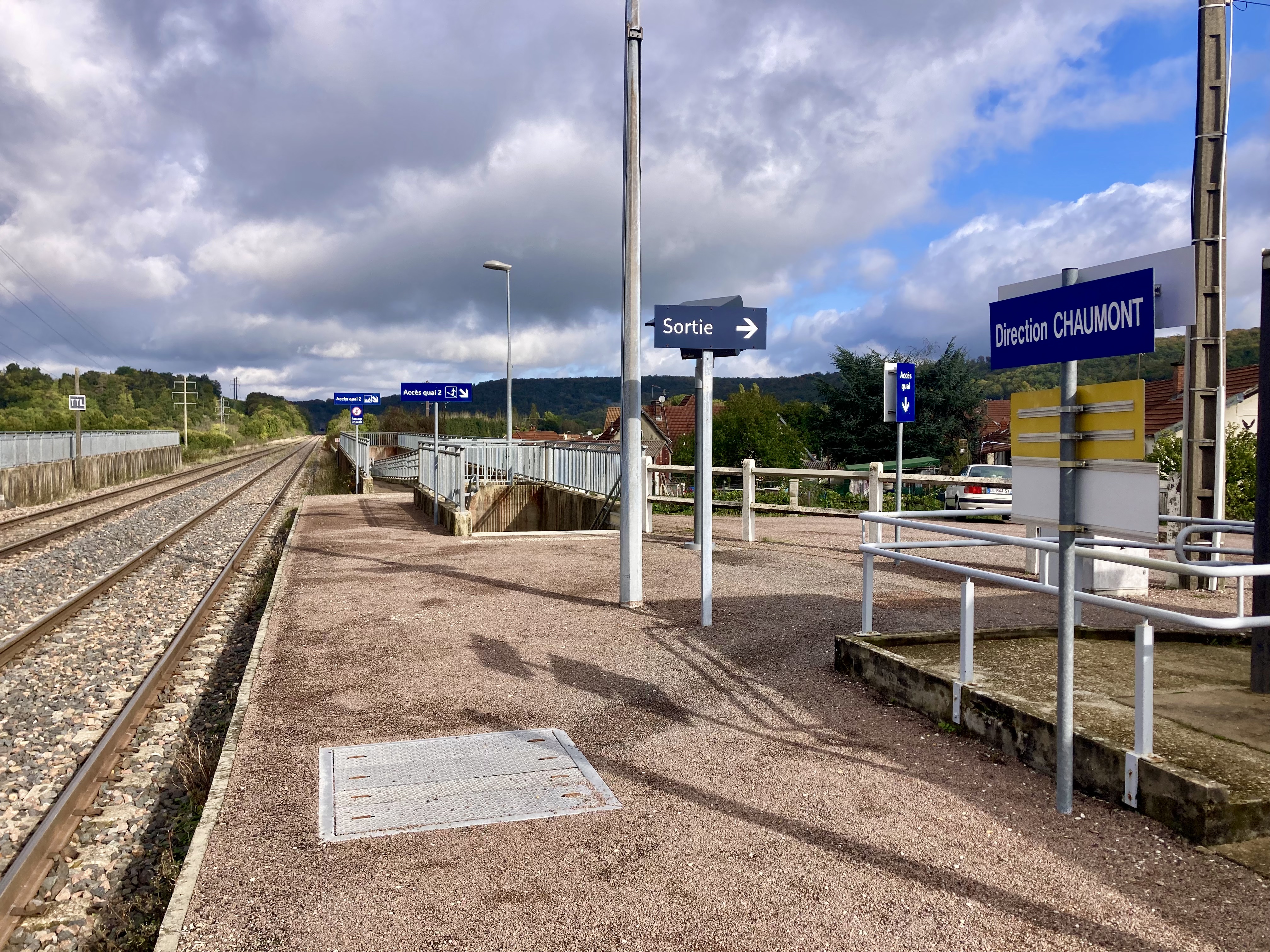

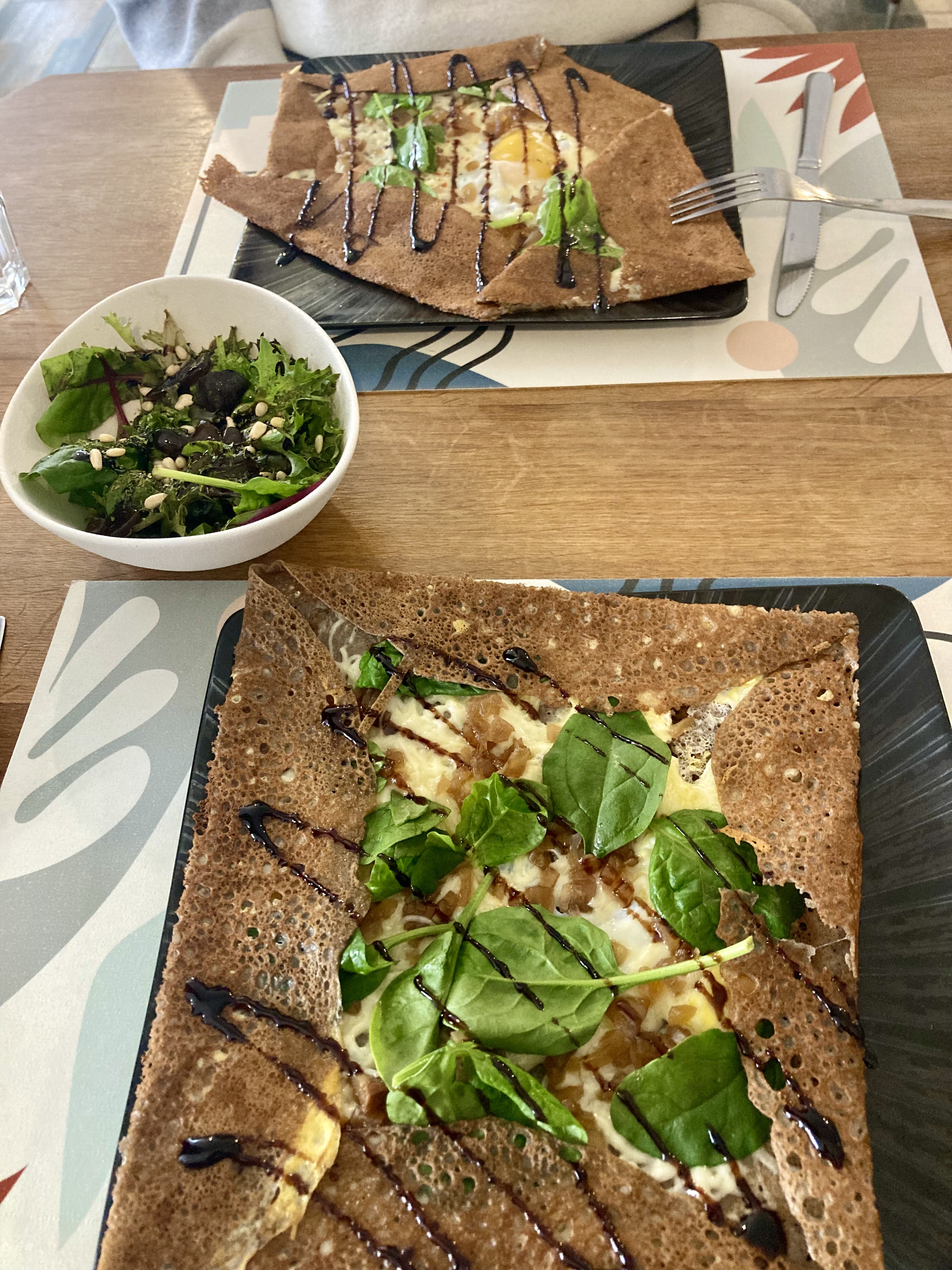

Chaumont, as its name suggests, is on a ‘mont’, or hill. This means you can look down on the rooftops as you go down the hill to the Brico and supermarket. I cheated on the way back and caught the bus up!

Despite enjoying our little break in Froncles in the Autumn sunshine we really did need to get going.
So one Wednesday morning we decided to cast off and put 12 kilometres behind us that day. We could start to feel in traveling mode again.
It was hard to leave this lovely view but we knew we had other good views in store.
[As an aside I read that ice breaker boats were required in Froncles 3 months later, so just as well we left!]
Bologne
Bologne is one of those moorings that most people pass by. It is a very simple quay in a quiet location, yet only 10-15 minutes away by bike from a good supermarket. This becomes important on this canal as many moorings are pleasantly rural, with no shops!

With Froncles in our wake we were off through Voécourt and on towards Viéville, where we had another short hiatus in our journey, though only about 15 minutes this time.
The lift bridge at Viéville did not respond to our remote control, nor to the sensor on the canal-side that we had passed.
A phone call to the VNF soon had someone there and the bridge was lifted for us.

In another hour we were moored at Bologne enjoying lunch. Calliope had behaved perfectly through the day’s 6 locks; Captain and crew were feeling relaxed and refreshed.
We had decided not to stop at Chaumont again and so we probably had 5 days of moorings ahead without a chance to re-provision. My bike was taken out of the ‘bike shed’, or front deck locker, and I cycled off to buy what was needed.

Cycling back I stopped on the bridge over the canal to capture the lovely loneliness of the mooring.
I hope you can spot Calliope moored on a quay on the left of the canal.
Foulain
Next day we pushed on for 26kms – back to the longer days we had initially planned for our trip to winter mooring.
[I realise that for many boaters 26km sounds like an average or even a short day. It is totally possible to put in longer days. It is just that Stu and I, retired and normally with all the time in the world, choose to potter along enjoying the views, then moor up early with time to explore our surroundings.]
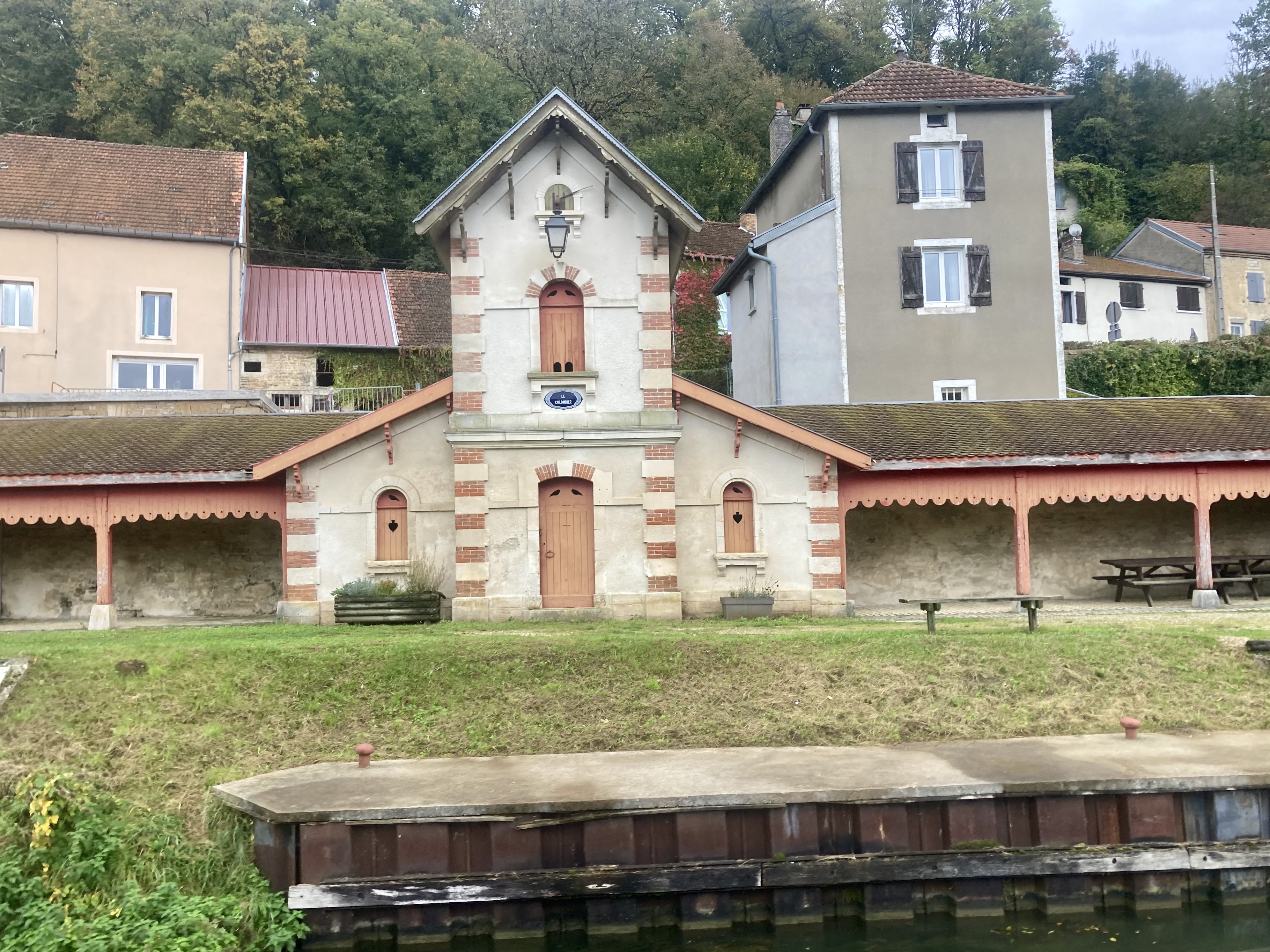
There is plenty to look at enjoy along this canal; this stretch is no exception. Just a short distance from our Bologna mooring is Riacourt écluse (lock) and village. We were not stopping today, but admired once more the unusual building by the quay.

After going up through the lock there was time for a cup of cruising tea and a quick scan of the map to see what was coming next.
The wheelhouse ‘work surface’ is a telling view of everything we are ready for! I can see sun hats, warm hat, map, remote control for lock operation, fly swat, binoculars, bird identification book, log book – and tea!
I guess we are not the tidiest of crews!
Four kilometres on is the little hamlet, lock, mill and farm of Brethenay.
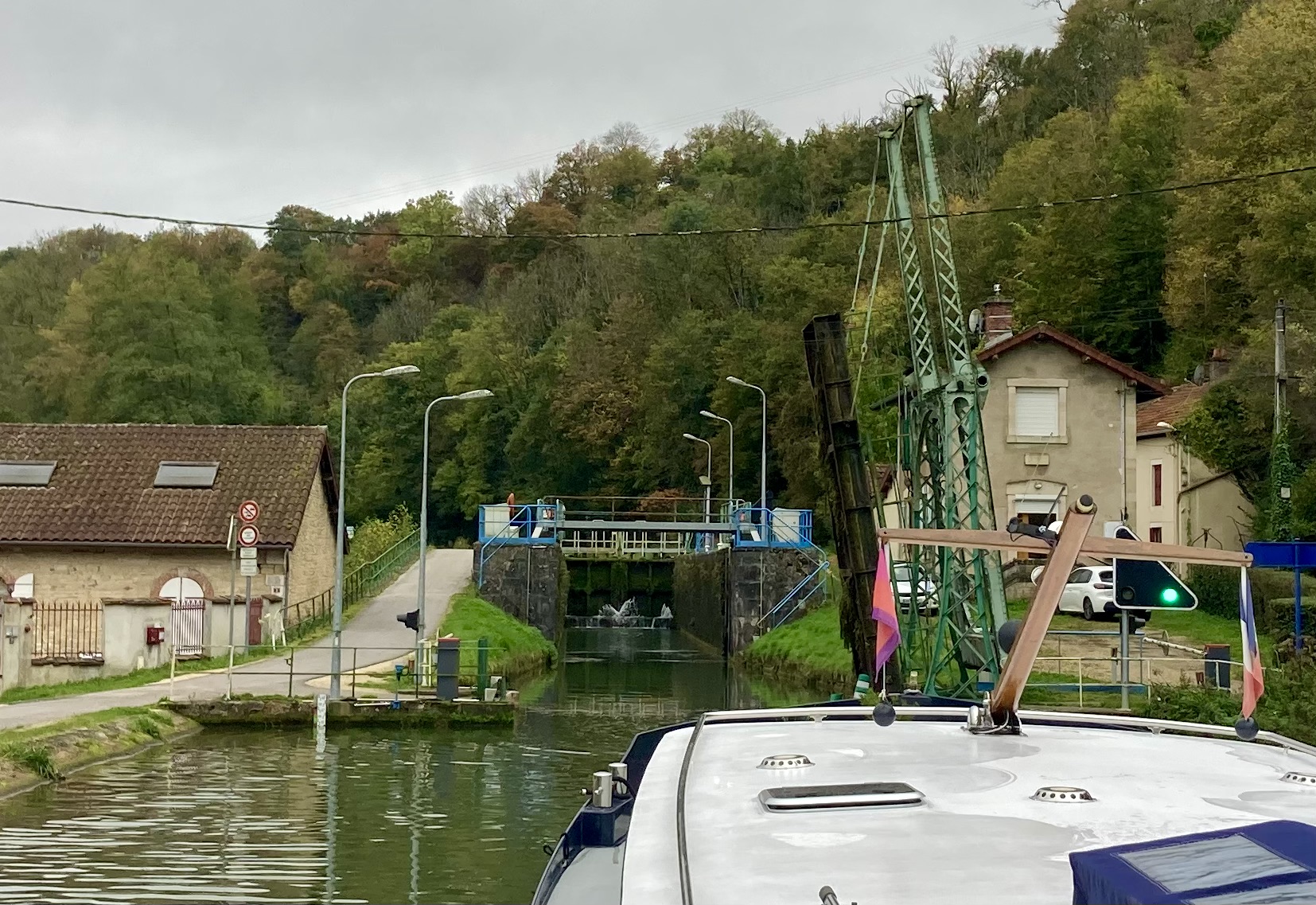

On a clear sunny day the whole scene here is beautiful – the green lift bridge, blue lock bridge, the old stone buildings and the curve of the Marne through the mill farm, all combine as a reminder of tranquil rural days from the past.
But today it was grey and drizzly.
Just around the bend is one of my favourite canal combinations, at Condes, whatever the weather.
We arrived to find a green light at the lock – a good sign,

Once at the top of the lock, as the gates open, you see ahead the entrance to the little Condes tunnel. This takes you through a small hill while the river slowly circles round the edge.


The tunnel is well lit, a decent width, and only about 200m long.
Then we emerged into the Autumn colourscape to find a pont canal once more taking us over the river, which has reappeared from its circular journey. And at the end of the pont canal is a lift bridge, permanently open these days. On our first trip through here in 2016 the bridge was still operational, but would not respond to the remote control. We had to float gently on the pont canal, looking down at La Marne, until help arrived.

Twenty minutes later we passed by the old silos that signalled our approach to Chaumont, this time by water.
We had decided not to overnight in the little Chaumont marina, and to carry on to Foulain.
That meant 14 kms still to go, but it was only 11am so plenty of time. It started with the narrow section taking the canal round the base of the Chaumont hill.


To port are wooded slopes, trees just turning to their most glowing colours. To starboard, as the canal widens again, are the fields lining the flood meadows of the Marne, and a tree lined canal path running alongside.
Across the meadows, way up high on the hill, Chaumont can be seen. The photo top left shows two of the big modern buildings; other aspects are better for views of the old buildings and fortifications.

In the narrowest section ladders are placed into the water every 100 yards or so to allow unfortunate wet sailors to climb out.
This has not been my mis-fortune yet …..
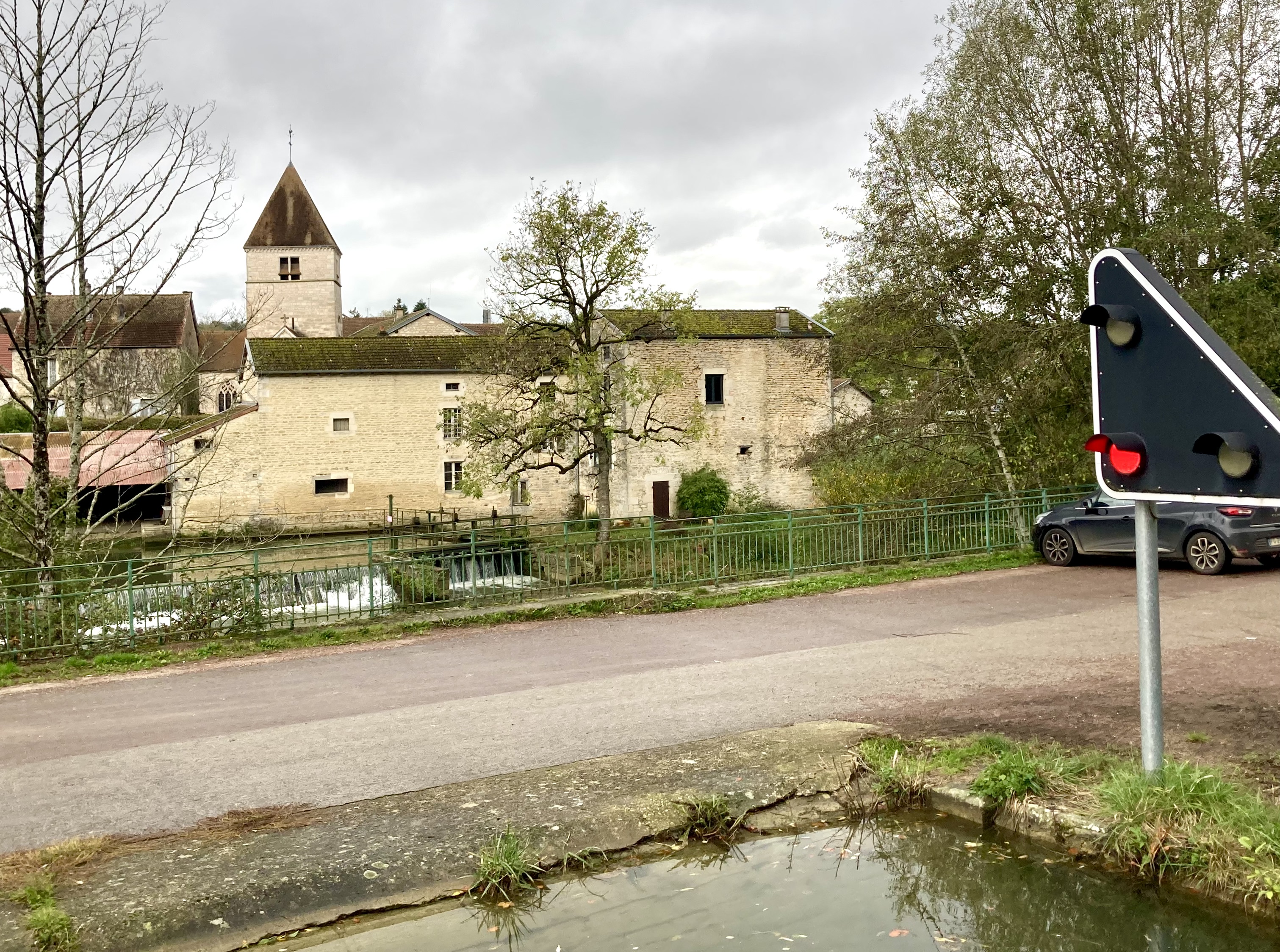
Leaving the narrow channel through the lock at Chamarande-Choignes there is a great view down to the right. An old mill sits astride part of the river, with a long weir next to it. Water is the great feature here, to see and to hear. It is well used by water-sporters, especially in kayaks.
I have often looked for the history of this mill but so far found nothing online.
A few more kilometre and a few more locks; we were nearing Foulain, but first La Marne, now on our port side, must come back to starboard.
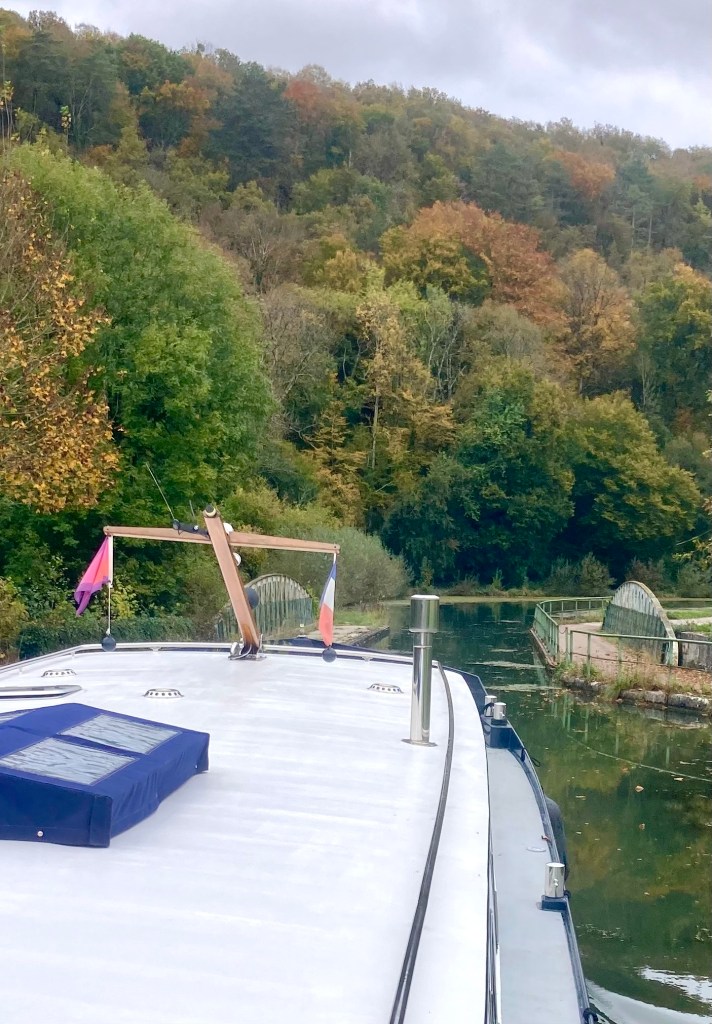
We arrived at the little ‘pont canal’, or aqueduct, taking the canal over the river, under gradually greying skies, but still bright trees.
It looks so narrow, but is the same width as all the locks so fine for Calliope.
I always enjoy looking down on a river from the canal above. There is something special about a water crossroad.

Finally we followed the long curve of the canal, between the hill and the river, for a kikometre, arriving to find the two little Foulain quays empty.

Mooring here is always interesting, requiring a little agility on the part of Captain and crew. Each quay is about 12m long; Calliope is almost 20m. The two shoreside bollards are small and set back in the grass. But a bit of jumping ashore with ropes and coordination between us makes it is a relatively easy moor.
Good; we can settle down for the evening in this quiet little park and watch the birds.

We knew a supermoon was due around this time and had been glancing sideways through the wheelhouse door waiting for the moment it would rise. The clouds parted and – wow!

What a wonderful way to end the day.
Langres
This was our last full day going up. We were off to Langres, 24kms away. It would leave us with just 6 kms and a final two ascending locks the next day before we went through the tunnel that crosses the summit; more of that later.
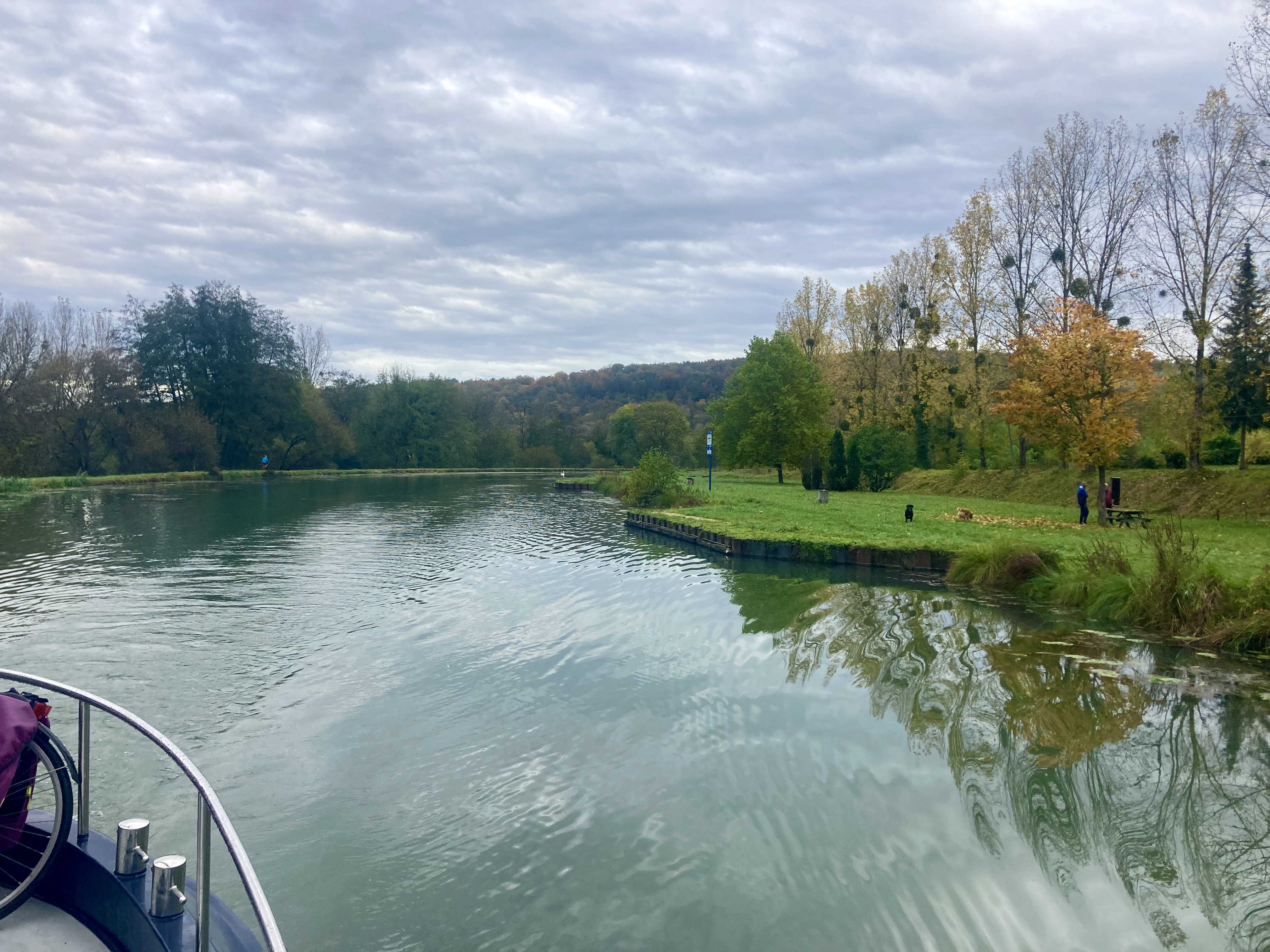
The weather was still rather overcast as we left our overnight stopping place behind and headed for the first of the 14 locks of the day. It is always a bit more of an effort going up a canal than down. This was the ‘final push’ of the season; all down hill from here!
It’s obvious really, but the point about going up the locks is that Calliope comes into an empty lock and depending on the depth it can be easy or a bit of an effort to secure her to bollards on the lock quay. Every boater works out a method that works best for their boat and their crew. 😁
The really deep locks have built in structures to help; floating bollards that more with you, poles your ropes can slide up on, or bollards at different heights that you can move to gradually as the lock fills. There is an example of the latter later on today’s journey.

Entering the second lock at Pré-Roche was interesting, going under a railway bridge first, and through a narrow channel into the lock, beautifully accomplished by Captain Stu. And the next lock, at Pommeraye, was also going even more interesting.
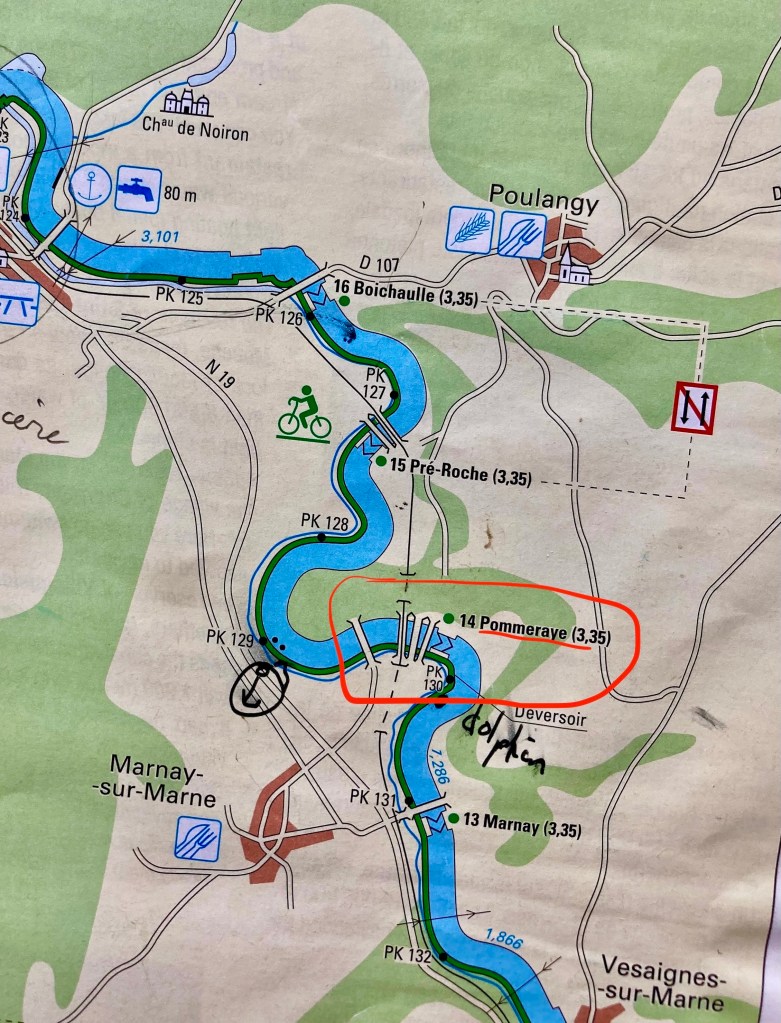
The map shows the meandering nature of the canal, following the contours of the land, with 4 adjacent bridges leading round a bend into Pomeraye lock (circled).

It is these twists and turns that keep the journeys constantly fascinating, but not always easy for the Captain!
Looking closely you will see that all the locks here are the same depth – 3.35m. The precision of those engineers way back in the late 19th century is something to be admired.


On we went – Marney lock, Vesaignes lock, Thivet lock – the latter with an old deserted lock house and a partly new concrete quay.

Thivet is a good example of the renovation work happening on this canal. Sections of the lock wall and top needed renewal, whilst next to Stewart the original stone built lock still stands firm.
Some locks remain totally original, and others are transformed with modern materials.
By 1130, at Prées lock, we had our first glimpse of today’s journey end – the city of Langres, up on its hill.
It would take us another 3 hours gentle cruising to get there, ever onwards and upwards through the French countryside.
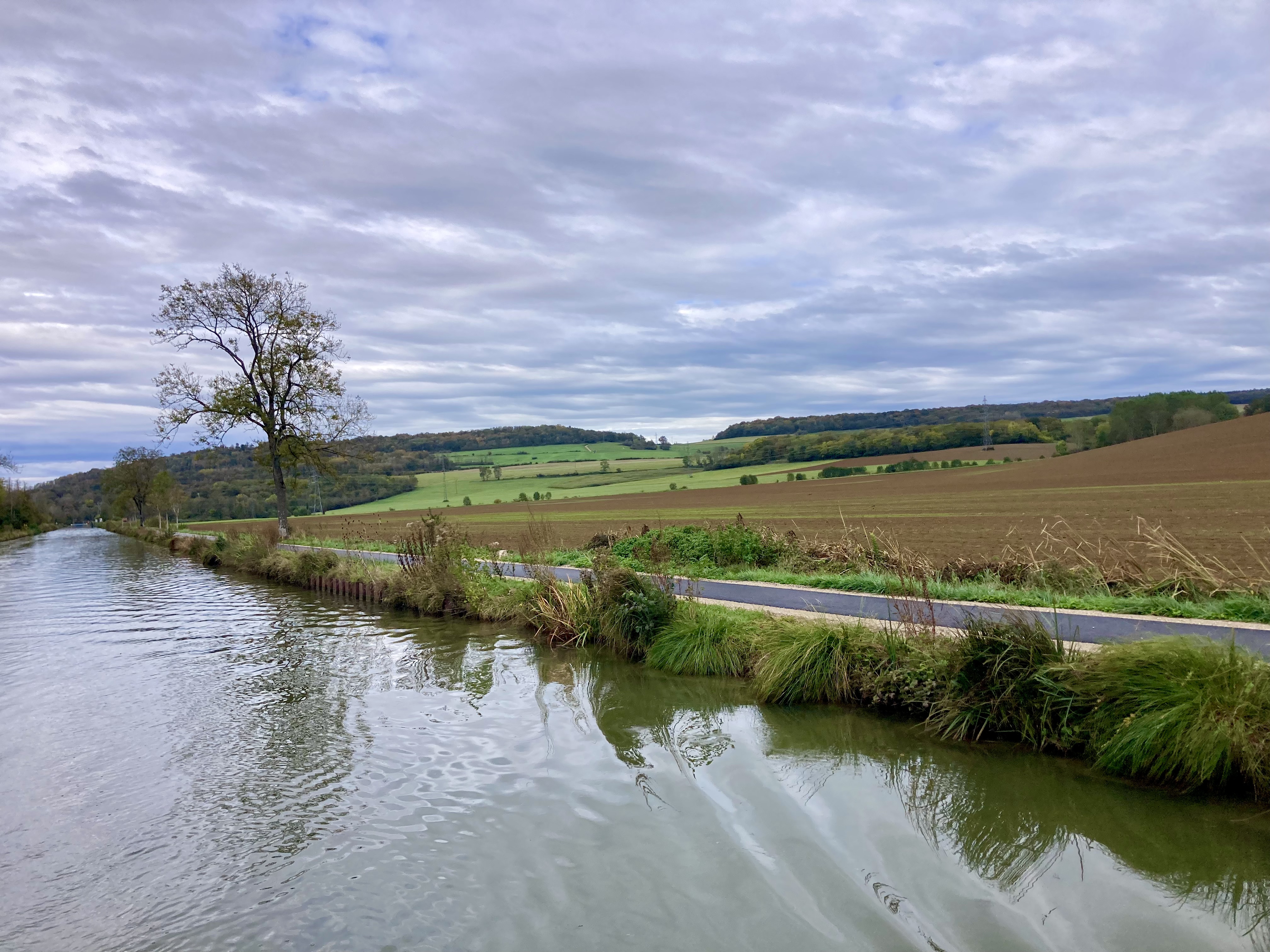

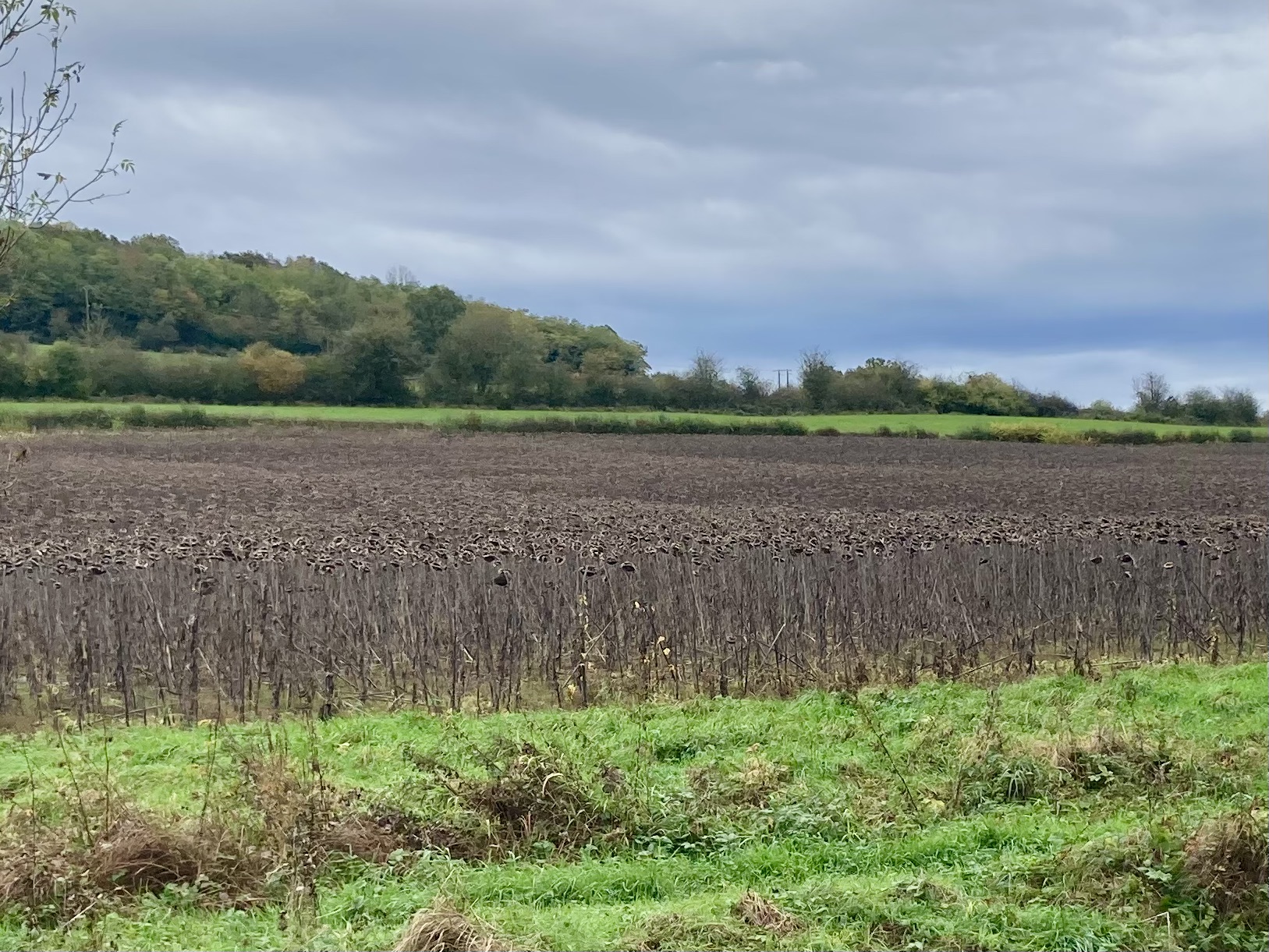
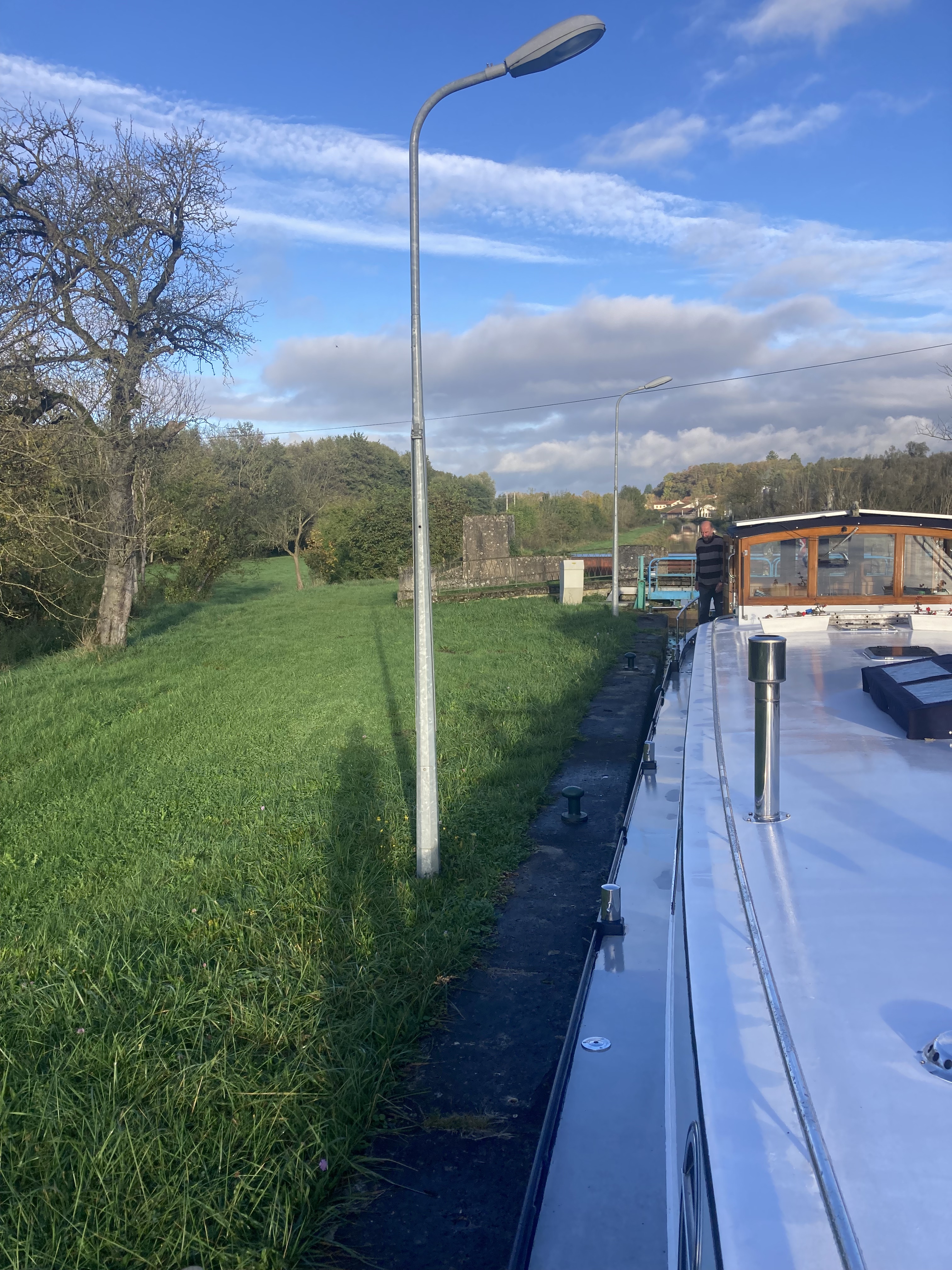
A few locks further on is Channoy where these is an example of the bollards placed in lock walls to help boaters gradually move their ropes with the rise or fall of the water in the lock.

This lock has obviously been renewed with concrete sides and has quite large ‘alcoves’ where the wall bollards are situated. This makes it simpler to throw or place ropes on them. Above this bollard is another on the top of the wall; a similarly placed bollard is just visible further along the lock. I think that demonstrates the principle. It is at its best when the wall bollards are just the right distance apart for your boat, not always the case. But there is always a way to make it work.

Just one more photo to demonstrate the loveliness of our journey up to Langres.
Even with dull skies the scenery, reflections, peace and nature cannot dull our enjoyment!
Enough of my reverie!
We arrived at the long Langres quay by about 1400 to find it almost empty, and, as always, plenty of space for Calliope.

She’s looking good after her climb up the Marne side of the canal, through 69 locks (2 to go next day) and almost 150 kms. She has risen about 232m and is ready for the final 7m tomorrow.
Piépape
I did think of splitting the blog into the ‘up’ side and the ‘down’ side, but we only stopped twice on the way down, so here goes …..
We left at 9 in the silvery light of a mid-October morning.
The sun was making a big promise to appear soon, although as were soon to be in a tunnel for an hour it didn’t matter too much.
As mentioned before we only had two more locks up to the tunnel.
By the time we reached the first, Moulin-Chapeau, (what a lovely name) the sun was out.

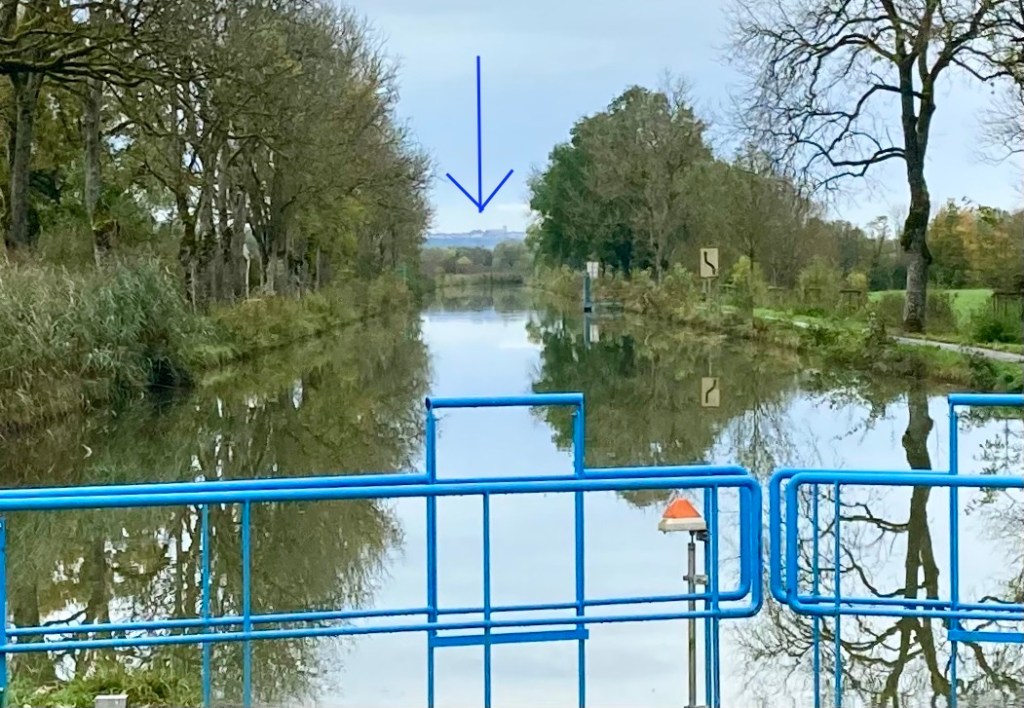
We continued on the 2.5kms to the last lock, checking along the way what we needed to know for the tunnel ahead. It seemed that there was a job coming up for the ‘communications officer’ .
A big sign at the side of the lock told us that we must call up the Heuilley-Cotton control post for permission to go through the tunnel – it is not wide enough for boats to pass so a one way system operates.
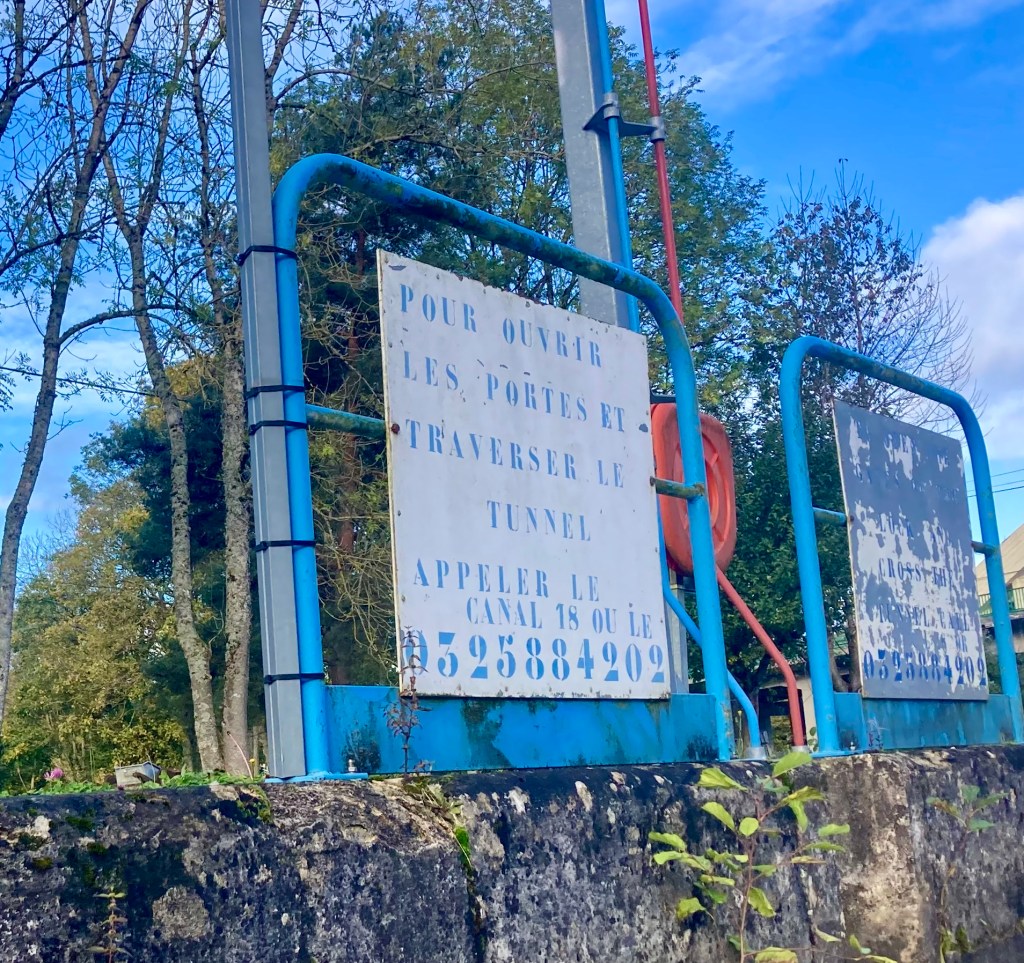
I called them, gained permission, and was asked for the number on the back of our remote control – 176.
It always surprises me that there is another 3kms to go between this lock and the entrance to the tunnel. Half way there we arrived at the narrowing of the waterway and the cutting for the tunnel approach; there we saw a nice illuminated sign with our 176 number at the top.

It was clearer through the binoculars than it is here! But it was telling us that 176 could pass the tunnel, and the green light verified this. As you can see once you are in the cutting there is no space for a boat to come by, hence the one way system starts here.

We have always found these cuttings to be very quiet places, full of greenery and wildness.
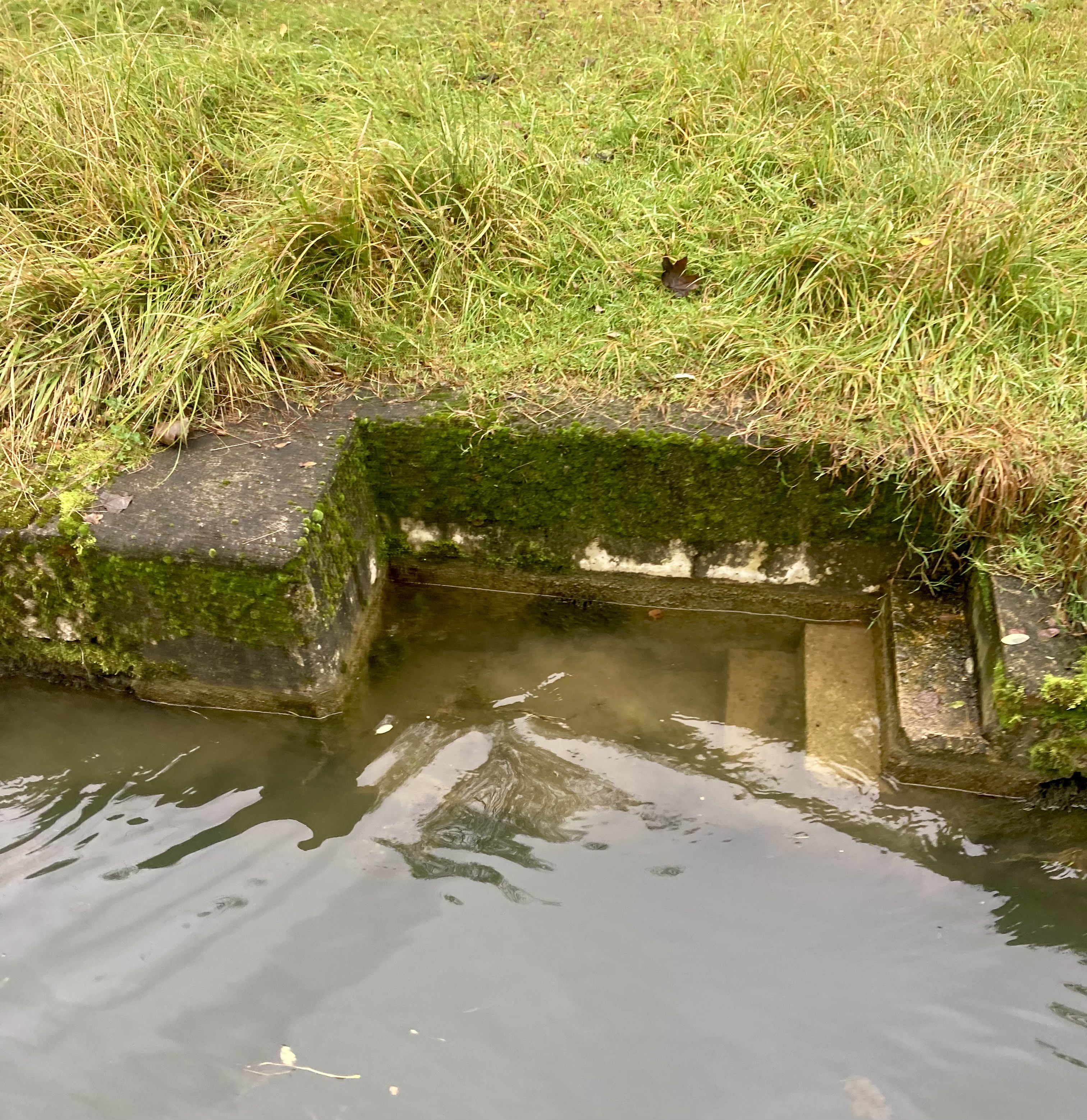
It seems that animals, especially deer, get in the water here and steps like these help them to find a way out.
And then we were in the 5kms Balesmere tunnel. Tunnels require good concentration on the part of the Captain, so crew tries to keep quiet, maybe making tea but otherwise out of the way.
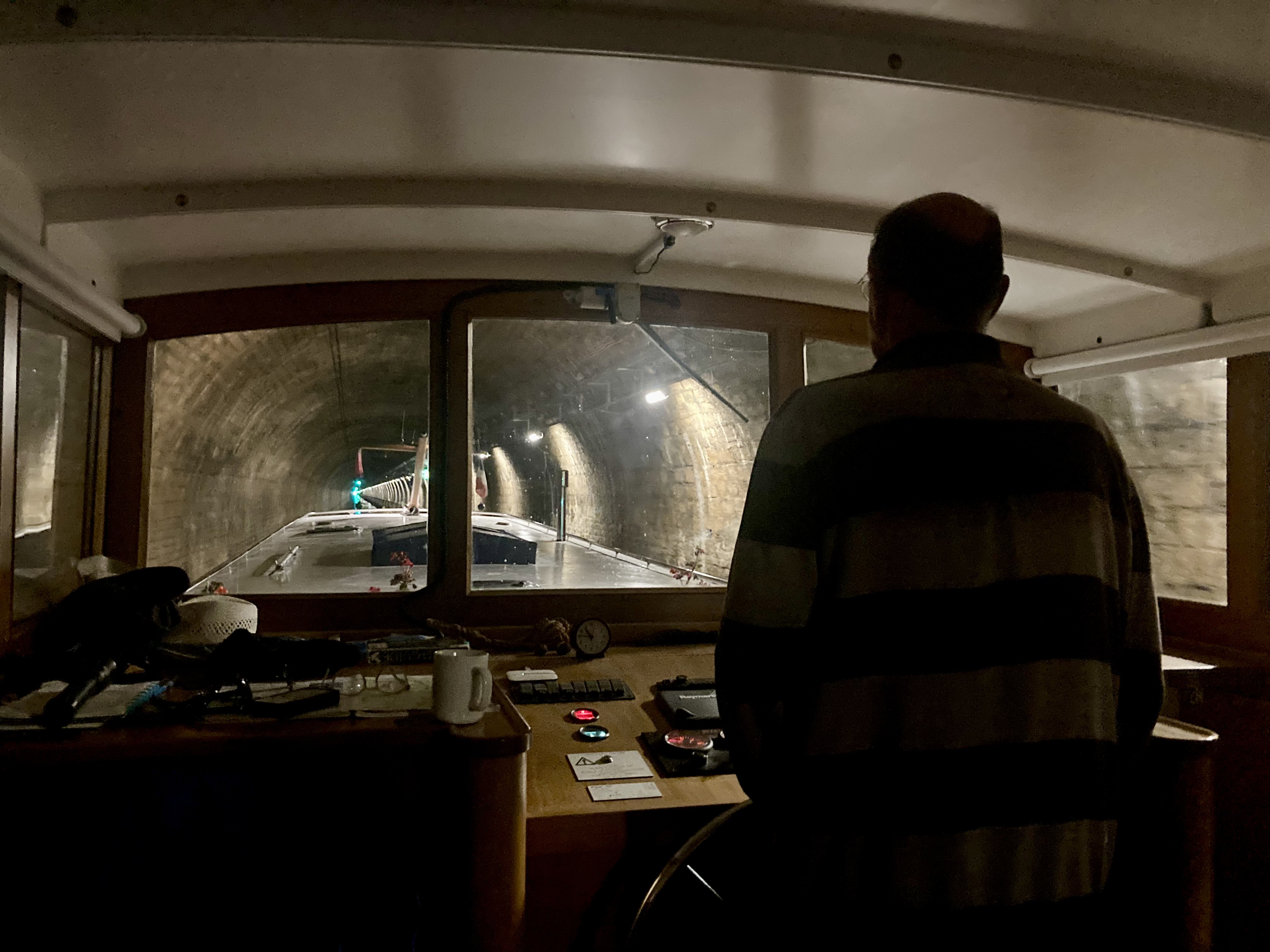
The tunnel is tall enough and wide enough for Calliope, but concentration is needed to drive a straight path along the full length.
And this is what Stu did, for the next hour, until we emerged on the Saône side of the canal, once known as the Canal de la Marne à la Saône.

It felt good to be in the cutting leading away from the tunnel, and towards the 43 écluses (locks) going down to the river. We had in mind to get the first 11 of these behind us today.
Locks 1 to 8 Saône side are in a flight across 3.5kms. This means that as you leave one lock the next one is preparing and opening for you, making the trip through them quicker than you might imagine, especially as they are all about 5m deep.


The 8 locks are broadly similar, particularly in length, breadth and depth. But vary in the amount of greenery that is growing on the sides!
All have the bollards in the wall that allow crew to gradually lower the ropes down to the bottom.
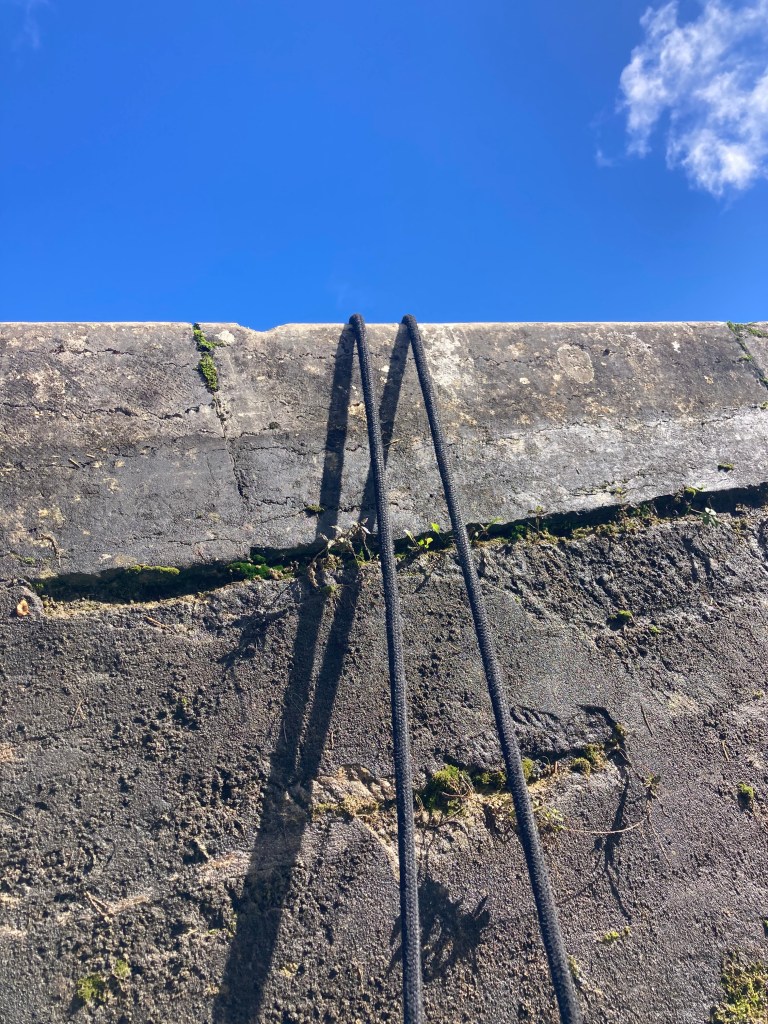
Actually this time we found that we had longer ropes and could leave them round the bollards at the top for the descent.
One by one we went down – here is No. 7.

The countryside on the Saône side is different – more open, and now we were descending we had south facing slopes rather than north facing ones.
We could see for miles!


The sun began to break through; it was feeling more southerly already.
Two hours after leaving the tunnel we were down through the Versant Saône flight of 8 big locks and heading on to the last 3 of the day taking us past Villegusien-le-lac.
The landscape closed in again, trees lining the canal as we approached our mooring for the night at Piépape …….

… four sturdy bollards on a quiet sunny bank under the trees.

Pouilley-sur-Vingeanne
After that pleasant sunny October evening it was a bit of a shock to wake up to this.
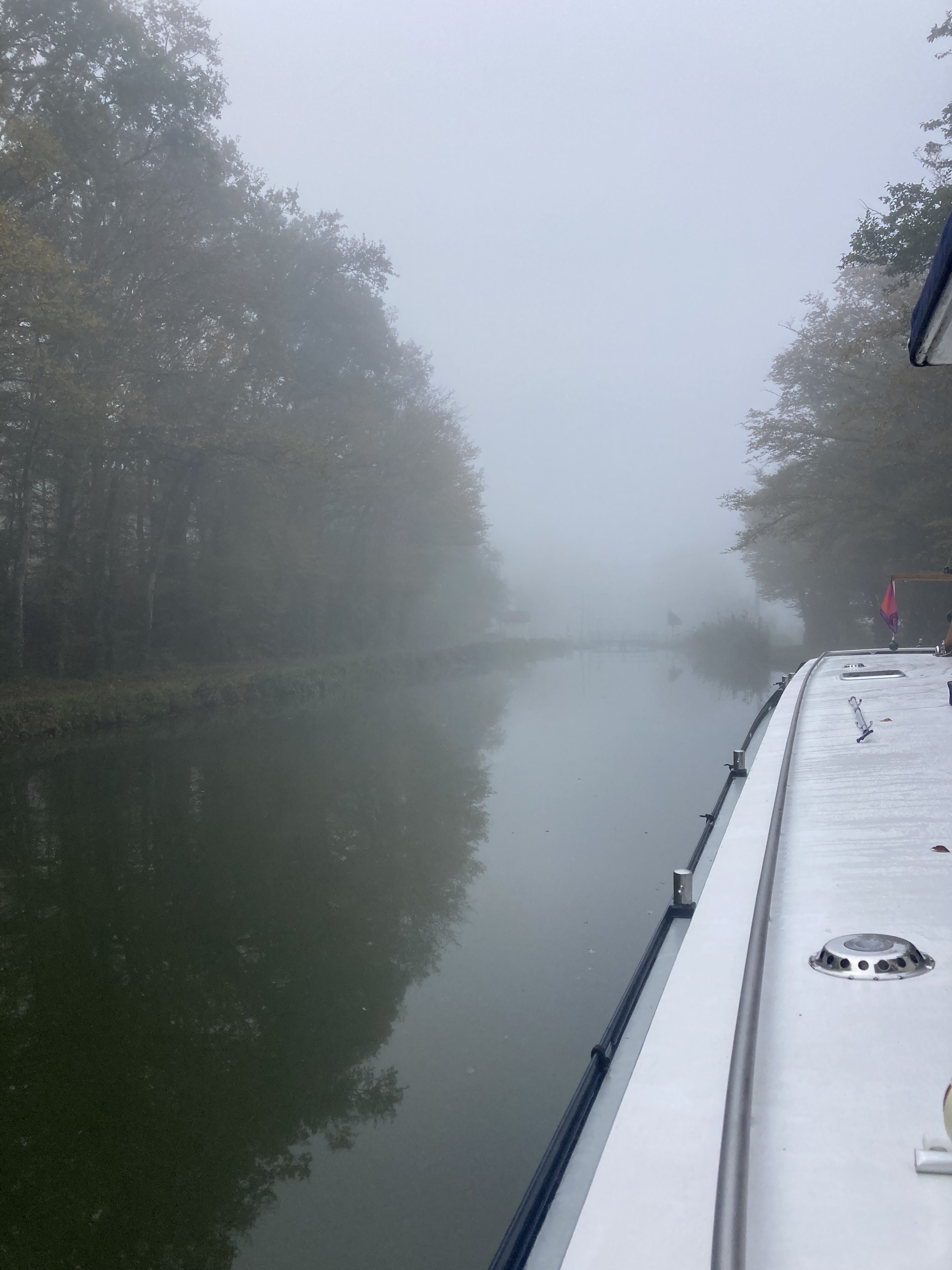
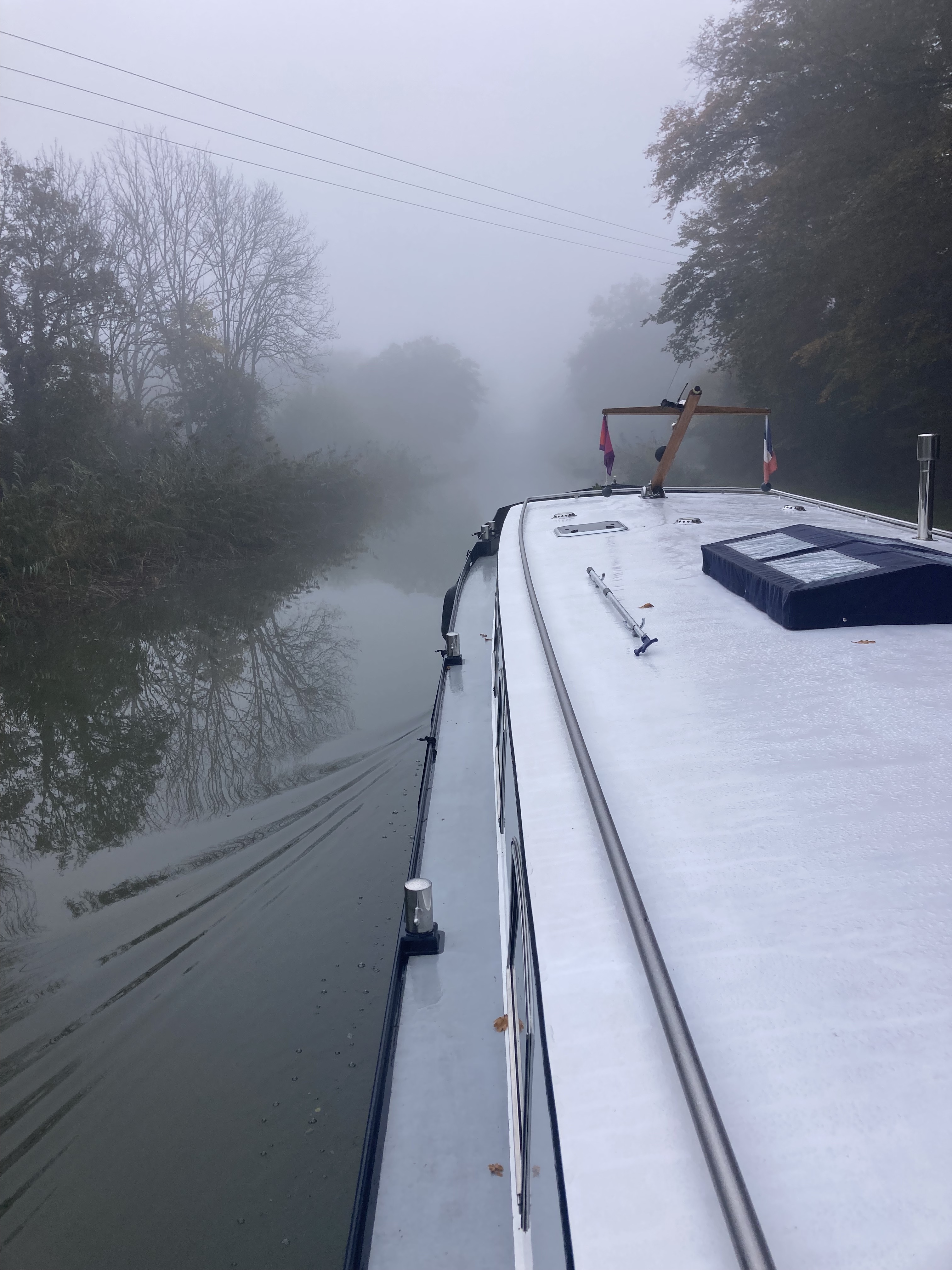
We waited an hour and the mist cleared slightly so we decided to set off. We could definitely see far enough ahead to see any boat approaching, and to see locks and bridges in plenty of time.
It was to be another fairly long (for us) day; 26kms with 17 locks – all down and all just over 3m deep, so not difficult to negotiate. We wanted to get started.
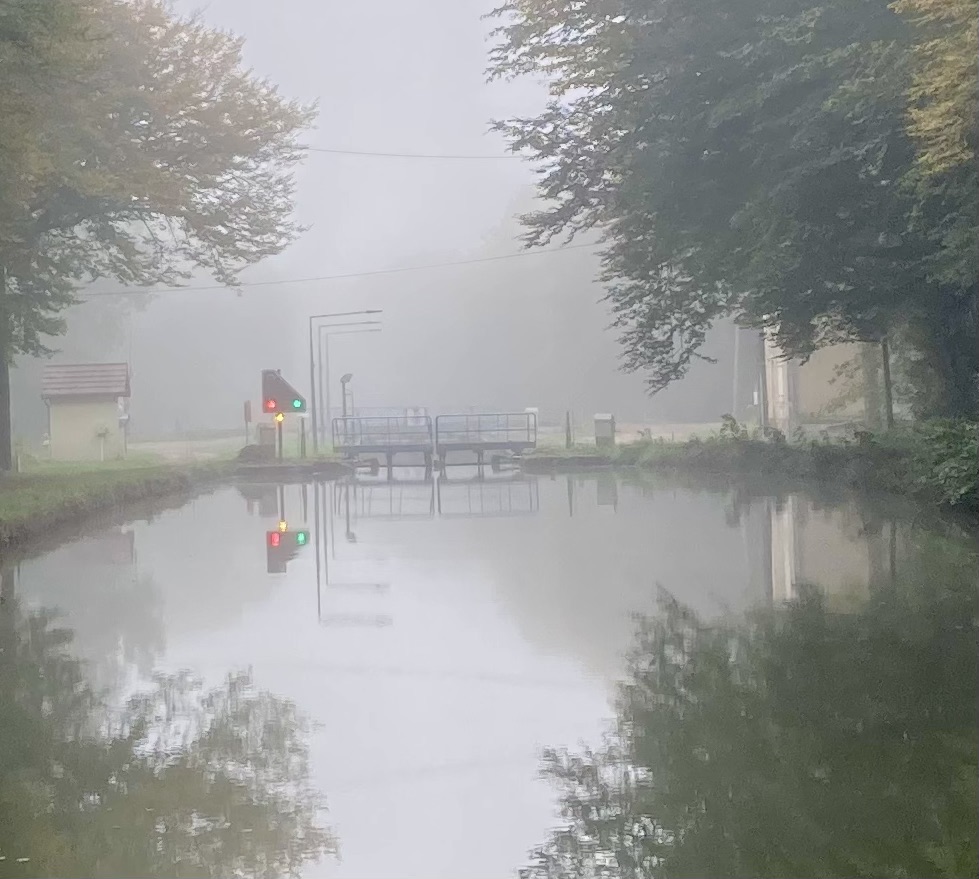
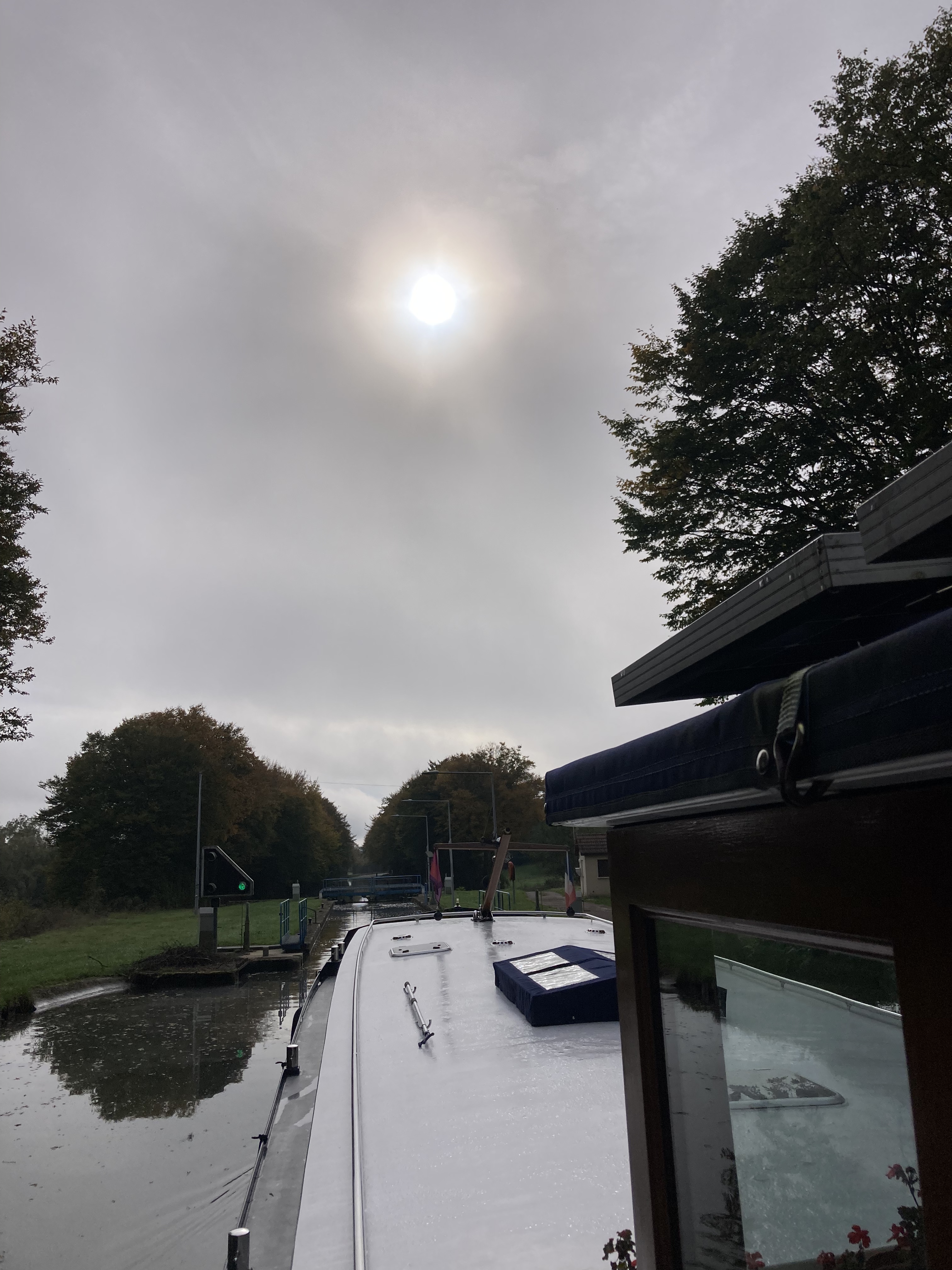
Half an hour later, as we approached Croix-Rouge lock, the mist seemed to have thickened a bit but we could still clearly see the red and green lights at the lock gate; all was well.
A bit further we saw the signs indicating a narrow passage under a bridge – keep between the white triangles!


Calliope cruised on comfortably, with crew diving back into the warmth of the wheelhouse after each rather misty damp lock.
By 1215 the sun was working hard to break through what was left of the fog, and we could tell we were heading South towards it.
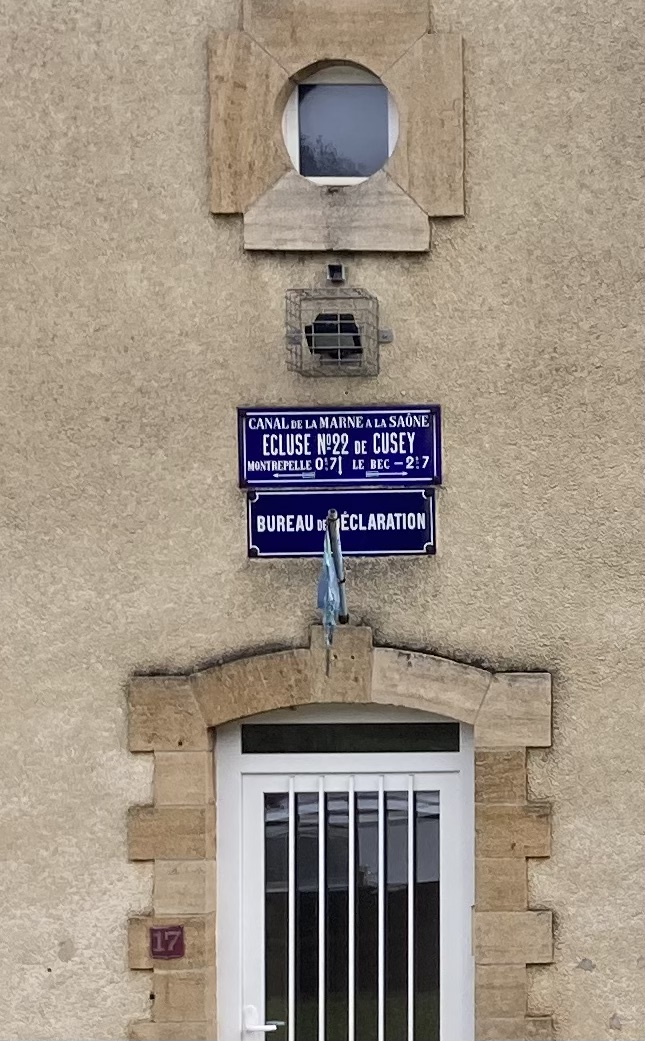
Not long after we reached our eleventh lock of the day. Écluse No 22 de Casey was a Bureau de Déclaration in the past – a place where bargees must stop and declare their cargo, which might be taxable; payment must be made before they could continue.
The sign above the door also told us we had come 0.7kms since the last lock, and had 2.7kms before the next – enough time to make a sandwich to munch along the way.

A landmark was reached at Corchamp lock – we entered the départment of Côte d’Or – the French department that also contains our winter mooring place at Saint Usage!
We really were getting close to home.
There were much wider views again now, this time across to a village called Percy-le-Grand.

If I am right in the positioning of my photos we had another 4 locks until mooring for the night. We had considered stopping a bit sooner, but then I discovered a small funky pizza place at Pouilley, so we kept going.
An hour later we had a bit of an unexpected delay!
As we approached Lock 26 Saint Maurice we saw the disappointing sight of two red lights. The lock was ‘en pan’, out of order.

I called the VNF; it was a Sunday so we might have to wait a while.
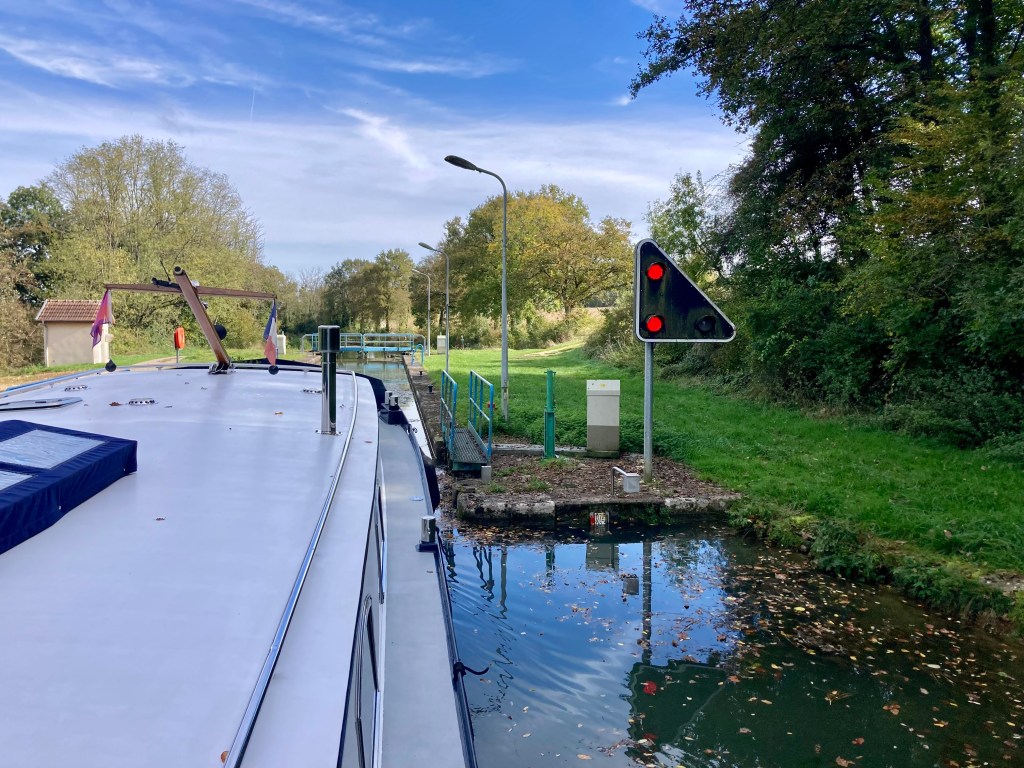
But out luck was in; within 20 minutes our service man had arrived and before too long we were on our way through the last 3 locks of the day and moored up on a single dolphin at Pouilley-sur-Vingeanne.

Single dolphins require us to get a rope midships onto the dolphin, then crew can jump ashore and Captain can throw me fore and aft ropes to attach to the bollards that will be hiding in the grass somewhere.
With boat secure I went to find the pizza place, ready to visit it later that evening.

It is a pretty little village, built up around a bridge over the Vingeanne river which runs along close to the canal in this area.
However it no longer has a pizza place, funky or otherwise! I found where it had been, and even tatty posters advertising it, but no pizzas to be had.
So back to Calliope for something from the freezer!
And then a nice evening and night with our dolphin.
Maxilly-sur-Saône
There was one more long day on the canal down to Maxilly. This is the last mooring before the canal runs into La Saône a kilometre and a half further south. We had about 27 kilometres to cover and just 13 locks to descend.
This was a day to savour; we both really like this canal and would have preferred to take it at a steadier pace, stopping longer in our favourite places. But because of an earlier 5 week canal closure we now needed to scuttle back to our winter mooring before we used up both our French visa and additional Schengen days!
Here are some scenic highlights of that beautiful day – no fog or mist, just blue skies and sunshine.


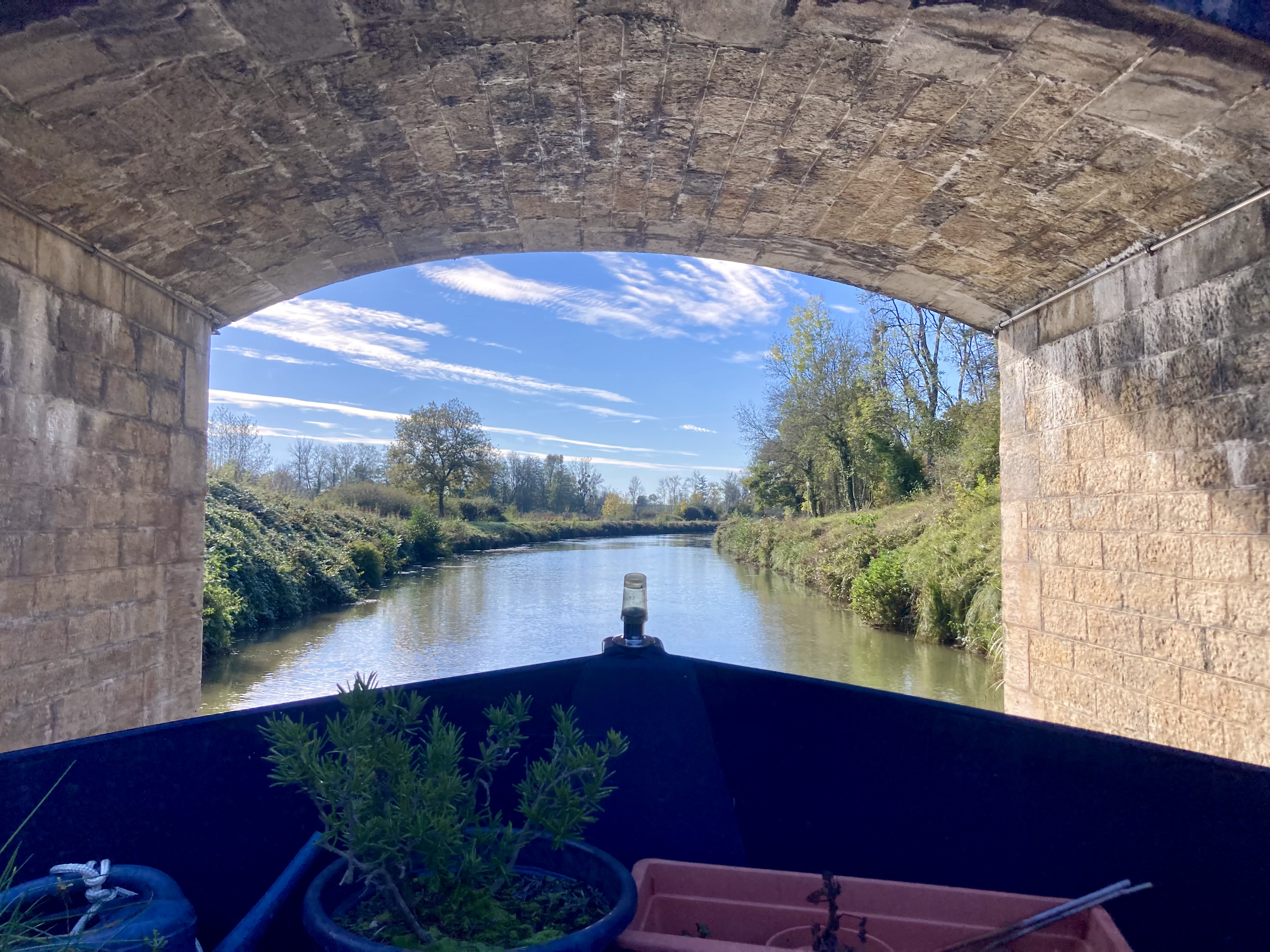


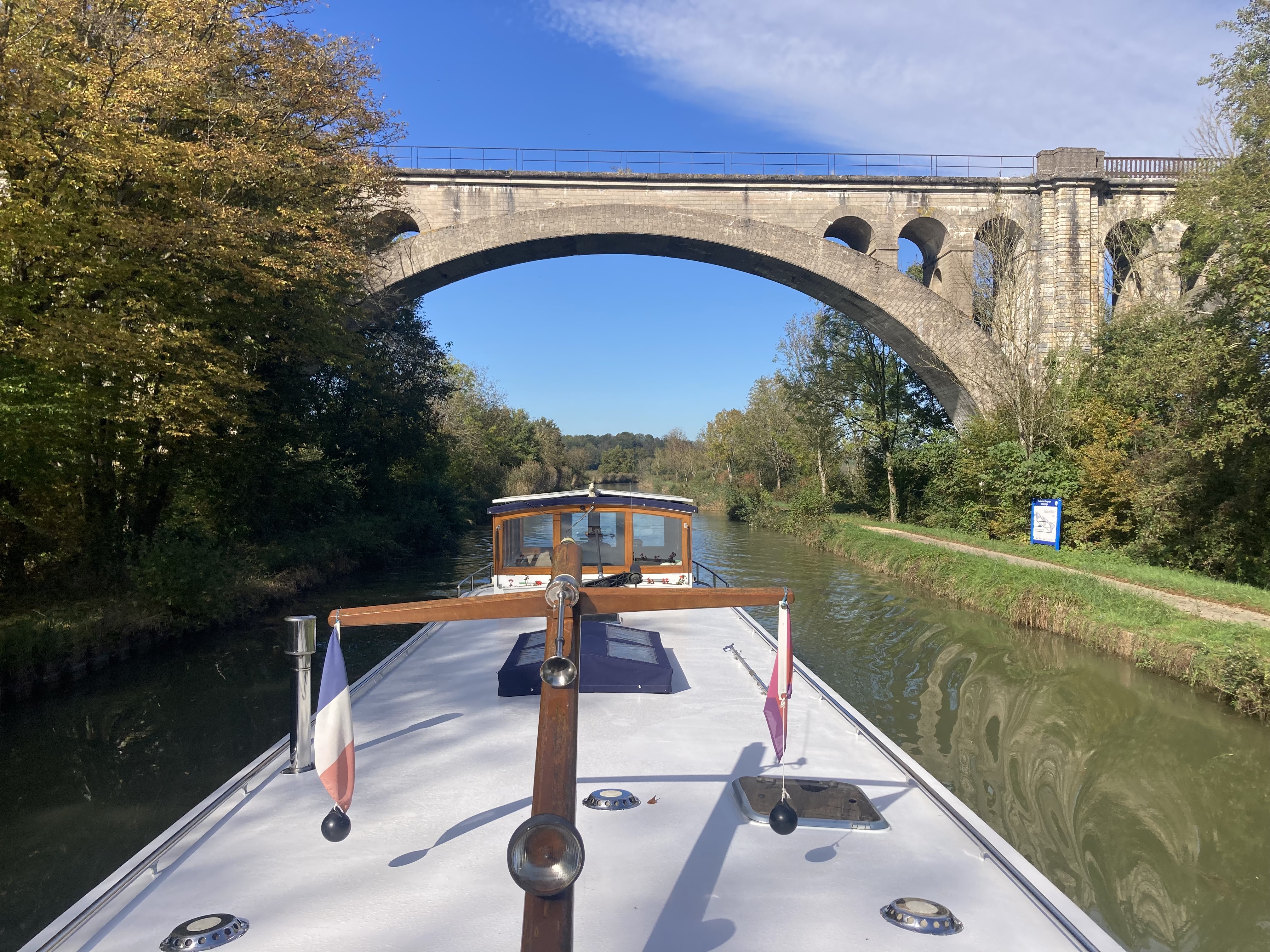
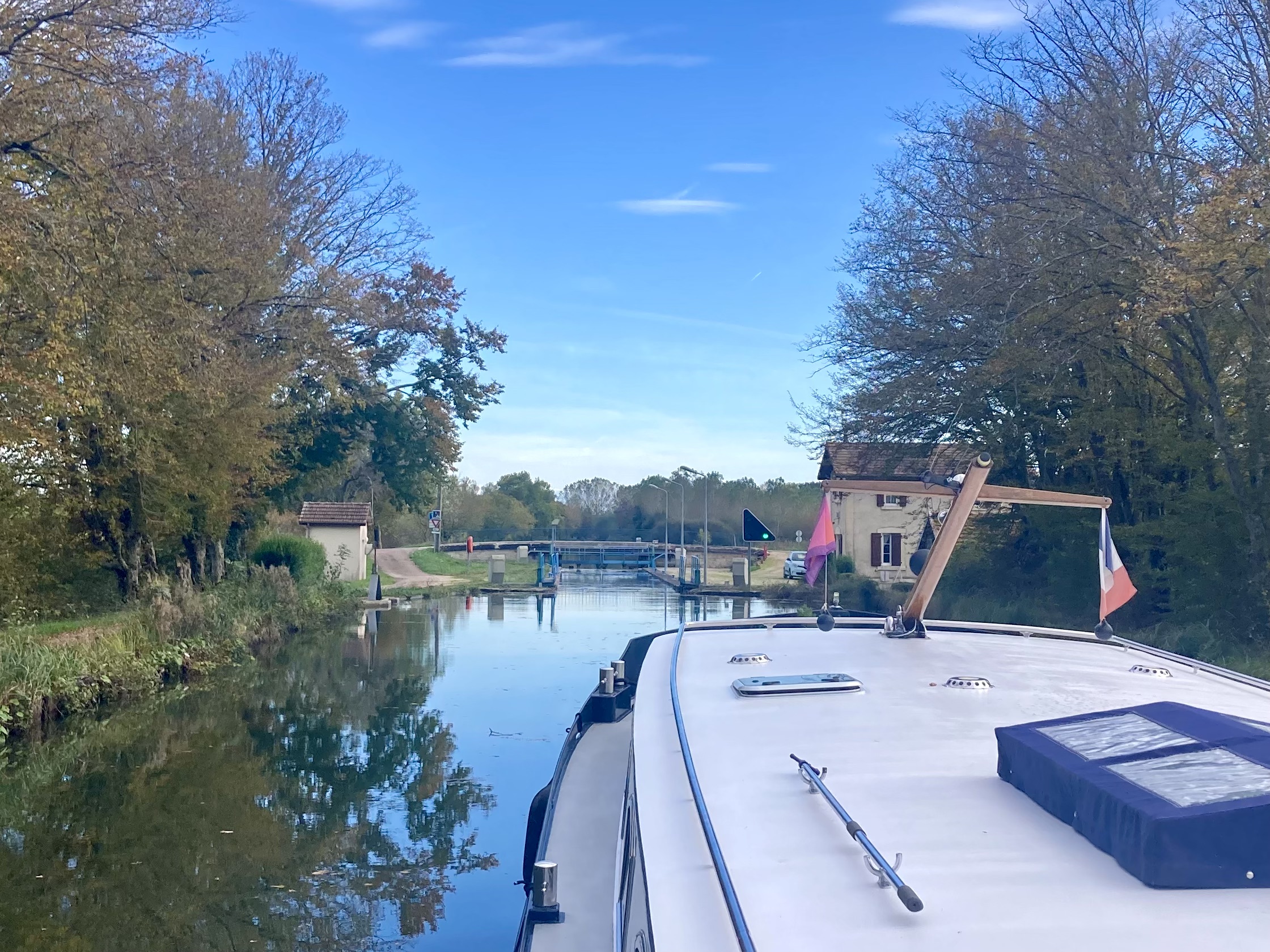
There are so many other lovely photos of this stretch; I must restrain myself. The best thing to do is advise others to take a boat or barge along this canal.
I was loving it. (Apologies for the crazy angle – we weren’t really tipped on one side!)

And this pack of hounds, out for exercise, were having fun too.


The canal still had one more double red light for us – this time at a new lift bridge at Cheuge.
This small bridge connects an old mill on the Vingeanne with the hamlet the other side of the canal.
(Sorry about the photo, taken into the sun)
This meant another 20 minute wait while our long suffering VNF service man caught up with us again. He was very surprised that we had a problem at this bridge, fairly recently renewed and normally without any problems.
He soon fixed it for us and we were on our way again – with a better photo taken the other side of the bridge.
By now it was 1520. Normally we are moored up by this time; today we still had 6kms plus 2 locks to go – about another hour. That’s OK.

Calliope came on down towards her last lock of the day at Saint-Sauveur. It was still a beautiful day – such a treat for our last full day on the Canal Entre Champagne et Bourgogne.
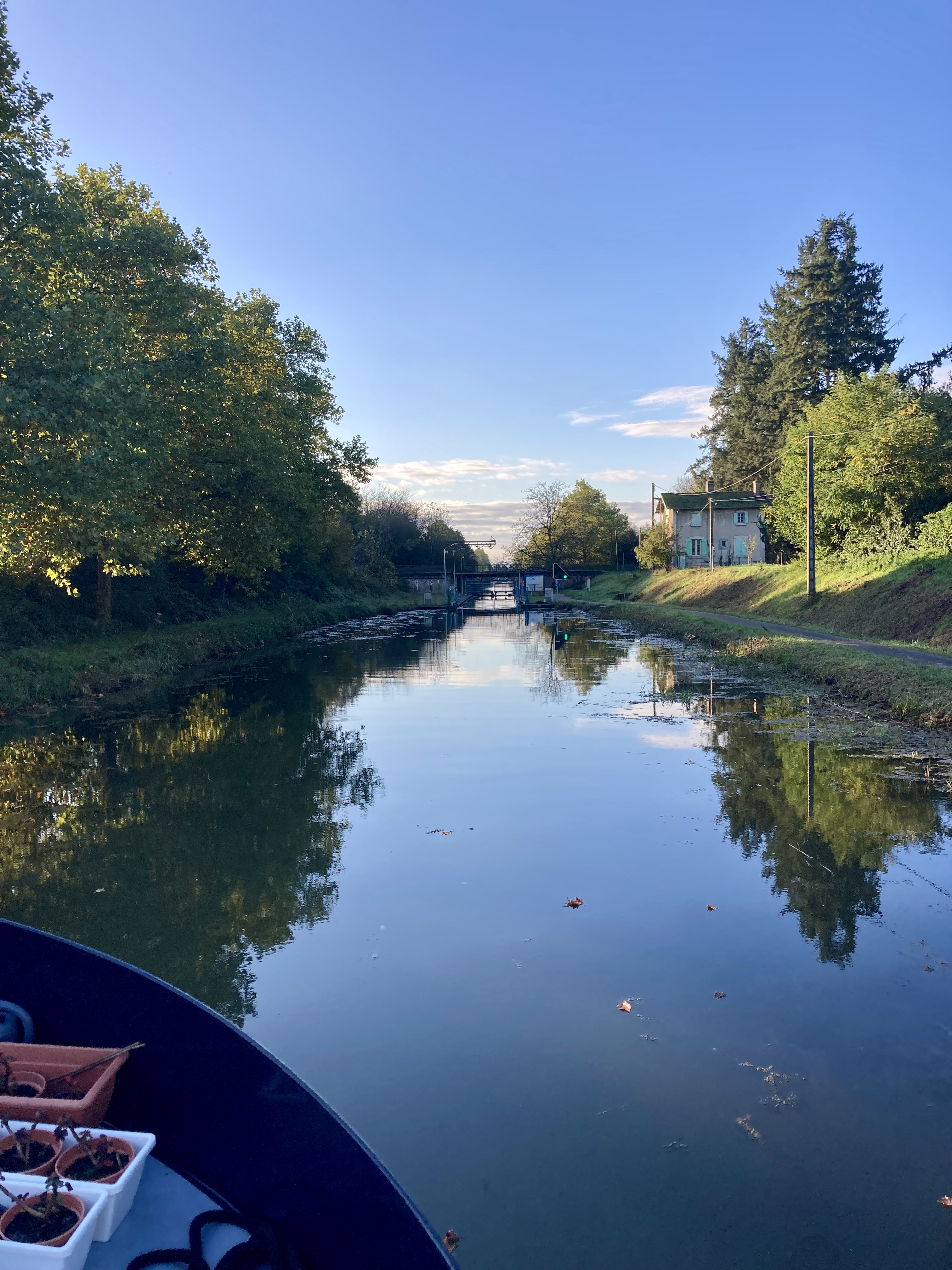
There is a long straight stretch of canal leading down to Maxilly. You can see the quay in the distance and see if there are other boats already there – but the perspective does not allow you to work out if there is room for Calliope until you are almost upon it.

Yes, there was plenty of space for us, as expected at this time of year. Not only that, but the only other boat there was La Fée Verte, a boat we had met several times on our way through the canal. Now we had time to get to know each other a bit better and an amiable early evening hour was spent aboard chatting to our new Swiss friends.
Next morning, looking at our energy levels, the date, and the weather we decided that after our long but enjoyable haul over the past 223 kms and 18 days we could afford to take a day off.

So we stayed at Maxilly an extra night and relaxed, although I was less relaxed watching my football team play! (they lost 😢)
We had made the right decision about the weather. We awoke to bright skies – and a heavy dew!

The last 1.5 kilometres of the canal down to the river includes two locks., one immediately by the quay where we were moored.

By five past nine we were through the one lock and heading towards what was our last lock of the 114 between Vitry-le-Francois and the Saône.
It was the final use of our trusty ‘telecommand’, pressing Avalant to prepare the lock for our descent.
And then there we were at lock No.43, Chemin de Fer, so named because of the railway bridge adjacent.
A bit sentimental I know, but here is a mini pictorial record of that last lock.

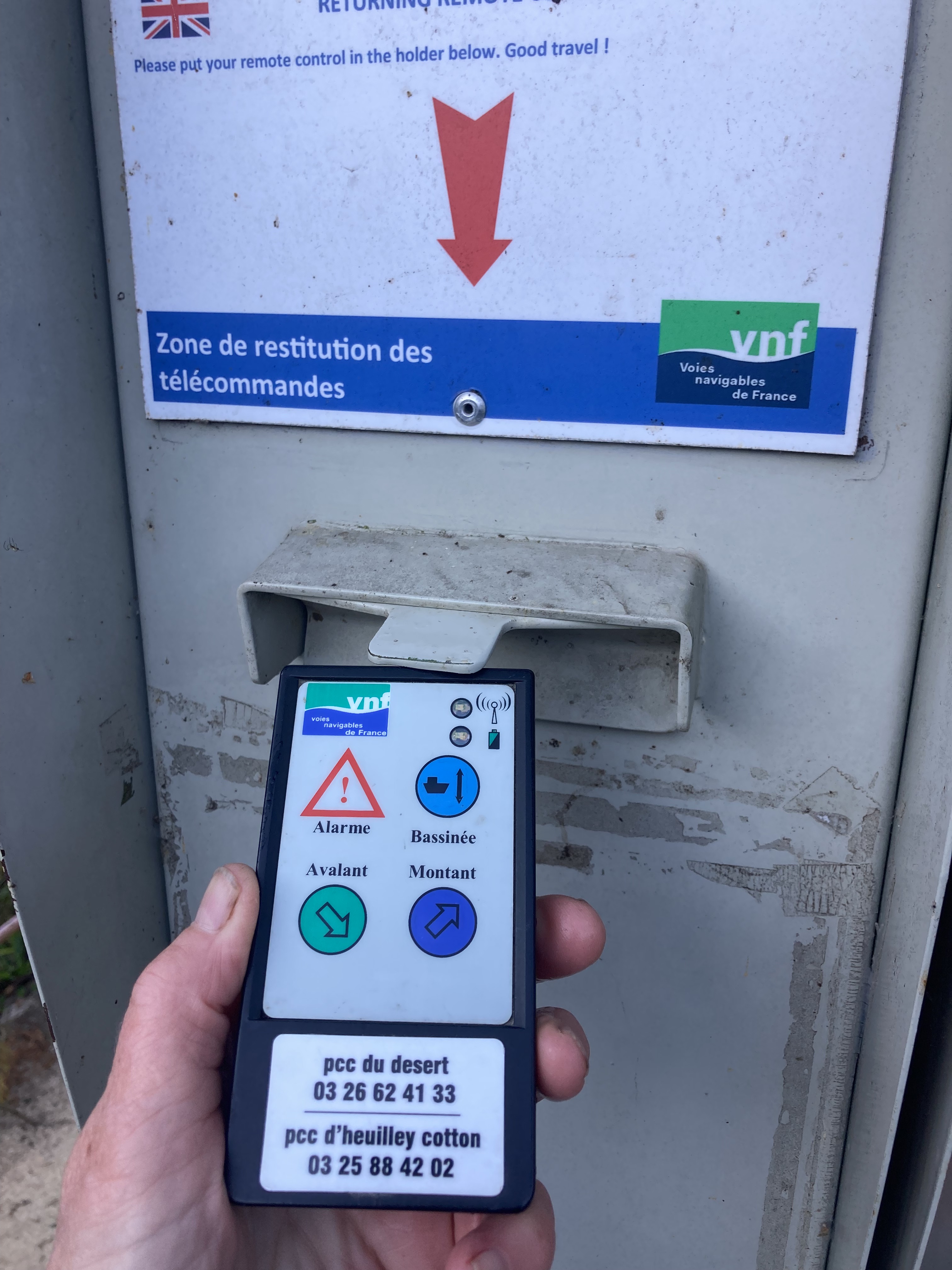

You may recall way back at the start of the canal we had to pick up the telecommand. Whereas at Lock 43 we had to return it, and follow specific instructions to do so – all carefully shown on a big noticeboard, in several languages.
And that was it – the lock began to empty and we began to go down to river level.
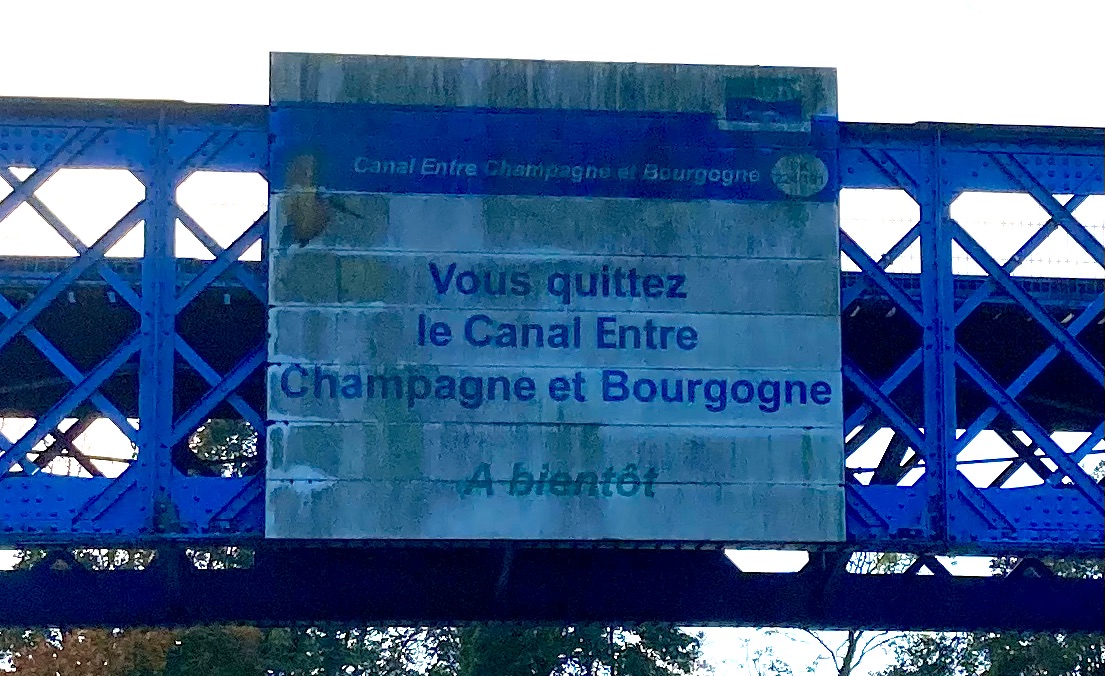
Another kilometre to the bridge over the entrance to the canal, with its tired sign saying we were quitting the Canal Entre Champagne et Bourgogne and we entered the Heuilley lock-cut out onto the river.
La Saône
The lock cut is a deviation of the river along to Heuilley-sur-Saône, but today we were heading the short distance to the right and onto the Saône.
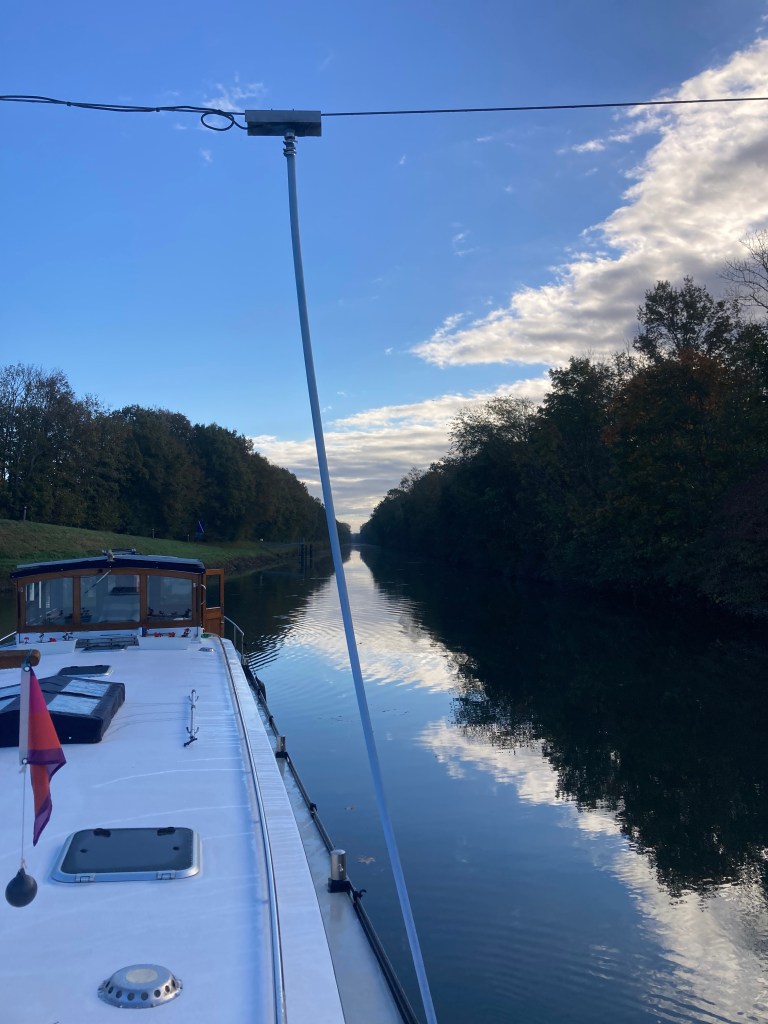
Now we were away from remote control operation of locks, and back to ‘pole-turning’.
These flexible poles, more like thick hoses, hang over the river before each lock.
To get the lock to prepare and to open its gates one must give the pole a quarter turn – an easy thing to do, especially with a good helmsman to direct the boat towards it.
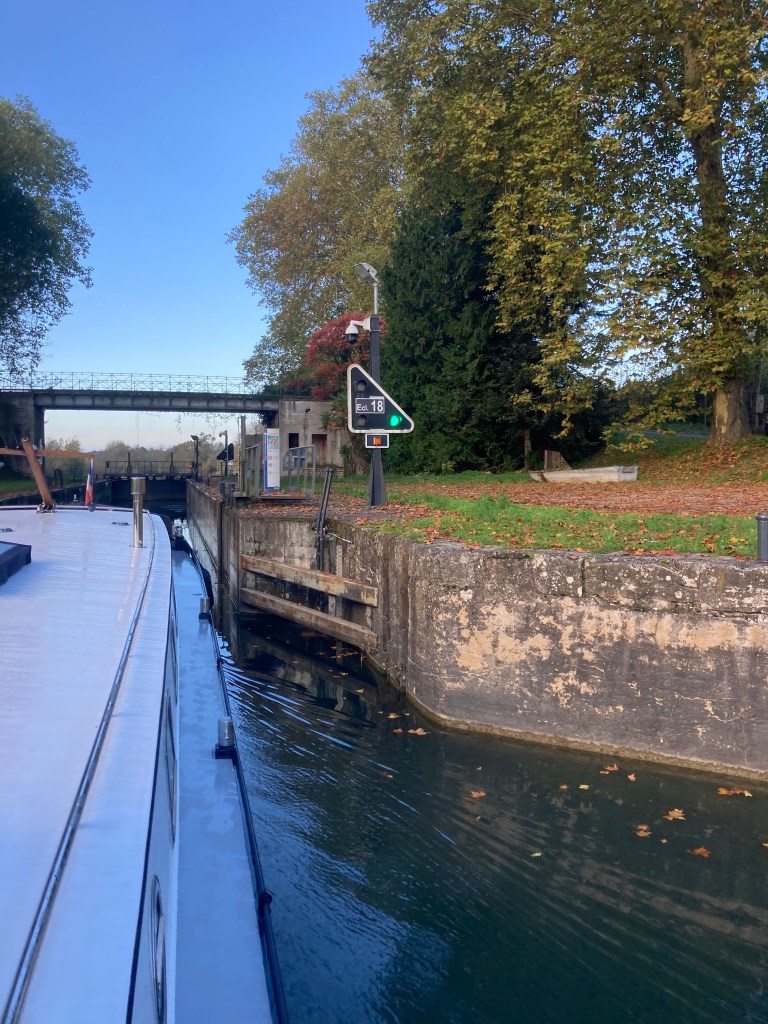
The lock out of the deviation and onto the river proper is in a pretty location and, at this time of year, not very deep.
There had been a fair amount of rain so the river was running fairly high, meaning not too much difference in depth from the deviation to the river.

And then we were out!
Set free from the narrow, though lovely, confines of the canal, and out onto the width and spread of the river.

It brings a smile to my face even now to recall how it felt sweeping downstream on such a beautiful day. 😁
Despite the sun glowing down on us we were still covered in dew. It was a good excuse to be out in the fresh air with a mop, using the dew to give the roof a quick clean up. We would be in our home port within a few hours so good to smarten her up.
Calliope was soon passing the bridged entrance to the small marina at Pontailler-sur-Saone.
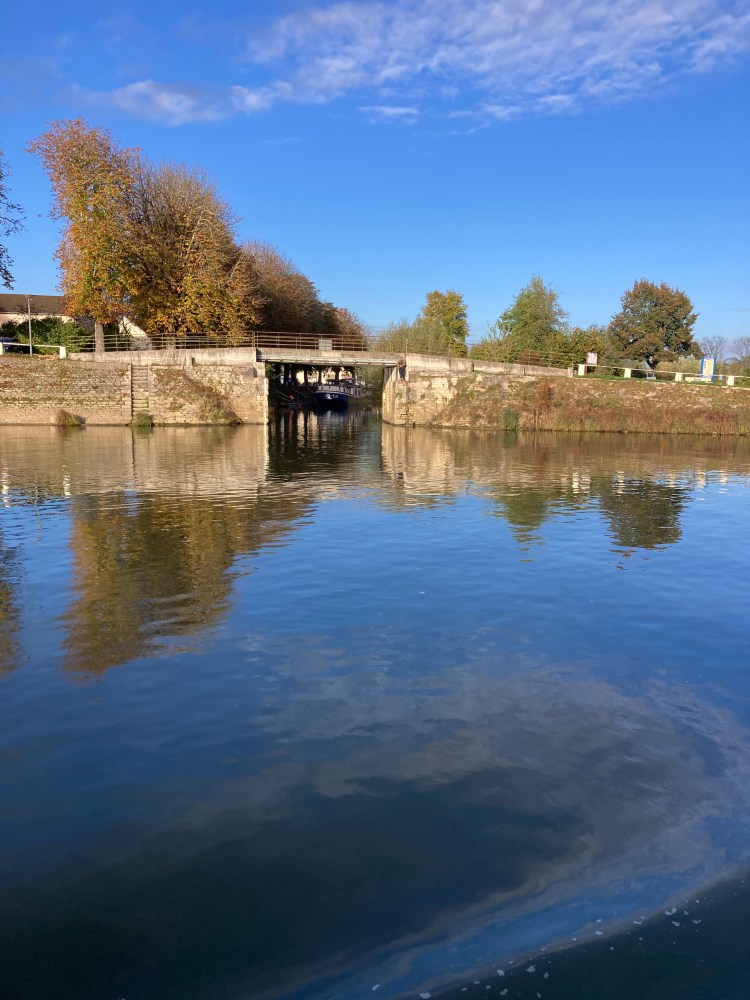
Although mainly best suited to smaller vessels we could see a barge alongside the quay in the marina. Normally barges moor on the low quay and steps just downstream.
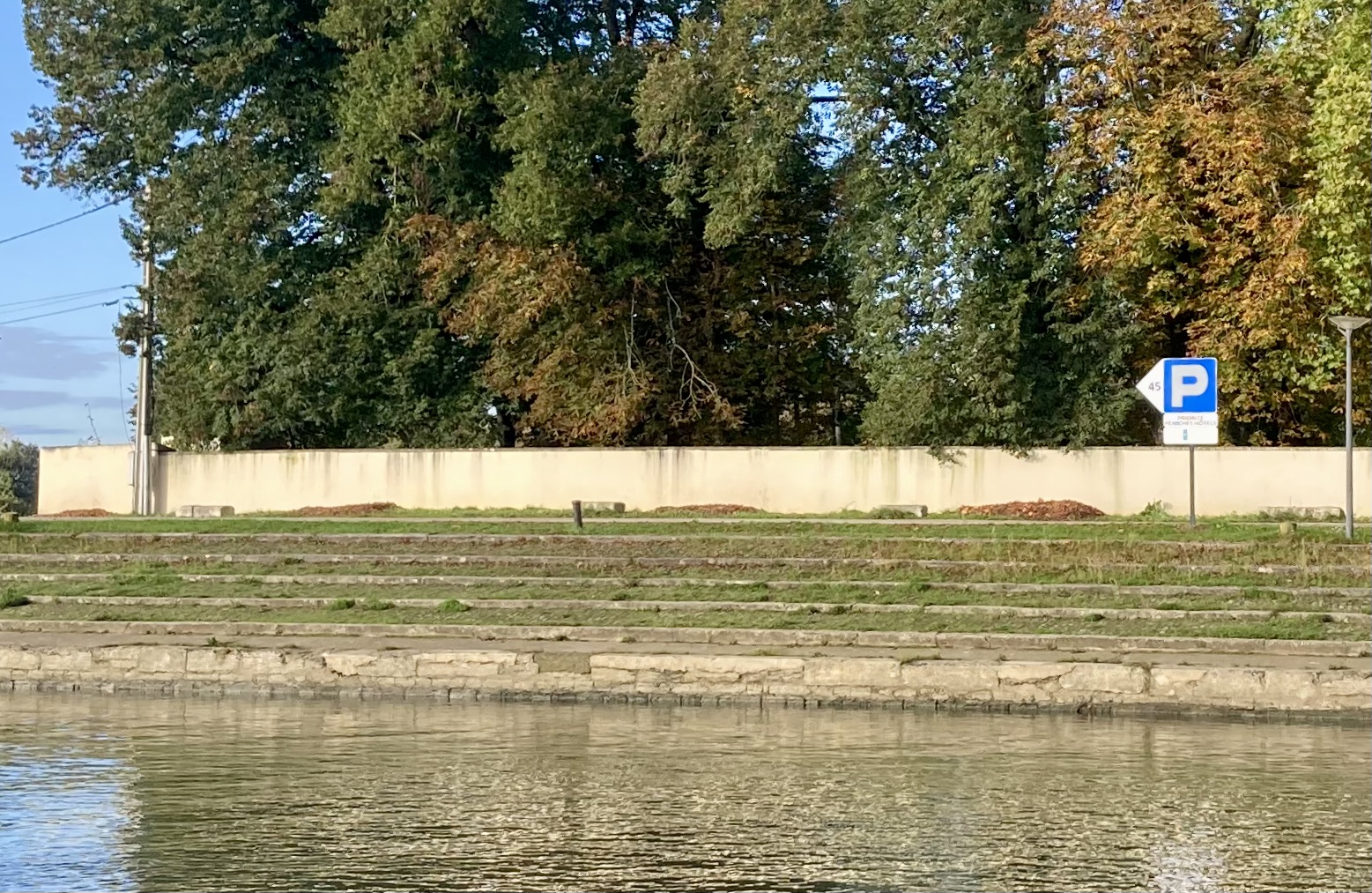
With the current helping us along we found we were travelling at 10-11 kms per hour. It may sound slow, but it is a good but faster than the 8kph on the canal, realistically reduced by half when you factor in all the locks.
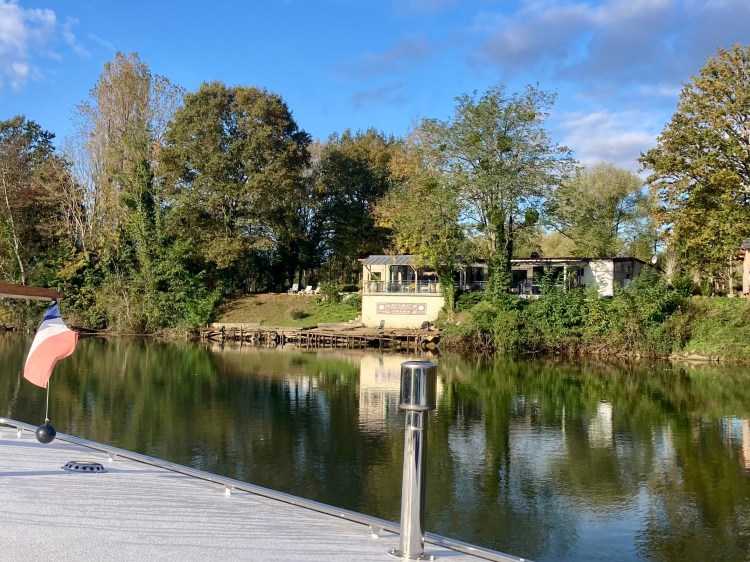
So it was not long before we were passing La Nymphéa restaurant at Lamarche-sur-Saône.
Despite its somewhat tumbledown look this is an excellent place to eat; slightly precarious moorings are available too.
The next landmark for us was the 1 kilometre deviation of the river called the Poncey lock cut. We were watching out for it on the left; looking into the sun it was not initially easy to spot, but then suddenly not was obvious.
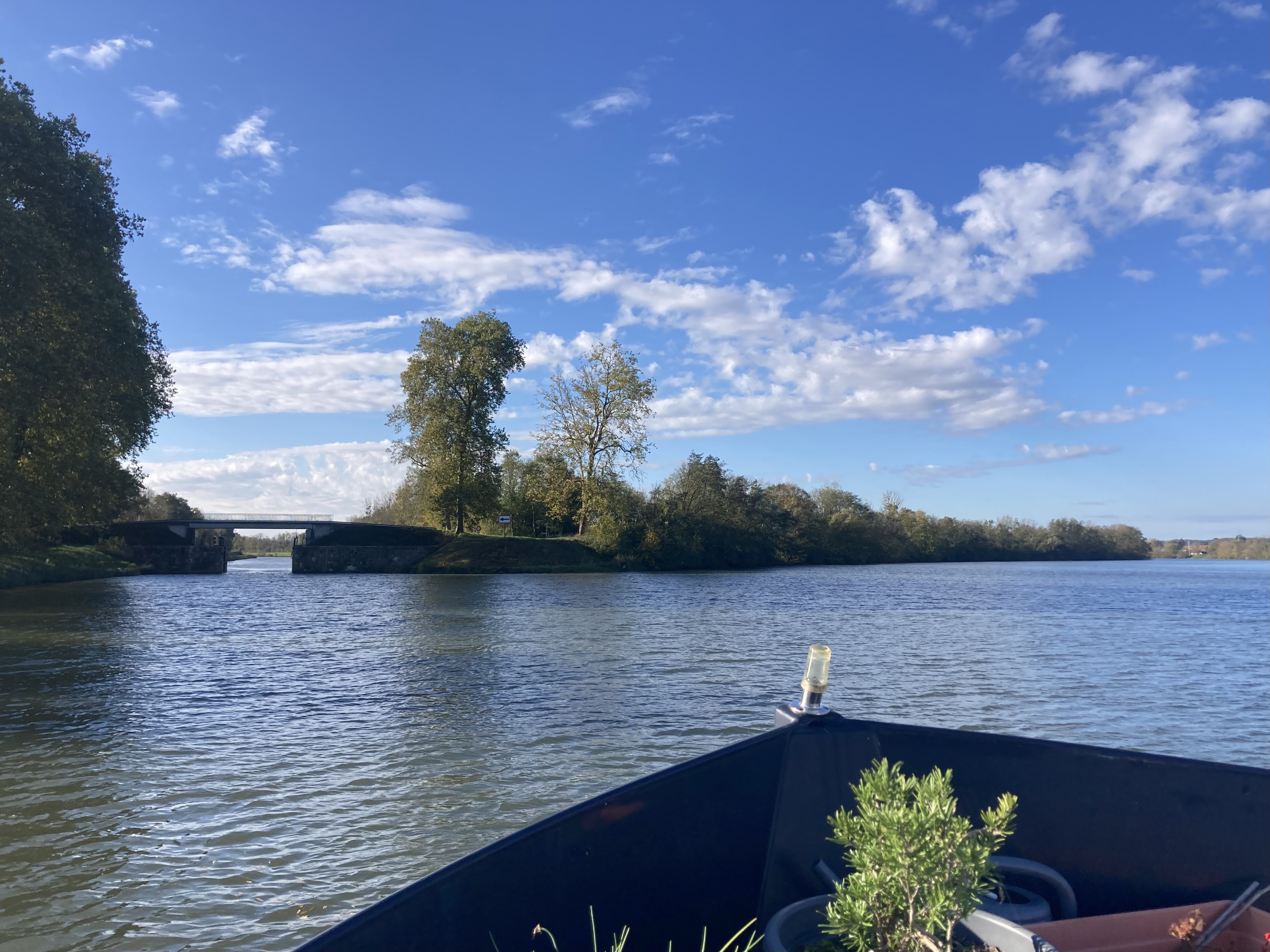
It’s a bit hard to see here in the photo, but just to the right of the big tree is an arrow informing all craft that they should go through the lock cut, and not down the river.


The upstream end of the cut has a flood gate, closed when the river is in spate, but open today for Calliope.
And at the downstream end was our first full Saône lock, 40m x 8m on this stretch and feeling wonderfully wide after the 5.2m width of the canal.
The view was becoming increasingly familiar. We have cruised up and down this section of the river a few times, always loving it.

After 8 kms we were passing the famous city of Auxonne, where Napoleon went to army school and where many boaters stop for a few days or all year.
This very poor photo shows us passing the H2O marina, waving virtually to all our friends moored within.
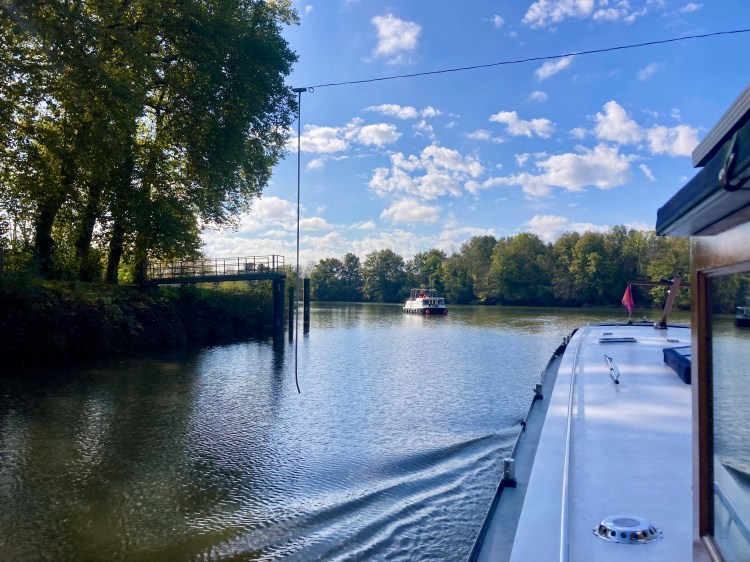
Just beyond Auxonne there is another deviation, with a lock the far end. We found ourselves waiting here for a while as a boat in front of us slowly organised themselves into and through the lock.
Then it was our turn. As we left we had a good view of the pole to be turned for boats heading up stream.
With just an hour and a half of the seasons cruising left we went on down the river past the junction with the Canal de Rhone au Rhin towards Saint-Jean-de-Losne (SJdL).

I was enjoying it so much I tried to make some videos of my joy at being on the water, but I am not yet any good at vlogging so you are spared that!

SJdL and its bridge appeared on the starboard bow and we noticed that the church, with its amazing Burgundian roof was now clear of scaffolding.
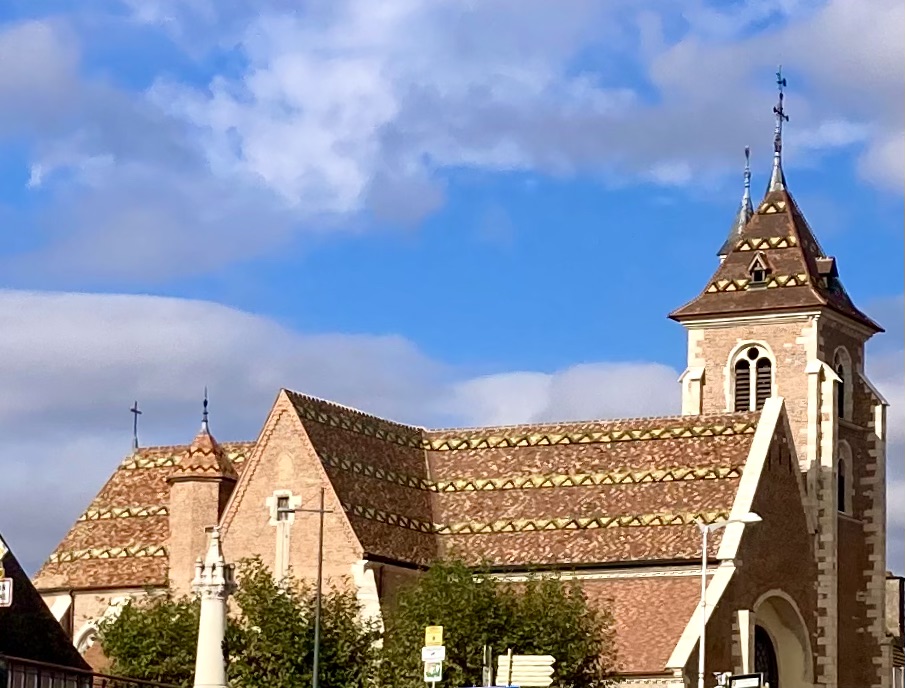
Saint Usage
Just after the SJdL bridge a turn to the right brought us into the entrance to the Canal du Bourgogne and the Port de Saint Usage – our winter mooring place for the past three years.

It only remained for us to go up through the lock and along to the far end of the basin.

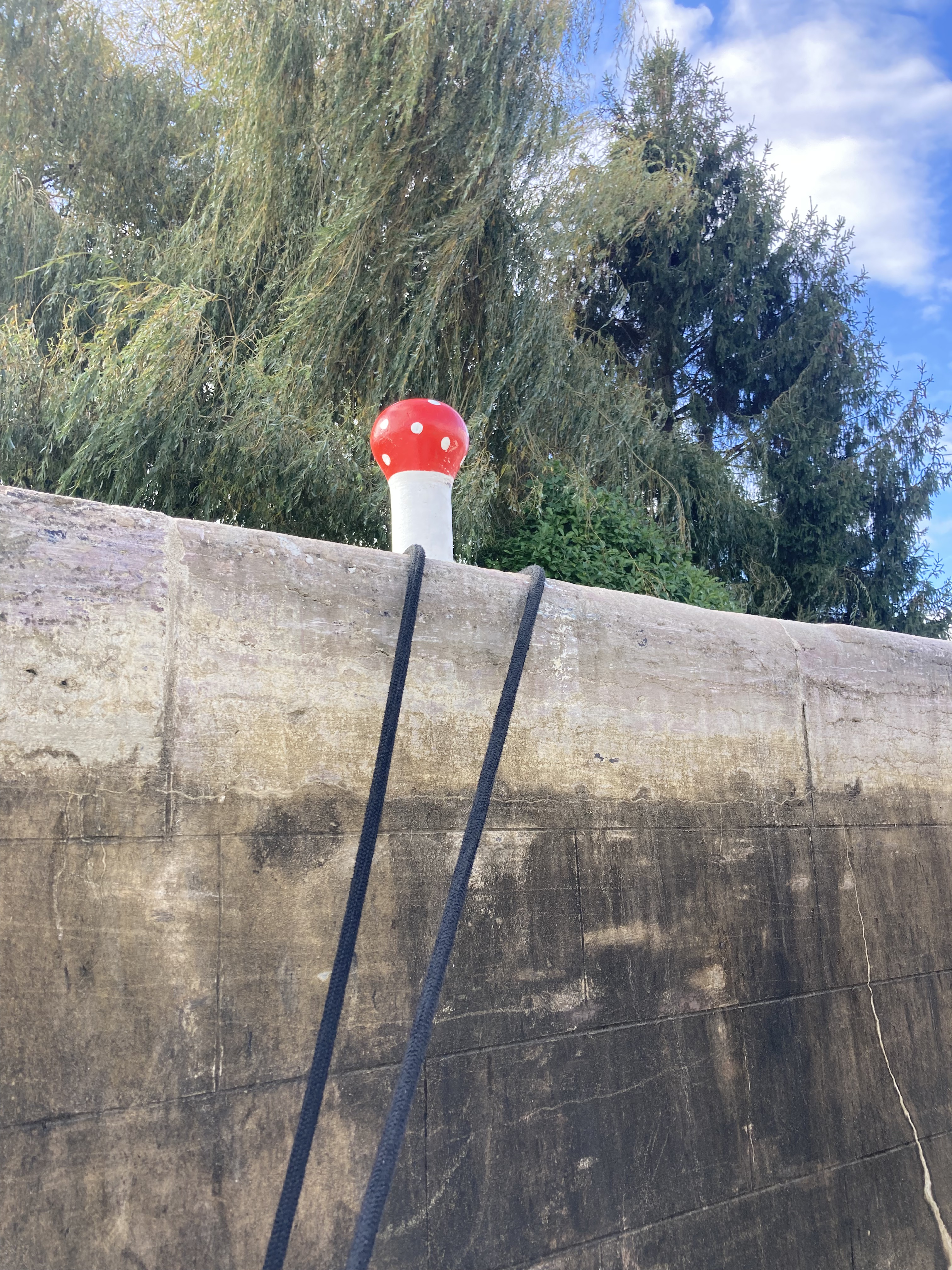
We reached the top of the lock and could see along to the far end of the port where we were due to join a group of other Piper boats in what has become known as Piper Port.

It feels good to be home among friends for the winter.
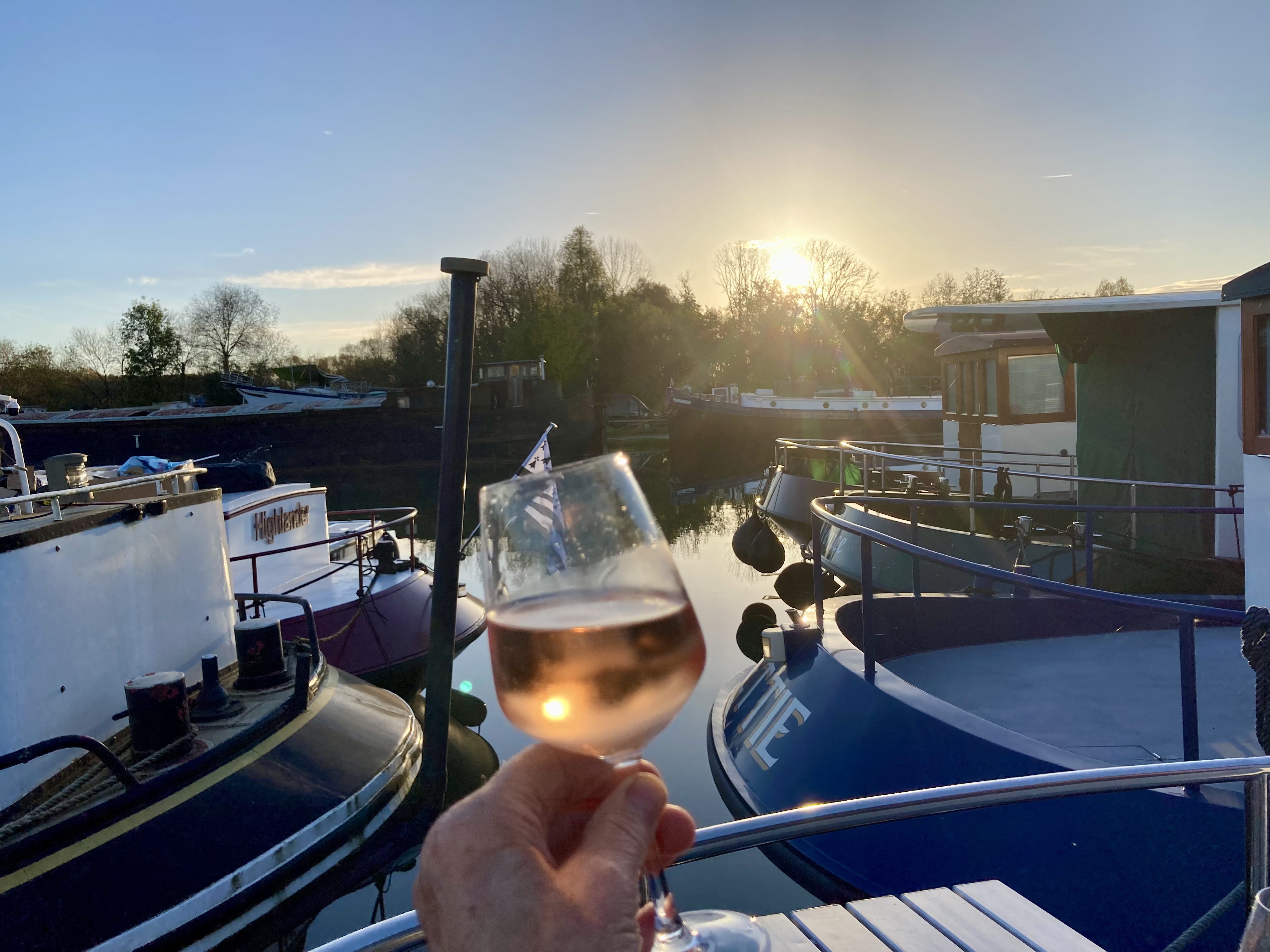
Cheers Calliope!
Cruising through until October has its own particular attraction; the Autumn colours and peace and quietness of the waterways more than make up for the cooler days for us.
But now it’s time to tuck the Old Girl up for the winter again, a gentle ritual we both enjoy with our own responsibilities to accomplish in our own time (the skipper especially).
This time though perhaps has an extra poignancy; after the most wonderful 10 year adventure with our beautiful ship we feel that it is now time to pass her on to younger owners.
When we return in April we will be asking Simon Piper to broker her sale.
Thank you all for reading the blog over the years,
Lesley xxx
(And Stu…)
From Reims South to Vitry-en Francois
30th September to 2nd October 2024
Canal L’Aisne à La Marne
Courcy
We had been waiting on this canal for 5 weeks, due to the canal closing upstream of Reims for maintenance on a lock. Now, with our son aboard to help us make up time with longer days of cruising, we were off from our mooring at Courcy towards the fine city of Reims.
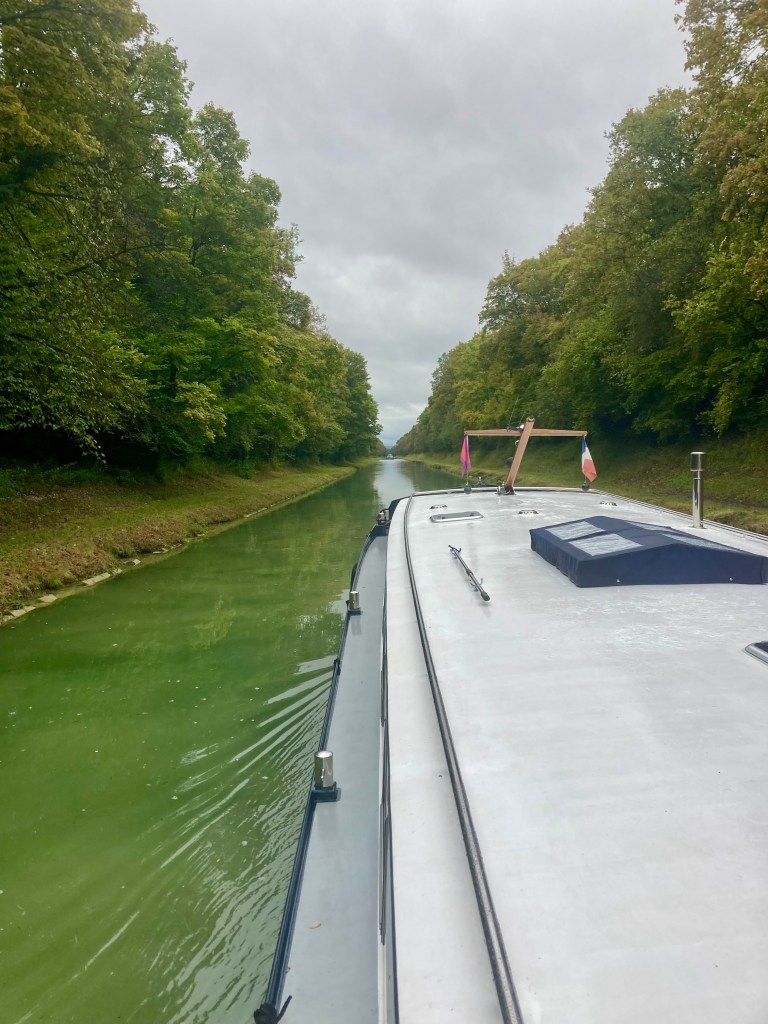
It was a bit of a grey day when we left next morning.
It was also a slow start; after about 10 minutes we saw ahead of us. in the distance, a very slow moving working barge. It was definitely in no hurry – maybe waiting for its turn on one of the commercial quays ahead.
We followed it at almost tick-over speed for half an hour, slowly catching it up. To be honest it was rather frustrating! After being held up for 35 days and being ready to ‘speed’ forward at out usual 6-8 kph, we were now traveling at about 1 kph!
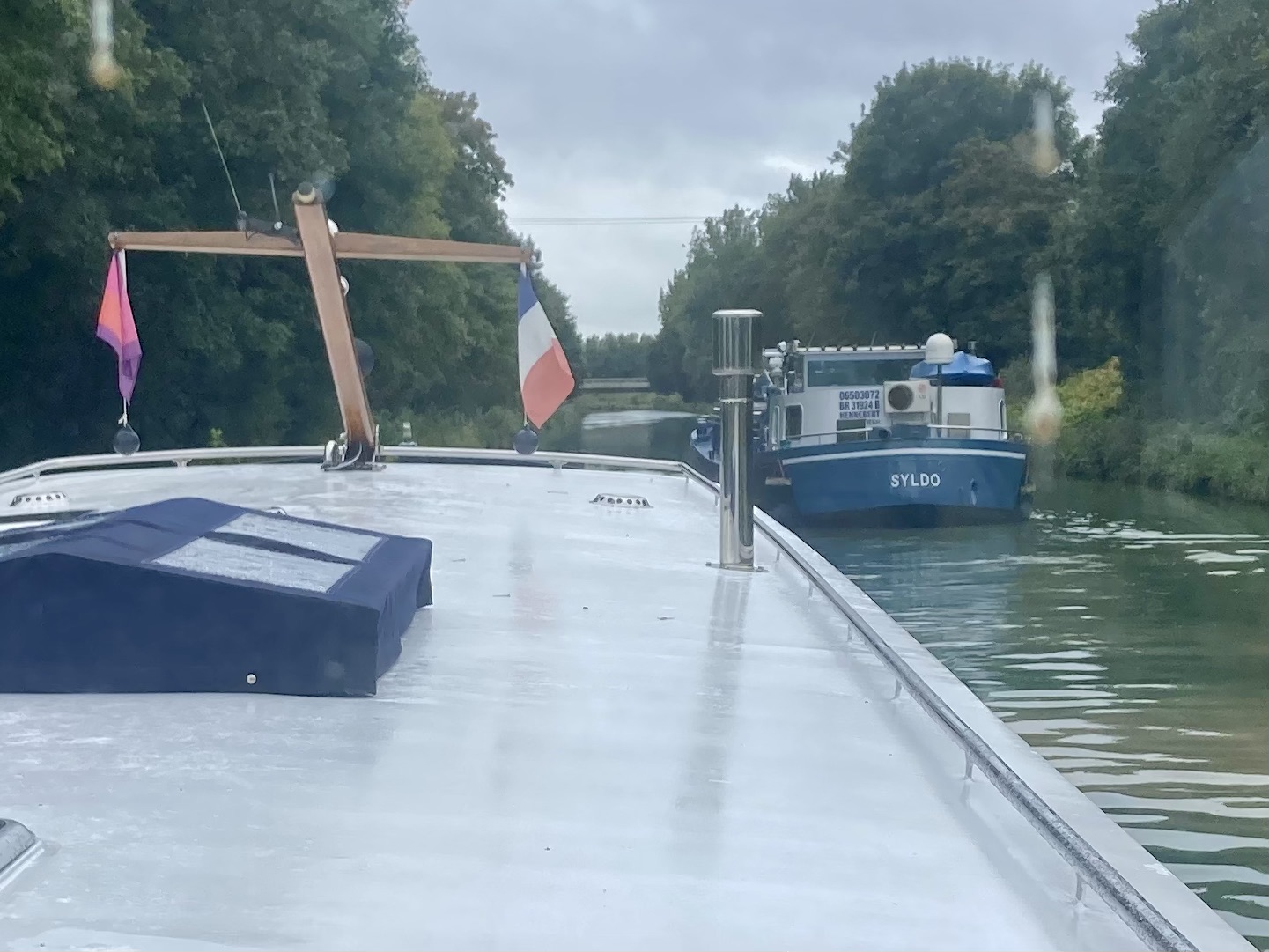
The Captain decided we should ask barge Syldo if we could pass, so using the VHF Channel 10 (ship to ship channel) I called up and asked if that was ok. “Bien sûre” came the reply, and he pulled over to the right to let Calliope overtake. Now we could get going.
As we entered the outskirts of Reims we passed the long working quay, quite likely the destination of our friend Syldo.
The canal widens here, with an island in the centre, allowing barges to turn or pass each other by. Maybe we could have passed Syldo here, but we are not sure of the depth to the right, and how much that channel is used.

Going back a few weeks we had been hurrying towards Reims to avoid a 5 day holdup for the demolition of a bridge. That work was moved to night time only so would not have delayed us; we got caught instead by the 5 week closure!
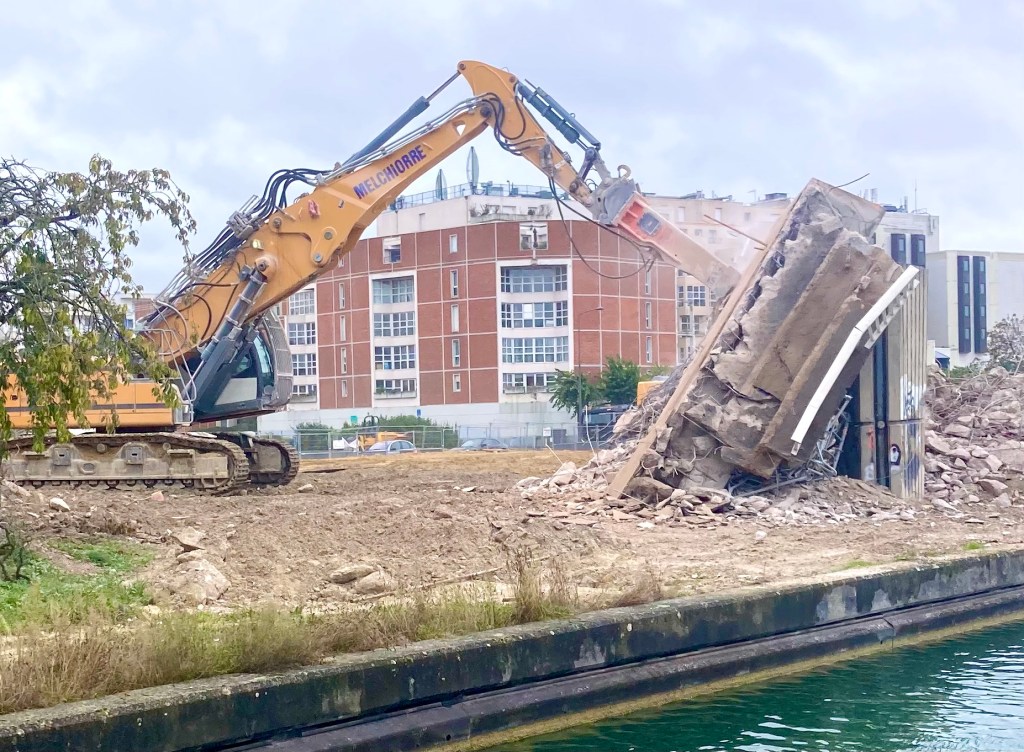
The evidence of the bridge demolition was still very evident. It may have disappeared from its position over the canal, but huge limps of concrete and roadway were still being broken up and removed.
The whole area is destined for regeneration and should look a whole lot better next time we are there. In fact large swathes of Reims are being redeveloped, especially canal-side areas including the old port. The plans look good and should add to what is already a largely beautiful city.

A kilometre and a half further through the city and we arrived at our first lock of the trip. There are three close together in Reims – Fléchambault, Chateau d’eau and Huon. All are less than 3m deep so we were through them quite quickly.

At Huon there was a good clear notice telling us about the opening hours of the next 12 locks, up to then summit at Billy-le-Grand, and down the other side to Condé.
Despite our hold-up it was still Haute Saison, and to be honest we wouldn’t normally travel outside of the winter hours of 7h30 to 17h30.

Here we are at the top of the Huon lock, off towards the summit.
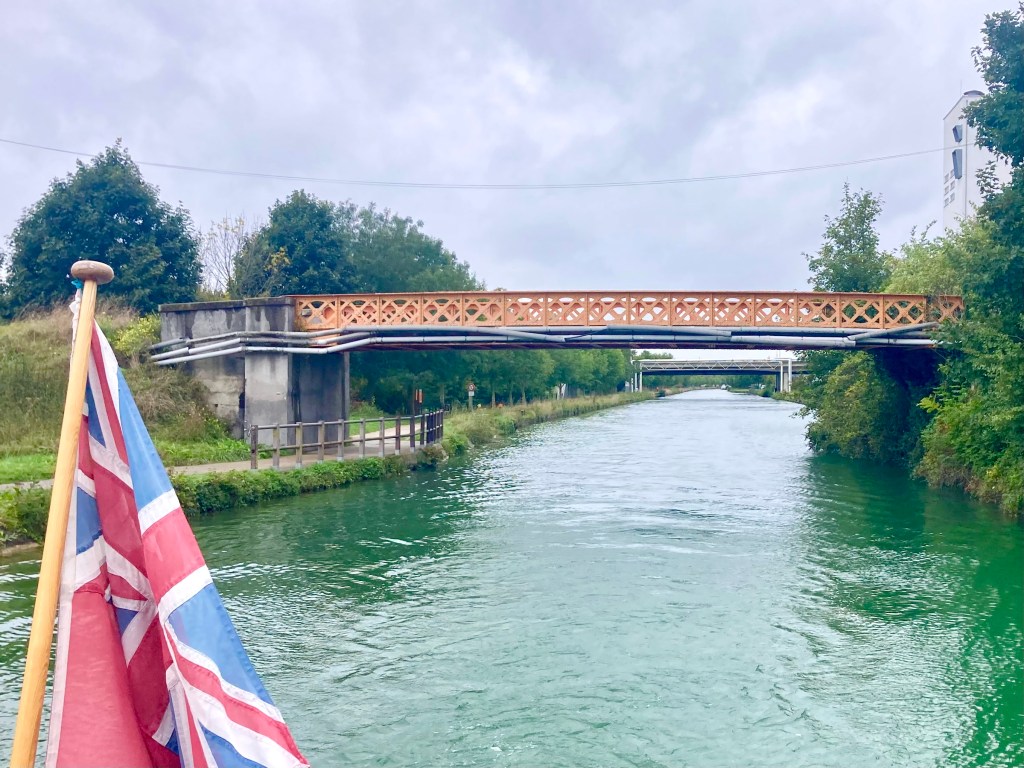
I do have one more photo from the south easterly outskirts of Reims however.
I have seen bridge steelwork painted blue, green, black, and white …..
… but never before orange!
We carried on through Sillery and its marina where Calliope had spent the winter a few years before, and on to one of my favourite lock names – L’Esperance meaning The Hope.
On this occasion it was not so hopeful as the lock did not respond to my turning of the pole. I called up asking the VNF for help and we managed to tie Calliope up at the side.
After a while I went up to the lock to see what was happening, if anything. The éclusier (lock keeper) arrived more or less at the same time; hooray.
And who did I find in the lock but our friends on Piper Boat Plan B! We hadn’t seen them all season.
They were coming down the canal as we were going up; their pole had responded and the lock had started to work again. They had been held up the other end of the maintenance work. Sometimes it’s a small world on the waterways.

Now we were on our way again; next lock Beaumont where all the maintenance work had been happening for the last 5 working weeks.

And was still happening!
Although the lock was officially open once more it was being operated manually by two éclusiers, whilst other VNF workers were in full swing tidying up and making good.
The Captain had decided that we would stop in the summit bief (pound) at Sept-Saux, just a couple of kilometres from the tunnel. So the rest of our journey that day was quite high and quite windy.
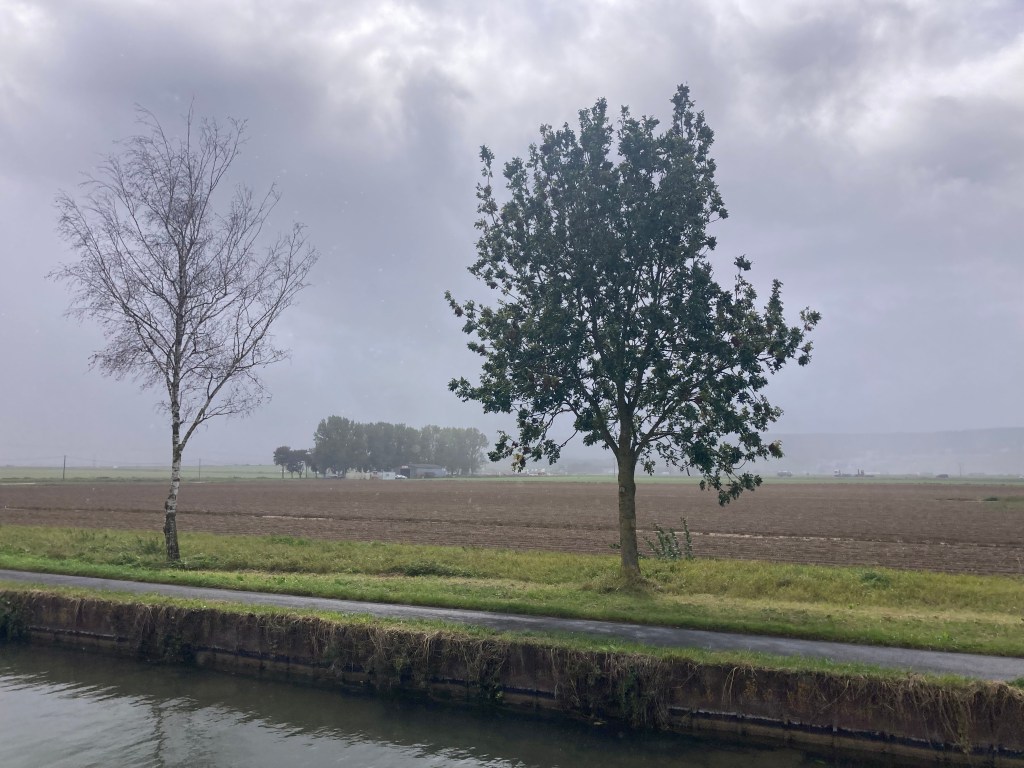
Way out across the fields and through the grey mist are hills covered in vineyards.
We are still in the Champagne region, although not a drop aboard Calliope. Made an error there somewhere!
Sept-Saulx
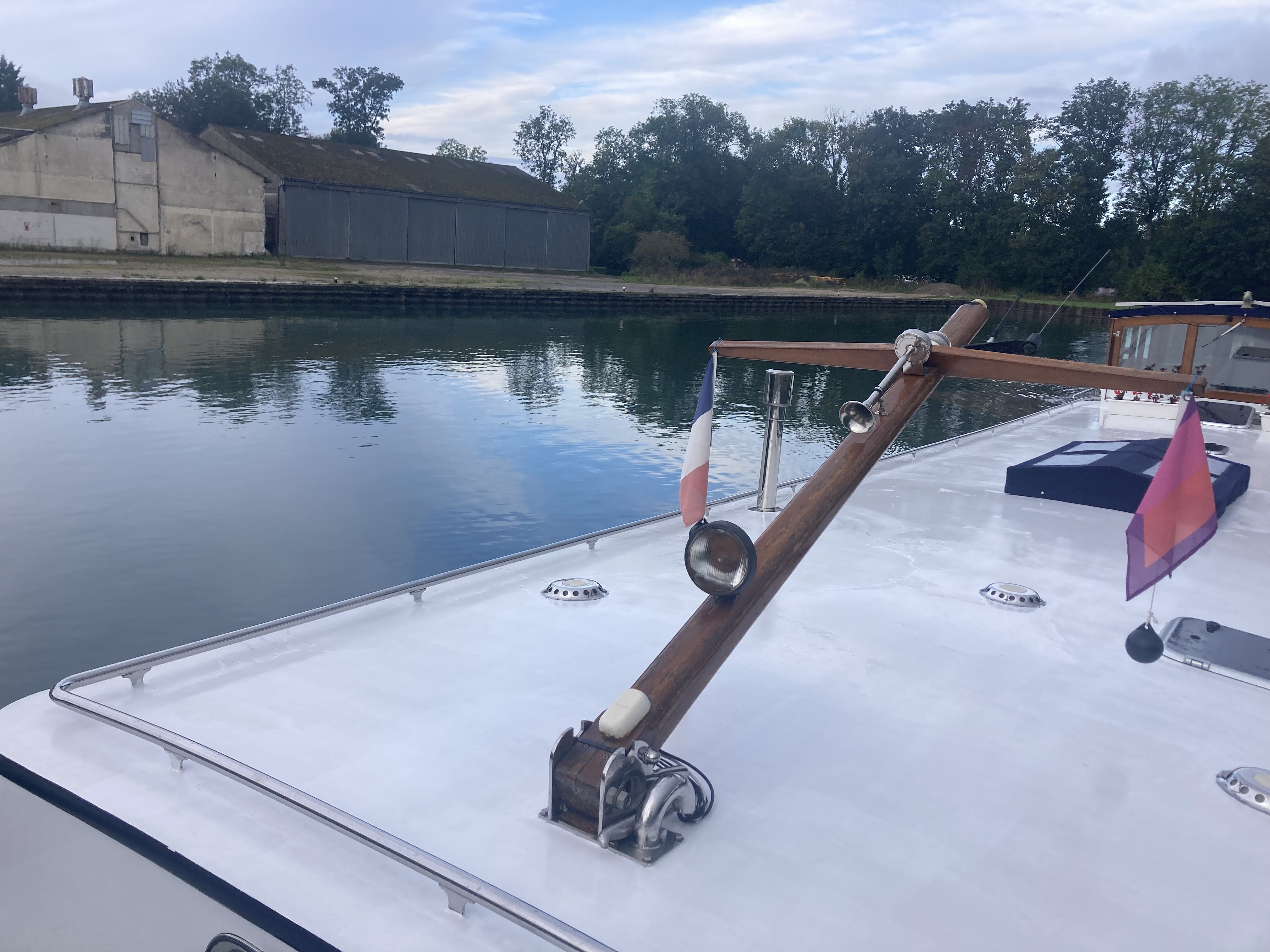
We arrived at the Sept-Saulx basin with a strong wind blowing us off shore and not making it at all easy to moor up. But within a few minutes we had the boat secure.
Ashley set off for a bike ride to explore the local area while Stu and I relaxed! It was a quiet pleasant evening together, eating one of the meals I had prepared and frozen a few days before (Luxury Fish Pie I think).
In the morning we were off before 0900, wanting to make a good day of it along the rest of this canal, including, of course, the tunnel.
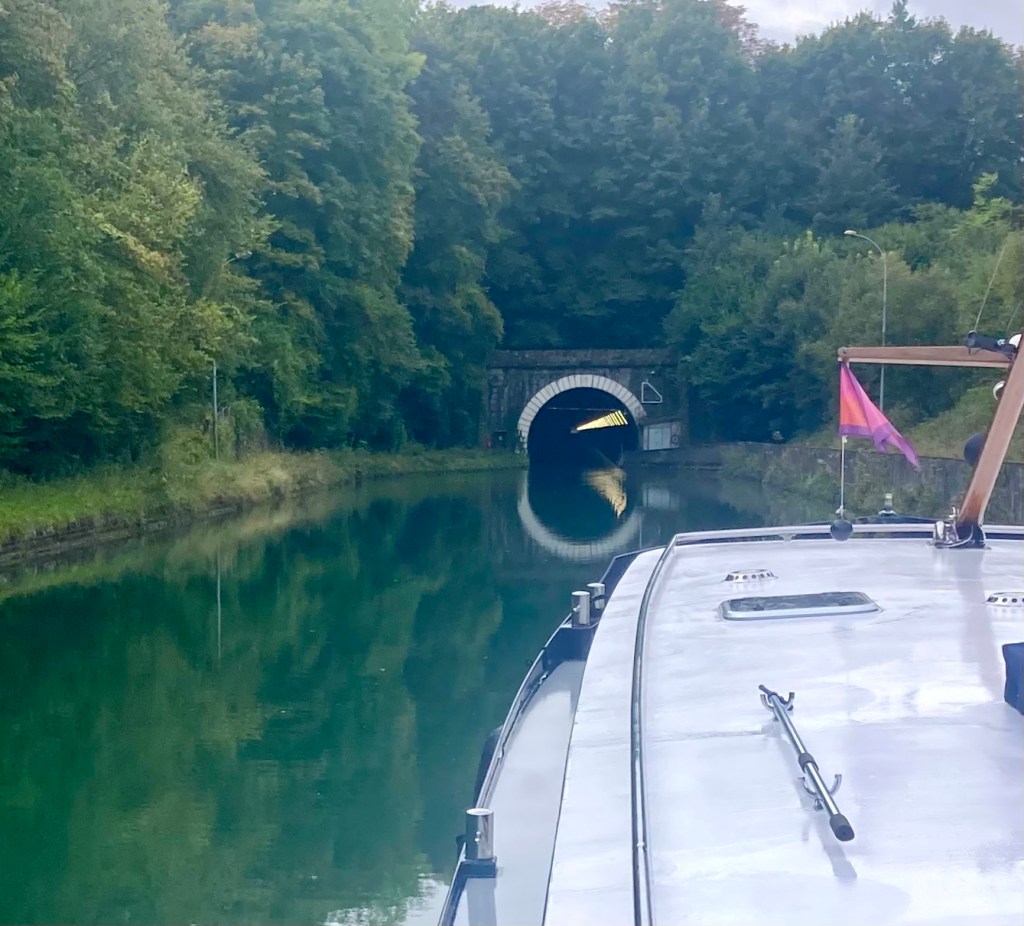
It seems an odd thing to say, but Stewart calls it his favourite tunnel. I think it is a blend of its length (quite short), lighting and general ease of navigation.
We were at the entrance within 15 minutes of setting off that morning.


The Captain made the tunnel seem easy – in about 20 minutes we were out on the Marne side of the ‘mountain’ and stating to head downhill. Locks going down always feel like less work as you are not throwing ropes upwards towards bollards.

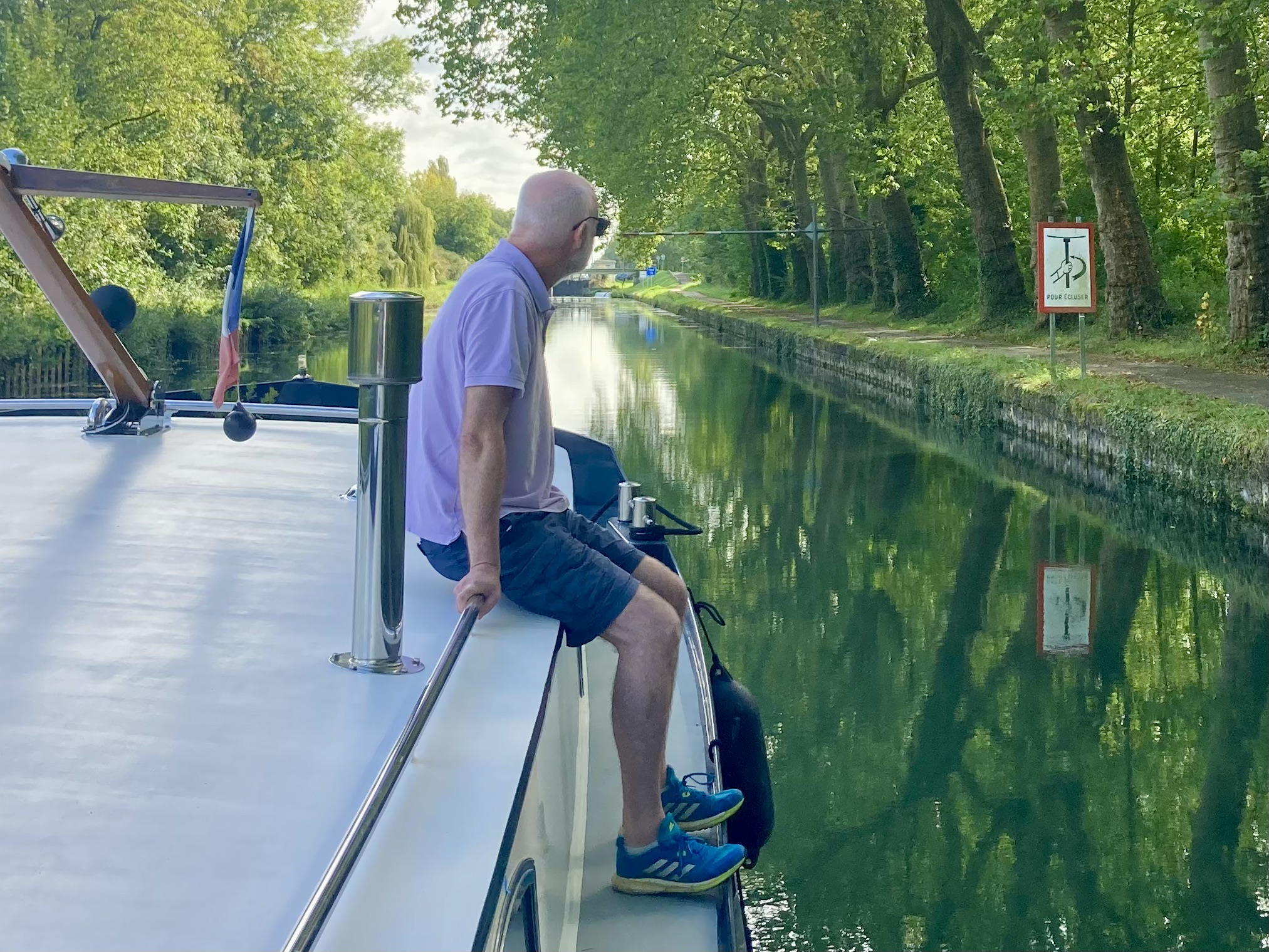
It wasn’t long before we saw a sign telling us that we were approaching the first écluse (lock) down. There would be a pole hanging over the canal waiting for a quarter turn. It seems experience either direction works.

It was Ashley’s turn to turn, so he made his way bow-wards and got the lock ninth operating mode as soon as possible.
By the time we reached the lock he was back bye the wheelhouse managing the aft rope.
The lock was beautifully modernised with a flat concrete inner wall and a rounded metal edge that allows ropes to run across them smoothly.
Older locks often have stone quays with gaps between the stones and ropes can get caught in the cracks. Crew must always stay alert to this possibility, and have a sharp knife ready to cut any rope that gets really stuck – otherwise the boat can get ‘hung-up’ at one end, fill with water the other, and sink!
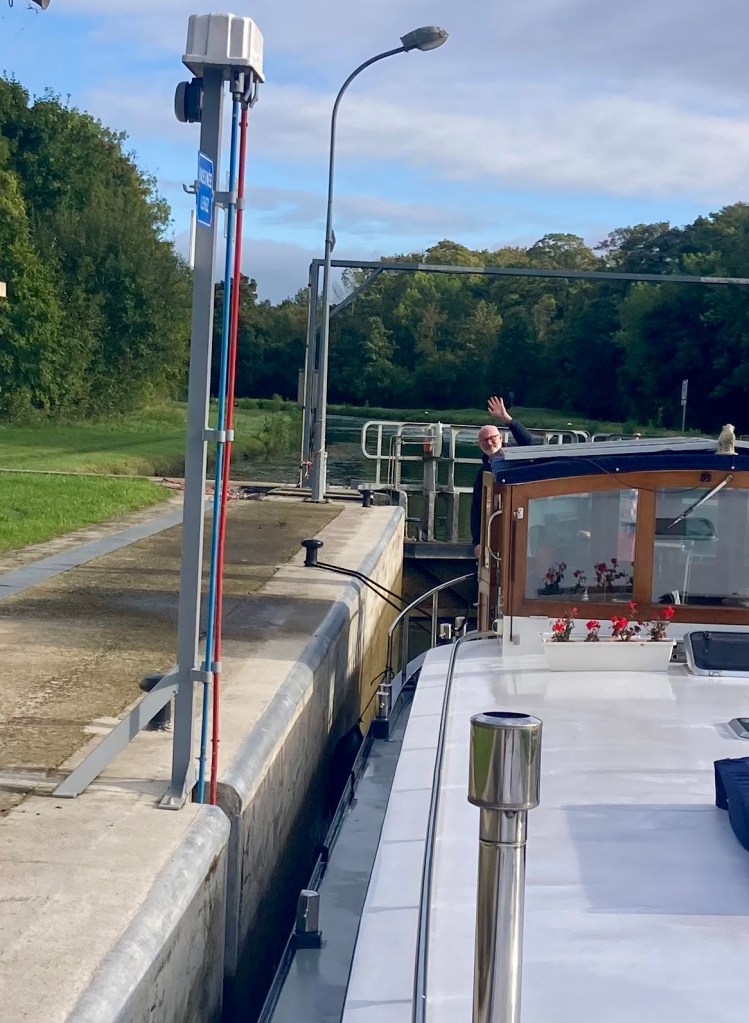
No such danger here.
An hour later we were hung up, or rather held up, in a different way. We had successfully come down through 4 locks since the tunnel and now as we came towards Lock 21, Fosse Rode, we saw then 2 red lights that signifies a ‘broken’ lock.

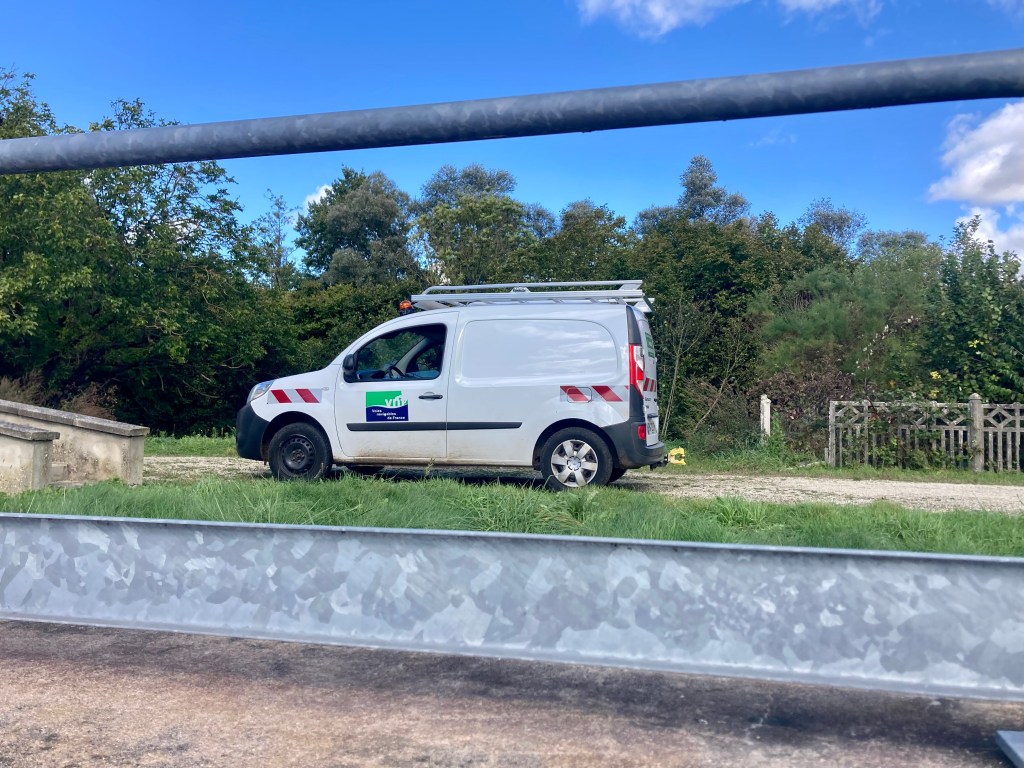
We found a bollard that we could tie up to in a makeshift manner and I phoned for help. In a matter of minutes the VNF van arrived and sorted the problem for us. We were on our way again, and almost at the end of this canal.
Three kilometres later we were at the lock at Condé-sur-Marne, where Calliope would join the Canal that runs lateral to the river Marne.

While we waited for the lock to fill for us I jumped off and took a photo of this new deer escape ramp.
Deer often fall or jump into the canal and then cannot find a way to get back onto the bank.
But they swim well, so escape steps or ramps are included along the canal to facilitate their exit. This was a very modern one – more smooth concrete.


One last point of interest on the L’Aisne à La Marne – the Billy tunnel that we had come through earlier has narrow gauge rail tracks along one side. These are left from the time when barges were towed along the tunnel by the little green traction engine now parked up at Condé lock. This continued up until 1970 when ventilation was installed ot the tunnel and barges were allowed to pass along under their own power,
Canal Lateral à La Marne
Normally we stop at Condé. It’s a good quiet mooring, with a handy boulangerie in the village. But this time we were focused on longer cruising days, especially while Ashley was with us.
So Calliope was turned to port towards Chalons-en-Champagne to start following the Marne right up to Langres, near its source. That meant after coming down through locks from the Billy Tunnel we would now be going upstream again.
It was just 16 kilometres to take us to our stop for the night at Chalons, just about our favourite French town or city to visit in the boat.
It’s 16 kms through the countryside, with no bends or curves until the outskirts of the city, and with just 3 locks. So three poles to turn, three sets of rope to throw and three levers to raise.

The first one went according to plan, with enough peaceful time in the lock to photograph some local fauna, still out and about on the first day of October.


On we went through the sunshine.
I know its just another photo of Calliope on another straight canal, but the colours were so vibrant that day.
Stewart and I were looking forward to showing Ashley why we like Chalons so much. We have stopped there 4 times before for periods varying from a night to 5 weeks.
At this rate there would be plenty of time for a walk round the centre in the afternoon sun, and later a beer in yet another Place de La République.

As it turned out we were not to arrive there quite as soon as expected. As the next lock, Juvigny, came into view we saw that there were no lights on outside the lock. We normally expect to see a red light, which is accompanied by a green light once we turn the pole. This lets us know the lock is preparing for us.
When there are no lights at all it usually means there is something wrong and that the VNF are working on it. We moored up and Ashley and I went to investigate. We found one boat in the lock waiting for the lock to fill and lift them to the next level, and another the other side of the lock waiting to come down.
We also found a VNF van next to the lock and a friendly lady éclusier in the office sorting everything out, so we returned to Calliope.

About half an hour later it was our turn.
We went into the lock under gradually greying skies, hoping that there would be a return to blue for our evening out later.
Ashley was given the helm for the remainder of the day, giving the Captain a bit of time to catch up on his crosswords.

Chalons-en-Champagne
By 1500 we were on the outskirts of the city with the impressive cathedral roof in our sight. Our conversations with Kati, the Capitaine at Chalons, had let us know that we were to moor outside her office, just above the final lock of the day.

It is a perfect position for us. Normally it is reserved for passing hotel barges, but none were due for a couple of days so we were able to use the space.
Previous years we have. moored further forward, just round the curve and under the chestnut trees – which at this time of year rain conkers down onto the boats.
With a metal roof this sounds like giant hailstones descending!
Now to explore – and to do a quick food and wine shop as well. I regret that this time I have not taken lots of photos of the wonderful old buildings, little waterways, churches, parks and streets of Chalons.
For those interested in seeing more of ‘our’ Chalons have a quick look at our stay there in 2018.
For this trip there is just a Place de la République beer photo of Calliope crew at rest.


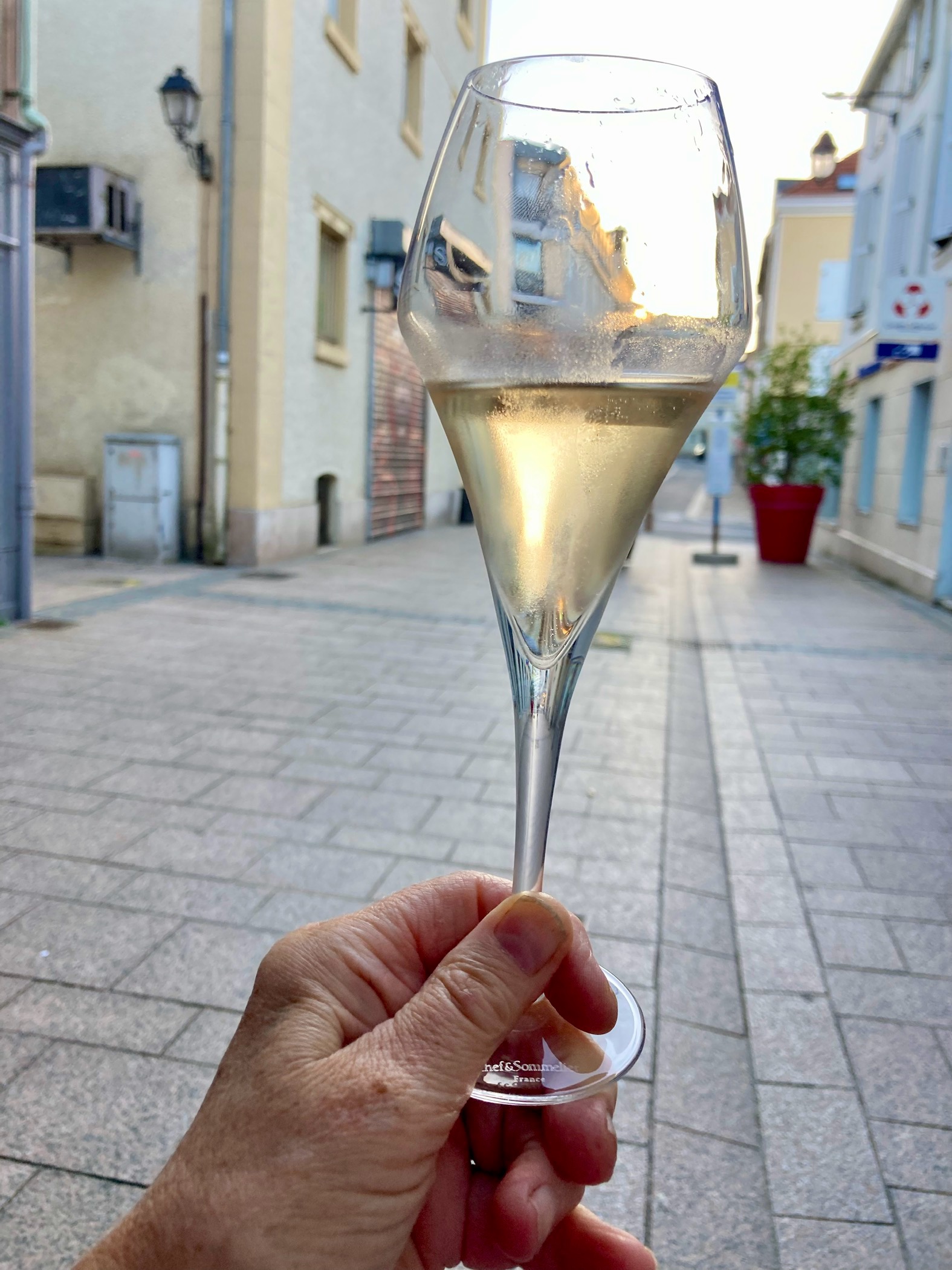
And as a homage to the name of the city and the region, here is a photo of crew and the port Captain, Kati, enjoying local wine!
Such a lovely place to stay but we had to be off again next day, making up for the time lost earlier. It was a rather grey and misty day as we left Chalons, down the next straight section of canal towards Vitry-en-Francois.
Not long after starting we could see through the mist and the binoculars a boat that seemed to be blocking the canal.
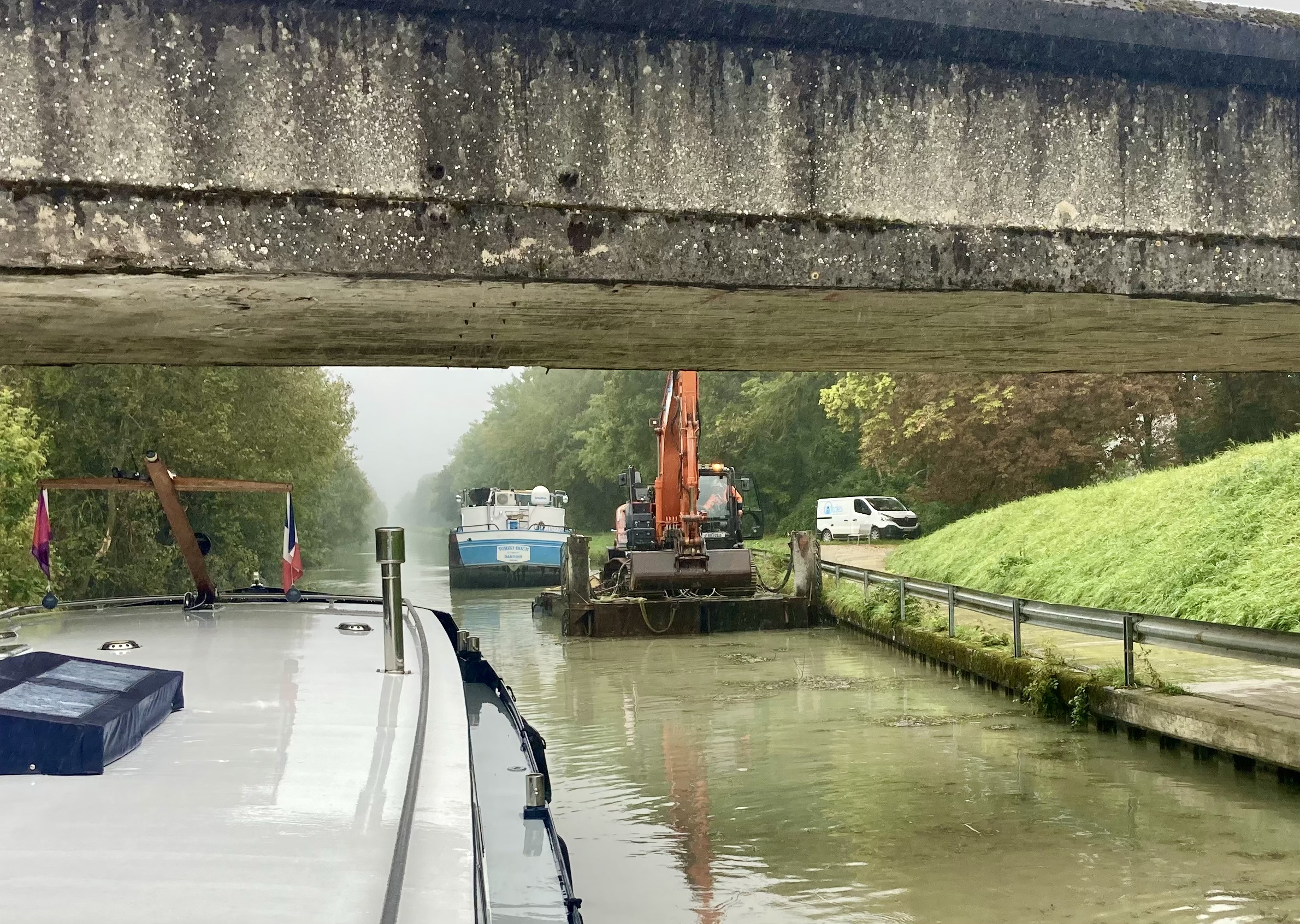
As we got closer we could see than it was two craft – one dredging at the edge of the canal and the-other being loaded up with the resulting sloppy mud. I remembered that I had read an Avis (notice) from then VNF informing all boats in the area about the dredging operation.
They soon noticed us and the big blue barge in the centre moved ahead to allow us to pass.
There was not a lot of room to spare!
But we passed by, with a friendly wave from the Captains of both the dredger and the barge.
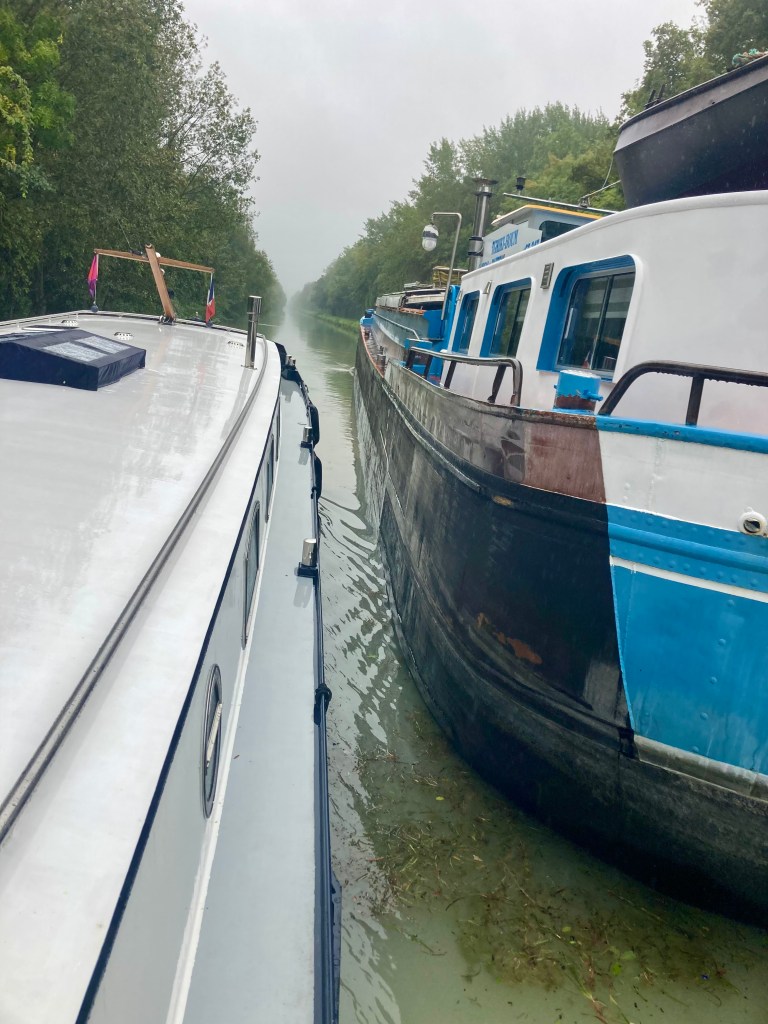
Calliope continued on her day’s journey, with the weather becoming progressively wet weather. On we went through Pogny and Ablancourt, by now all wearing wet weather gear!


Luckily we only encountered a few showers and they did not impeded progress, out even dampen spirits. We had lunch as we travelled, including trying out one of the desserts we had bought on Chalons-en-Champoagne.

This one was an alarmingly pink confection, but bore the Champenois label, os had got be tried.
To be honest it was not very special. It was sugary, almondy, and overall a bit sweet for me.

Soulanges
The original plan was to reach what we call the old quarry quay for the night, just outside Vitry. However by the time we were close to Soulange the Captain was feeling easy for a beak, and wd rather like Soulanges..
We knew we could probably moor near the lock on a wonderfully isolated quay.

All we had to do, once tied up, was to sit back and enjoy our supper, watching the constantly changing colourful skies, often a feature at the Soulanges mooring.

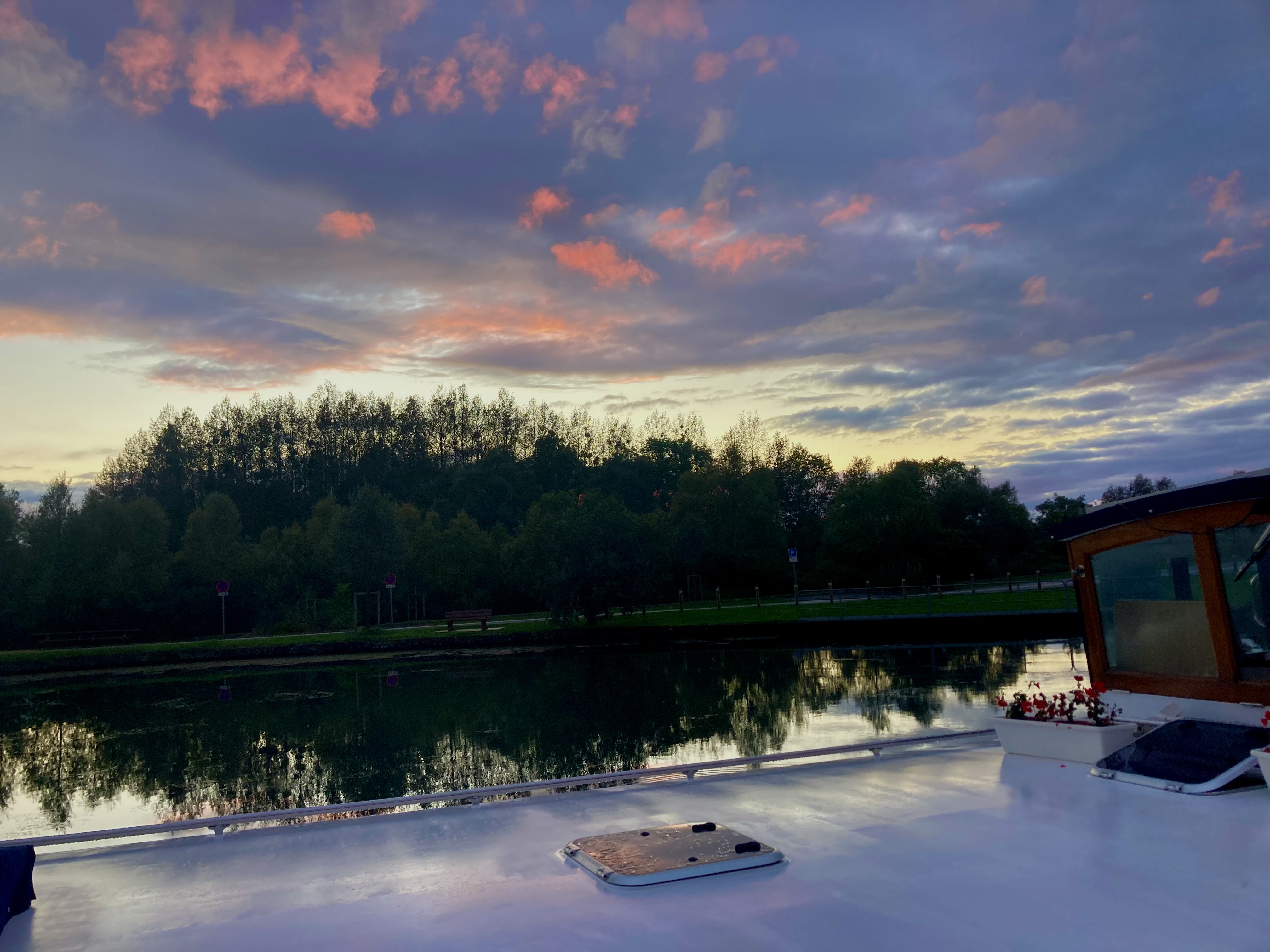
The team were prepared to get going quite early next day, but a commercial barge came through the lock as we were getting up and it seemed polite to let it carry on a bit. We therefore left our mooring half an hour later.
Four kilometres on and we reached Couvrot écluse – and saw the previous barge still in the lock.
Closer binocular inspection revealed that she was taking on water – normal procedure for a working barge – so, with our tank running a little low the skipper decided to follow suit when it was our turn to enter the lock. That would give the slow commercial boat a 15 minute start on us.
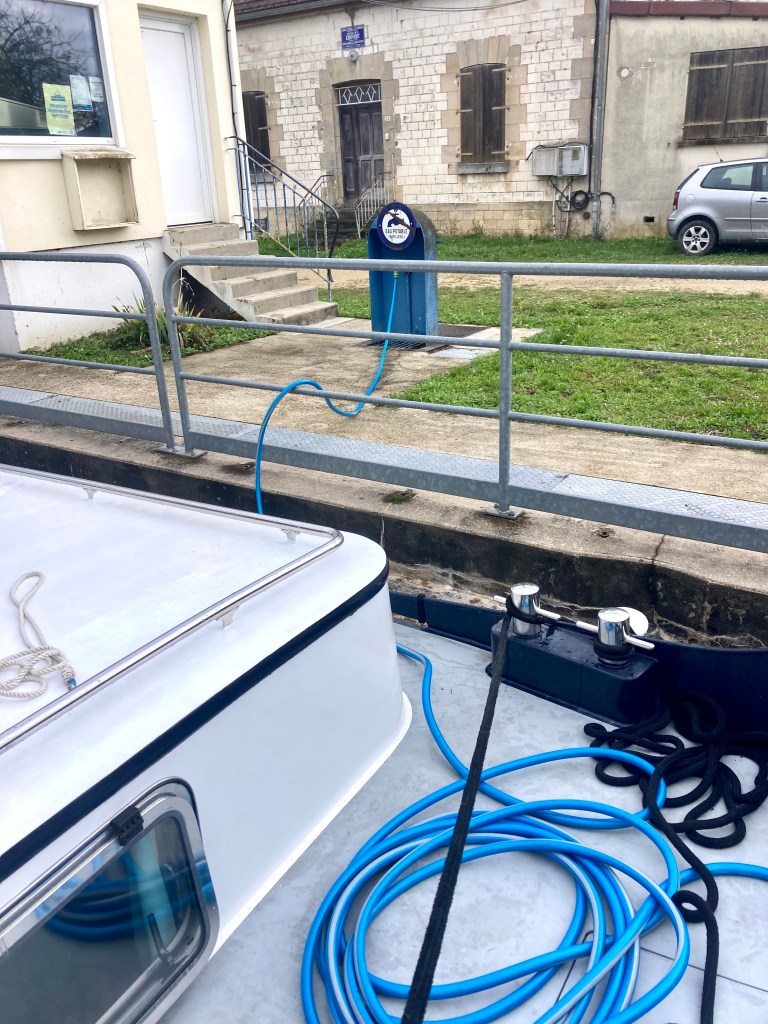
Within a kilometre of Couvrot is a dividing of the canal with a lock in each fork, although only one of them is still in use.

This is the point where there is a drop down to the Marne river, used exclusively in earlier canal times to move trade in and out of Vitry-le-Francois. The river became too shallow for modern vessels and a wide by-pass canal was built. This is what we would follow.
I hope the division is clear in the photo – the lock on the left where Calliope would continue, and the footbridge over a lock to the right, towards the river.
In the middle is the original lock keeper’s house. He (probably was a man) must have had a busy life with locks either side of him to open and close all day!

Through the lock and round the end we came past the previously mentioned ‘old quarry quay’. It is one of our favourite moorings, tucked away from houses, roads etc and sometimes with a kaleidoscope of butterflies.
Certainly there has been a lot of industry here in the past, but whether it was to transport stone from a nearby quarry or not we don’t know.
For this year it had just to be a sail-by and a photo.
Another bend in the canal took us into the last écluse (lock) of this canal.
The lock gates open I’m mediately onto a ‘pont canal’, a water bridge taking the canal over something.
In this case we were going over the river Saulx, one of many rivers that flow into the Marne.
The 115kms long and winding Saulx comes in from the SouthEast, originating up near Joinville which is on our next canal.

Not far to go now on the Canal lateral à La Marne. We completed the last two kilometres down to the outskirts of Vitry and the junction with the Canal de la Marne au Rhin.
Calliope turned to starboard for just one kilometre off the Marne au Rhin, and we were off onto the next stage of the Hivernage journey on the Canal Entre Champagne et Bourgogne – a whole new blog post!

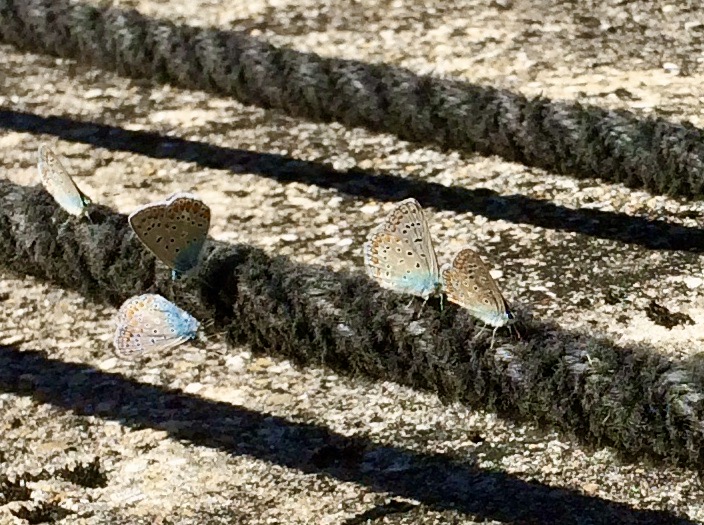
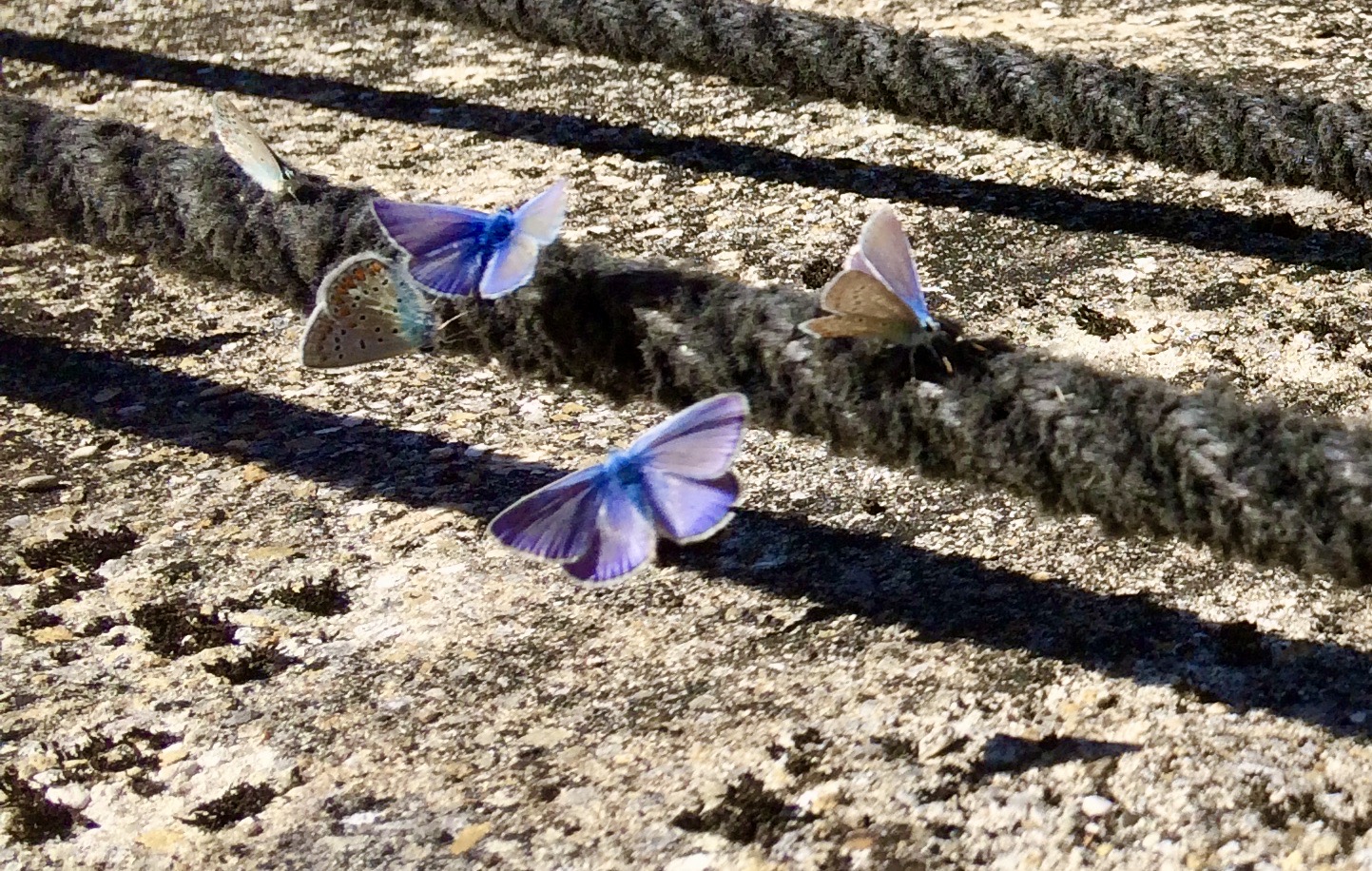
And to sign off, photos at the old quarry quay mooring from a previous year showing a kaleidoscope of butterflies on our ropes.
À bientôt – see you at the next post!
The Wait
25th August to 29th September 2024
Canal L’Aisne à La Marne
Berry-au-Bac
We arrived at Berry-au-Bac on Sunday 25th August after quite a long day’s pleasant cruise from the other side of the Canal L’Oise à L’Aisne summit. We were now on the Canal Lateral à L’Aisne, moored up just below the écluse (lock) that takes you up into the big Berry-au-Bac basin.
We planned to go through this lock the next day, turn hard to starboard, and go through another écluse that would start us on the Canal L’Aisne à La Marne.
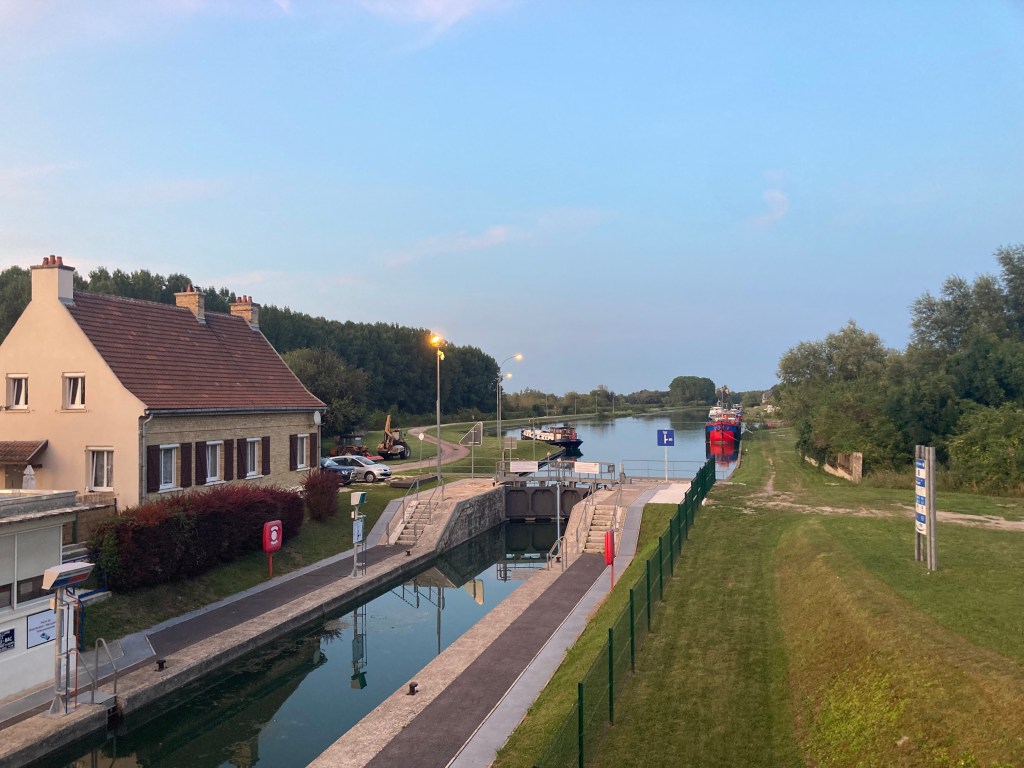
Part one of the plan went to plan. But as we were in the écluse the éclusier asked us where we were going. When we told him we were turning south towards Reims we got a bit of a surprise – the canal beyond Reims was shut – for 5 weeks!
Step one was to moor up just beyond the lock – you can see us on the left.
Step two – a re-think was required. Somehow, amongst all the emails that I received daily from the VNF (French Waterways Authority), the information about this canal closure had not reached me a month earlier.
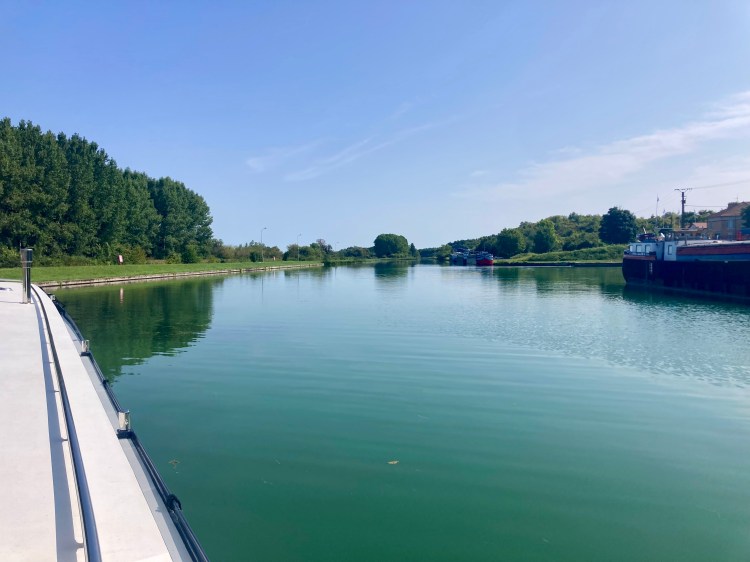
It seemed rather a nice place to be ‘holed up’ for a few weeks, and there was no obvious quicker route south.
So we decided to stay here for a while.
Although an unexpected stop it was ok for us as we are retired and have the time to spare. If we had needed to get back to UK sooner a different scheme would have been hatched – probably a different port for Calliope’s winter berth.
Now to decide what to do for the next few weeks. Maybe we could start to do some of the regular maintenance work on the boat that we do at the end of each season, starting with re-varnishing the wheelhouse and mast.
I went on line and found what we needed. The éclusier gave me the address of the lock house and a tin was ordered.
Then there was a chance to get ahead with the engine servicing. The internet helped out with that too; I found a company called Demolin based close by. Soon we had booked a visit from a mechanical engineer used to working on boats with diesel engines.
Within a few hours a Demolin van arrived and our new friend Damien stepped out.
He spent some time very thoroughly checking over the engine whilst sustained by coffee, biscuits and water at regular intervals.

We like Calliope to be as tip-top as possible and took the chance while we were marooned to have the injector pump fully serviced by Bosch (the makers), and while we were at it we ordered new injectors too. Thank you Damien – see you again soon when the pump is ready.
We now properly entered a period of waiting. We needed to get to know our new surroundings, neighbours, shops etc.
Berry-au-Bac is a big T-junction on the canal network, with the Canal Lateral à L’Aisne crossing East to West and the L’Aisne à La Marne leading off to the South. The large basin at the junction is testimony to the area’s importance in commercial barging history, with many more barges moored here in the past.

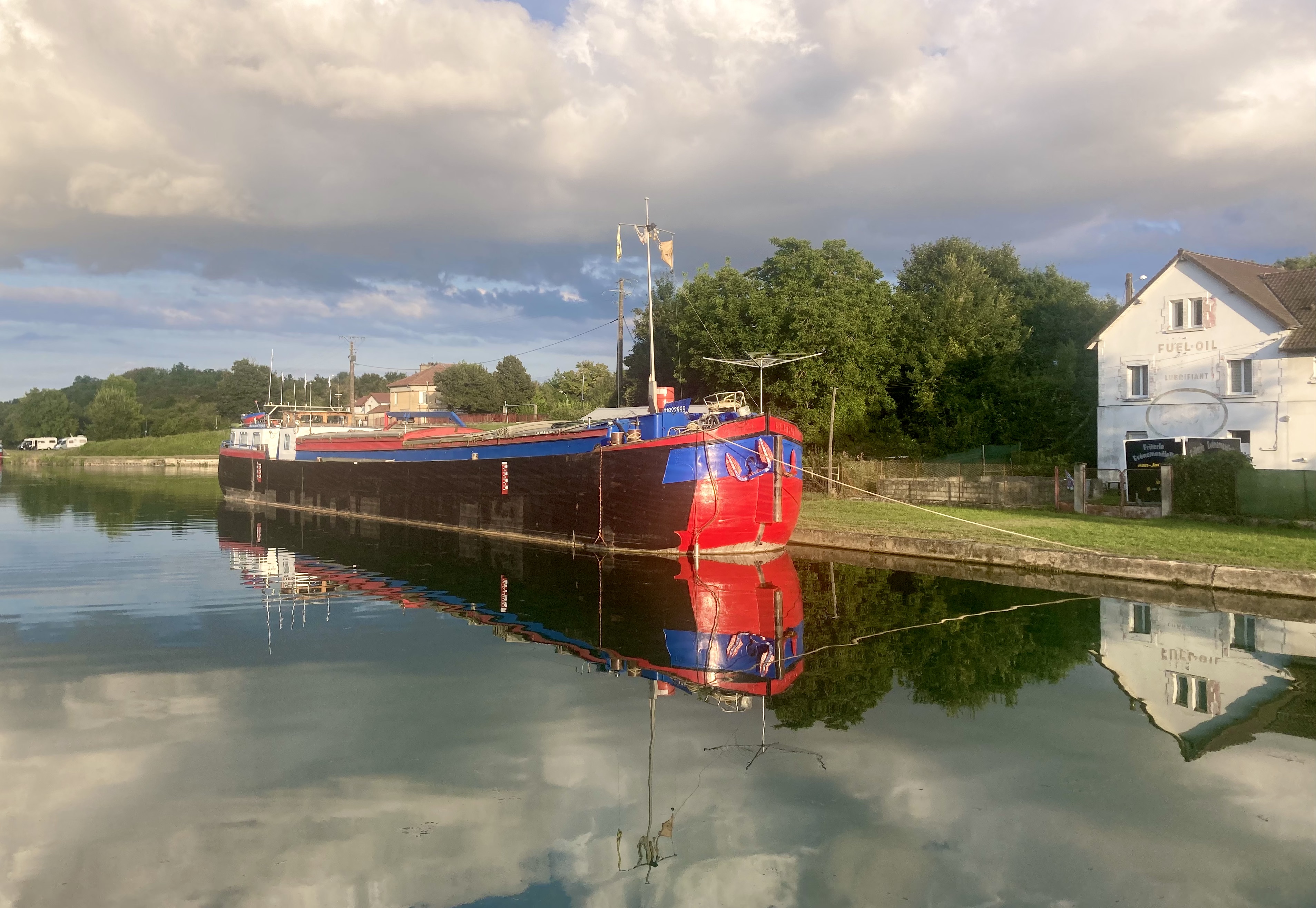
Because of the canal closure there was not as much traffic as usual going through. The two commercial barges shown above were moored up like us, and also using their time to spruce up their boats with new paint etc. We loved keeping company with them, although Calliope looked tiny next to them!
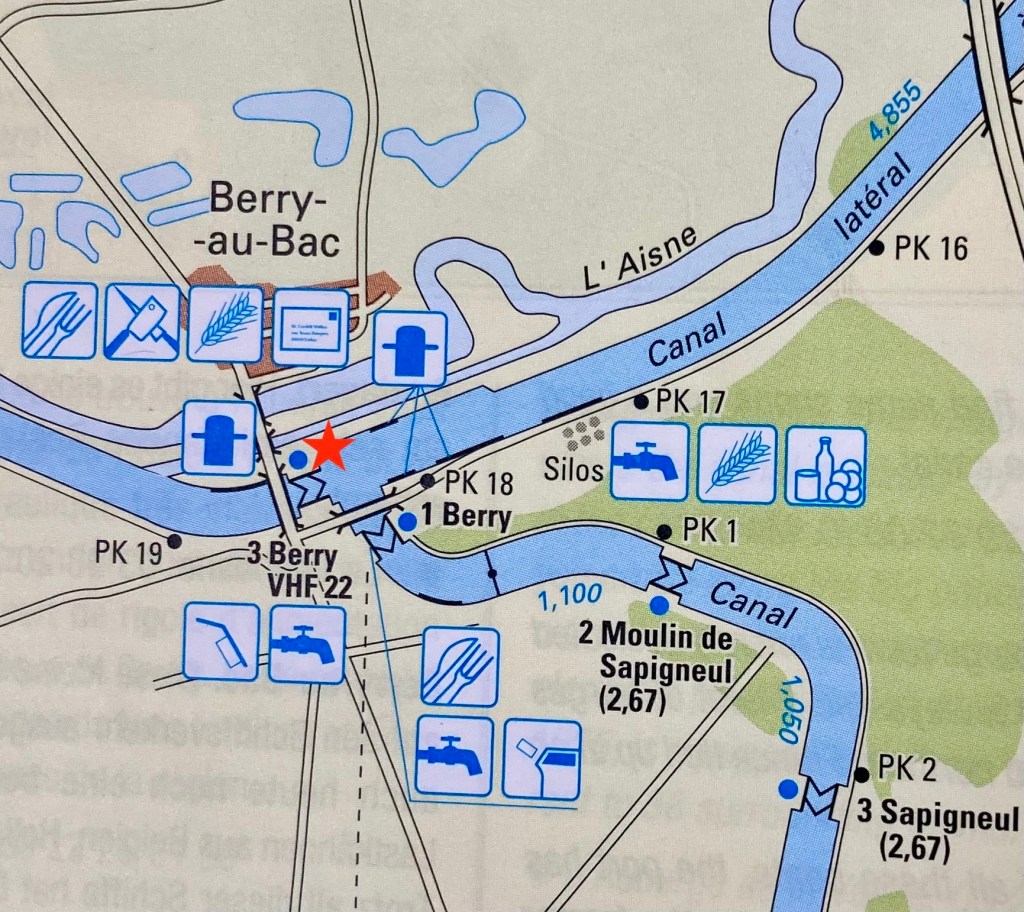
In keeping with tradition we began to walk around the area, leaving our (red-starred) mooring and first of all walking eastwards-ish.
The Aisne, split into two, runs along parallel to the canal by the basin before looping away, so there is plenty to see.
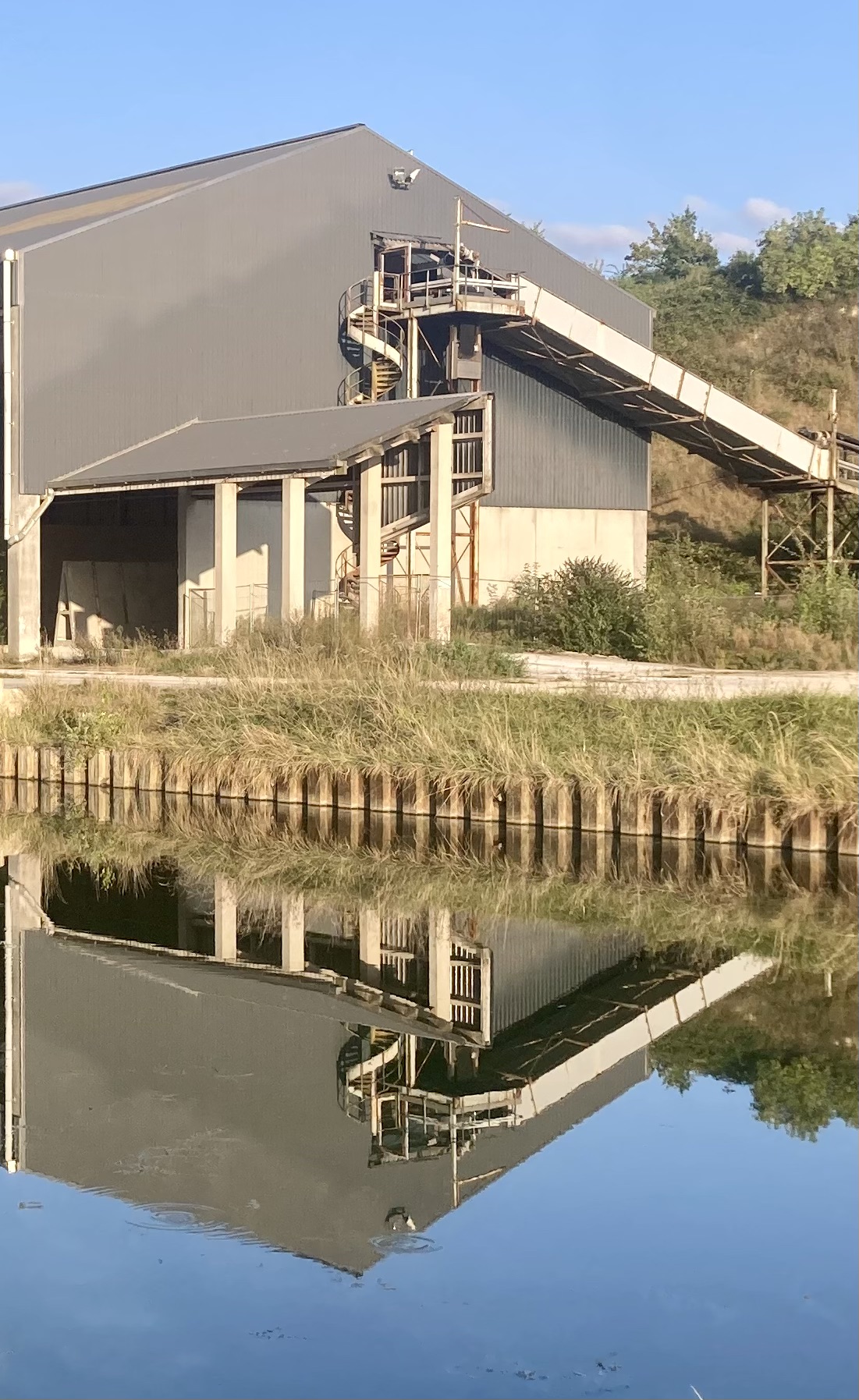

The area shows signs of its industrial past. On the southern bank just beyond the basin is a big quayside warehouse and silos, still with its weigh-bridge, some rail tracks and other buildings.
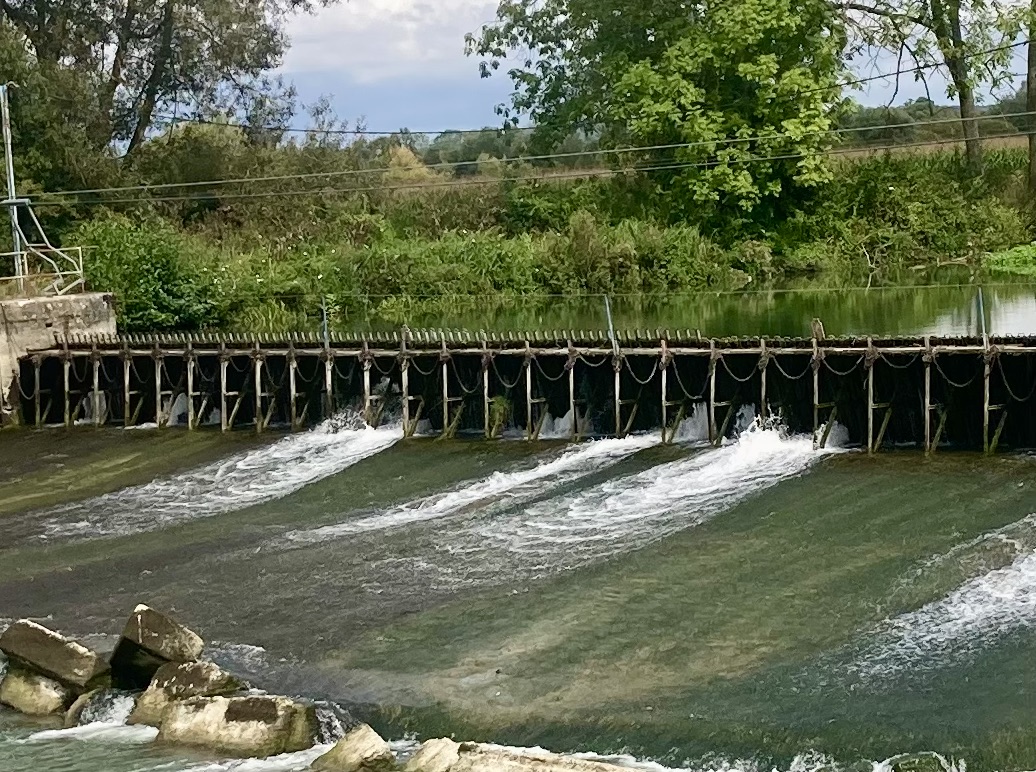
Turning north-ish we went through to where the Aisne splits and found a weir across the main channel. Much of the weir is still of the old ‘aiguille’ or needle type. The wooden ‘needles’ are leaned against a solid frame and are not intended to be water-tight. Individual needles can be added or removed by hand to constrict the flow of the river – a dangerous job in bad weather.
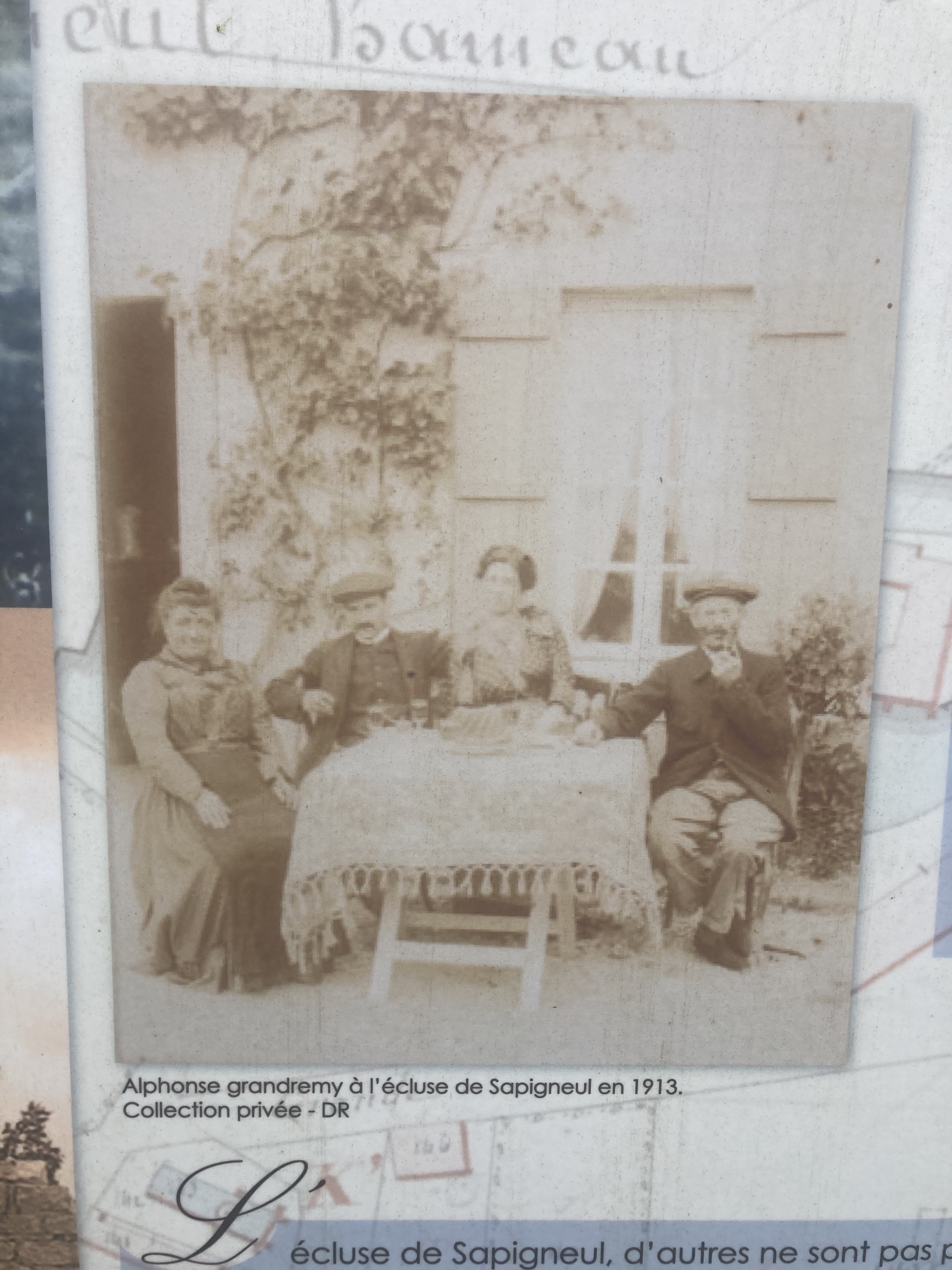
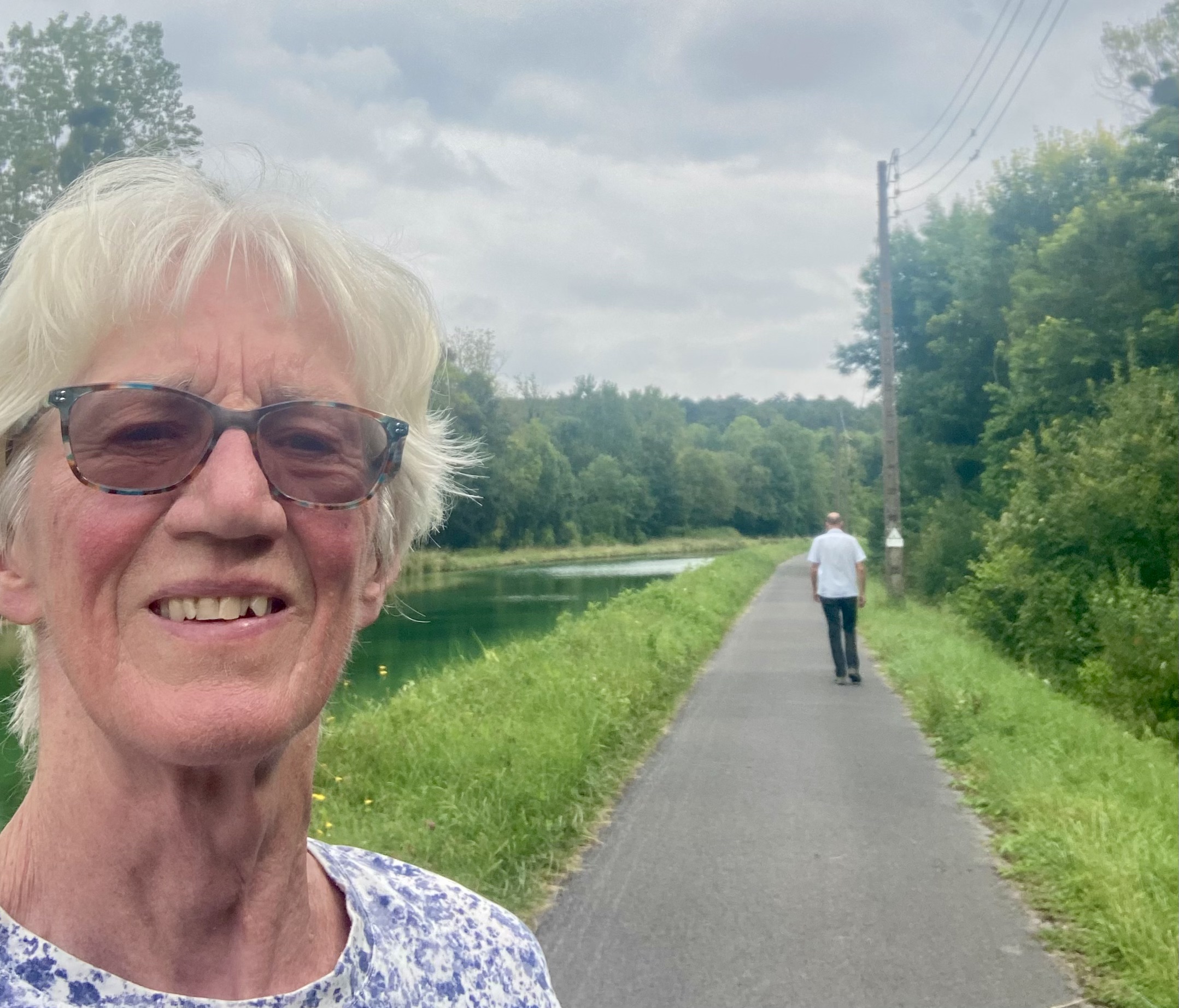
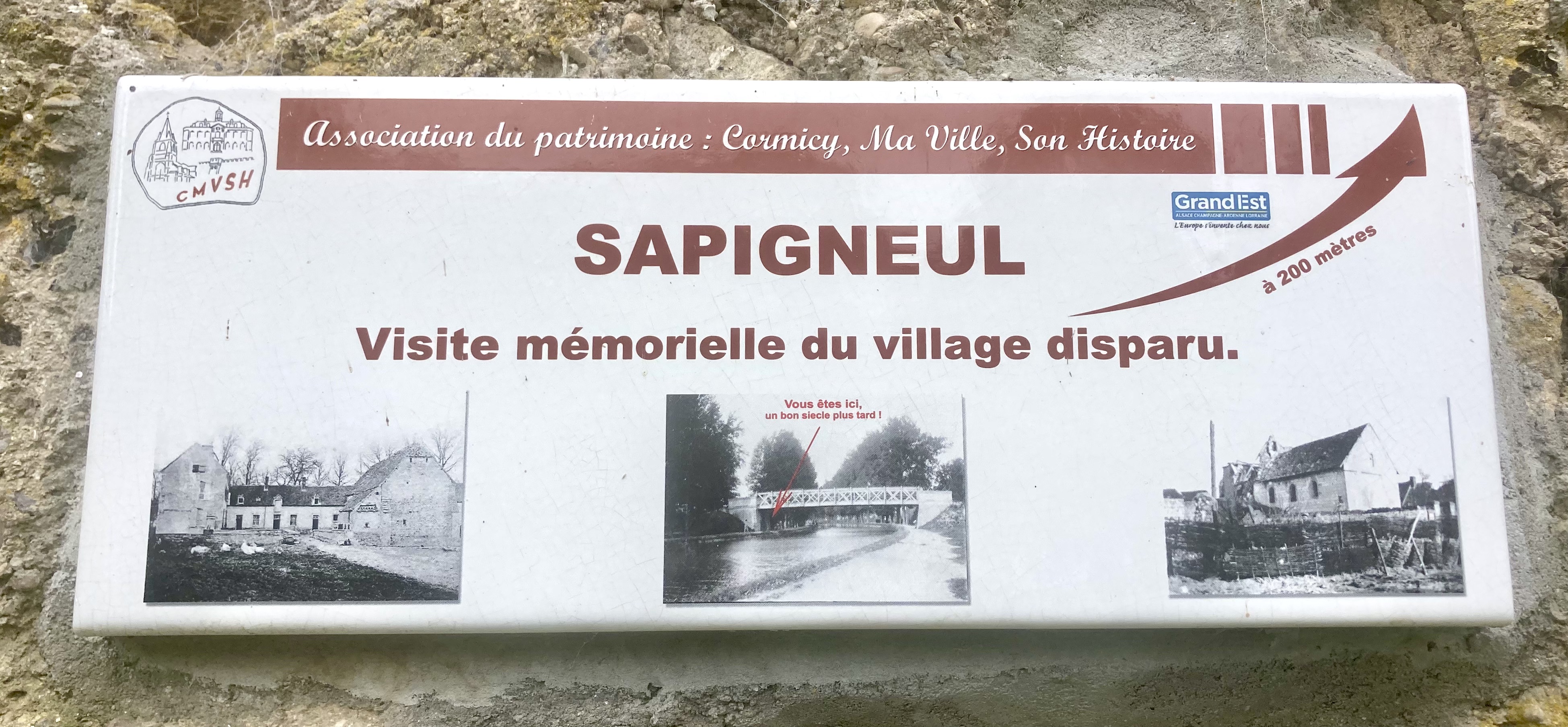


A few days later we went in a southerly direction down the Canal L’Aisne à La Marne to ‘see’ the remains of Sapigneul, a village that was obliterated during WW1. The 90 inhabitants moved to a nearby village and never returned because, initially, the are was still heavily mined.
There are various memorials and information boards, sad and interesting to see and read. One of the boards was about Alphonse Grandremy who had been the éclusier at one of the Sapigneuil locks. There is a photo full of charm and history showing him sitting outside his lock house with his family.
The evenings were as enjoyable as our days in Berry-au-Bac.
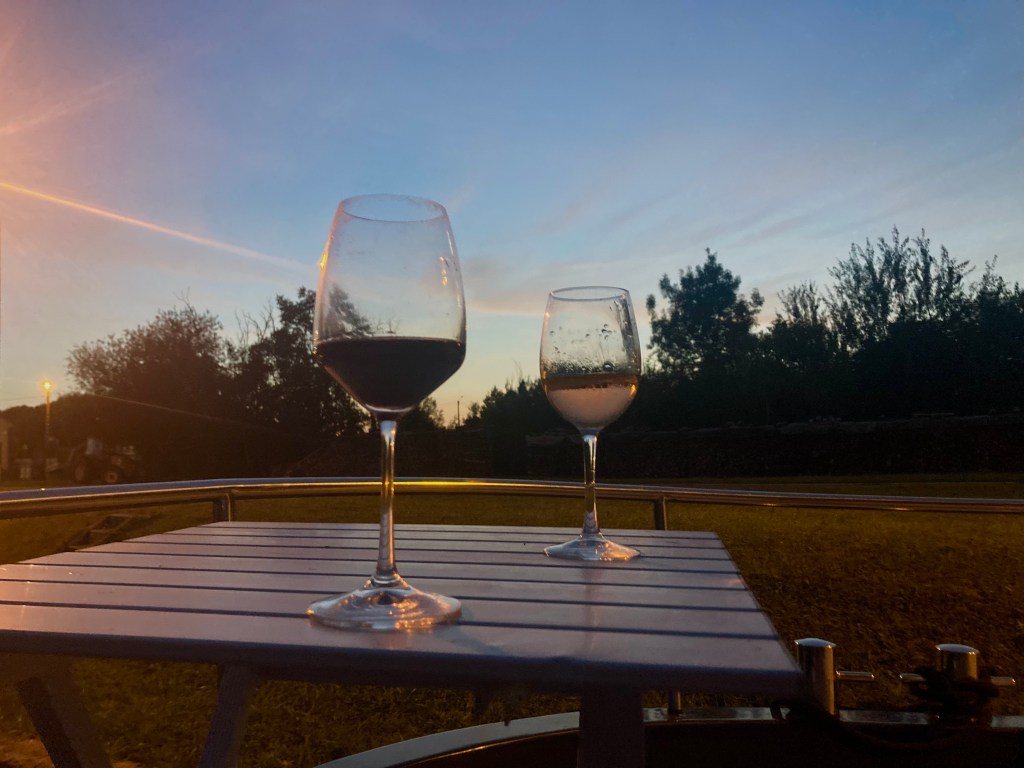
Sunlit hours on the back deck, under the parasol when necessary, drinking Aude rosé and rouge bought, bizarrely, from the boulangerie at €4 a bottle – and quite nice to drink.
The boulangerie is the only shop in the village and its bread, quiches and wine were quite important to our sojourn there.
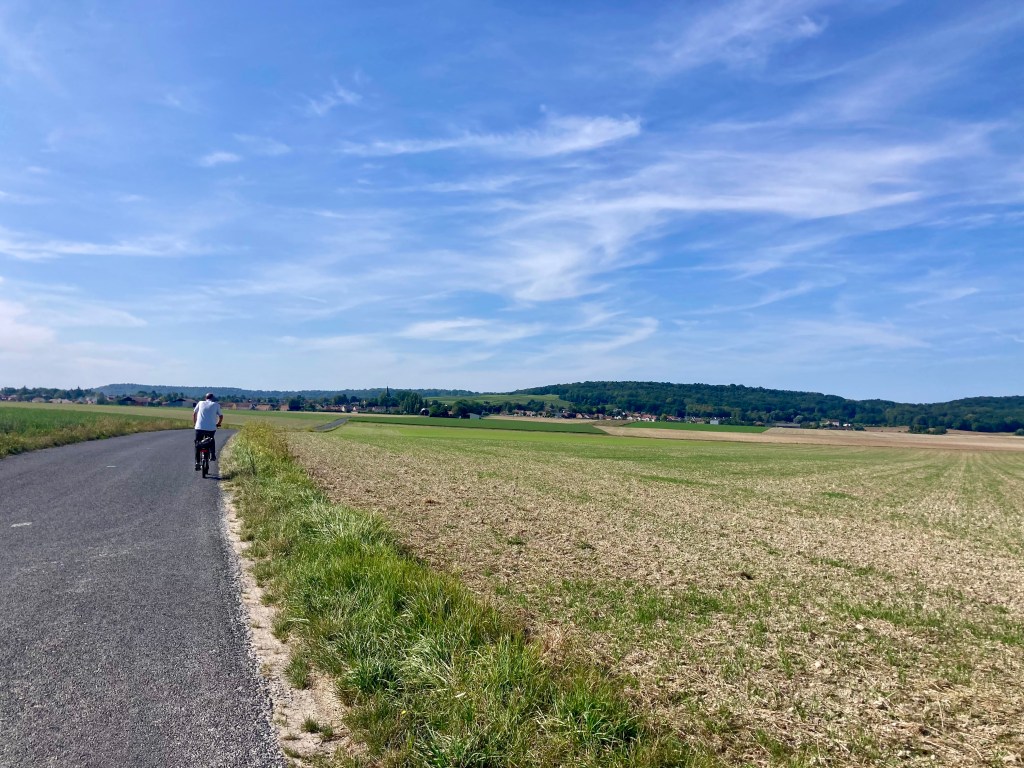
Of course we needed more than boulangerie faire. Looking on Google Maps our closest supermarket was in Cormicy, 4 kms away through the fields.
Out came the trusty bikes and this became a familiar route over the next three weeks.
Cormicy has been a champagne village, like much of the region, for decades, probably centuries; each time we cycled there we passed a big old grape press that served as a reminder.

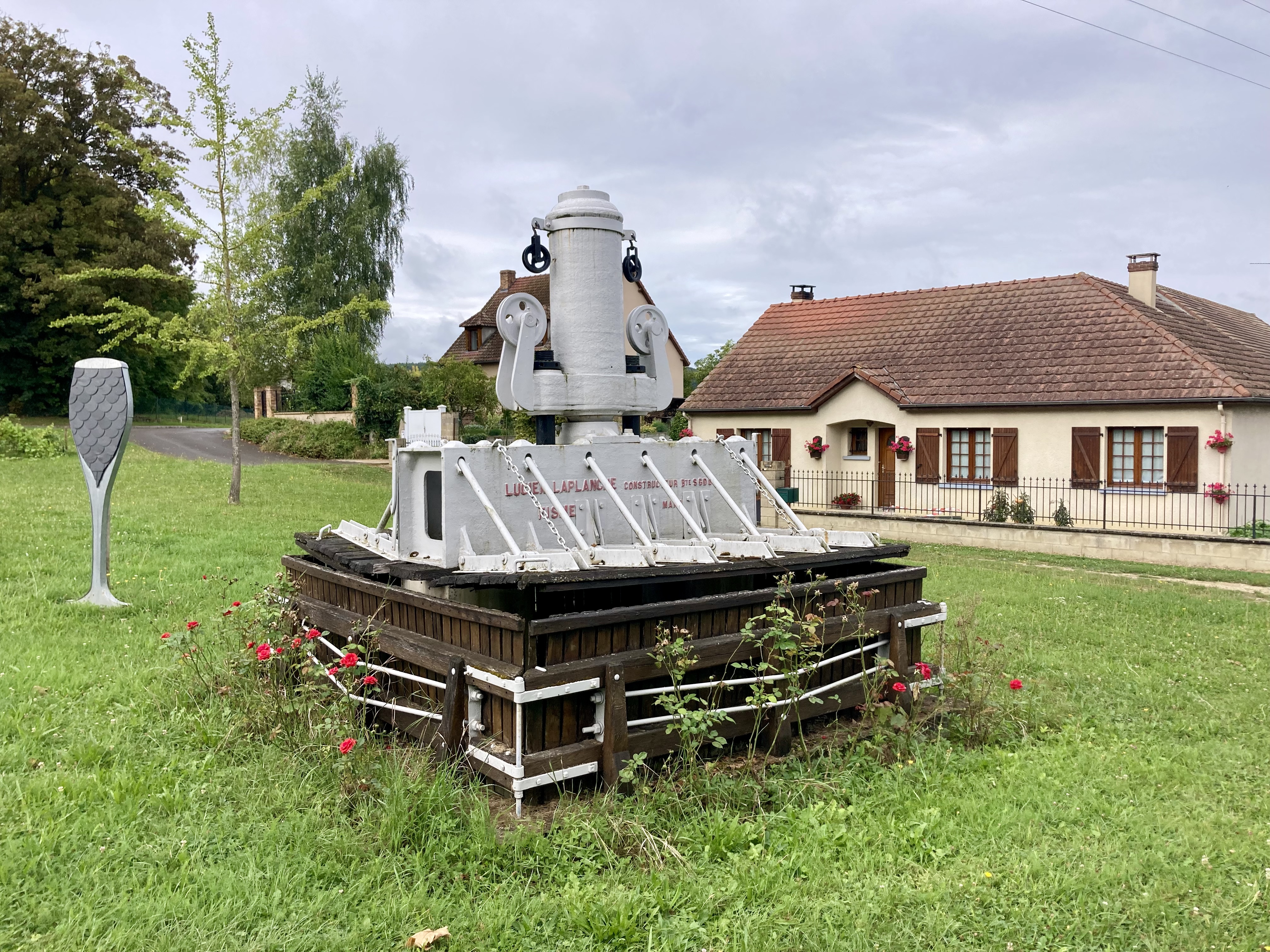
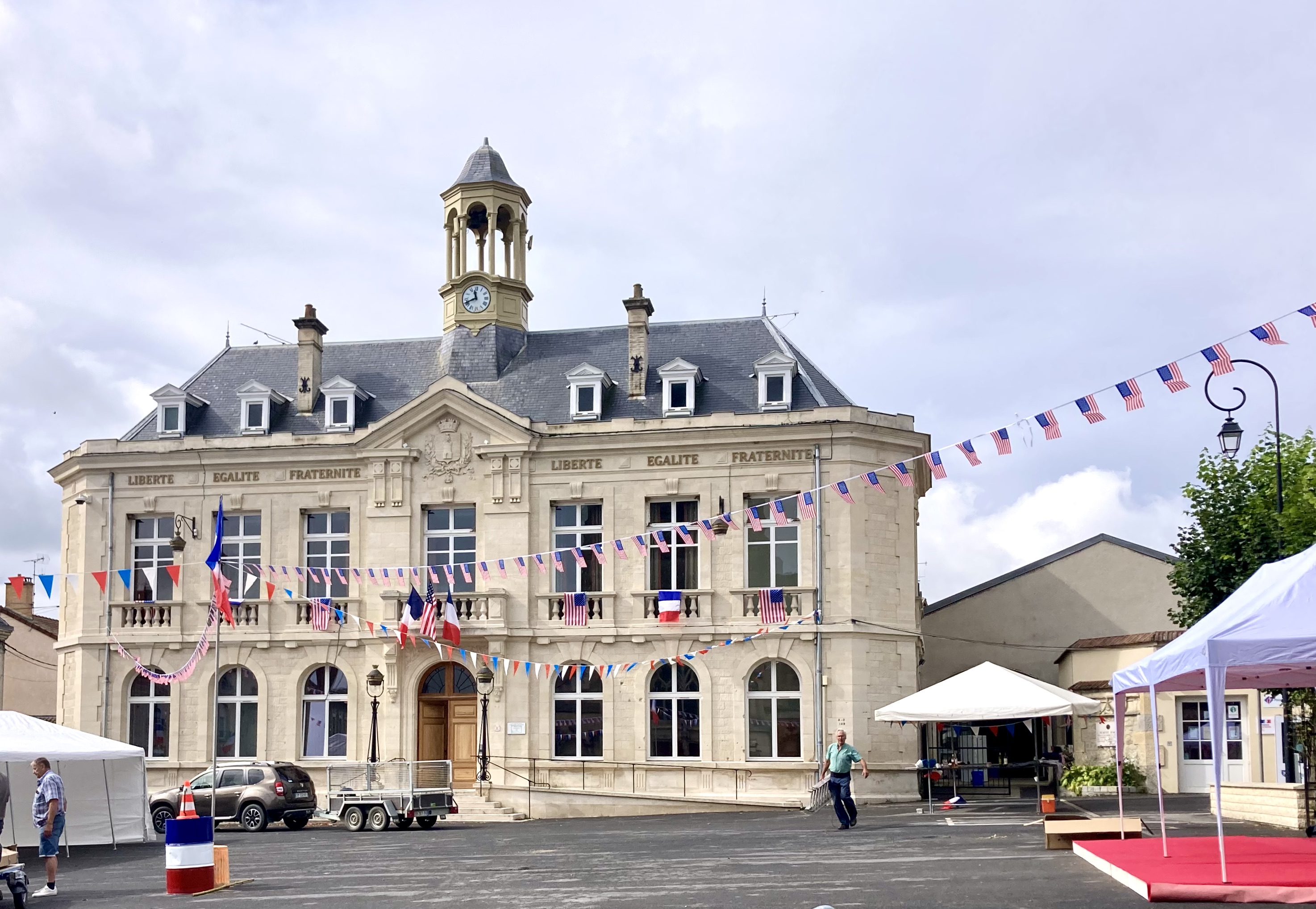
One time as we passed through we went up into the main square to have a look round. The old Postes, or post office, is now an Italian restaurant, cannily called Il Postino!
The flags were up around the square and preparations were evidently being made for an event. It turned out to be the 80th anniversary of the village being liberated by the Americans. A party with 1940s swing band music, vintage US army vehicles, and a champagne bar were all on the programme, amongst other things.
But Stu and I didn’t have the energy to cycle back that evening, in the rain, to join in.

Apart from that evening the weather was mainly hot and sunny.
The wheelhouse temperature was over 30C on several days – very pleasant.
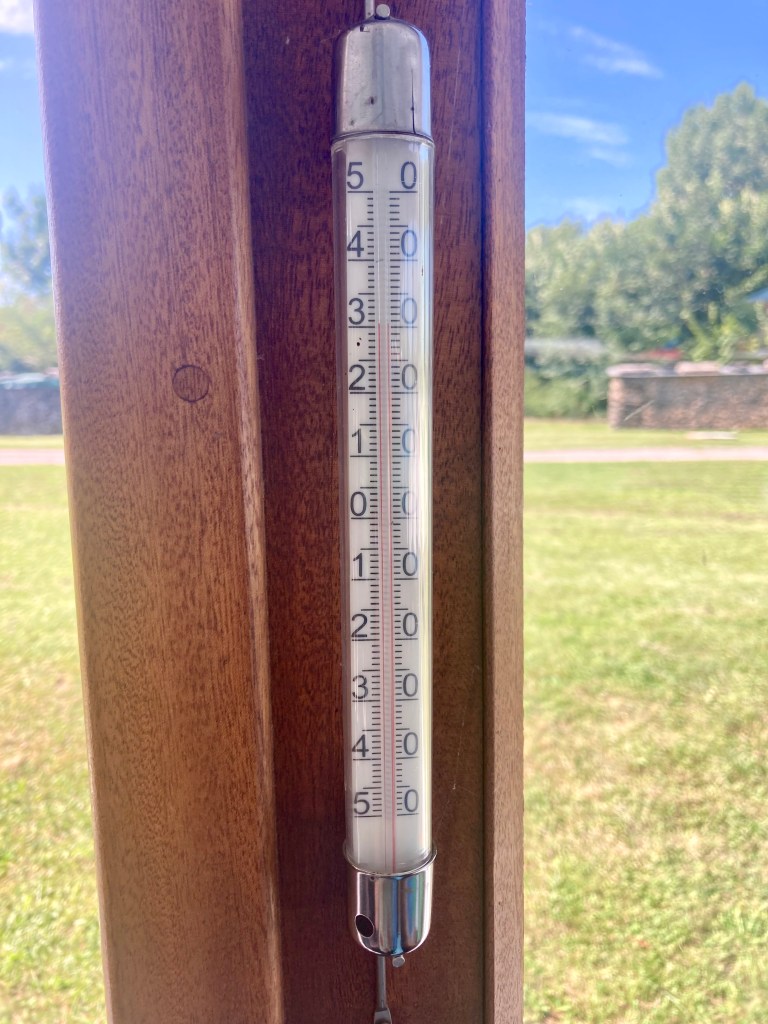
We were still awaiting the arrival of the ordered varnish, but Stu was able to get going with the preparation.
In the end DPD took so long to deliver the new varnish that Stu used some varnish we already had on board; Calliope was looking smart.


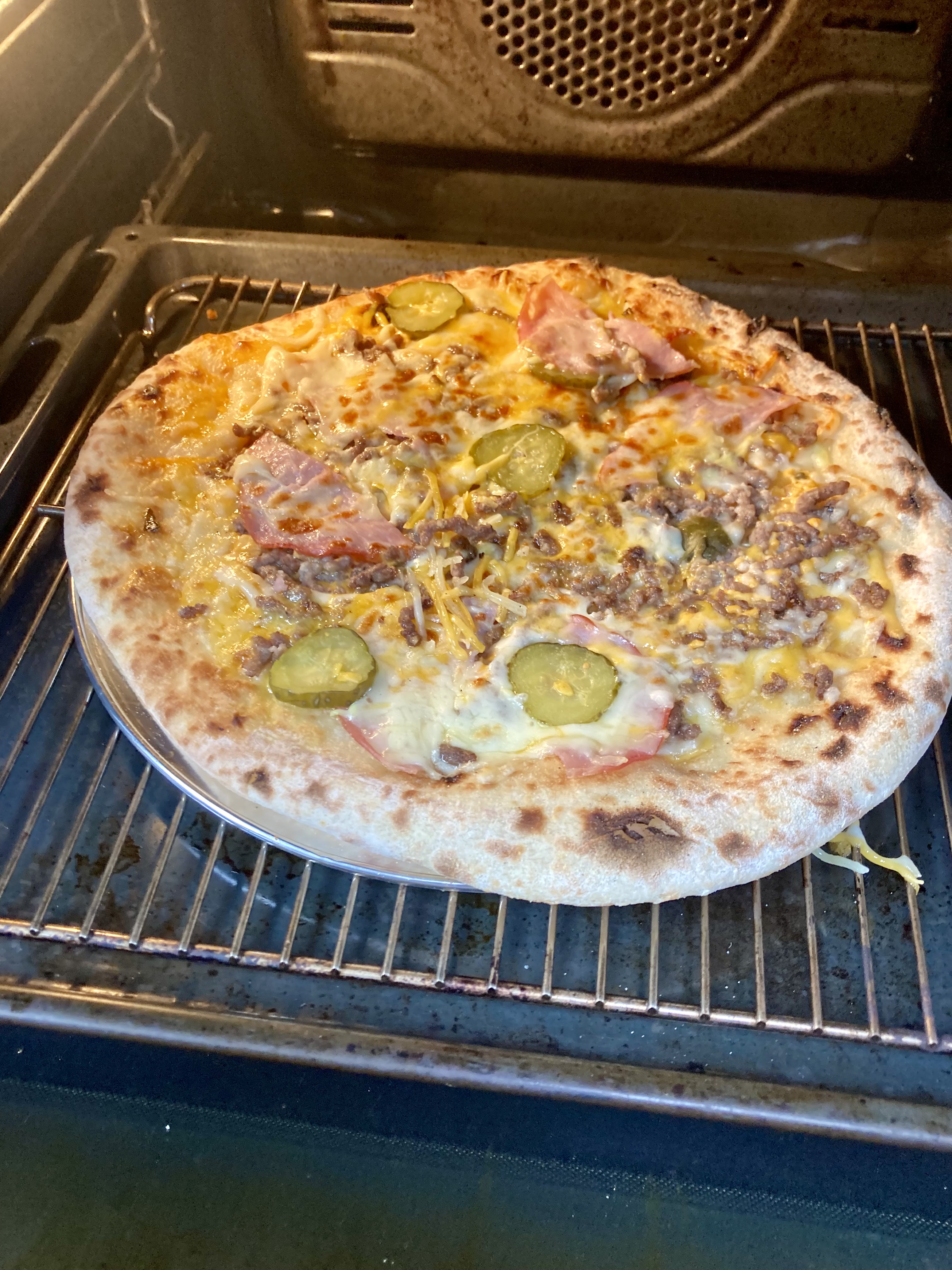

Being in Berry-au-Bac for so long led us to explore the (limited) local food and drink. There was one restaurant that looked good, but somehow we never made it there.
Instead we tried out the Just Queen pizza kiosk we had been cycling past. It was amazingly good! I felt very modern, ordering from the app on my phone and cycling over to collect hot crisp freshly cooked tasty pizza!
We also went to the local bar a couple of times. The locals weren’t quite sure what we were there, but made us welcome. It is also the local PMU or ‘bookies’, with entry forms ready on every table.
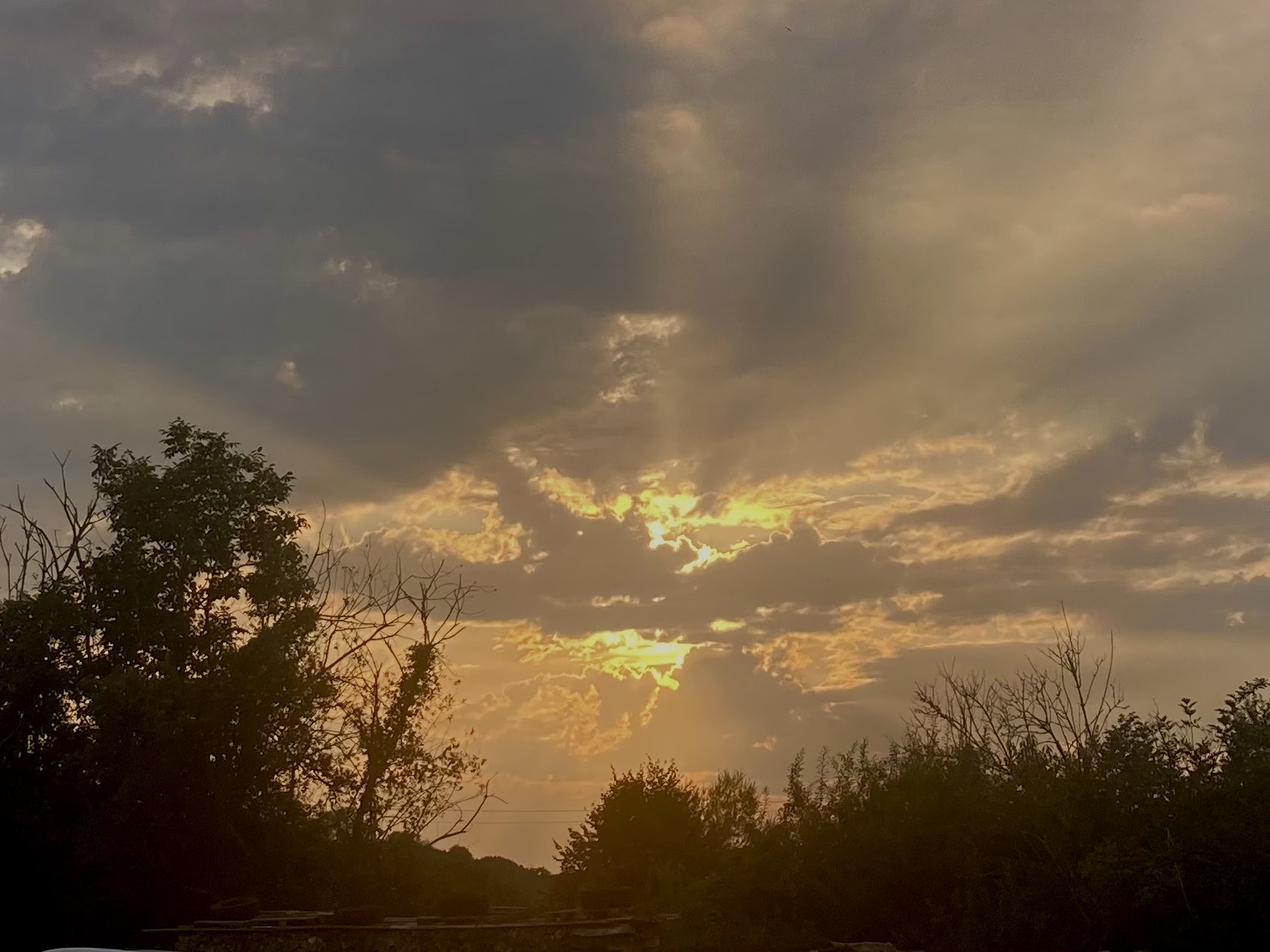


The sun was still rising early and setting late even though it was August. We saw so many beautiful skies that I felt I should include a few. It was so lovely waking up to these view.
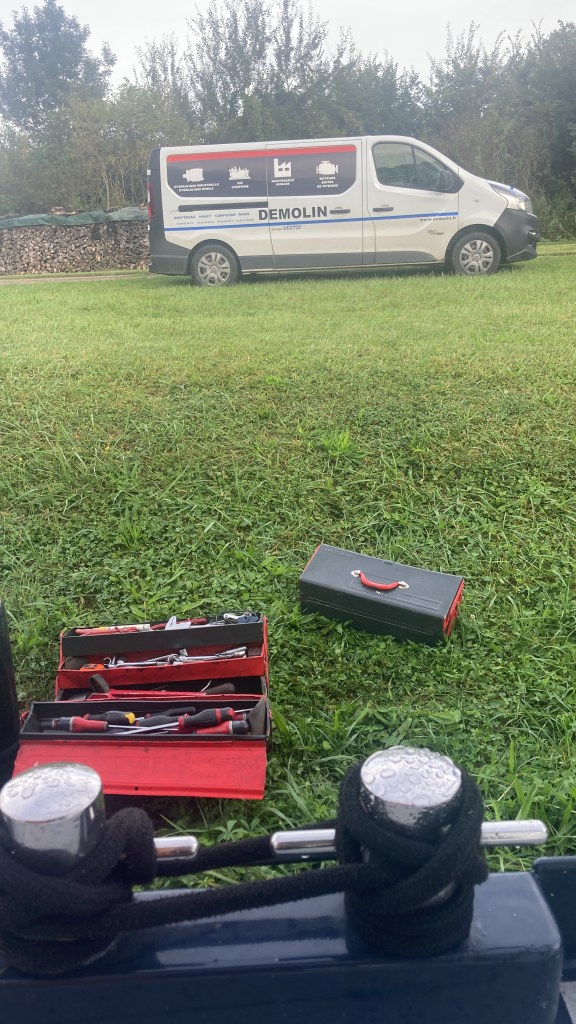
Then the things we were waiting for began to `arrive, starting with Damien and our injector pump.
He soon had all fixed back together, and after running the engine a few times, tweaking the settings, and explaining what he was doing we had our usual sweetly purring engine.
Now we could start to think about where to spend the rest of our time while we waited for the canal to re-open.
Also we could now top our water tank from the tap in the lock.
Stewart reversed into the lock with great skill . (We went in backwards because we needed to be facing the right way t when we came back out, ready to carry on with our journey).

Once we had the hose tucked in we could look, from a different angle, towards our berth of the past two and a half weeks, just around the corner on the left.
It takes a while to fill up 1000L. We had checked with the éclusier that he was not expecting any boats to come along, and knew we were not going to be in anyone’s way.
A day or so later, having agreed with DPD that I would go into their depot in Reims to collect the package, (their drivers were having difficulty locating us), my phone rang.
It was a man from DPD, driving his own car, and bringing us the varnish! We were delighted to have it at last. To be honest it was only about 4 days late.
Earlier in the season we had had great success having packaged delivered to Amazon lockers. A courier delivery was obviously a bit more difficult when you are on the water!


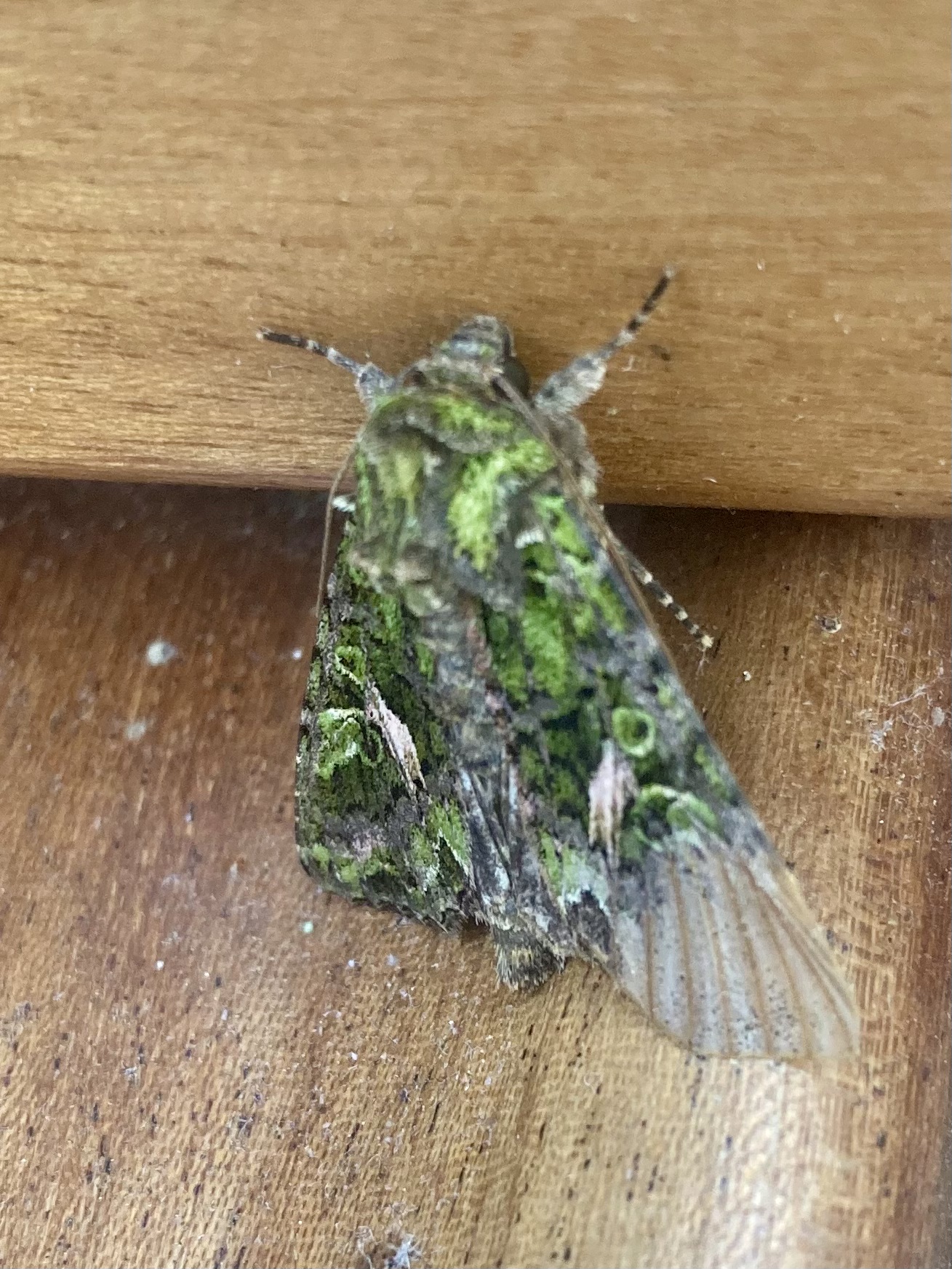
Before we leave Berry-au-Bac a few other minor happenings. We had some visitors – green ones! The grasshopper was a large one, sitting happily on the path and going nowhere until his photo was taken.
The moth was just brilliant colours. I have not managed to identify it – any help appreciated.
They both visited while we still had good weather. Finally the weather changed. It was needed – it had been hot and dry almost continuously for weeks, apart from the day of Cormicy’s celebrations a week before.

The clouds were a wondrous swirling black, and it wasn’t; long until the rain began to fall – that welcome big splots of summer rain.
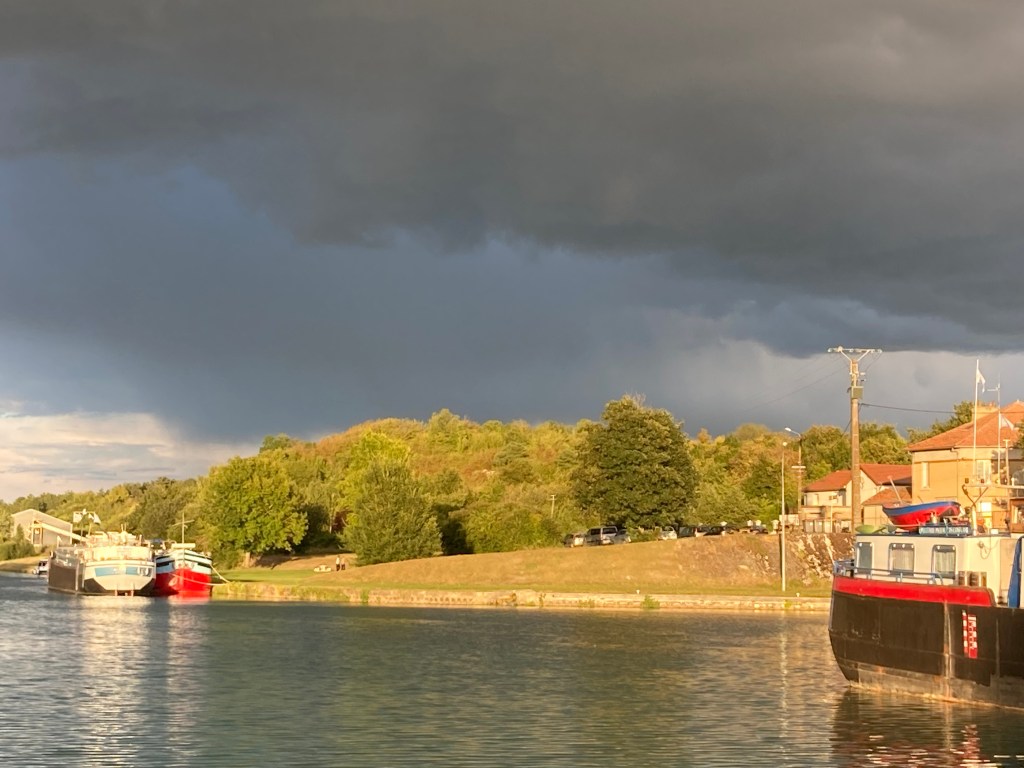
As the sun emerged behind us a lovely light shown across onto the trees on the hill opposite – Cote 108.
Cote 108 is another of the WW1 sites in the area. Much of the Battle of the Aidsne and of the Chemin des Dames was fought in this area.
Behind the trees is the reason for the infamy of Cote 108.
Much of the area had been tunnelled to reach under enemy lines and then blown up.
Here at Cote 108 there was a huge explosion, leaving this vast crater, now overgrown and out of bounds.

That sad note does not reflect our overall time in Berry-au-Bac. We needed to get on with our journey and although the canal was still closed about 20kms ahead we thought it would be nice to get a bit closer to Reims.

So finally we left our mooring behind, and took that turn to starboard that we had planned about three weeks prior.
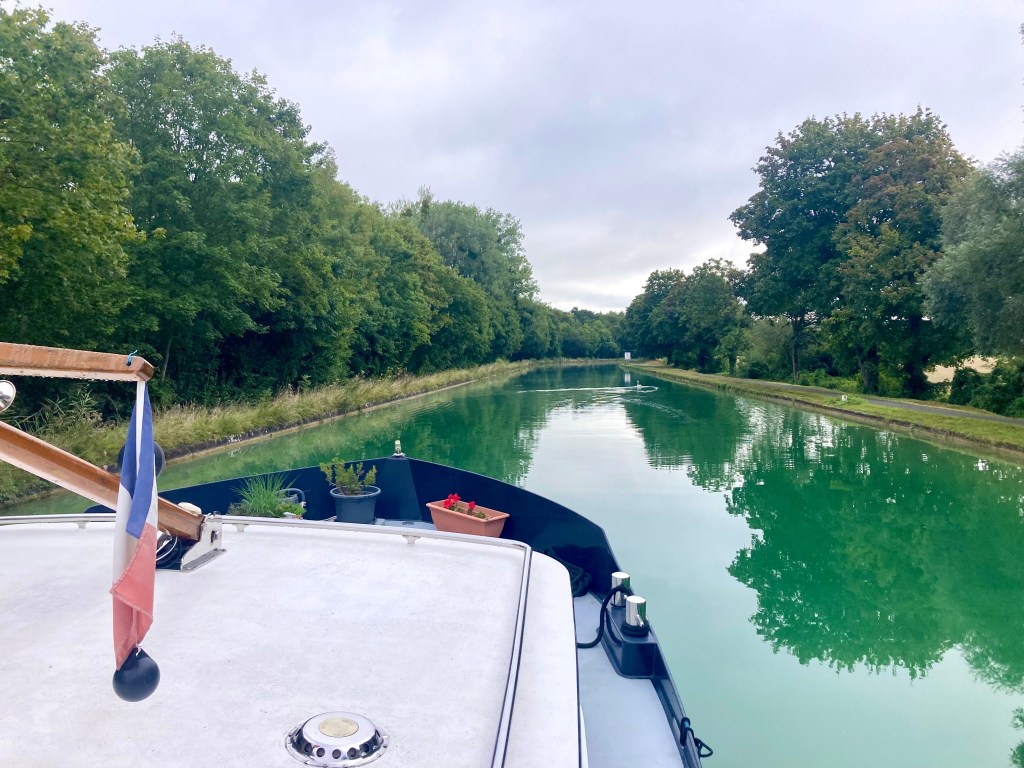
We set off slowly as we knew we could not go far – just 9 kilometres and 5 locks to Loivre.
It was lovely to be on the move again along almost emerald waters.
We passed Sapigneuil again, looking for the old lock house we had read about.
It was a gentle couple of hours. We were going upward in the locks once more, and discovering the idiosyncrasies of the locks on this canal.
On the Canal L’Oise à L’Aisne we had found the blue control levers at each end of the lock – right at each end. They were obviously designed with the 38m Freycinet working barge in mind. For them the levers would be perfectly positioned by their wheelhouse, whether going up or down.
Here they were at one end only, and out of reach for our 19.8m boat! So crew quickly secured to a bollard, then clambered up the ladder to activate the lock before a quick descent to the boat and manage the bow rope.
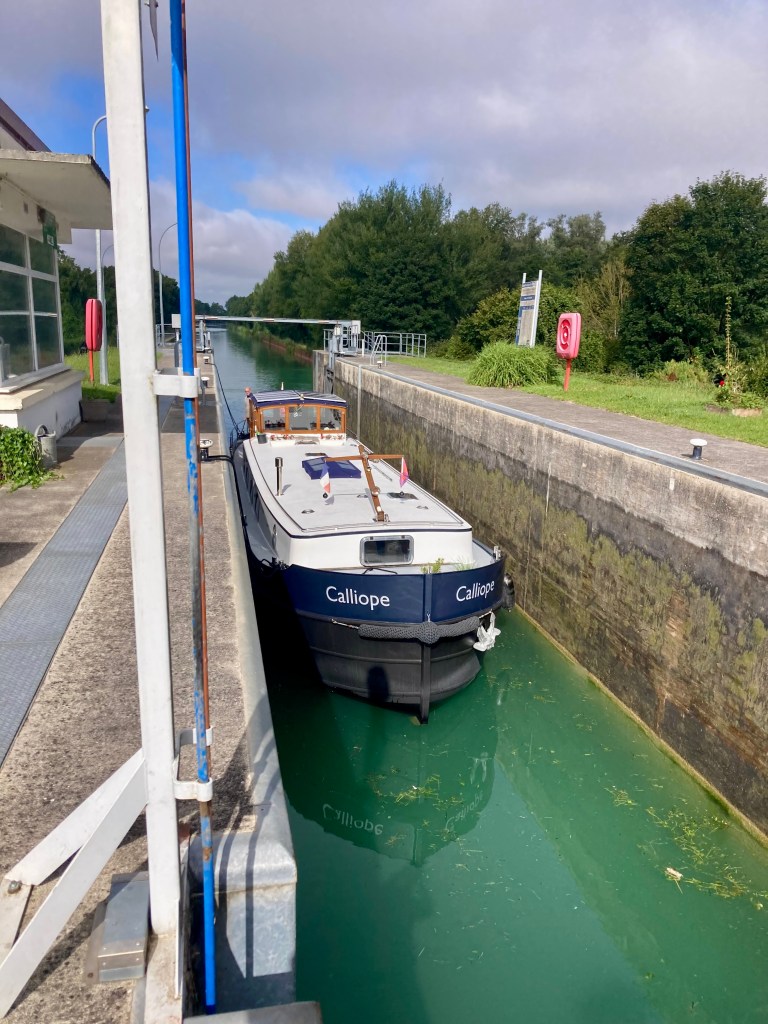
It’s all safe if you take care on the ladder, checking each rung for slipperiness – and something that I really enjoy doing.

Most of the trip is so peaceful and quiet; maybe a tractor in a field or a bird singing. But now and then the noise of a road intrudes. In this case the canal passes under the main A26 highway from Calais to Troyes and known as the ‘Autoroute des Anglais’.
Looking back at the bridge it is about 3 hours by car to the left to our boating destination St Jean de Lone and 3 hours to the right to Calais. We’ll be heading that way in a few weeks time, but for now are very much enjoying life in the slow lane …

Our 9 kilometre day was soon over and we had moored up ay Loivre. Although we had spotted this mooring before we had never stopped there and had been wondering what we would find.
The first thing we found was two perfectly placed bollards – perfect for Calliope anyway! Excellent – and just time to get to the boulangerie for our lunch. The boulangerie in Loivre is very good, not only making bread, cakes and quiches as you would expect, but also occasional takeaway meals such as paella, lasagne, salmon croque (like a croque monsieur, but full of fresh salmon and on delicious brown bread.
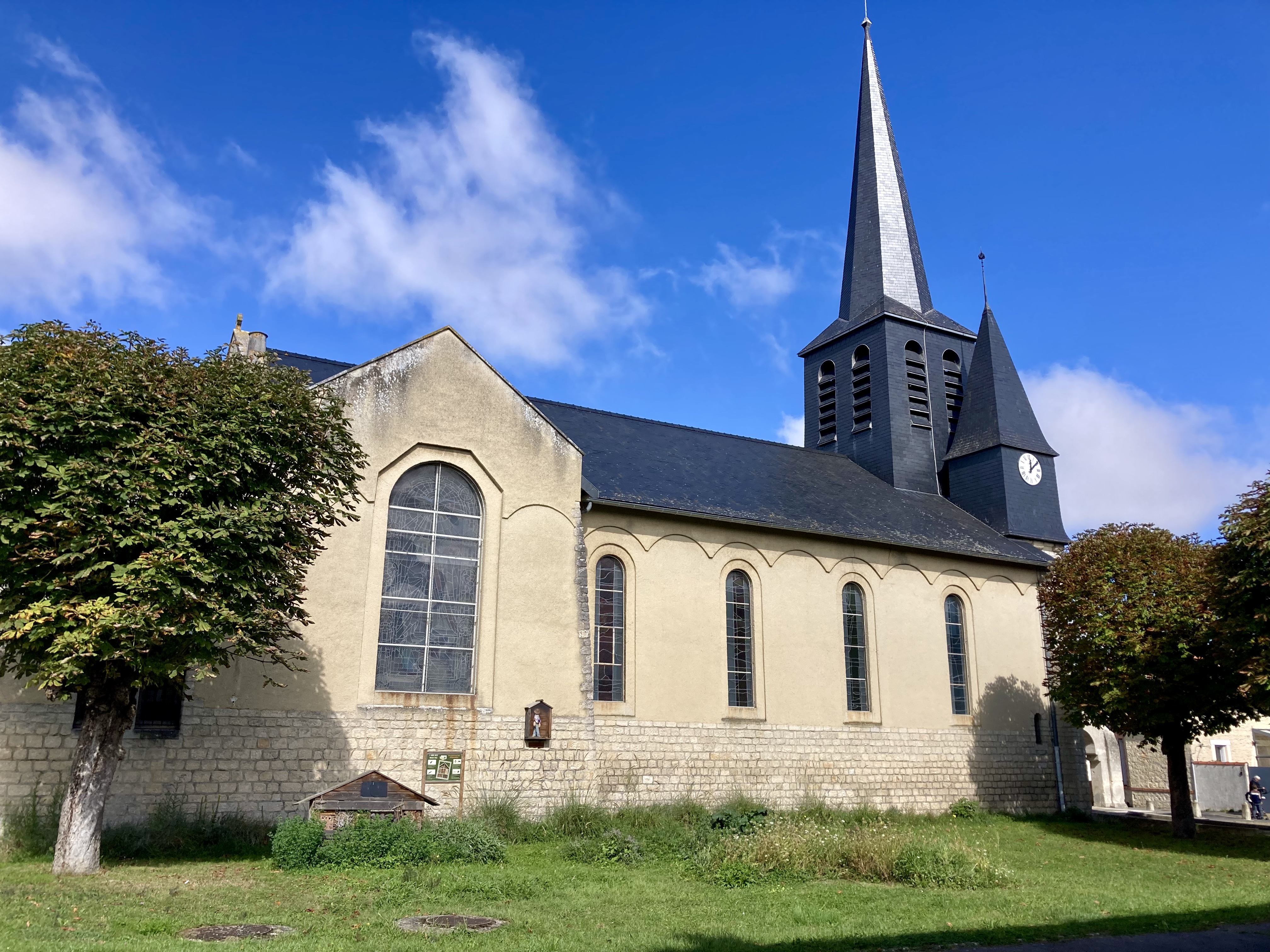

Loivre is a small village with character. The church , despite looking old, was rebuilt in the earl;y 20th century. I think the Mairie (town hall) is a similar age and houses the local post office and, on the left, the elementary school, as well as the offices for the local administration. It was all very welcoming and friendly.
Captain Stu is seen here striding past the Mairie on his way to the one other shop in the village – a small and very useful Proxi supermarket!
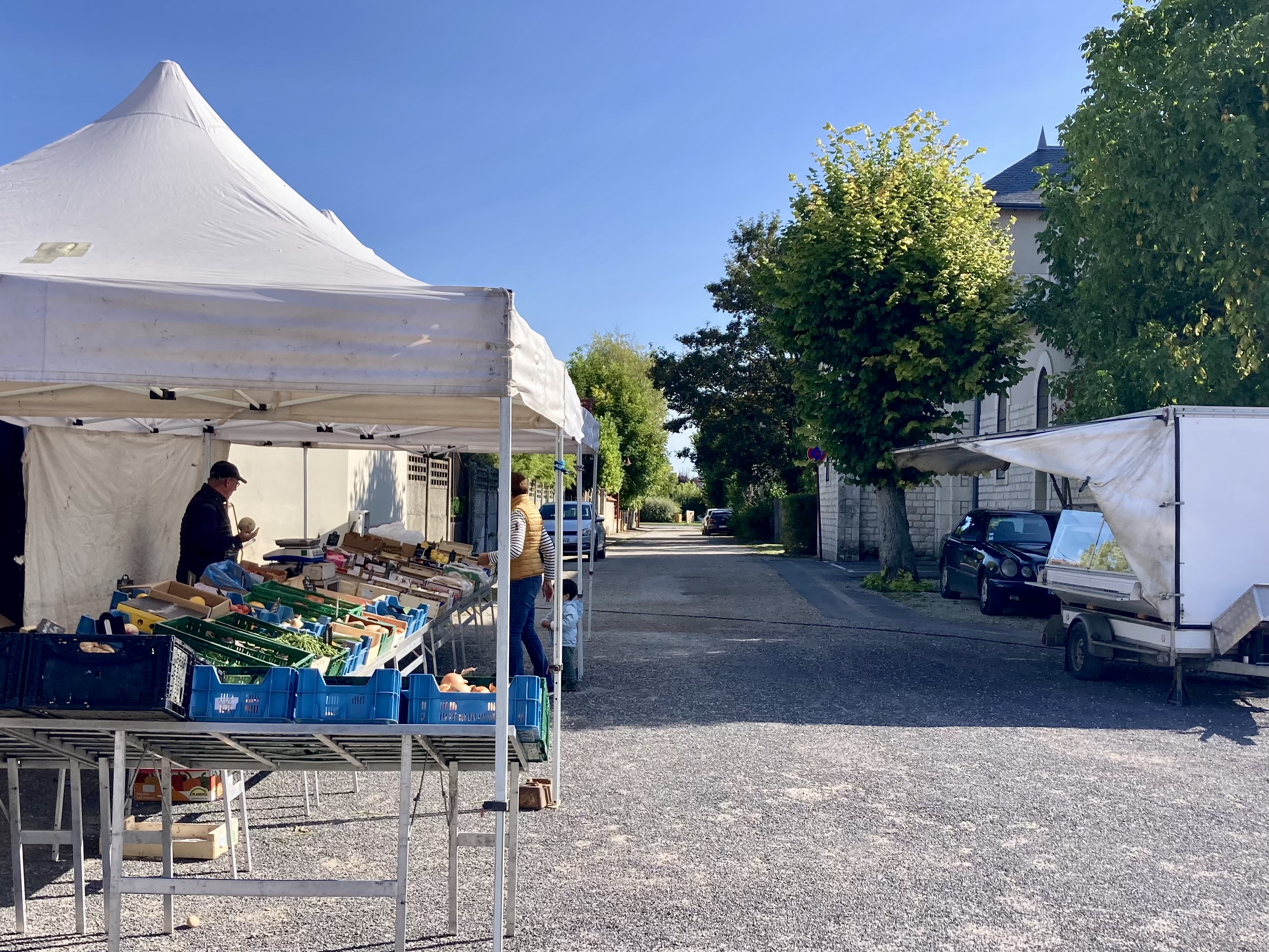
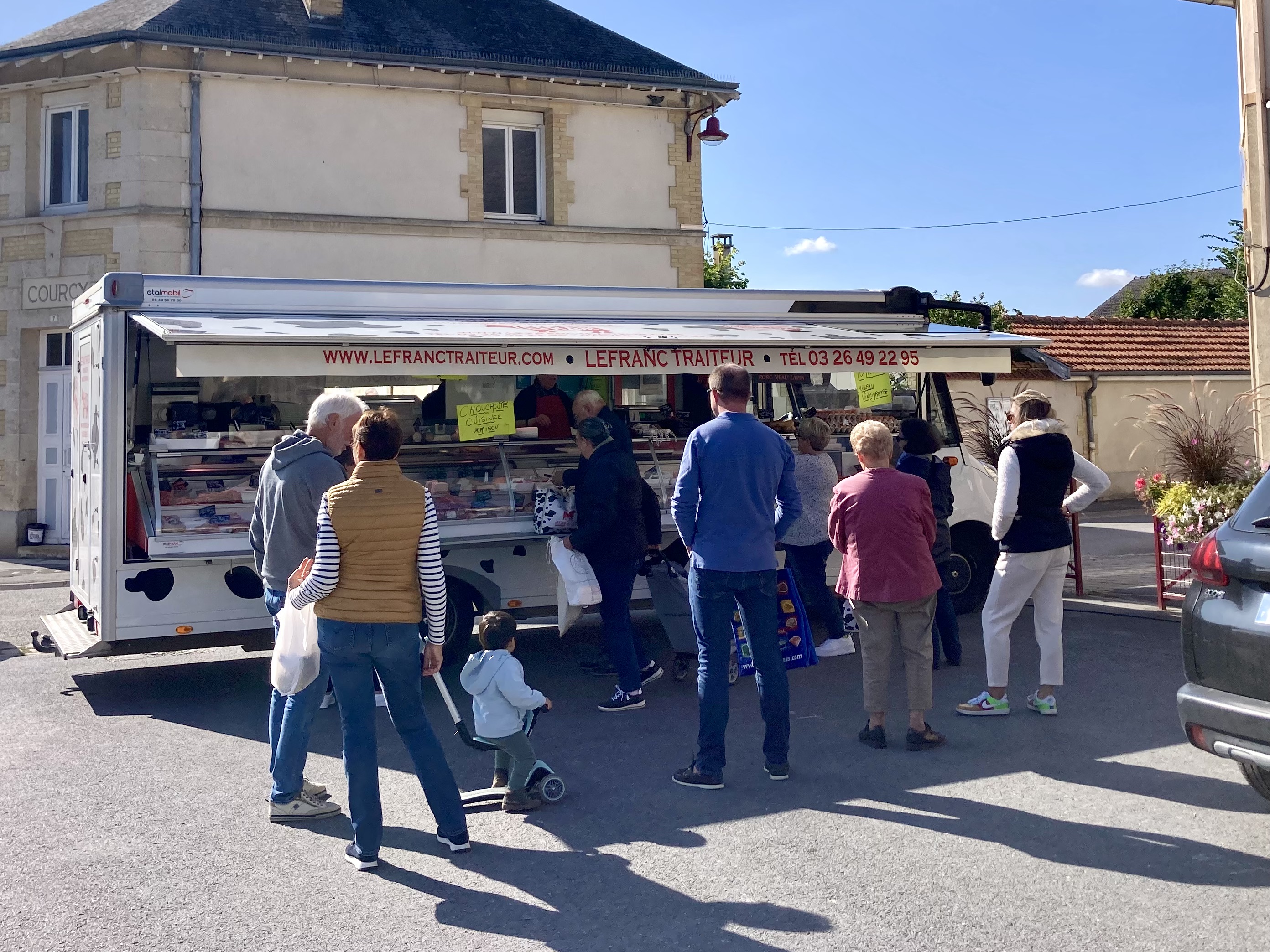

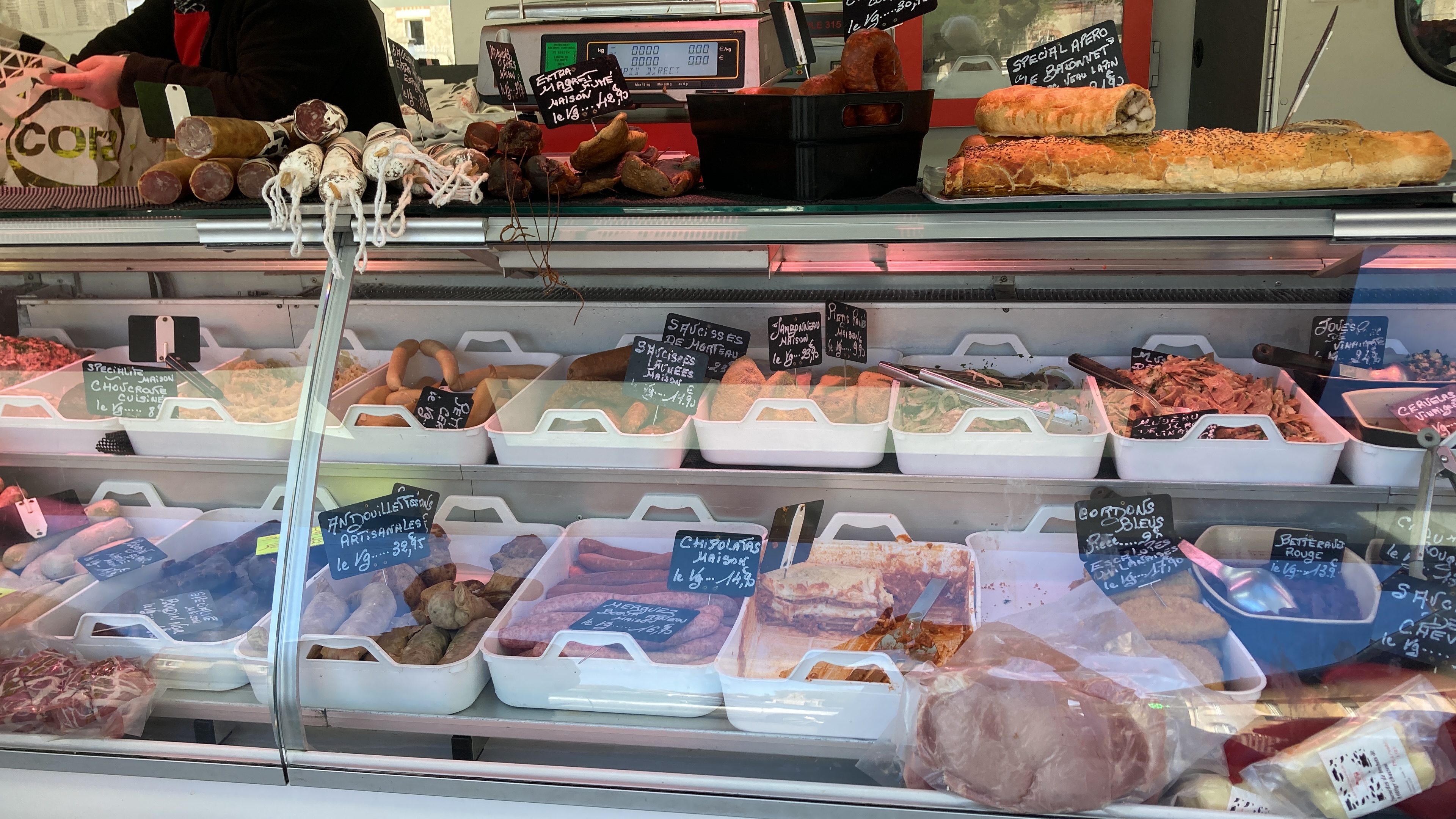
We arrived on a Friday. The customers and staff in the Proxi were keen to tell us about a market in Courcy, a local village, the next day – close enough for us to cycle to.
So we did. It was a nice cycle along the canal path, and then up into town itself. The market is very small – a boucherie (butcher) van, a green grocer and a cheese stall. All had very good produce, and were obviously popular with people from all around.
Recycled back with our bags of fresh produce, enough for several good meals.
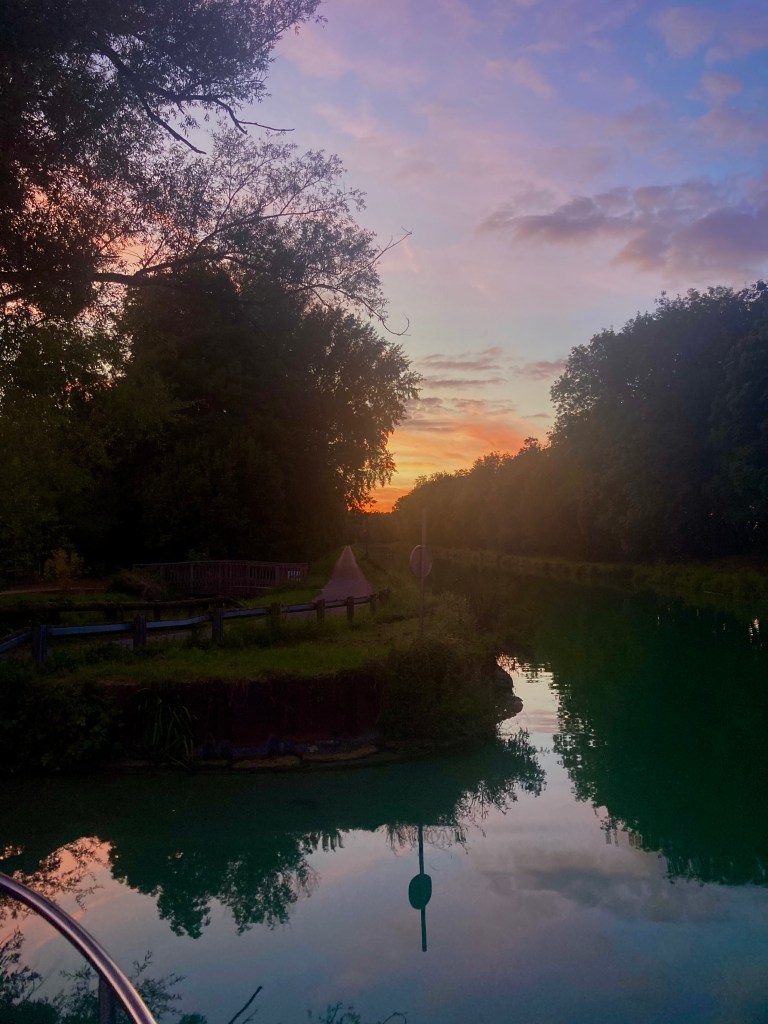
That set us up for the day and we relaxed into our new surroundings with a beautiful sunset.
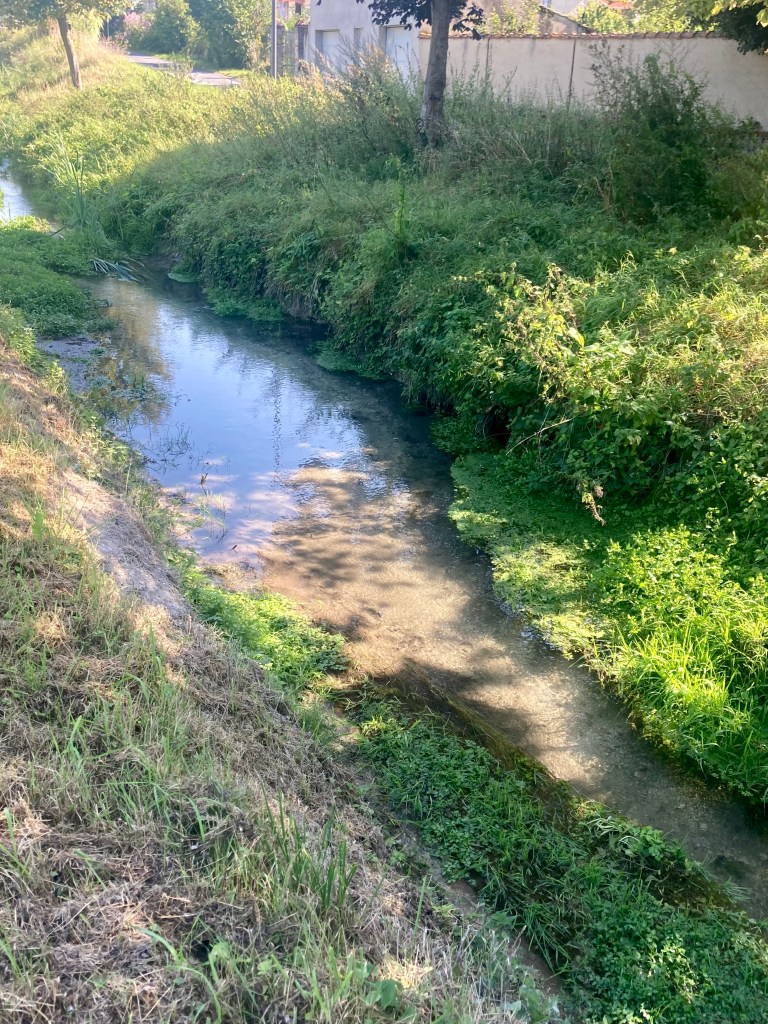
As we began to explore around the mooring we discovered that the ‘ditch; running alongside the canal next to us is in fact the start of the Loivre river, after which the village is named.
This clear free running stream, called La Loivre, grows as it flows eventually joining the Aisne at Berry au Bac.
One of the reasons for moving from Berry-au-Bac was to make it easier to go into Reims. Loivre has a station about a 15 minute walk from the mooring, and is then just a 10 minute ride into central Reims, and we had a mission to accomplish there.
We wanted some ‘non-slip pearls; to add to our deck paint, recommended by Simon Piper who built Calliope. Despite diligent searching on line we could not find them in the France, so devised a plan. We bought them online in UK, had them sent to our daughter who then posted them on to a Poste Restante address at a Reims post office. All we had to do was track the package and pick it up.

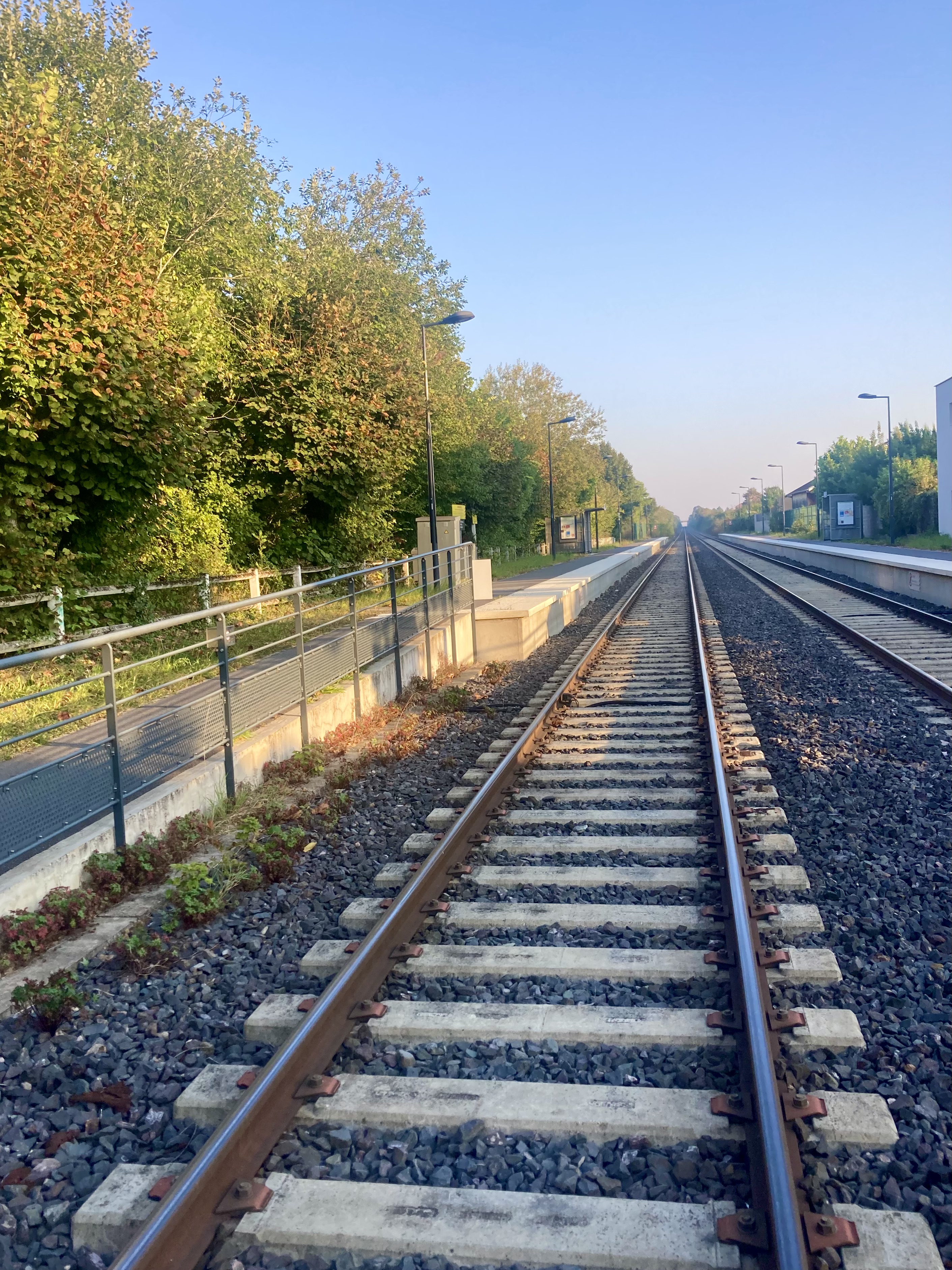
The station at Loivre is simple nowadays. It its just two platforms and a small shelter. The original station house is now a private home.
Mostly it is used by students going to and from school, college etc – and some commuters. We were more unusual passengers, out for a day’s shopping and sightseeing!

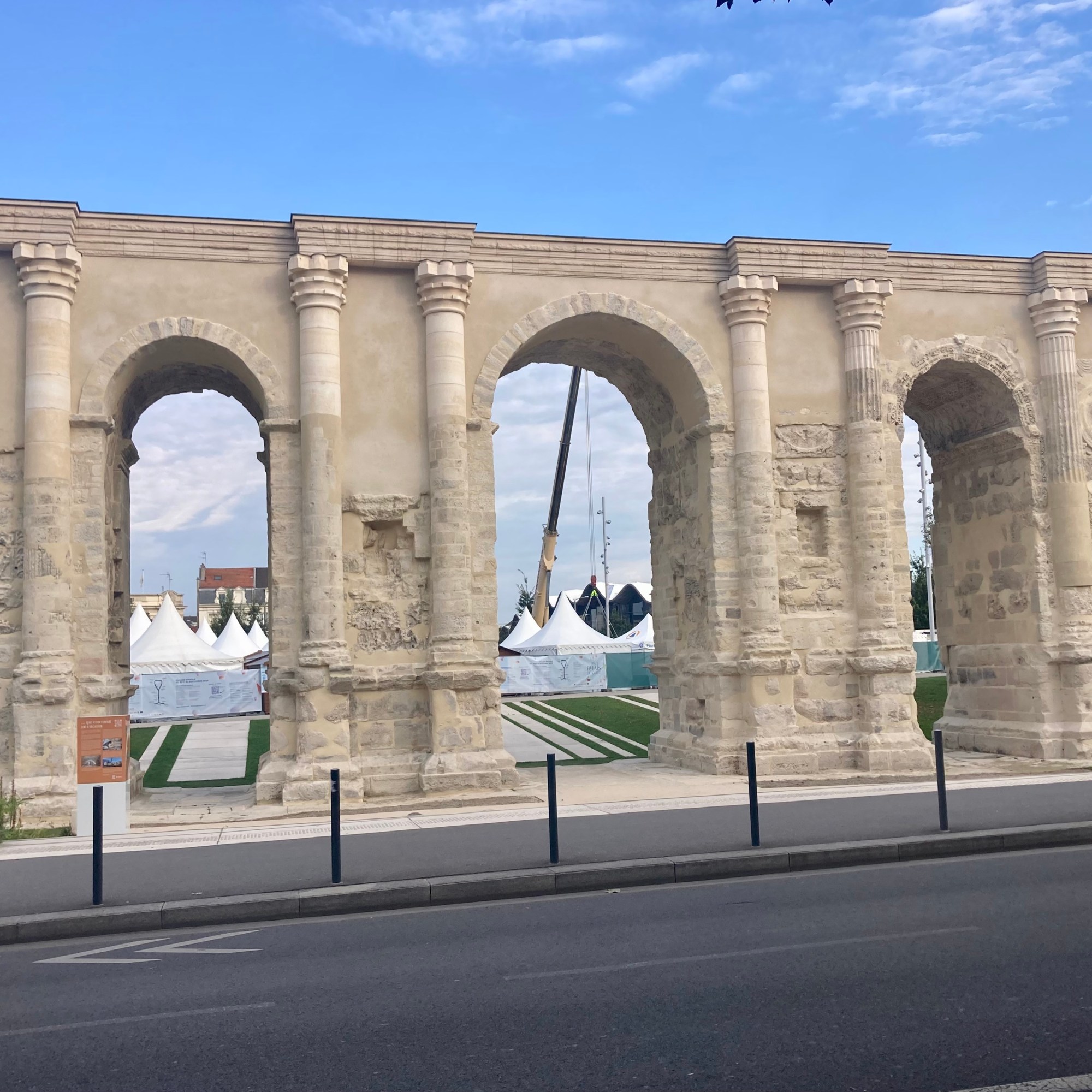
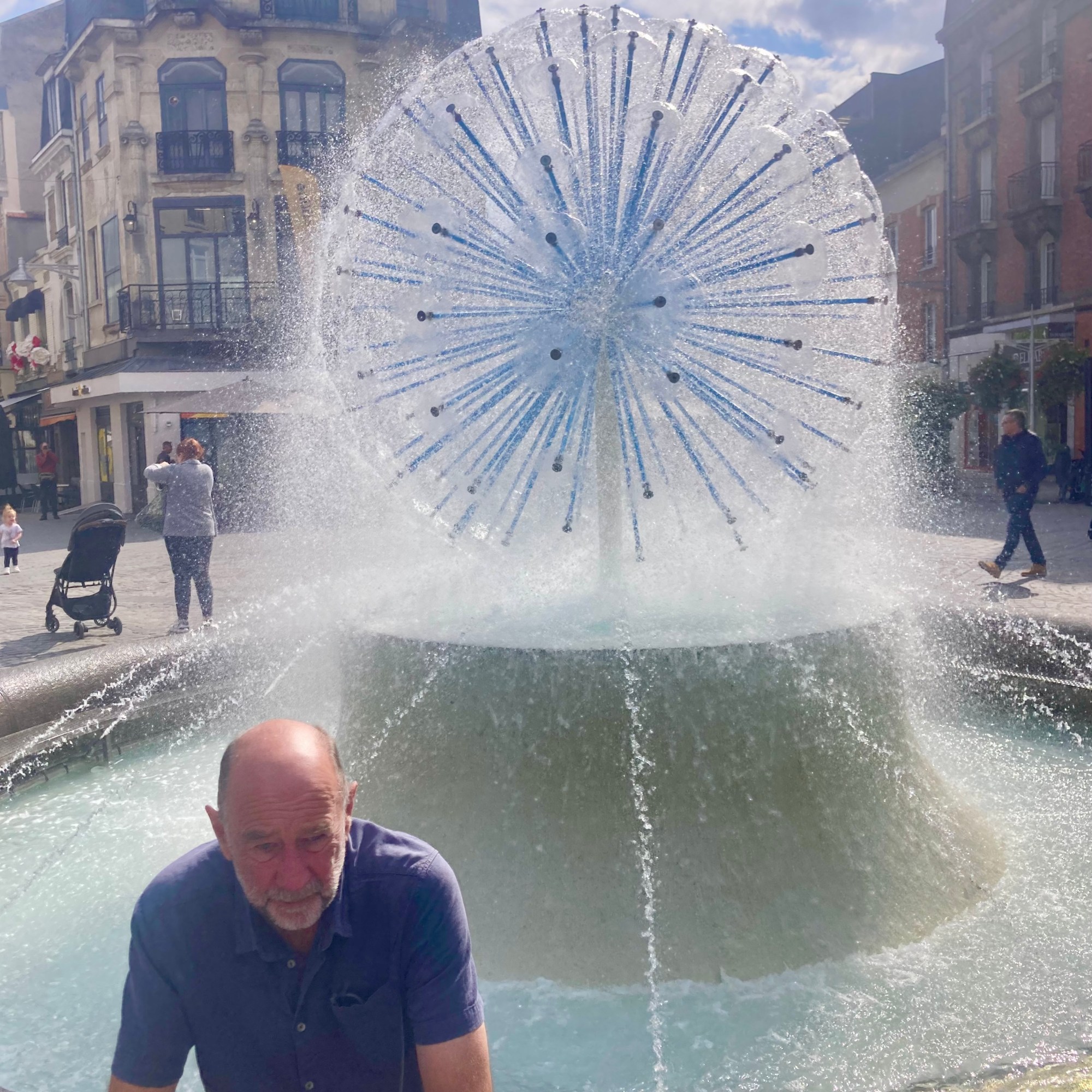


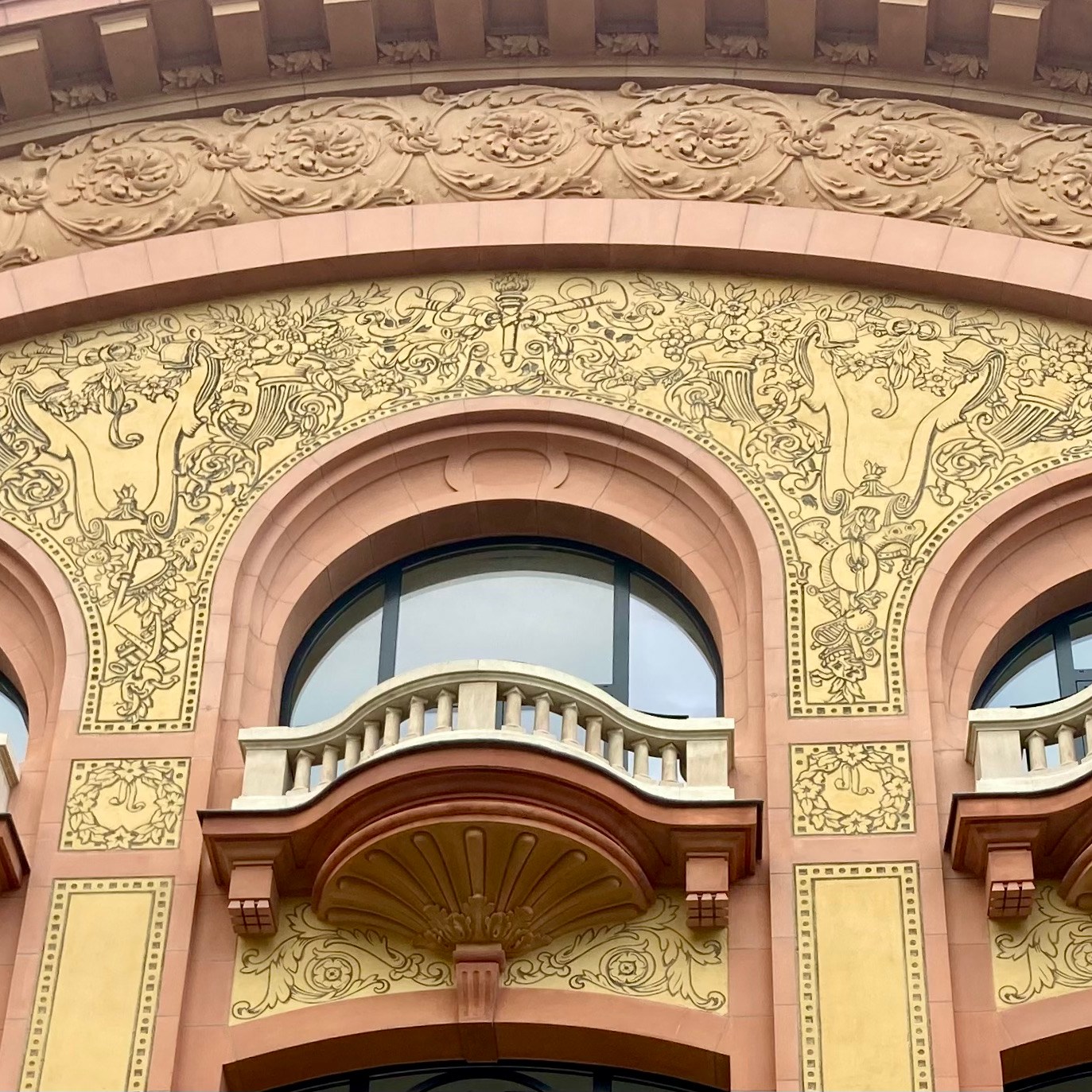
Here are a few of the many sights to be seen, The old and new fountains in the centre of the city; the Porte de Mars (one of the old gateways into the city); Les Halles, the colourful infdoor market; the famous cathedral, seen along the tramlines; the outside of the old Opera House, now a Mango fashion store.
On our first trip we went of course to the post office, but our package had not yet arrived. Tracking has told us that it had passed through customs two days before so we had been hopeful it would be there already.

Ah well, never mind. It was easy to come back into Reims next day.
In the meantime we could buy a new jigsaw to do during our enforced cruise slowdown. (In fact we bought two!)
And early for the train back to Loivre we stopped in at the bar at the station for a beer.
I came back into Reims early the next day, leaving Stewart aboard to start preparations for painting the cabin roof, while I checked in at the post office again.
I went in on an earlier train and therefore had an excuse to turn native and enjoy coffee with a pain au chocolate at a café bar we had noticed the day before.
I have to say it was very pleasant to sit there watching the Reims world go by.
But no package at the post office!

Meantime back on Calliope Stewart had decided to get a first coat of paint on, and then add the pearls to the second coat.
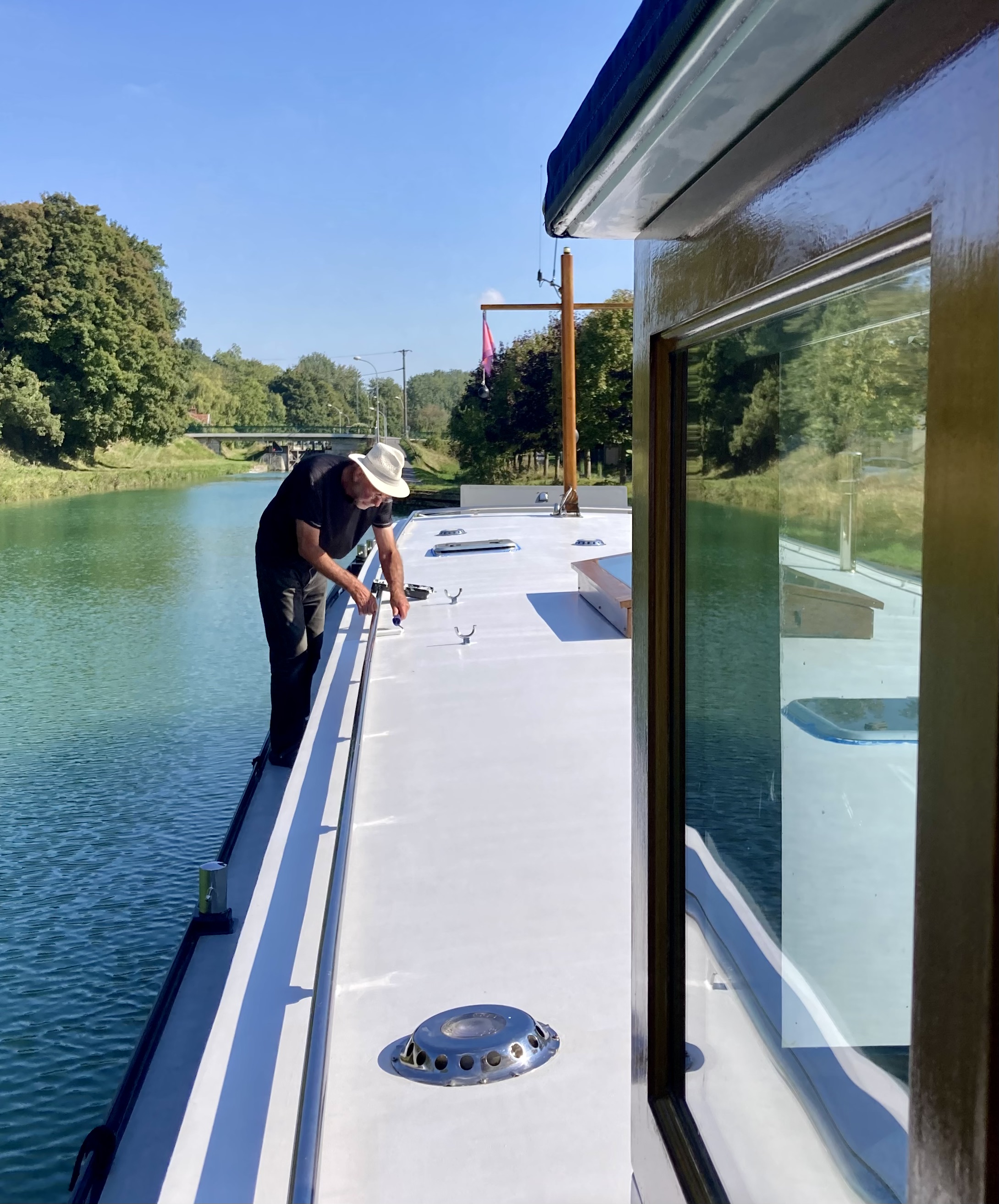
When I got back he was busy painting, and making good progress as you can see. Next to big commercial barges Calliope seems tiny, but come to wash, prepare and paint the roof and she seems to stretch out to her full 19.8m!
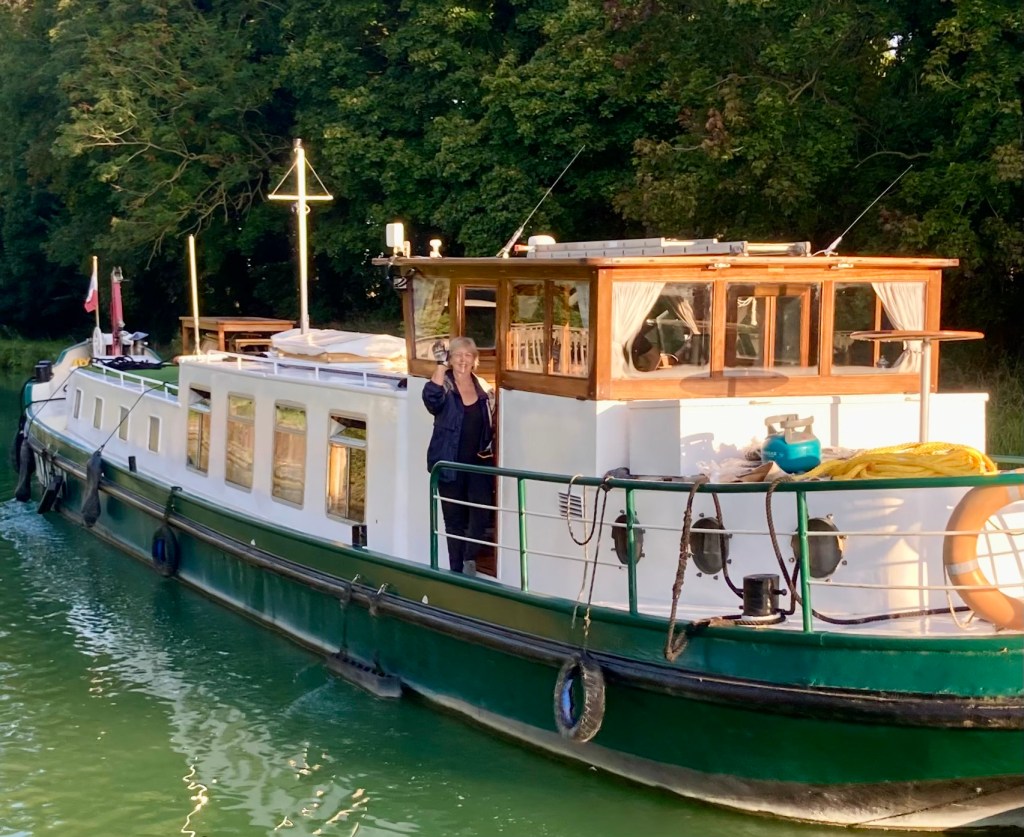
Most of the time we were moored at Loivre we were there alone, but one day another barge arrived and moored at the other end of the cut-out we were in.
We quickly got two know the crew aboard and had a lovely evening together in the sun on their deck.
Then it was time for them to carry on, towards Berry-au-Bac. They had popped down to Reims for a week to see the city, knowing that the canal beyond was closed. And now they were on their way back to their home port.
I mentioned above the friendliness of the Loivre people. One of them, Lise, walking past Calliope and stopping for a chat, told me that the next day there was an organised walk to an old fort that was normally closed to the public. Would I like to join them?
So I did. I was slightly daunted by the fact it was 10kms (I don’t do enough walking these days!), but went just the same. Lise and her two daughters took me to the start point in a village about 5 kms away where we met the rest of the group and set off.
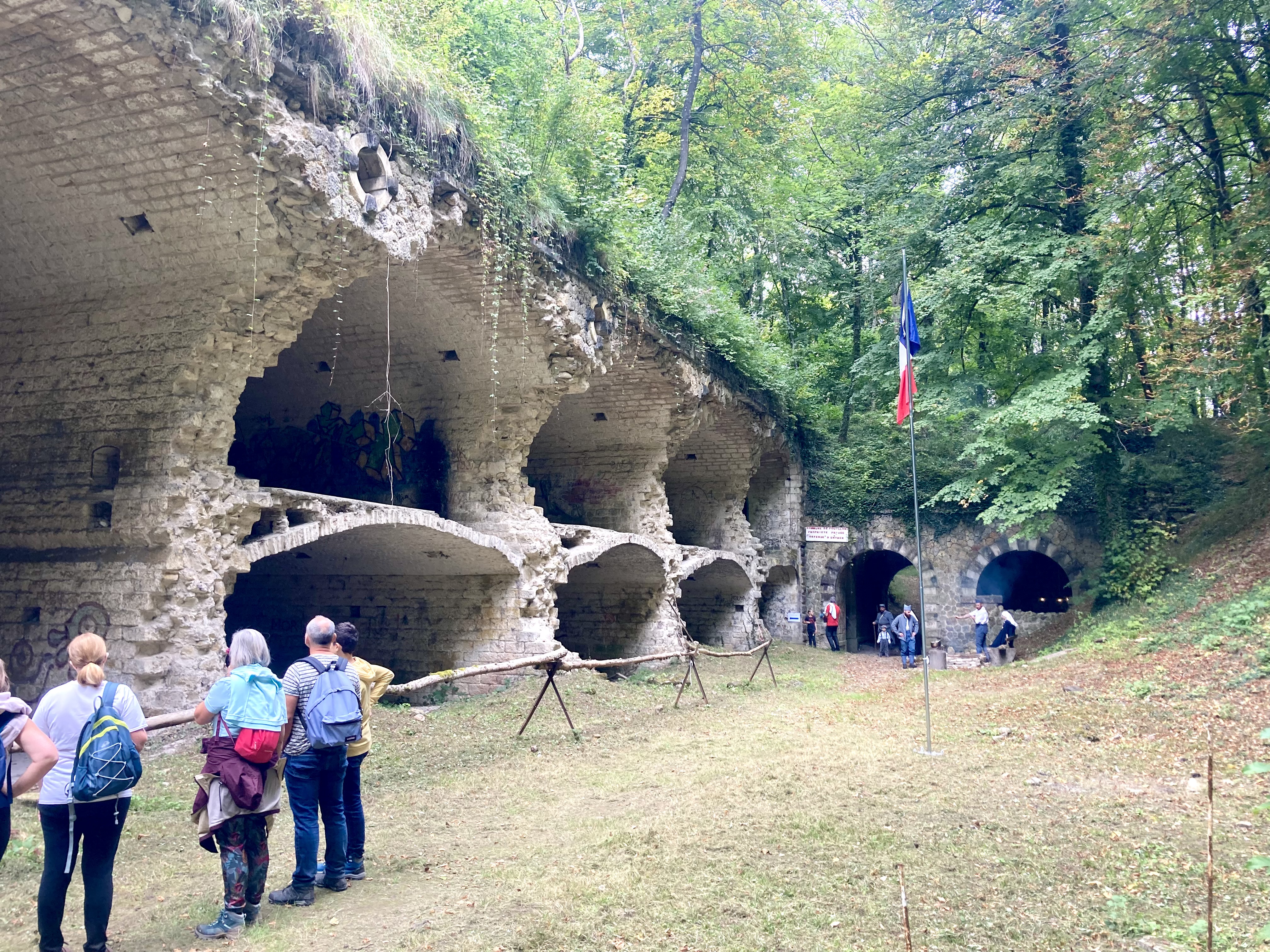
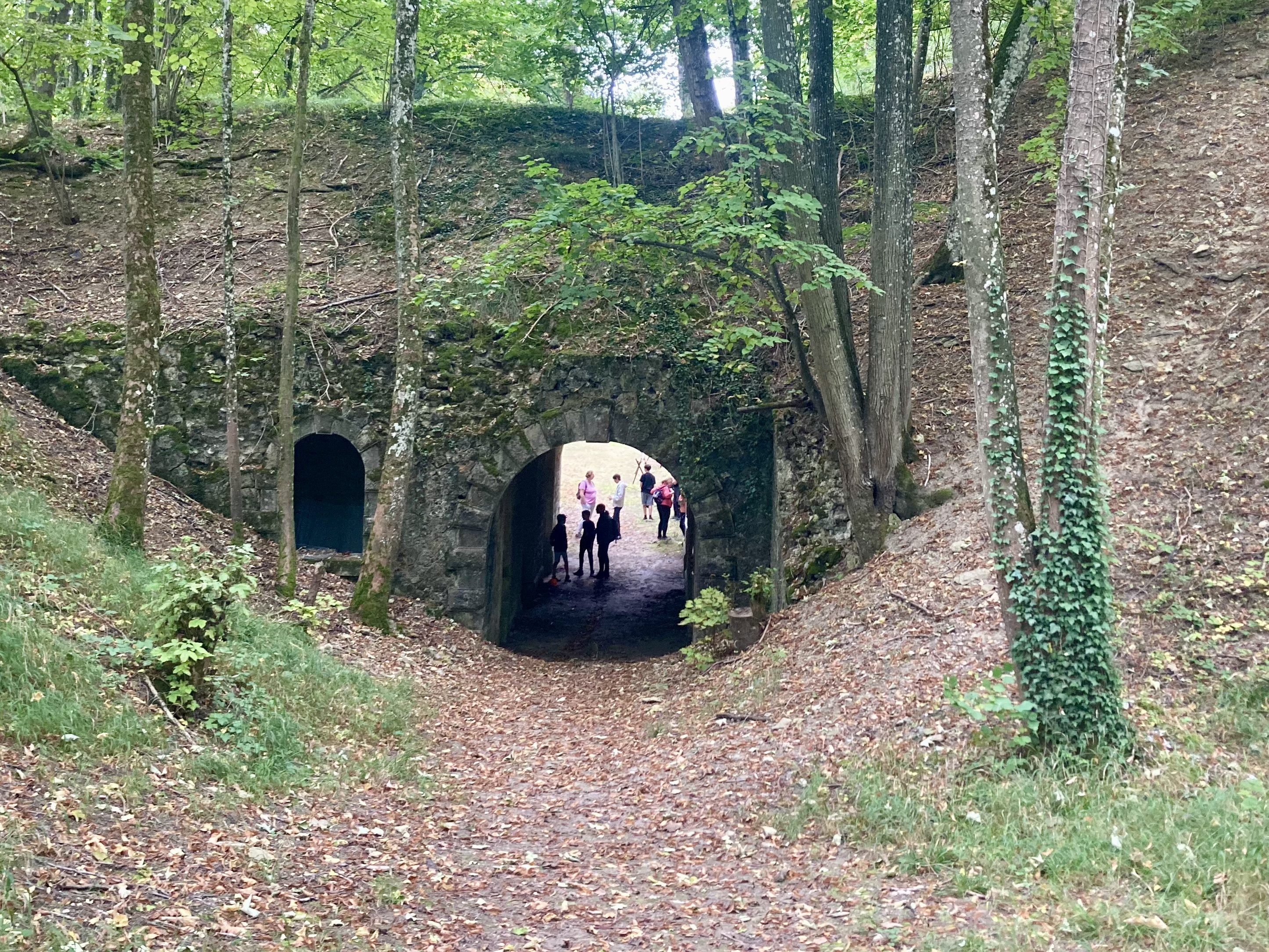

Here are some pictures to give you an idea of the lovely walk through fields and forests plus a few of Fort de St Thierry itself, built between 1877 and 1880. It is one of a number of forts that were built around Reims after the Franco-Prussian war, to protect the city from future attack.
It is a fascinating place, built deep among the trees and tucked into a series of hollows. Although my French is not very good I could manage to understand enough from the helpful people and the signs to get an idea of the history.
I got home knowing I had walked 15,745 steps!
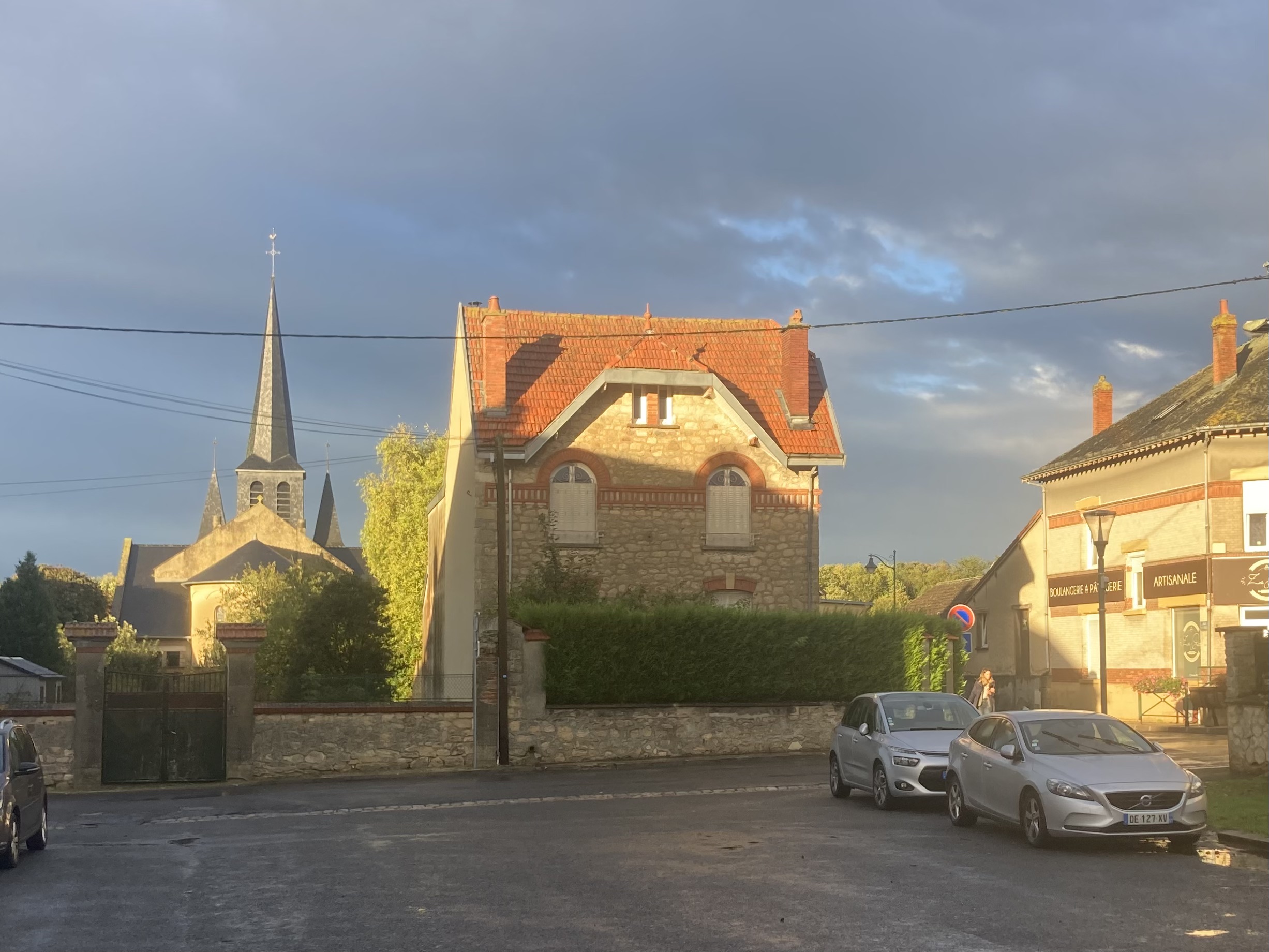

Before we finally leave Lolivre, just a little more of the village. It may lack cafés and restaurants, but two evenings a week different food trucks arrive in the Place de la Republic. The pizza one was particularly good and worth waiting for, especially with the low golden sun lighting up the buildings.
I also was told about local walnut trees that I could collect nuts from (Lise again!) so went out with my bucket to take part on what is definitely a rural French tradition.
The day after walnut day we were off to Courcy. The canal was due to open two days later so we got even closer to Reims ready for the off. Also our son Ashley was arriving the following day to give us a hand with a few long days traveling, and Courcy was easier to reach.

The voyage began backwards. In order to operate the lock in front of us we had to turn the pole that was behind us!
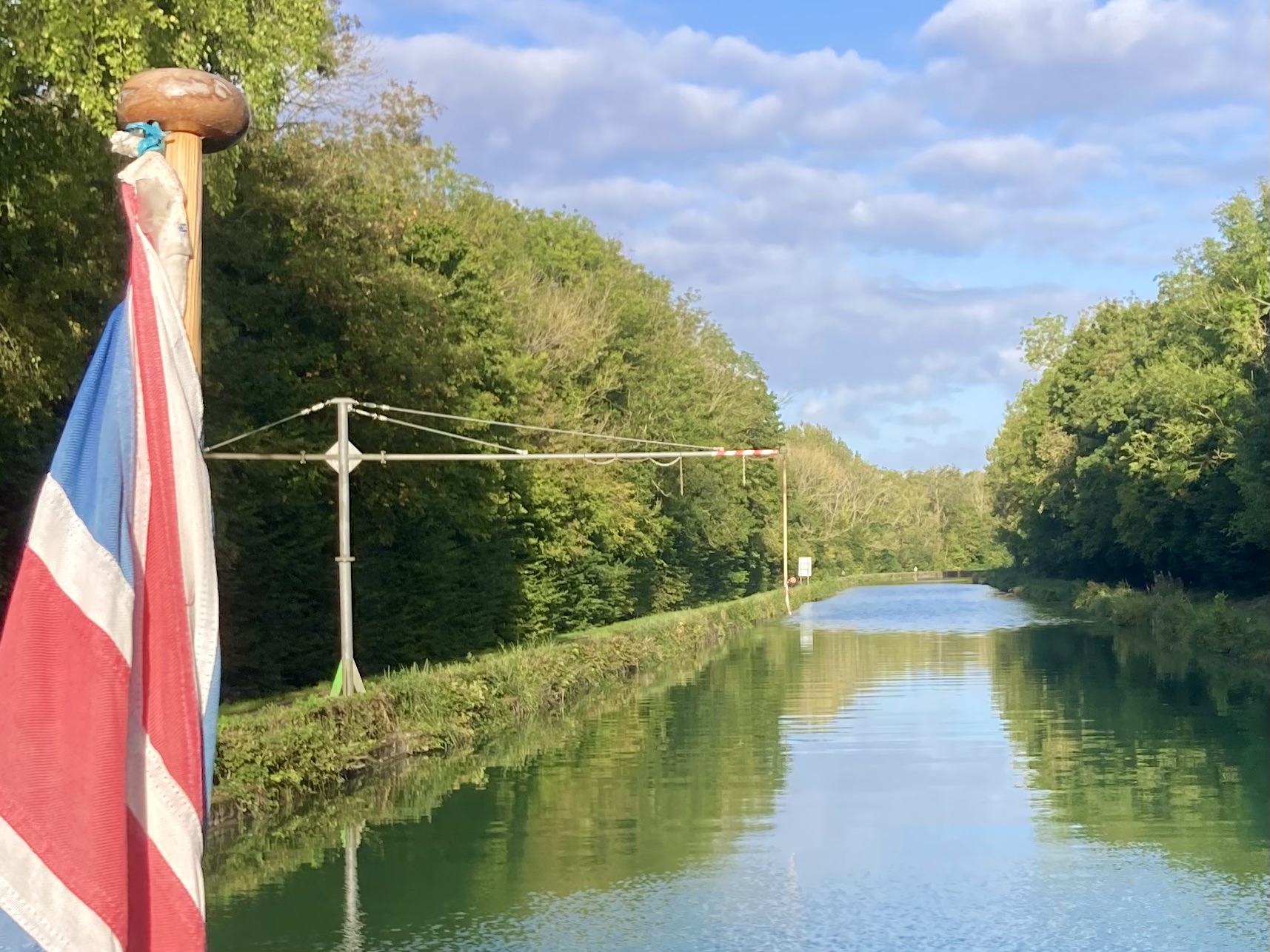
This was accomplished successfully and off South we went, just for four locks and 3 kms. You. might recall that we had cycled to Courcy two weeks before to go to the Saturday market. Once tied up my bike was dropped ashore and I whizzed up to the village for more fresh fruit, veg, meat and bread.

It’s another lovely mooring, and made even lovelier at this time of year by the colours of the water and the trees.
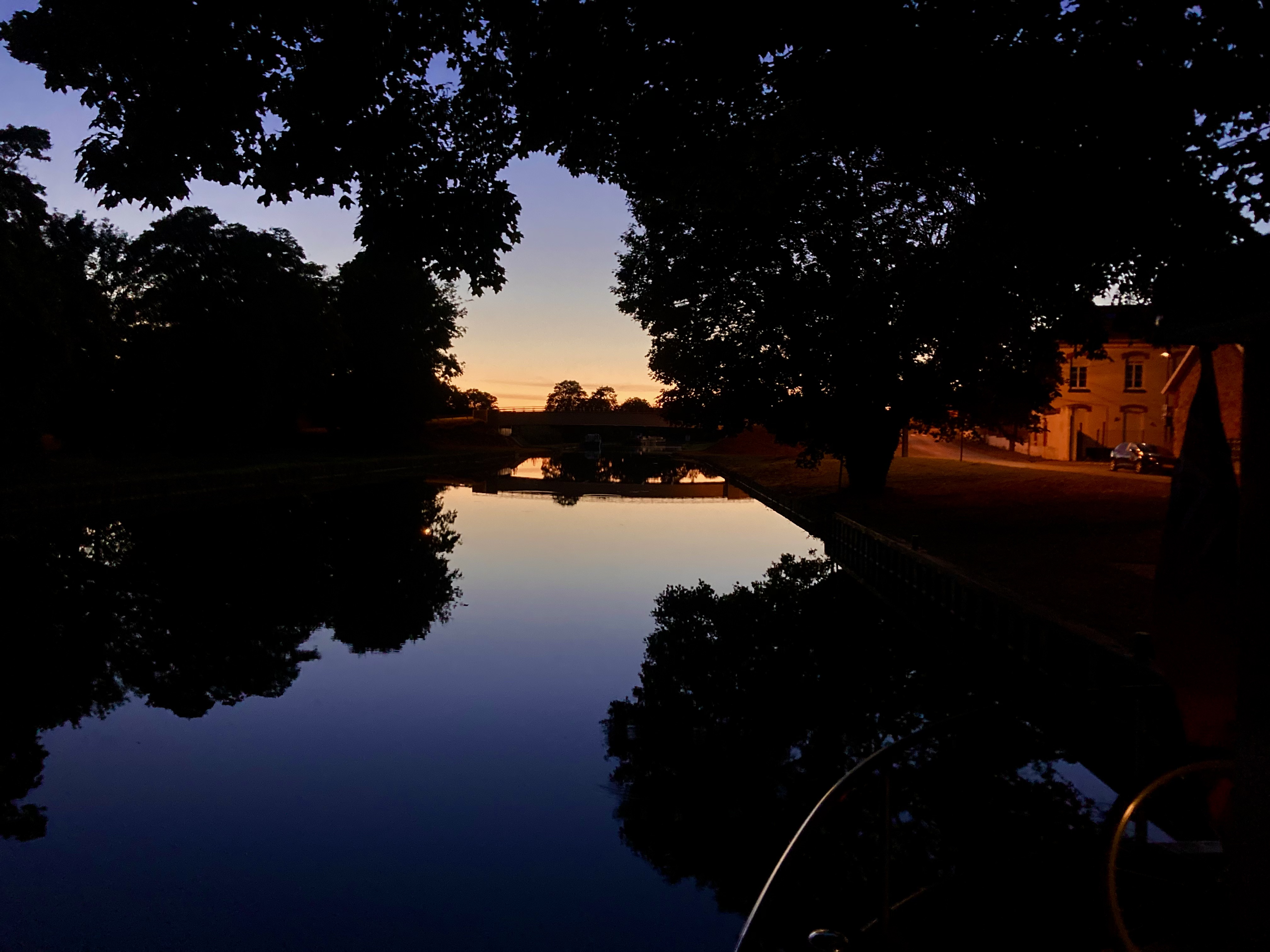
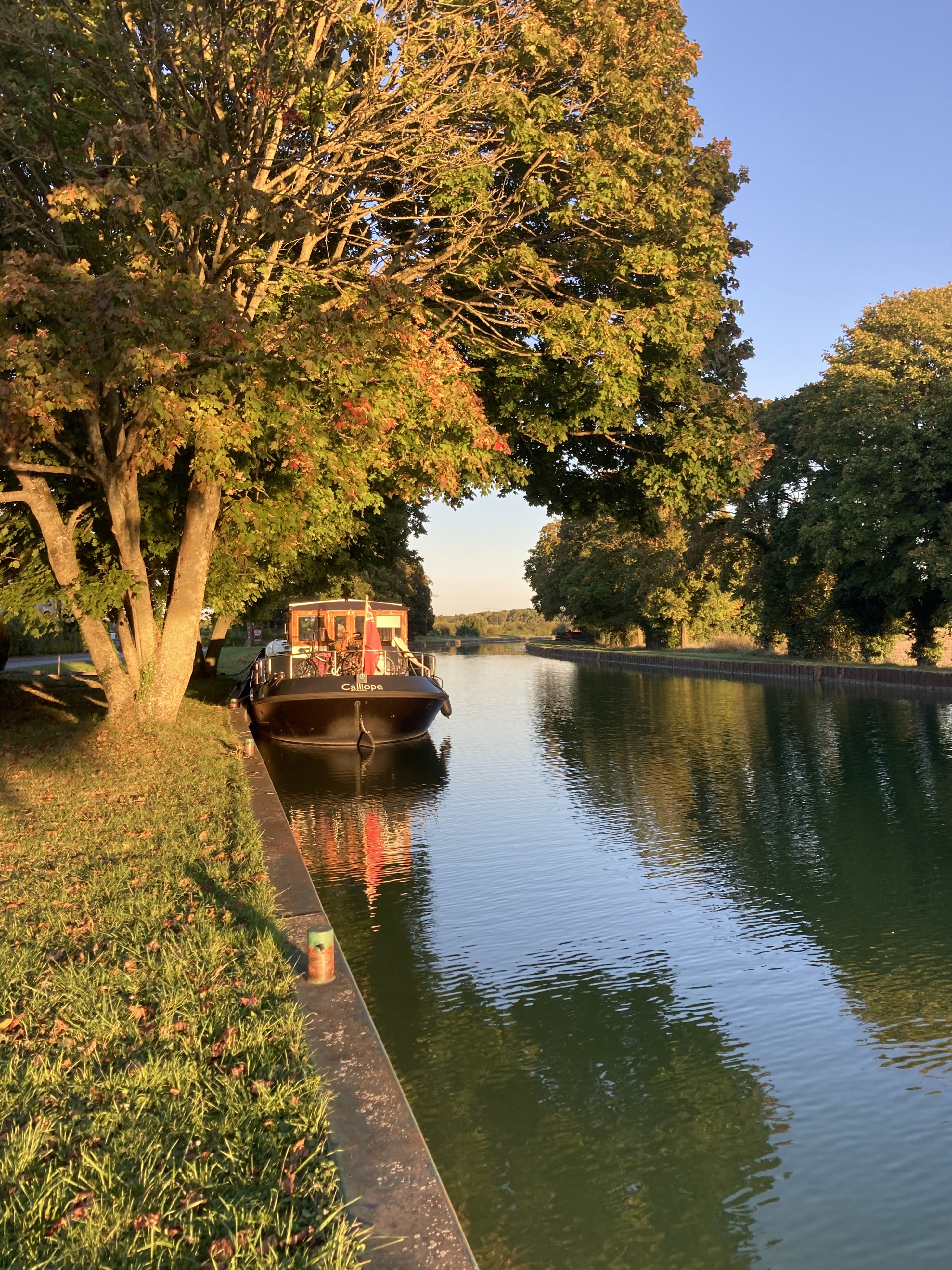
The colours changed and softened as the day wore on.
The following evening Ashley arrived in a Uber from the TGV station outside Reims – a direct line into Charles de Gaulle airport. We fed him a good stew made with purchases from the market and cake from the boulangerie.
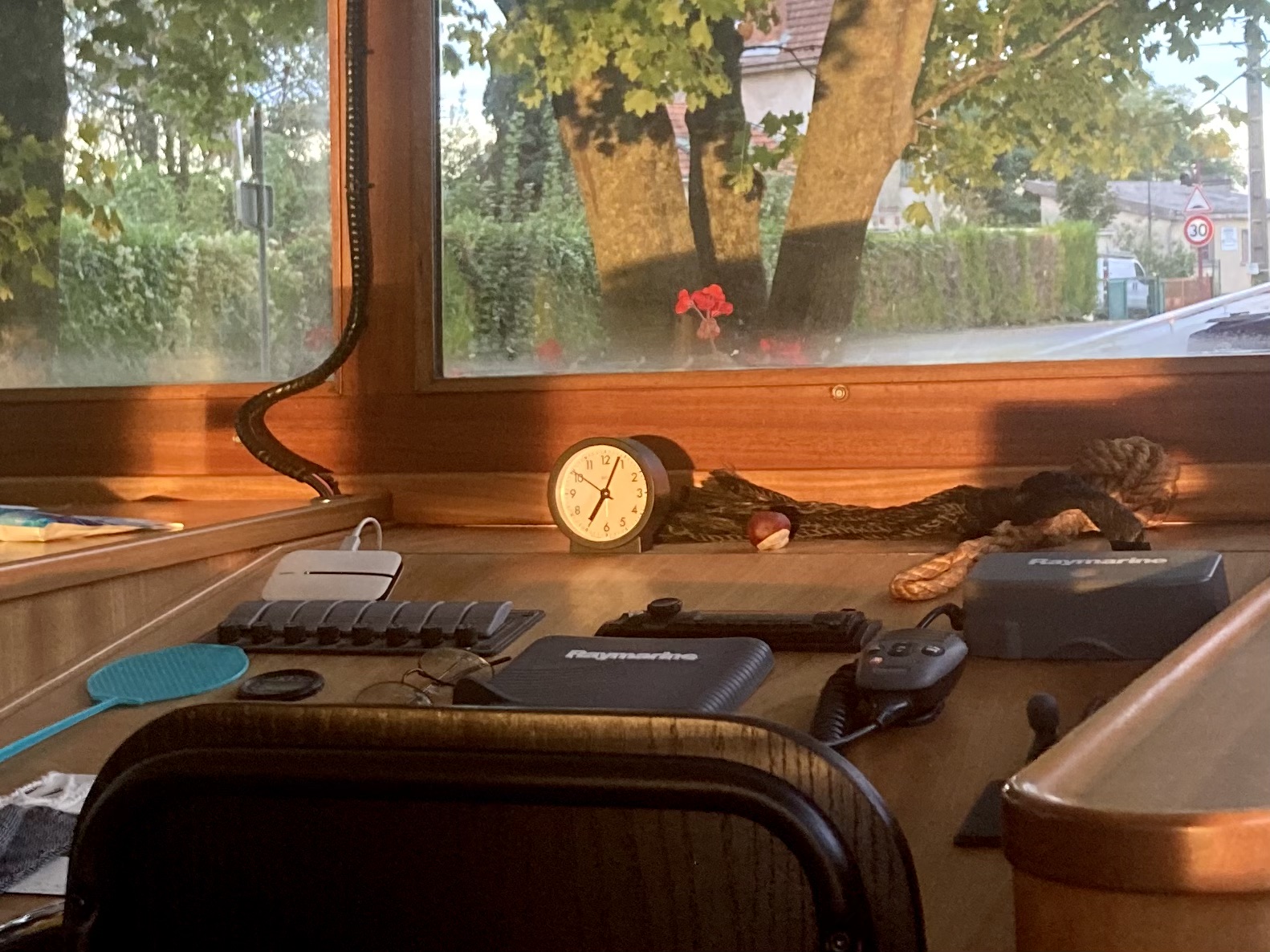
Then early to bed, because next day, after a 5 week wait, is the first day the canal is open beyond Reims!! Though it was not quite as early as shown on the ships clock above!
Although this was an enforced and totally unexpected delay to our plans it has also been a delightful experience. So often we are moving through French villages without getting to know them. This time we have spent proper time in Berry-au-Bac and Loivre and it’s been great.
It was to take us just over 3 weeks to get back to our Hivernage (winter mooring) place at Saint Usage – a voyage that was to be just as adventurous we had hoped and imagined …..
On the Escaut, & canals Sensée, du Nord, plus 3 linked to la Oise and l’Aisne
17th to 25th August 2024
BovenSchelde/Escaut
Planning for our return to Saint Usage and our winter mooring had begun sometime before, partly to fit with the end of our French 5 month visa, and partly to get through Reims before it closed for a week while a bridge was demolished. We were on Plan B already; Plan A had been to go up the Meuse and down the Vosges, but there were closures on both due to low water.
This meant putting in some long days for a while and we set off from Antoing in Belgium with great intent.

We went up the Bovenschelde, a river that changes its name to the Escaut at the border with France. The border is still marked canalside with the old douane (customs) office, out of use since the formation of the EU.
It was the first time we had gone along this section of the river, so an interesting time for us, soaking up some unfamiliar landscape.
(I shouldn’t really call it a river, as it is ‘canalised’ now, and behaves more like a managed canal than a free flowing river, but for the sake off ease I will continue to say we are on the Escaut.)

A couple of hours later we reached a particularly interesting place for us; the junction with the Canal de Pommerœul à Condé. This was opened in 1982 to link the busy commercial waterway networks of Northern France and Belgium, but had to be closed less than 10 years later, following heavy siltation. We had moored in the (closed) Belgian entrance to the canal at Pommeroeul several times, and now could view the other end!
And, even better, the canal re-opened to traffic again this year!
Prouvy
Our normal gentle cruising day is around 20kms, so you will understand that we felt rather proud to have managed 40kms this first day of our planned rush to Reims.

This mooring at Prouvy was far from glamorous, on a wharf quay next to an apparently unused warehouse, but it was safe, quiet, and appeared just as we wanted to stop.

We enjoyed a relaxed evening, recharging our personal batteries and even industrial moorings can have beautiful sunsets.
Next morning, relatively as fresh as proverbial daisies. we were off again with another long day in mind.

We still had another 13 kilometres on the Escaut to cover, all shared with a surprising amount of commercial barges considering it was a Sunday. We passed through the crowded port of Denain, glad that we had not tried to moor there the night before.


I am constantly surprised by then length of some of these barges – often two 38m boats joined together – and full of admiration for their Captains who manage them into the smallest of spaces with such skill.
Calliope passed smoothly through one village after another, each with a church spire rising amongst the houses.
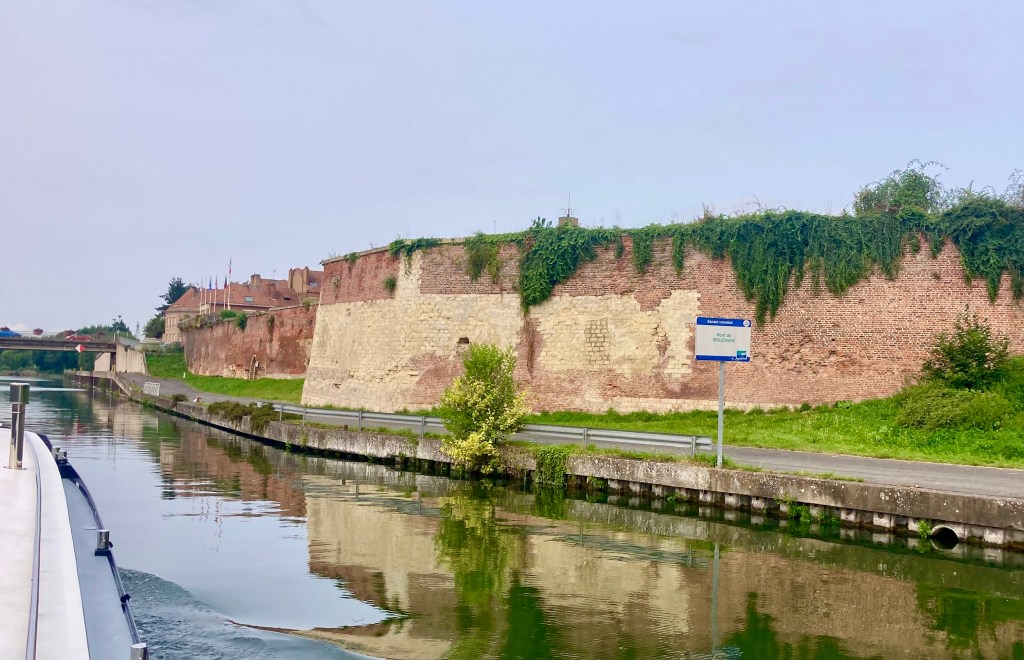
At Bouchain there is an old fort alongside the water, originating in C12, modified by Vauban, and with a magnificent history.
Twenty minutes further on we came to the last écluse (lock) on the Escaut for us – écluse 6 de Pont Malin. The lock walls in these locks were quite high, though the change in water depth was not great. You can see it here …


It was deep enough for its to be using the bollards in the wall of the lock, and therefore the two way radio thing between us, but the water line on the wall is well below the top.
I love locks! They all have similarities and all have differences.
Canal de Sensée
Just below écluse 6 is a big junction and where decisions for journey’s South must be taken. Continuing straight ahead onn the Escaut towards Cambrai takes you to the Canal Saint Quentin and its tunnel. Boats are towed through this tunnel, so the timing of your journey is partly dictated by the one time a day you can be towed through.
Turning right onto the Canal de Sensée takes you across to the Canal du Nord, another route south. This canal also has a tunnel – actually 2 tunnels – but you go under your own steam and schedule if you choose that way. Both have their advantages.

So we reached the junction, our decision had been made, and we turned to starboard to take the short Canal de Sensée westwards.


It was still a grey day at that point, and the canal is fairly featureless. It is wide, rural, and with quite far reaching views across the countryside.
Progress is marked by PK markers – counting the kilometres from one end to the other. There are 15 kms in all.

At the westerly end the skies started to clear, another big junction opened up, and we turned to port to join our next canal
Canal du Nord
This canal has been a main artery for commercial traffic since its opening in 1965. It is 95 km-long and was first planned to help French coal mining companies withstand foreign competition. It is the only French canal to be built intermediate dimensions between the 37m long Freycinet and the modern high-capacity boats.
Construction of the canal began in 1908 but halted in 1914, because of the First World War which caused widespread destruction. Construction did not recommence until 1960. Sadly, less than 70 years later, it is to be abandoned, and taken over by the future Seine-Nord Europe Canal, a huge and interesting project.
(I have added the link because the new canal is likely to be of interest to current and future boaters.)

Having turned to port Calliope was heading South again.
We passed plenty of working barges, tied up at the junction in Arleux for the weekend.


Within 5 minutes we were at our first Canal du Nord lock – a bit tall and forbidding with its guillotine style door! But all safe and manageable, especially when we have the two way communication radio thing between crew at the bow and Captain in the wheelhouse.

The way to contact the locks here, and on the Escaut, is by VHF radio; a little rudimentary lock French is usually required!
Calliope has an onboard radio, but this year we invested in a handheld one too. As I am the main communicator, and usually outside the wheelhouse when approaching and in a lock, this works perfectly.
On we went for another 8 kilometres, clocking up another 37 kms over the full day.
Just before last lock of the day we were reminded of the real and current purpose of the Canal du Nord – cargo transport.
But nowadays it is more grain and gravel than coal. These silos are full of grain from the recent harvest.
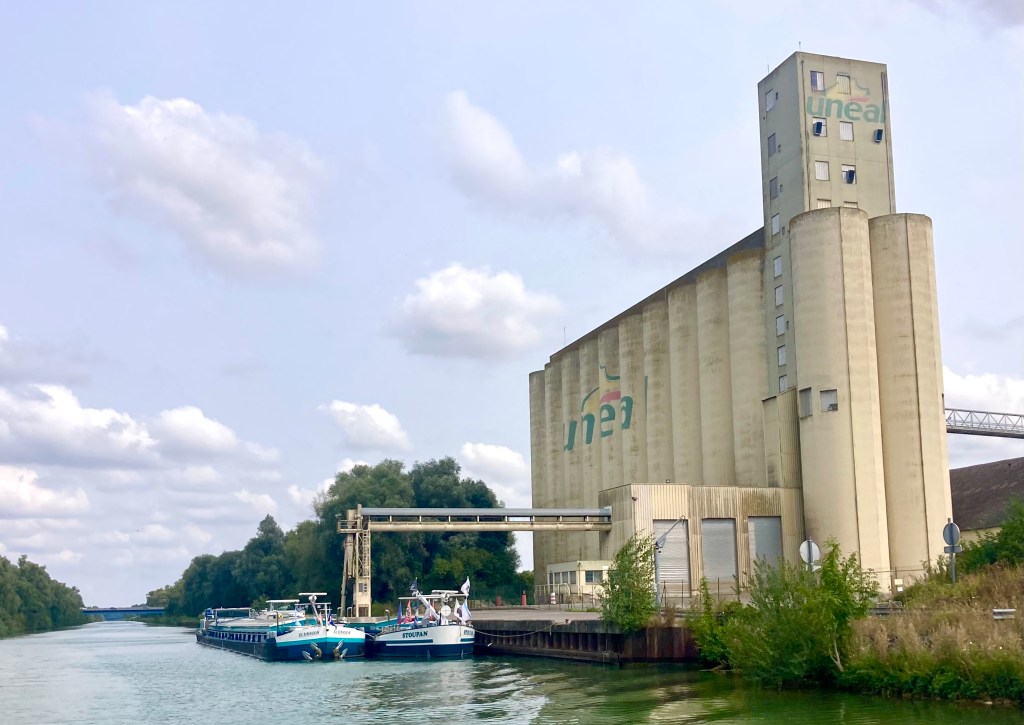
Sains-Les-Marqions
Back on a waterway we know reasonably well we had chosen our mooring in advance. Normally a tranquil place to stop we were slightly alarmed to see lots of cars, and on closer inspection balloons! A party was underway in the building and garden belonging to the local fishing club.
It turned out to be very much a gentle family affair and by 7.30pm they were all off home.

We were left with solitude and a full moon in a clear sky – just right after another long day. But by next morning the clouds had reappeared!
Allaines

The mooring at Sains-Les-Marqions is within sight of first lock of the day, and the start of our cruise to Allaines – although we didn’t know that would be our mooring when we set off.
By 0915 we were approaching it, and by 0940 we were up, through and on towards the next.

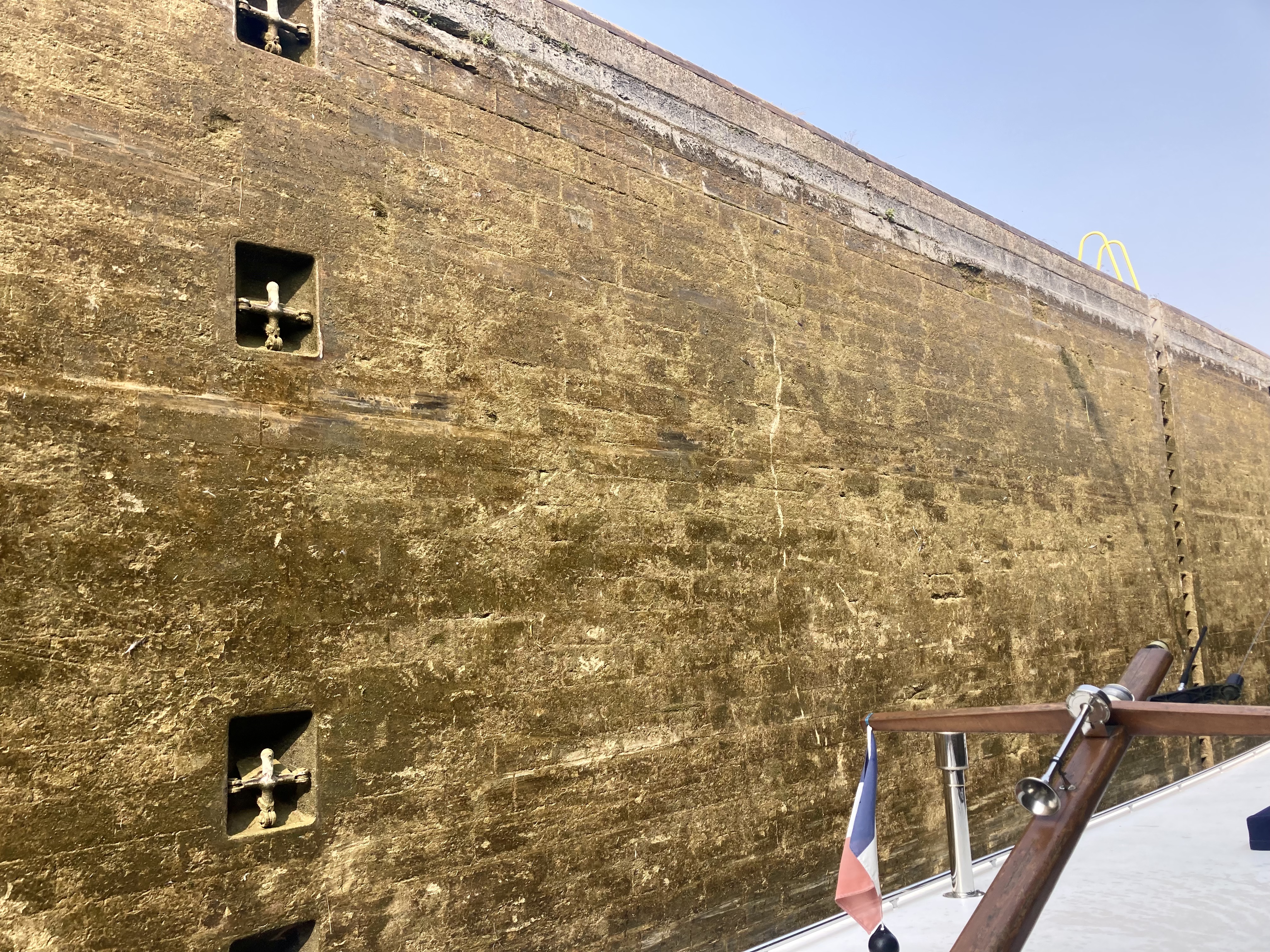

An hour later, with the sun making occasional appearance, we were at our fourth lock of the day, écluse 6, Graincourt-lès-Havrincourt. This is typical of the locks on the canal and I have included a few photos just as illustration.
You can see the guillotine door close behind us and the bollards going up the wall. As the water rises we move our ropes up a level, until near the top we can loop round a bollard on the quay – not visible from below.
The locks are well signed here, with the name, number and PK number all included, in case you have lost track of where you are!
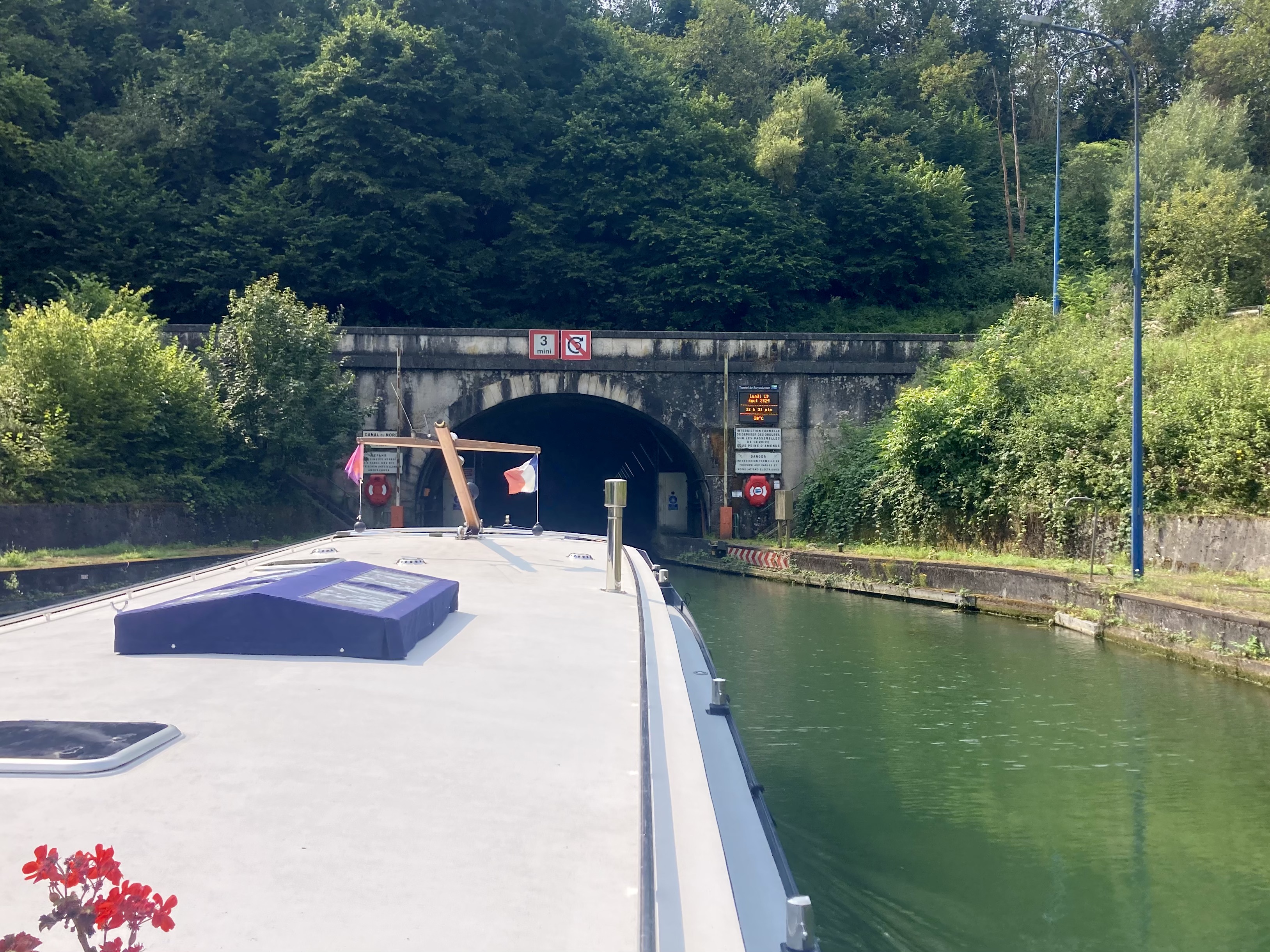
An hour and a quarter further on and we arrived at our first tunnel, expecting to moor up and wait for any barge coming towards us. As it was we were lucky and were given the go ahead.
Look carefully at the lighted information sign at their entrance and you will see that we arrived there on 15th August 2024. Canal du Nord, Tunnel Ruyaulcourt, Hauts-de-France, France. And above the tunnel entrance we were told to go at 3kph minimum, and not to turn round. Right, in we go.


It is an interesting and fairly unusual tunnel, having a widening in the middle to allow boats to pass each other. That means there is a set of traffic lights near the centre to let you know if you need to moor up and wait for another boat to go by.
On this occasion we were able to go straight through, a thirty minute trip; as we came out we saw another barge waiting its turn.
It is a well lit and well maintained tunnel, and the Captain found it easy to comply with the 3kph minimum speed – in fact he said it helped.

Tunnels usually pass through the tops of hills. It is always a surprise to see the different countryside lying on the other side. I guess that the weather is sufficiently different on the northern and southern slopes of the hill to make the agriculture and natural growth different.
We were obviously still on a high plateau – more long views in all directions.

Now we were going down hill, entering locks at the top, and descending to the bottom.
They were still big deep locks, with bollards in the wall.
Now that the clouds had cleared away the day was warming up. We had continued on for another 3 hours or so after the tunnel. That was ‘only’ 31 kms, but included 5 huge locks up, a 4km tunnel, and 3 huge locks down! No lunch break; just eaten as we went along.
No wonder the Captain was getting ready to have a siesta. We were looking out for a mooring.

There was half a plan to go somewhere else, but when we saw this out-of-the-way little quay, with shade from an old warehouse approaching, it seemed like the right place to stop.
The mooring was a typical one for us. We love the rural aspects, the nature and general calm, though we did have an hour of distant happy noise from children swimming and jumping from the bridge. That somehow added to the charm.
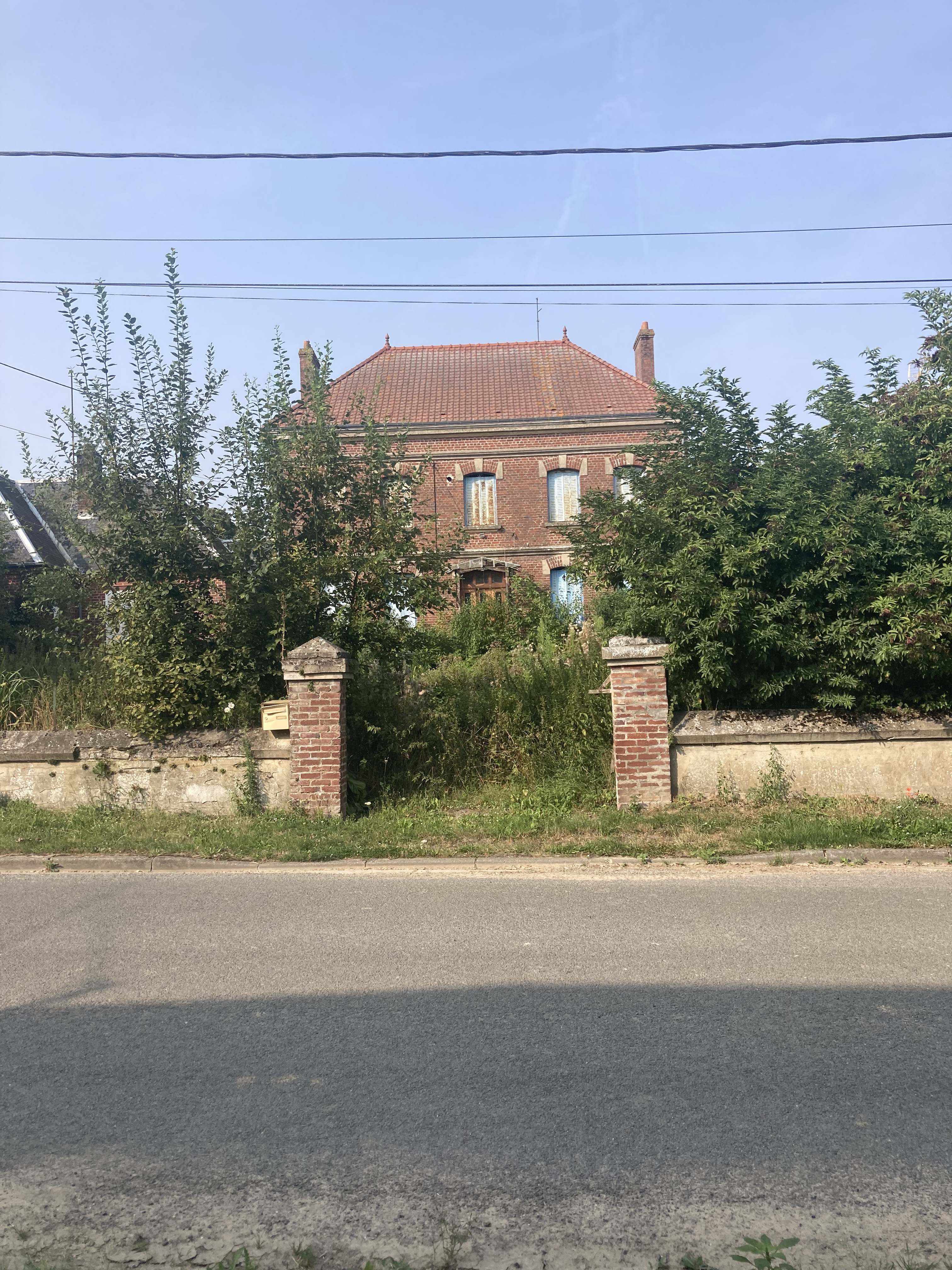


I decided that the village was worth exploring and went off across the bridge to have a look. There were corners of interest including a peacock stalking across the arched entrance to a farmyard.
Coming back over bridge, with the sun now veiled by high cloud, I could see how small our Calliope looks in a big landscape!


As darkness fell the big orange moon rose again. I went up on to the bridge to try and get a better photo of it, but I think I need a better camera. Through the binoculars it looked even more magnificent.
Going back to Calliope I had my first ever sitting of a glow worm! I was quite excited. Of course my photo of that little chap is awful as well, but included here as a memorable experience. Then back to the boat, which was looking cosy in the night.

On we went next day, passing the place where La Somme joins the canal – in fact some sections of the Canal du Nord are known as Canal de Somme as the river meanders along by the Canal du Nord.
This was a momentous junction for us back in 2016. We had arrived in France from UK, on Calliope, at the mouth of the Somme and this was where we came out onto our first big French canal! The junction is just below Pérrone, an interesting city but not a stop for us this time.


After Perone, there is still plenty of commercial activity, here with grain being loaded onto a barge, with a norther waiting its turn behind.
The difference in the level that full and empty barges sit in the water is huge! Both these barges are essentially the same – just one almost full and one empty.

Little things vary from canal to canal.
Here is a typical lock sign for the Canal du Nord, letting you know where you are; écluse/lock name and kilometre marker, plus how far north and south the next locks are.
Port d’Ercheu
The higher up we got the more the weather seemed to be closing in and by the time we got to our mooring at Port d’Ercheu the wind was blowing quite strongly. It must have been a port at some time in the past; the quay is substantial and there is a nearby village called Ercheu, but no port activity here any more.
We had put in another 34 kms, and were feeling pleased with our progress …. and then I got man email notification that the work to demolish the bridge in Reims would now be done at night; no need for us too rush! We could go through Reims during the day as normal. Phew!

Back to our time in Port d’Ercheu; thank goodness we were securely tied up before the stormy weather blew in! It just goes to show that it is not always sunny on the French canals!
We rather like the wildness and the cosiness combined, sitting in a nice dry wheelhouse watching the rain lash down outside. We have moored here before, and once it was so hot and sunny that I was swimming in the canal; not so this time.
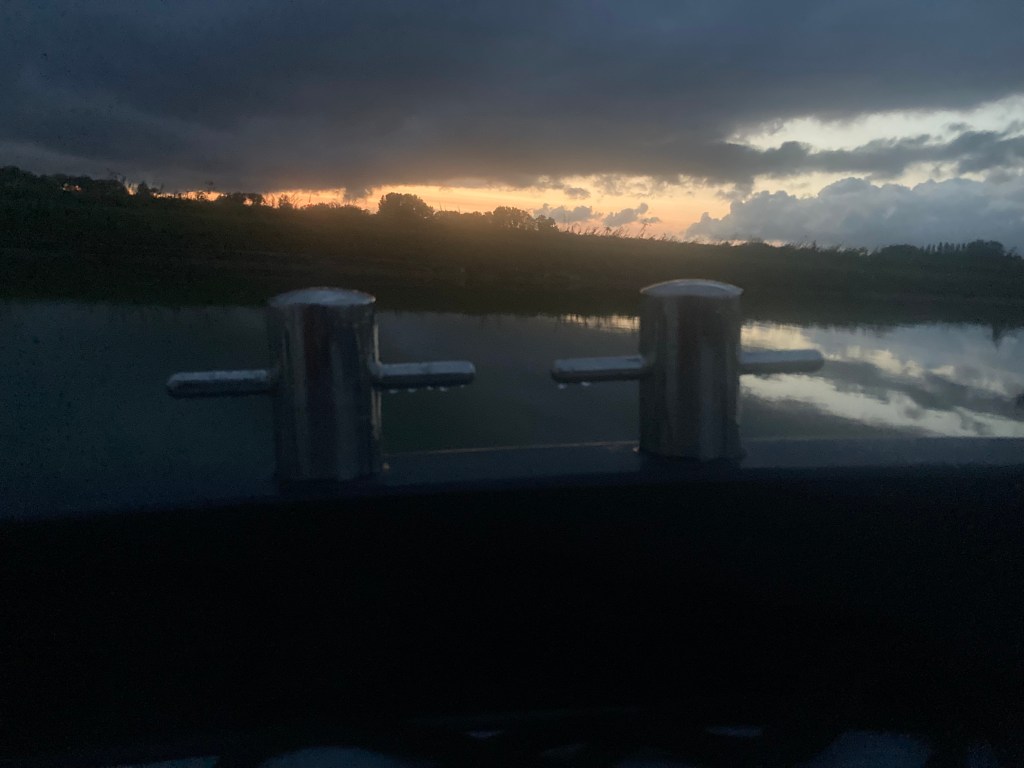
Three hours later, as it got close to sunset, the weather all changed again and we got an idea of what was in store for the morning.
So much better next day! We could enjoy being at the top of the Canal du Nord World!
Next event was a tunnel through the summit, and then we would be locking down towards Noyon.

Pont L’Eveque
It was our last stint on Canal du Nord for this cruise, starting with Libermont, this much shorter, tunnel.

Eight years ago it was the first tunnel we had been through on Calliope, and seemed quite a task.
With more experience under our belts it is far less daunting – in fact quite straightforward.
It is only just over 1 km long, and light can be seen at both ends of the tunnel.
And after the tunnel, as mentioned above, we started going down in the locks – an easier move on the whole.
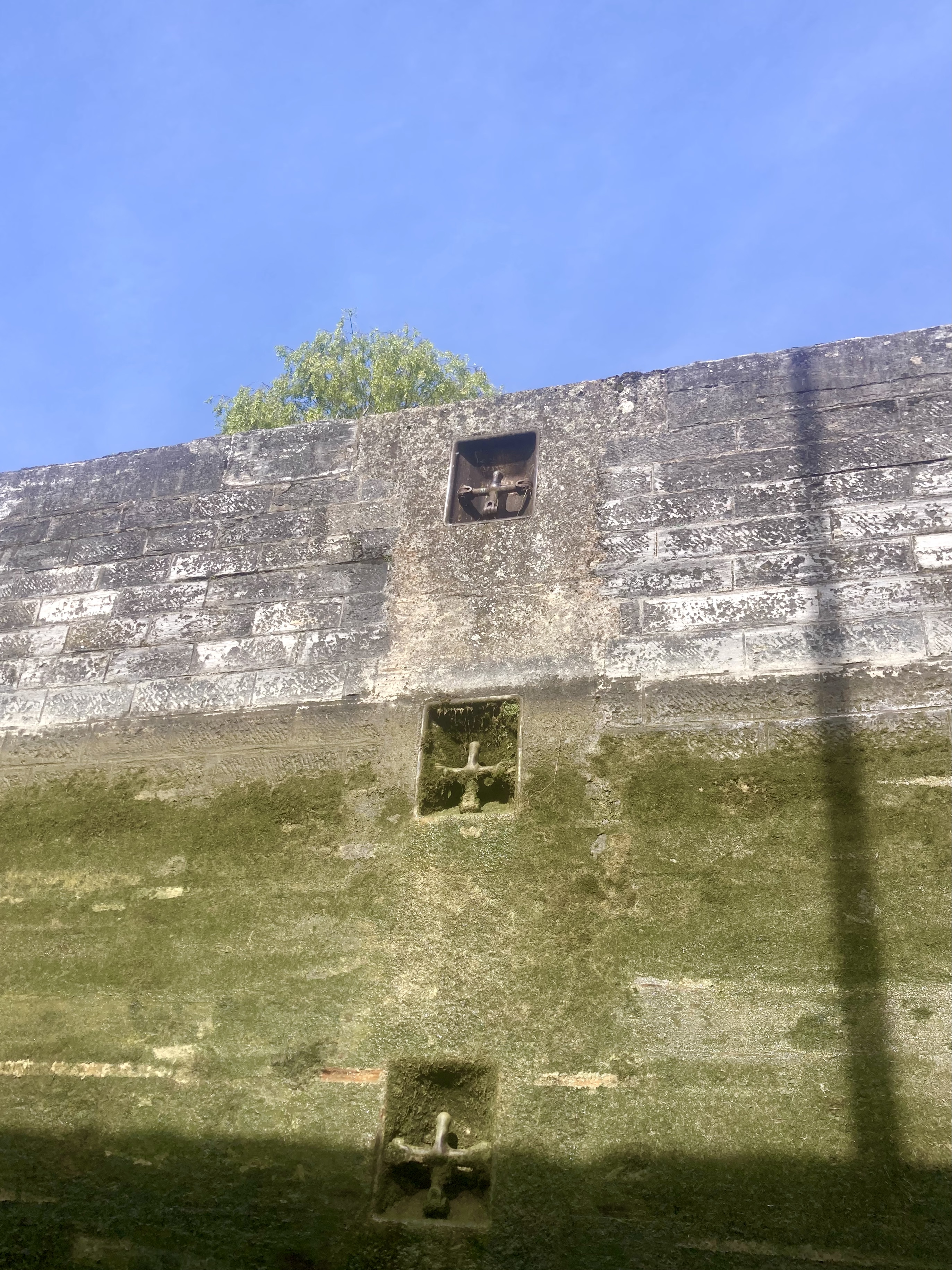
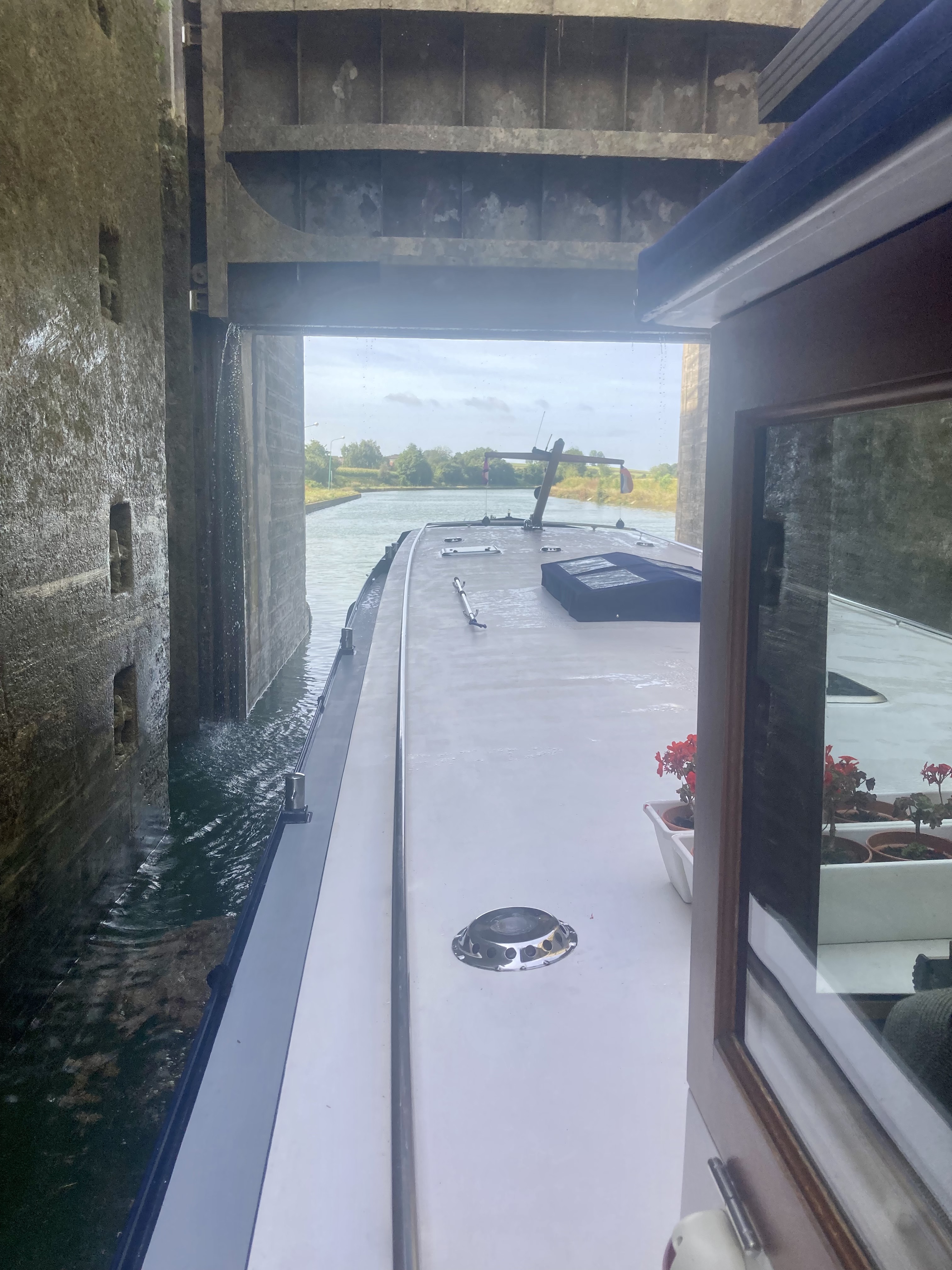
They are still big deep locks, and it is still necessary to make sure there is good communication between foredeck and helm, especially as we move our ropes down the bollards on the wall. It feels like good teamwork.
Now we had the guillotine doors one the way out of each lock. The guillotines are mostly at the lower end of each lock, with more traditional doors at the top.

This photo has just been added in as the name amuses me.
We were waiting above a lock at Haudival for ‘My Boat’ to come up and out; such a great name!
As we neared Noyon we were hoping to stop at the big quay there, which we had read was no longer in use. But when we arrived we found it busy with barges emptying their loads of dredged mud so we carried on to Pont L’Eveque.

There is a mooring at Pont L’Eveque that is right at the bottom of Canal du Nord, between a road bridge and a rail bridge; it is much nicer than it sounds!
From there we could walk back into Noyon to do a bit of shopping, but ran out of energy for also having a beer at the Confluence bar. This bar is right on the intersection between the Canal Lateral à L’Oise and the Canal du Nord, looking out at all the waterway activity. If you are in the area, try it out.

Captain and I settled down for a relaxing evening.
Not so the commercial traffic which continues into the darkness. This photo was taken just before 10pm; three commercial barges arrived and moored opposite to wait for the first lock upwards of the next day.
Lateral à l’Oise
We just had a hop and a skip along the Lateral à l’Oise – just over two hours to go fairly peacefully along the water.
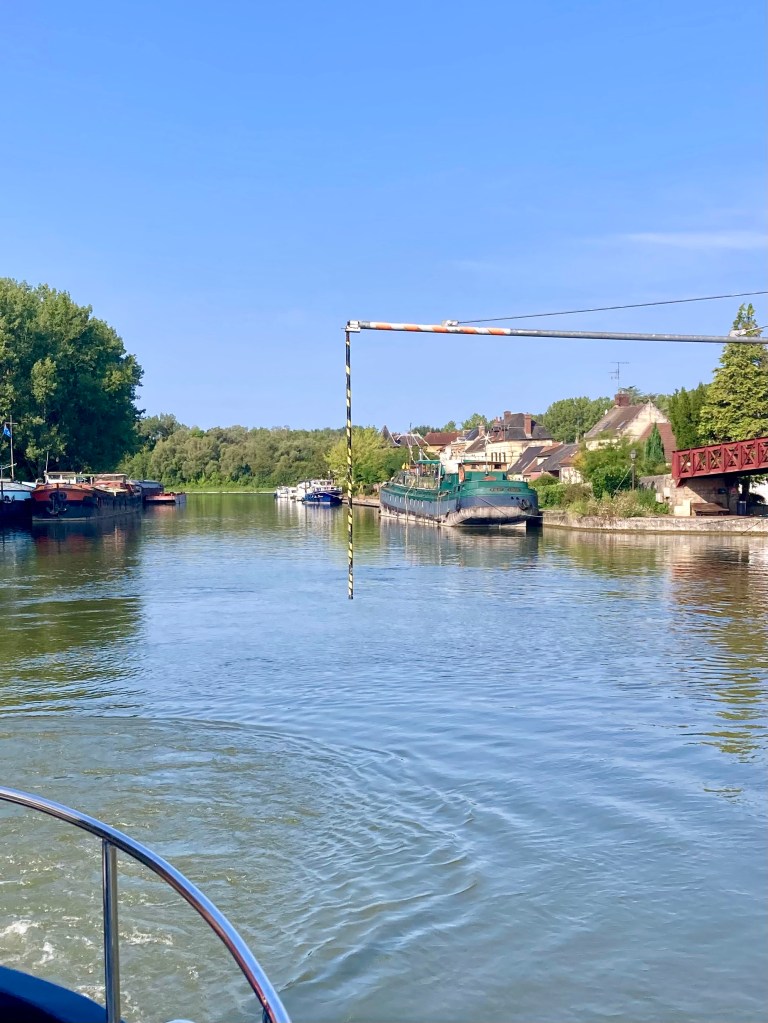
The day began with a turn to port. Basically the Canal du Nord ends at a squiffy T-junction with the Lateral à l’Oise, and we turned east to continue our journey.
It was now up to us to operate the locks and the first thing to do was turn the yellow striped pole to open the lock gates ahead – which we did.
We have been along this way before and were fairly sure that we would need to pick up a remote control for use along this canal, so full of expectation I walked to the grey box that appeared to be publicising remote controls.
But no matter what I tried I could not get one despatched. Also as there was a black line through a sign about remote controls we decided that they were no longer in use; we left the lock and carried on up the canal.

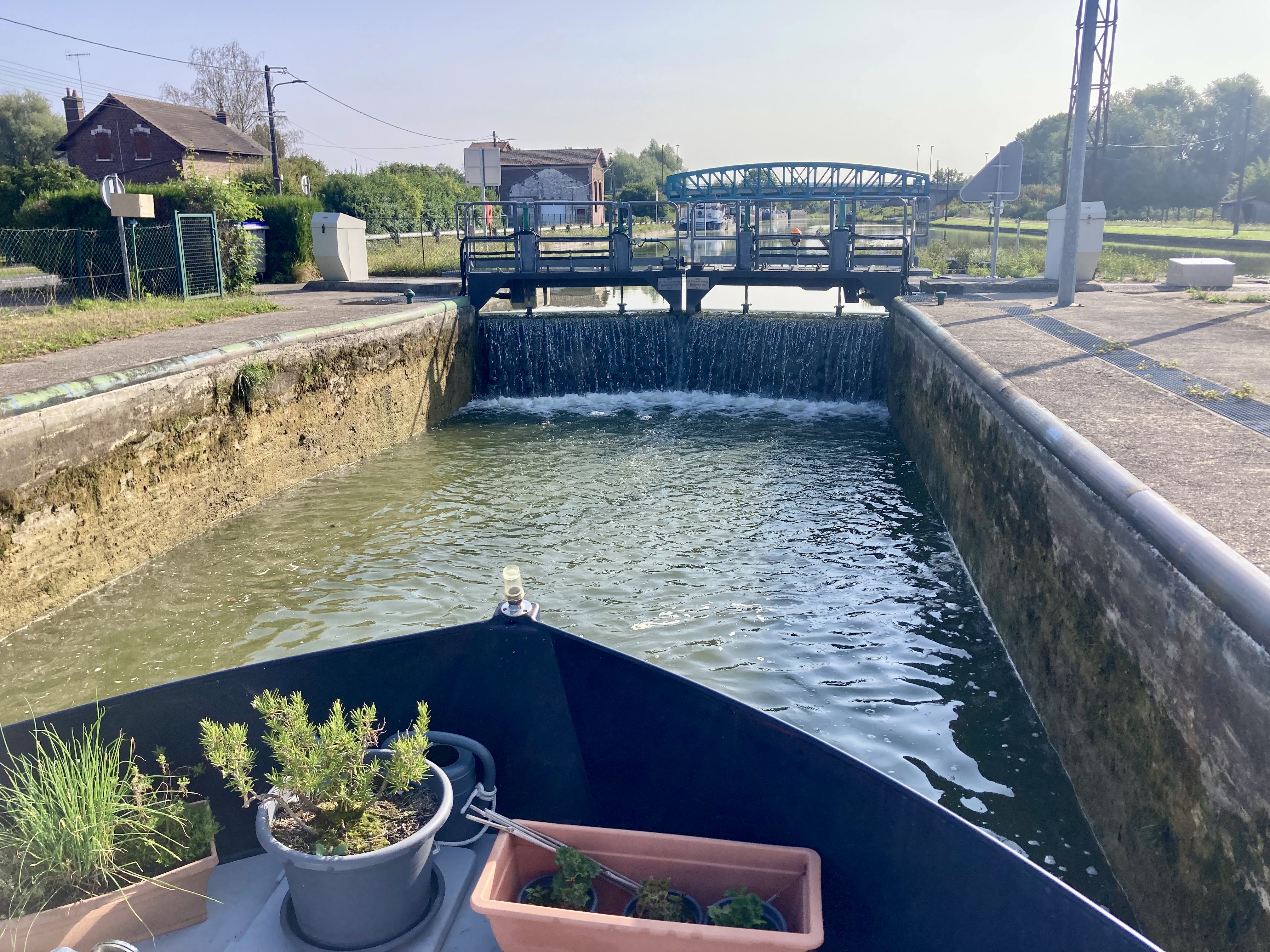
Here we go, eastward ho!
This is a very gentle section of canal, through plenty of countryside and farmland. Overall it is very calming on the soul after the commercially busy Canal du Nord.
We did encounter however one bit of a whoops. On arriving at the next lock we looked in vain for a pole to turn to open the lock gates. There was none. So plan B was put into action – get close enough to the bank forcer (me) to jump ashore, go up to the lock and look for clues.
Often there is an easy way to connect to the VNF office. Before I could find it, even better a VNF van arrived, with an amused man inside. He handed me the remote control that we should have found at the previous lock! I don’t know how we missed it, but he had chased down the canal to bring it to us.

With remote in hand we could carry on, knowing that it would see us along not only this canal, but the next two as well. Once more we could sit back and enjoy the green and blue of the scenery.
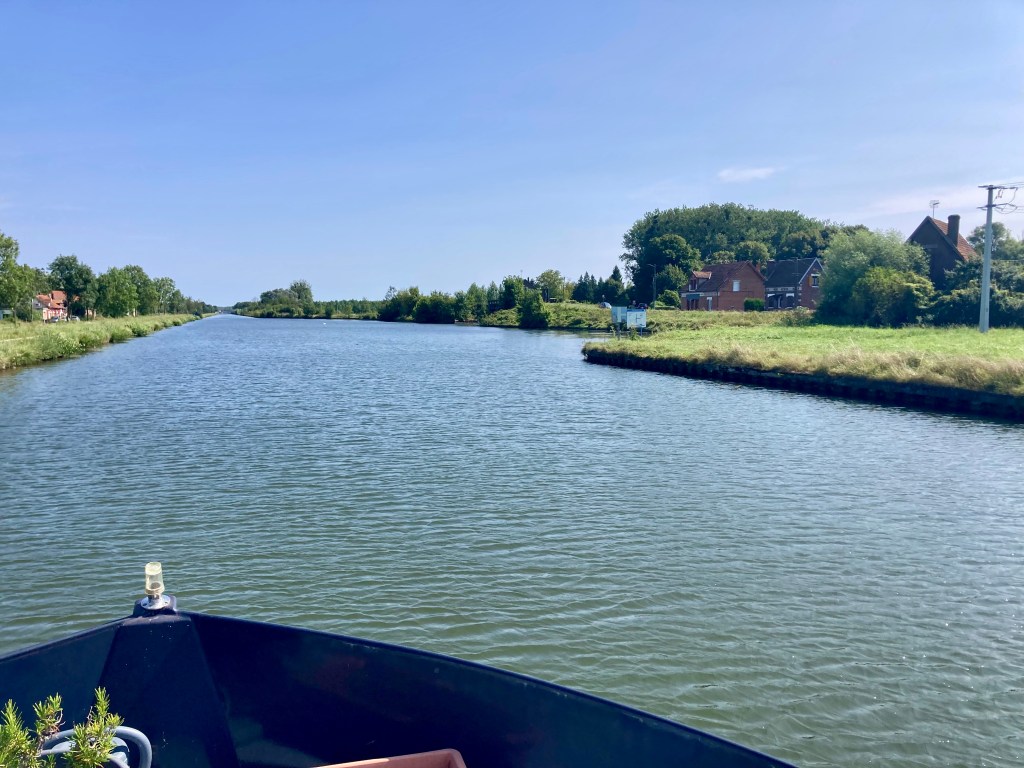
It seemed no timer at all before the canal broadened out and a turning to the right came into view.
This was our turning. We were going south on the canal that links the river Oise valley to the river Aisne valley.
Canal L’Oise à L’Aisne

The first thing to do was go under a bridge. And the second thing to do, within minutes, was to go over a bridge.

It was a bridge over the river l’Oise, which was running away on both directions at right angles to our new canal.
We were aiming for Guny, 11 kms along the canal. The description of the mooring sounded good in the DBA (Dutch Barge Association) Waterways Guide. This guide is almost our bible for finding places to stay, knowing where to find water, shops, electricity, trains etc etc.

This time the mooring information came with the phrase ‘immediately below conspicuous red bridge’ – and we did! It is a very agreeable place to spend one night when on one’s travels. There are no facilities here beyond rubbish bins, but we had no need to water or electricity and could enjoy a lovely late summer evening there.
Soon after we arrived another barge came in – Dilligaf. We had briefly met the Australian owners of this lovely boat at least twice before. This time we would have a chance to share some wine and nibbles at one of the shady picnic tables in the little canalside park. We really enjoy this ‘neighbourly’ aspect to barging. You may not see someone for years, and then. suddenly they are moored alongside you again and the friendship is rekindled.
Continuing on in the morning we began to understand the canal’s own lock building vernacular.
The canal opened in 1890, art nouveau times. This is definitely seen in the lock buildings, rounded on three sides and flat on the fourth, with distinctive white borders to windows, door and a decorative collar.


This canal is narrower than the last, or it seems so. It might just be that it has become so overgrown with lack of commercial use that it seems narrow.
At the same time it makes it very pretty, and popular with wildlife, especially birds.
More than one kingfisher was spotted along here – always a delightful sight.
We were taking it easier now that there was no mad dash to get through Reims; just a 15km day to our next stop at Pinon / Ainzy-le-Chateau. The mooring is on the Pinon side of the canal, with Ainzy up a small hill opposite.

It looks a very rural mooring in this photo, and it is definitely a tranquil place to stop.
In fact it is about a two minute walk from a good Carrefour supermarket, not far from main Aldi, and a 15 minute walk further into Pinon takes you to a big pharmacy and a rail station. The other side of the canal in Ainzy-le-chateau are two boulangeries, a post office and other retailers.
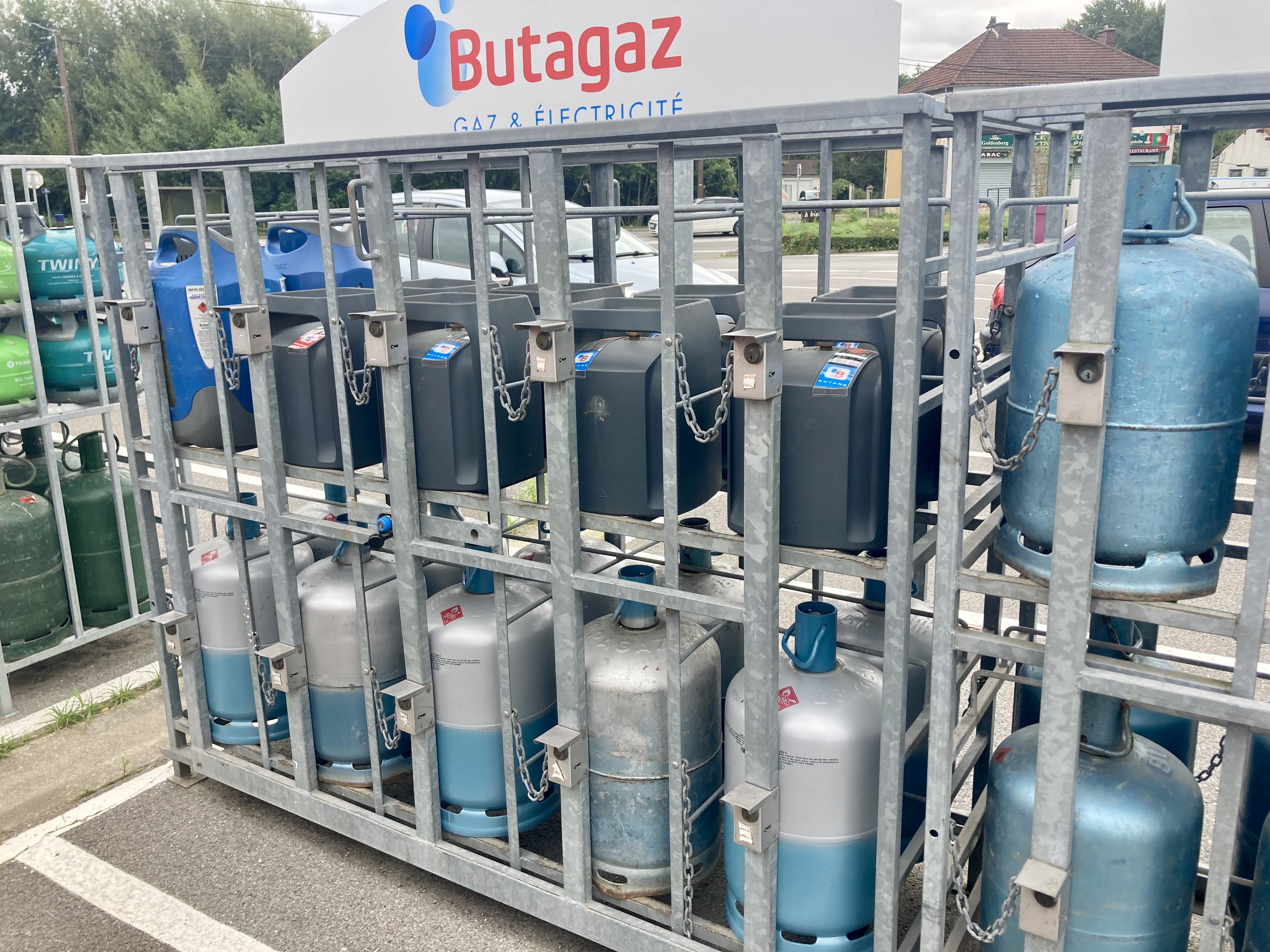
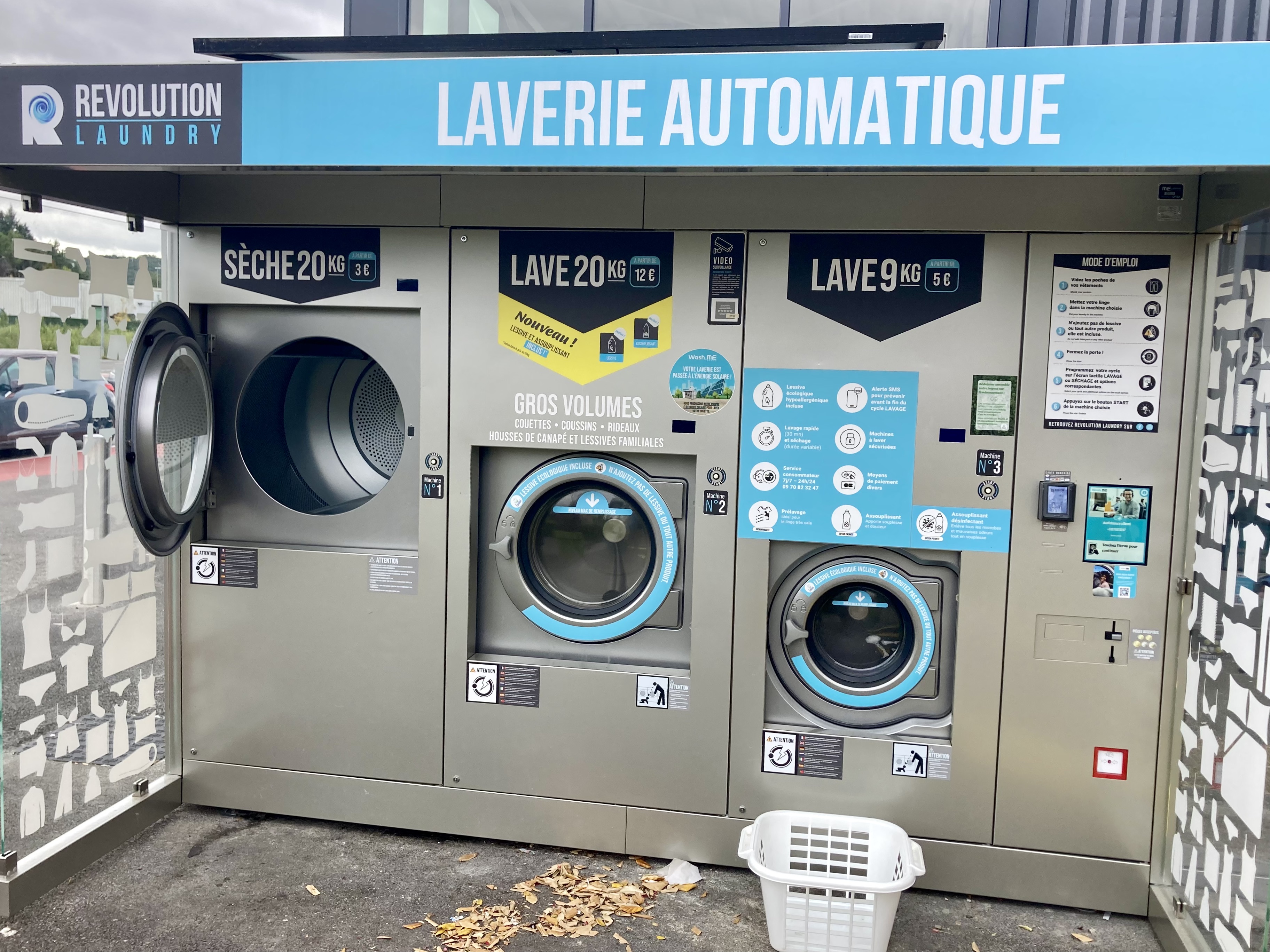
In addition to making several trips to the supermarket (I kept thinking of other things I could buy) we took advantage go the other Carrefour services. We needed a new spare bottle of gas; Stewart was in charge of that. And we decided to use the big washing machine and driers that were on hand, even though we have them on board; I was in charge of that.


It was now late August, and the bushes around the mooring had started to show signs of Autumn, generating a beauty that we all know so well.
But the slight change in seasons did not stop the warmth of the sun in the mornings and the enjoyment of breakfast on the back deck.
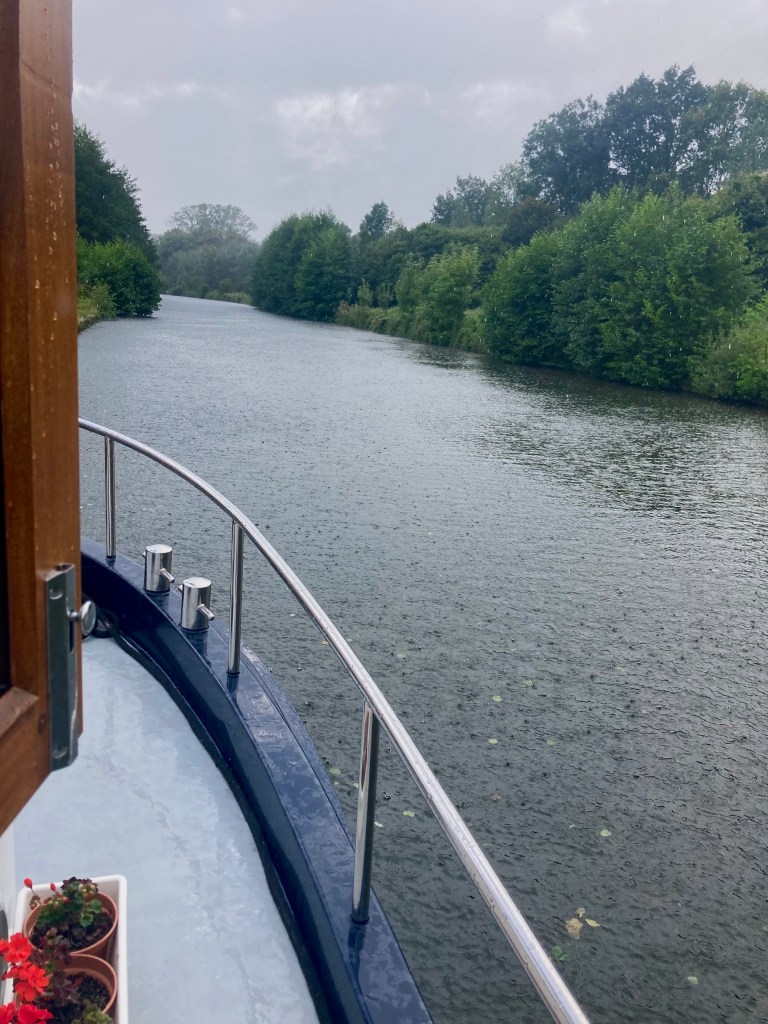
Although by that evening the skies had darkened, and later thunder arrived.
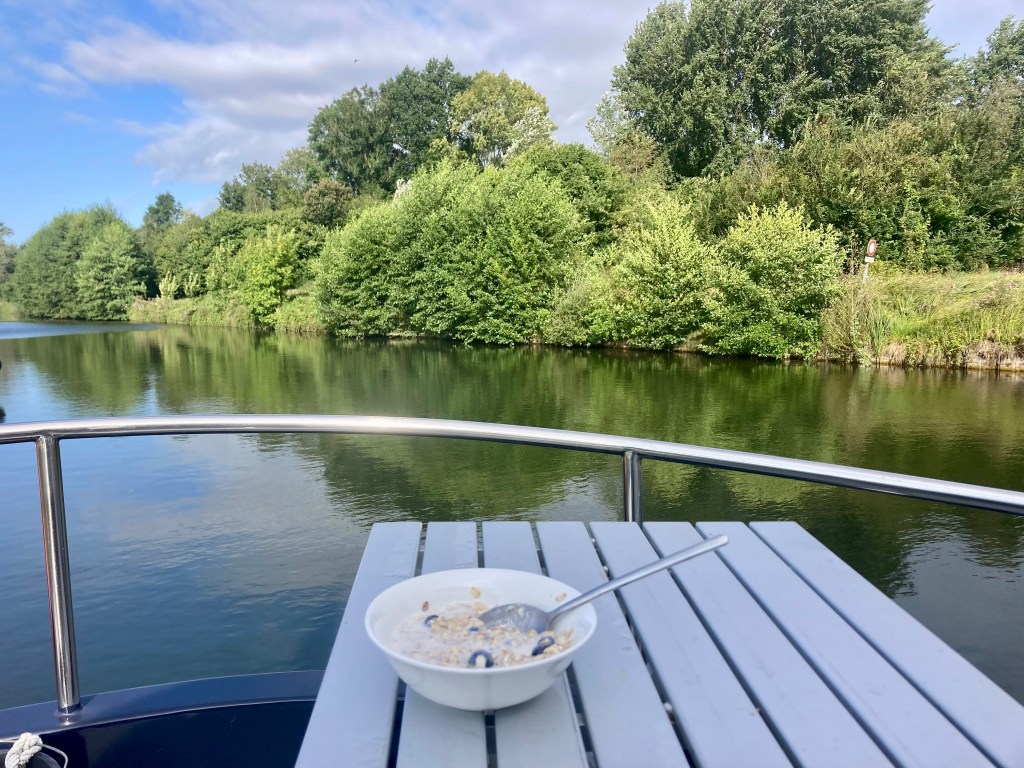
We liked the mooring so much that, now we don’t need to dash to Reims, we decided to take a day off and have a second day in the area – lots of R ‘n’ R. That is not Rock and Roll!!
Things were a little different at the locks in this canal; here is a collage of things that interested me.
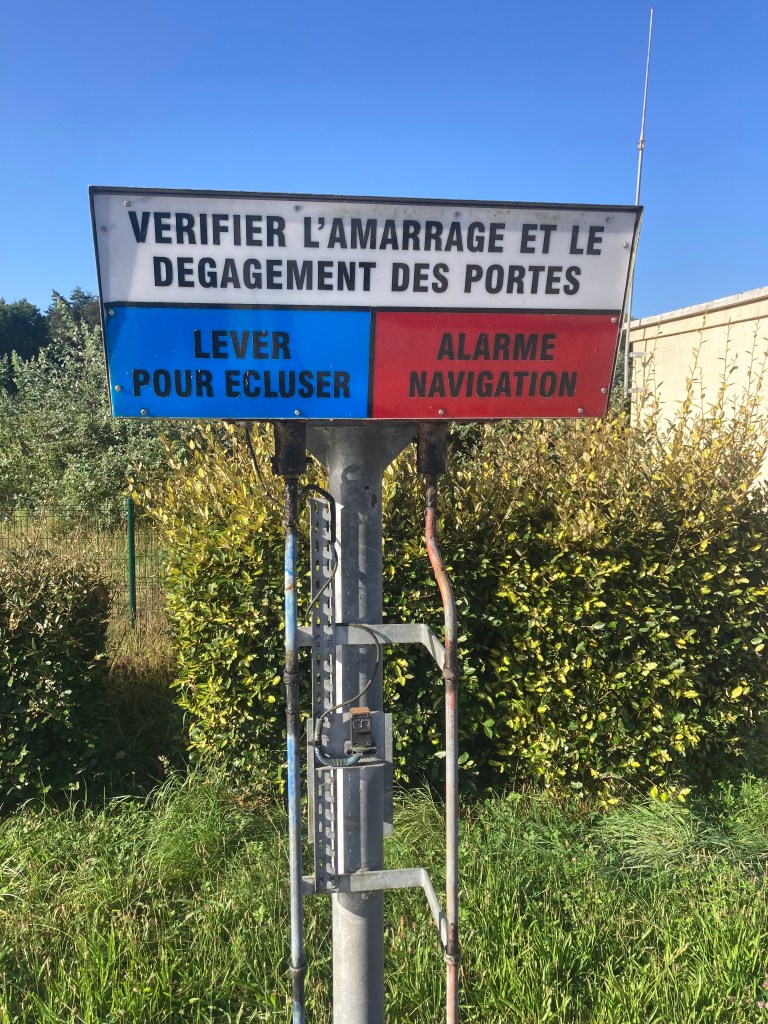
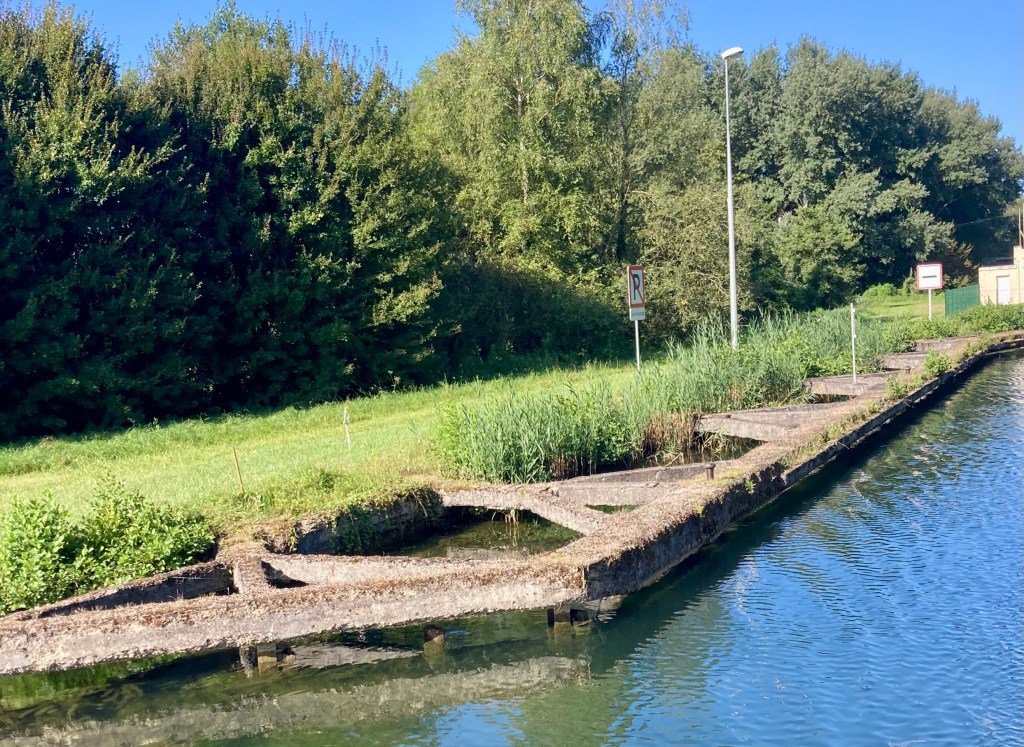

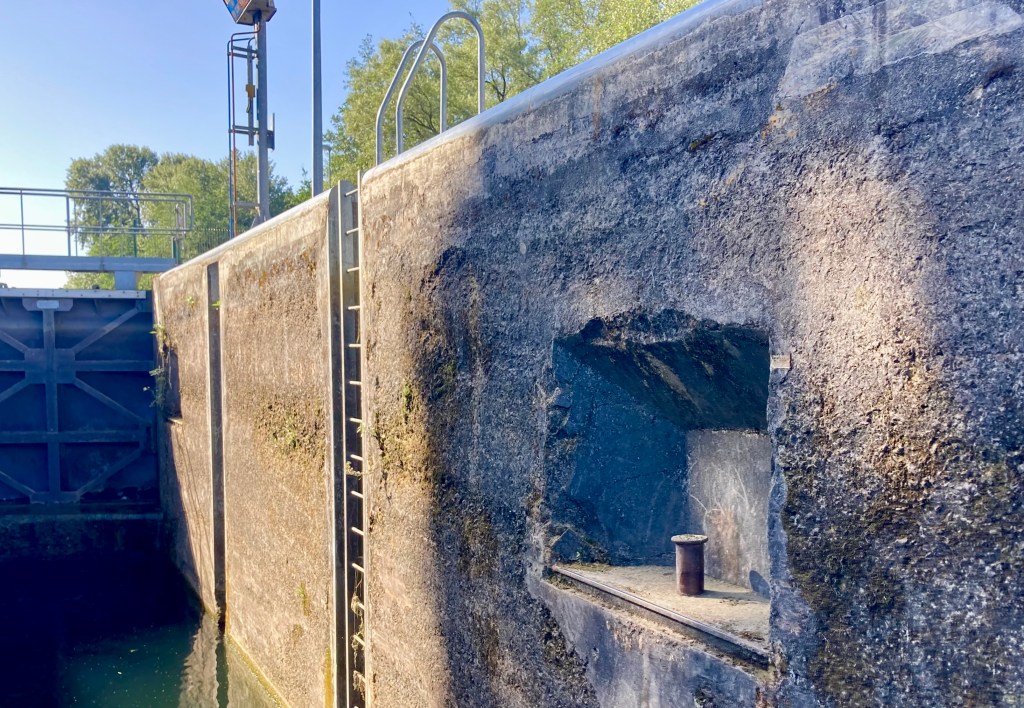
The positioning of the blue operating lever right at one end of each lock was very inconvenient for our 19.8m barge, but presumably works well for the freycinet size commercial barges that used to ply these waters. For us it meant – taking crew to the ladder; up the ladder with forward rope; reverse barge to get bollard for stern rope; walk along lock quay to push blue lever, then stay at the top managing the forward rope until Calliope floated to the top.
As soon as we had established a routine it was easy enough. It is these small challenges that keep us alert. 😁
We were on our way to the summit of the canal and a tunnel that would take us from the Oise to the Aisne side of the hill.

We were doing quite well with our new routine and the sunny weather, but then came to a lock where the gates did not open. Captain Stu tried bouncing on the gates to see if that would ‘un-trap’ whatever problem there might be.
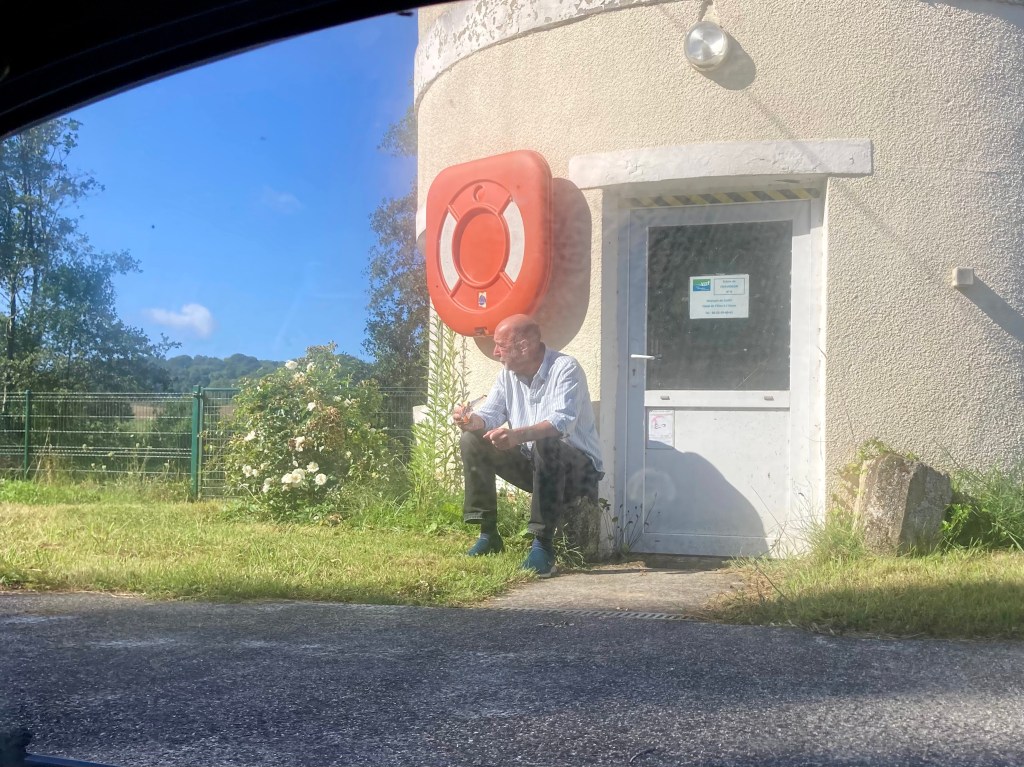
All to no avail, so we resorted to the tried and tested method of phoning the VNF and waiting for help to arrive.
Stewart found a handy seat in the sun on which to wait.
The wait was not too long. We only had one more lock to the summit pound. Coming out of that lock turned out to be spectacular.
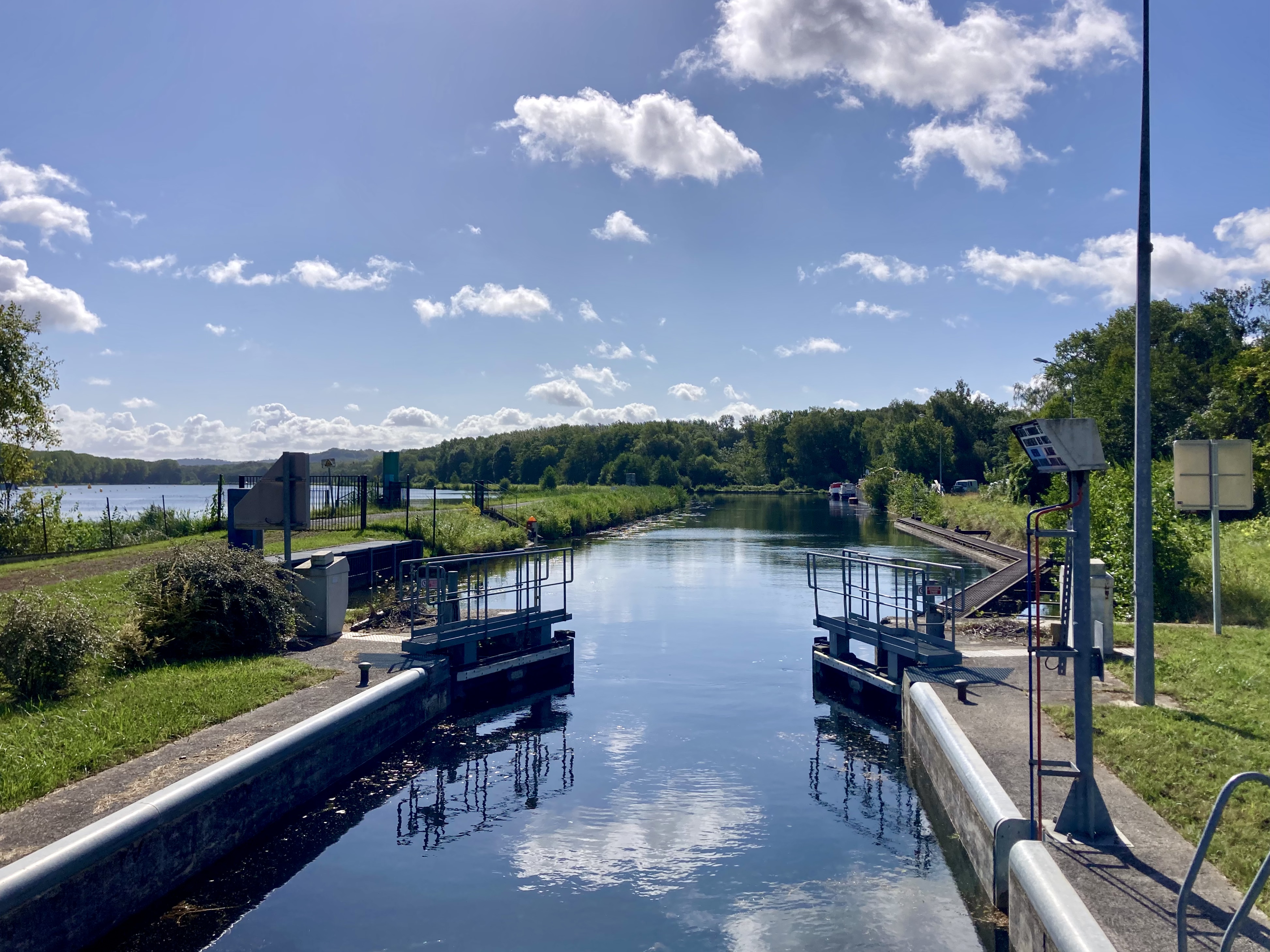
We had reached the top, and the top consisted of a big blue lake with the canal running alongside it. The lake is used for all kinds of nautical fun – sailing, paddle boarding, kayaking and more.

As we started our cruise around the edge of the lake we found a few boats moored up, including our Dilligaf friends who had moved on ahead of us.
A quick ‘over-the-water’ conversation established that we both hoped to moor at the bottom of the canal, Aisne side.
It was so beautiful up there I am including another photo of the lake. I am fairly sure that the lake, Basin de Monampteuil, is the head of the river Ailette, which flows down to join the Oise.

The Monampteuil basin was specifically designed to regulate the underground boat traffic, ensuring the level of water in the Braye-en-Laonnois tunnel, which we were about to reach.

We arrived to find a red light at the tunnel entrance; the waiting area is a lovely spot so it was no difficulty to wait 20 minutes.

After about 20 minutes a small cabin cruiser popped out of the tunnel.
Now it was our turn for the 2360m travel under the Chemin Des Dames, a sadly notorious area during WW1.

Every tunnel has its idiosyncrasies; it could be wide or narrow, have no path alongside, or one, or two; be lit or unlit; be straight or curved.


In the scheme of things this was a straightforward tunnel and only took 20 minutes to go through. From the start we could see ‘the light at the end’ so Captain Stu had something to aim for.
We came out into more sunshine, and a different terrain.
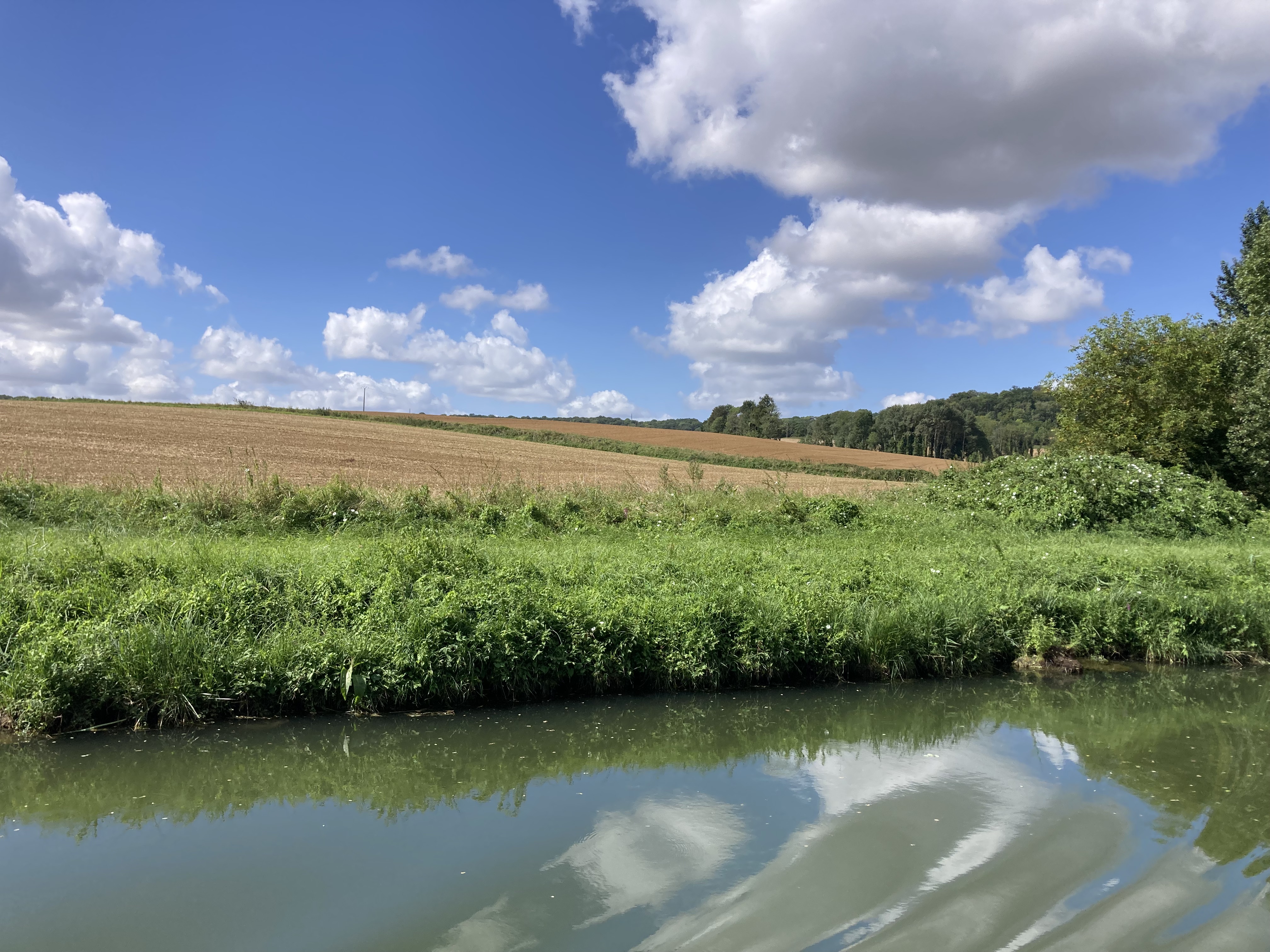
After the narrow feeling of the overgrown canal the other side of the hill, this side was open and joyous in its views .
There were 4 locks to take us down to the level of the river Aisne and the canal that runs ‘laterally’ beside it.
Three were between 3.5m and 3.75m deep, but the first one, according to the map, is ‘3.19 à 3.39’.
That somehow led me to think there would be two locks, one of 3.19 and one of 3.39, leading into each other.
But of course that’s not what it means. It means that the lock depth can vary between 3.19m and 3.39m, presumably dependent on the flow from the lake at the top!

And here it is, as we leave it.

It looks like we came through at the lower depth level as there is plenty of room above the waterline.
It’s also another good view of the positioning of the lock control levers, each end of the lock again. And of those lovely big alcoves for the bollards in the wall, making them much easier to use than those on the Canal du Nord.
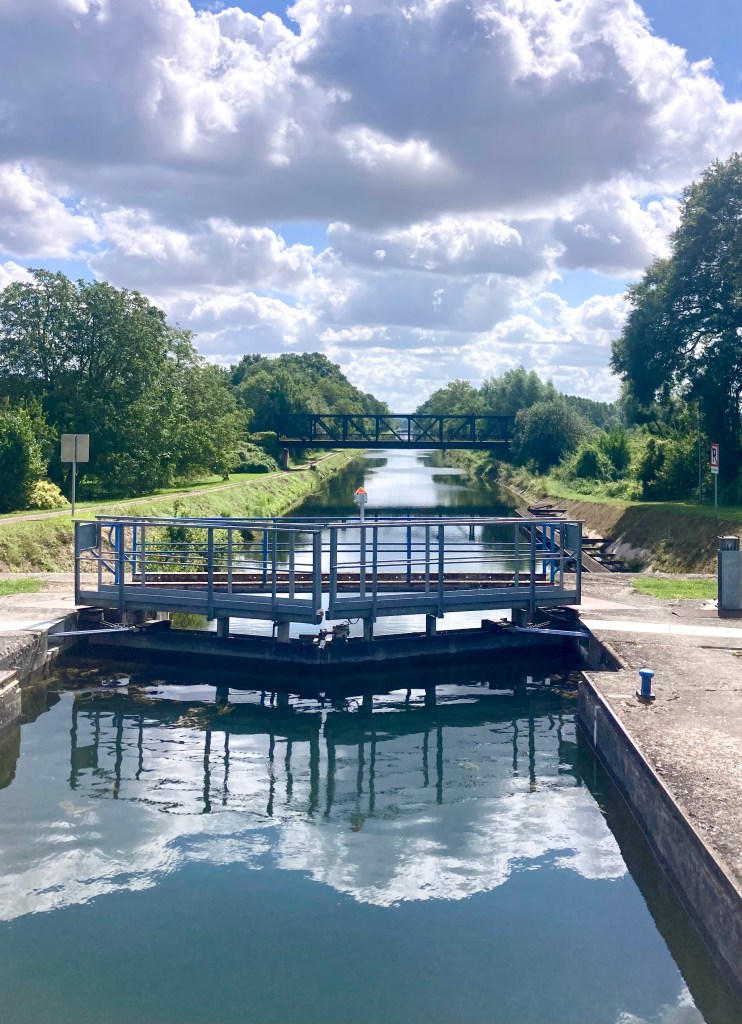
By the time we got to the third lock, Soupir, we were on a straight line down to the bottom.
I love these views, skies reflected in the water and green countryside all around.
Not much more than an hour after coming through the tunnel we were nearing the end of this canal.
Although not yet the end of August some plants saw Autumn coming and were putting on their golden colours, like this creeper, curtaining our way.
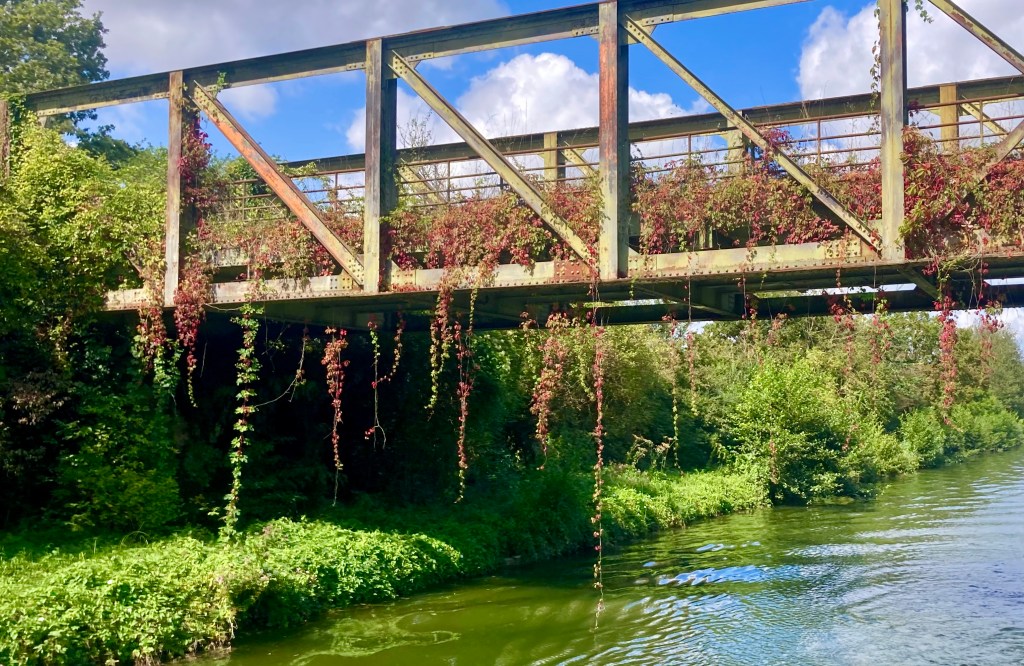
The canal ends at Bourg-et-Comin, a small commune built on the banks of the Aiosne and since C19 finding itself at the junction of two canals.
In 1925 an electricity power station was built, powered by 3 turbines using water from the canal system and still supplying electricity to 35 local towns.
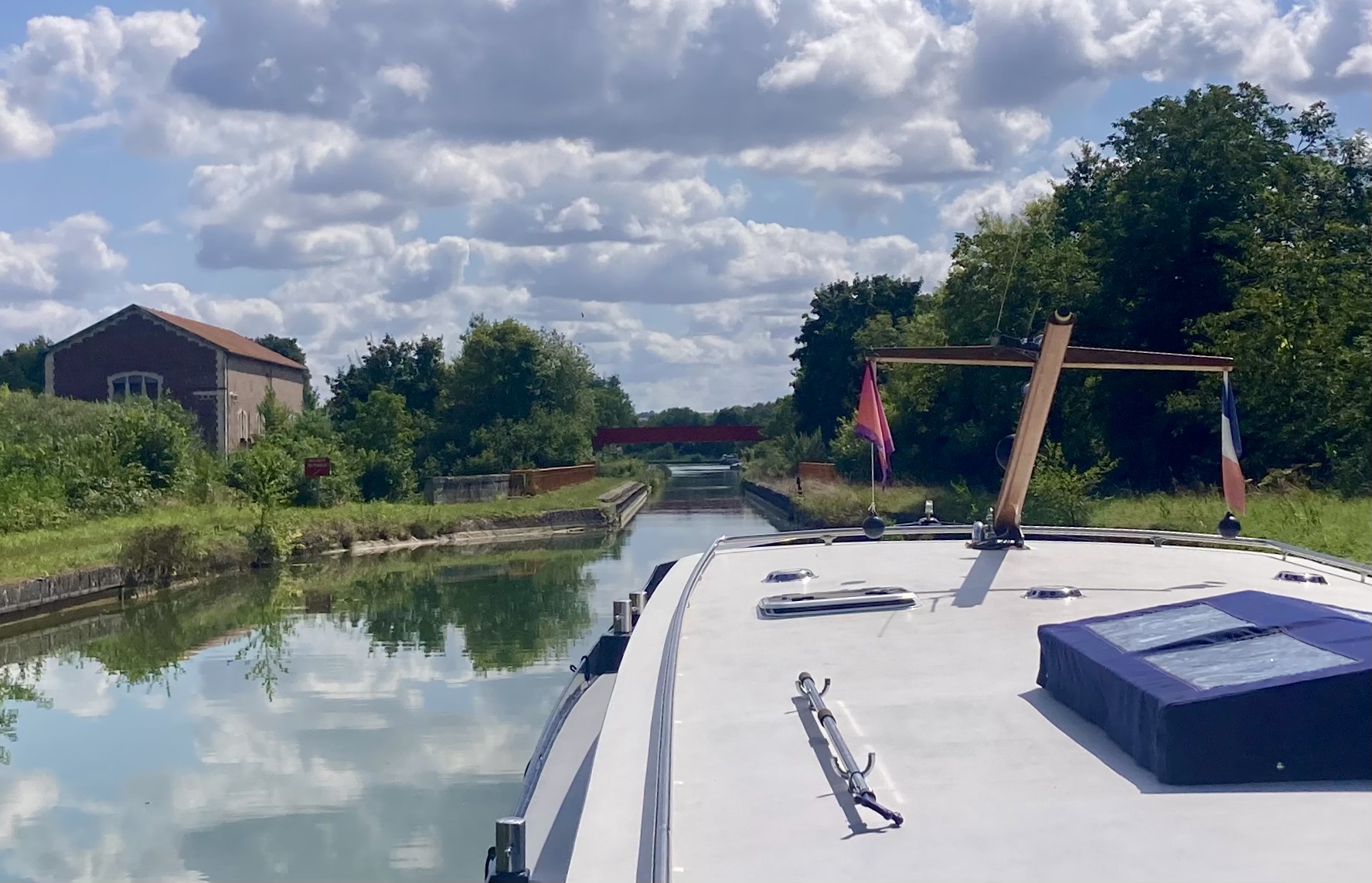
There is it on the left, as we pass through the last narrow section of the canal to where it joins the Lateral à L’Aisne.
We had hoped to stop here for the night, but it is only a short pontoon and was already full of other boats. Not a big problem; it was only 1330, so we turned to port and continued onto the new canal.
Canal Lateral à L’Aisne
I looked on the map for somewhere else we could stop for the night and it looked like we would have to continue for 20 kms to find somewhere we would like – in fact somewhere we had moored twice before – Berry-au-Bac.

It’s a straightforward 20km cruise, with no locks or other ‘obstacles’. We metaphorically sat back and enjoyed the journey and the scenery. There is just one small village, Maizey, to pass; the rest is woods, fields and hills.
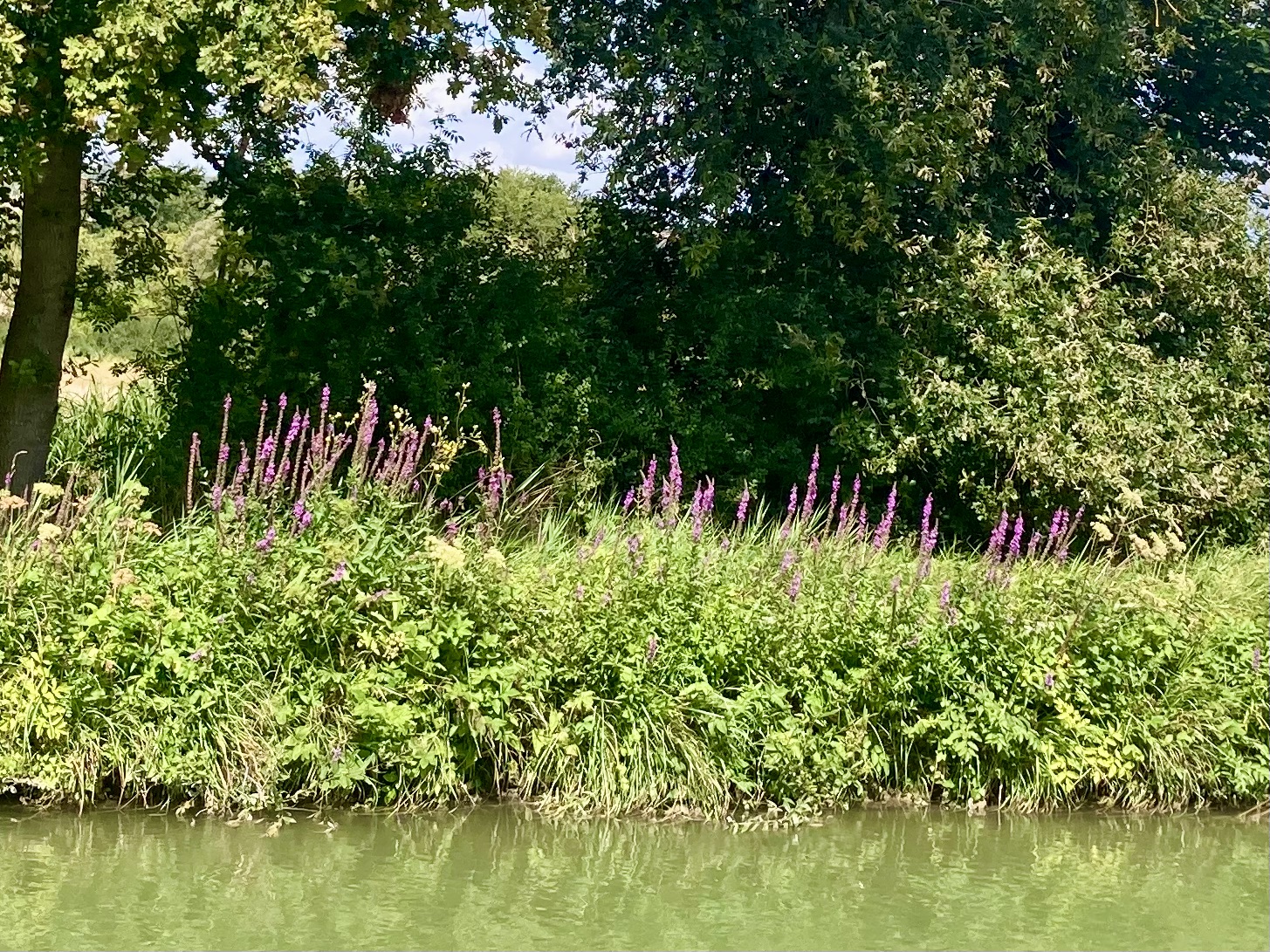

There was late summer colour along side the water, including the end of the sunflower crops, still yellow but soon to hang their heads and turn brown. At that point the seeds would all be harvested.

By 4pm we were tied up at Berry-au-Bac, below the lock.
It is a busy area for commercial barges, both behind our mooring and the other aside of the lock, and we were pleased to find this peaceful spot.
Everything was looking good – another 42 kms achieved, even though we no longer needed to make such speedy progress.
It wasn’t too long before we were relaxing on the back deck again, enjoying the later afternoon sun and watching what was going on with the commercial barges moored astern.
Both of us were there! I think the Captain must have had his beer in his hand.
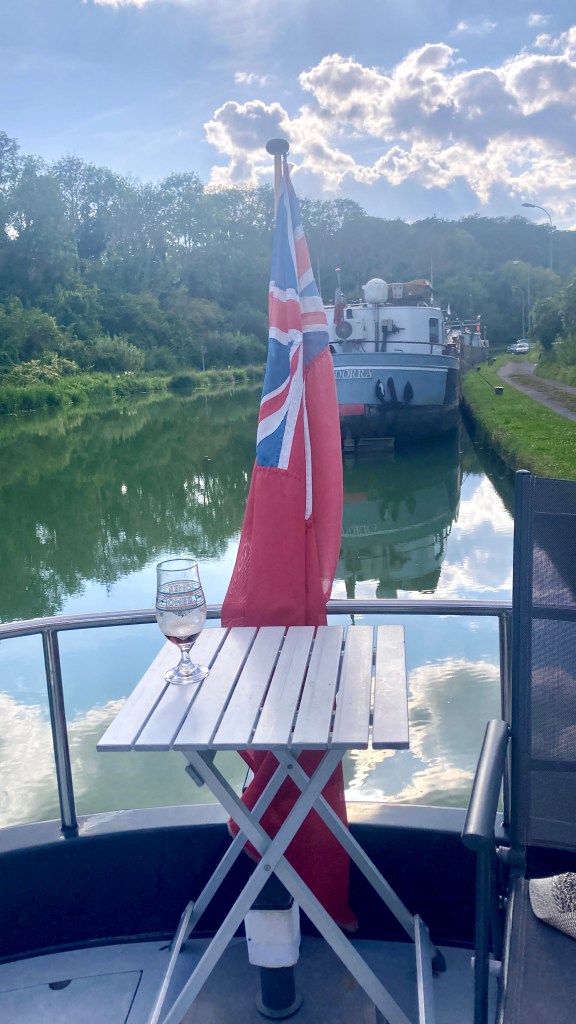

Well apart from going through the lock just ahead that was us complete with our short time on the Canal lateral à l’Aisne for now – time to change the map book.
We went to bed peacefully and confident about the next stage of our journey.
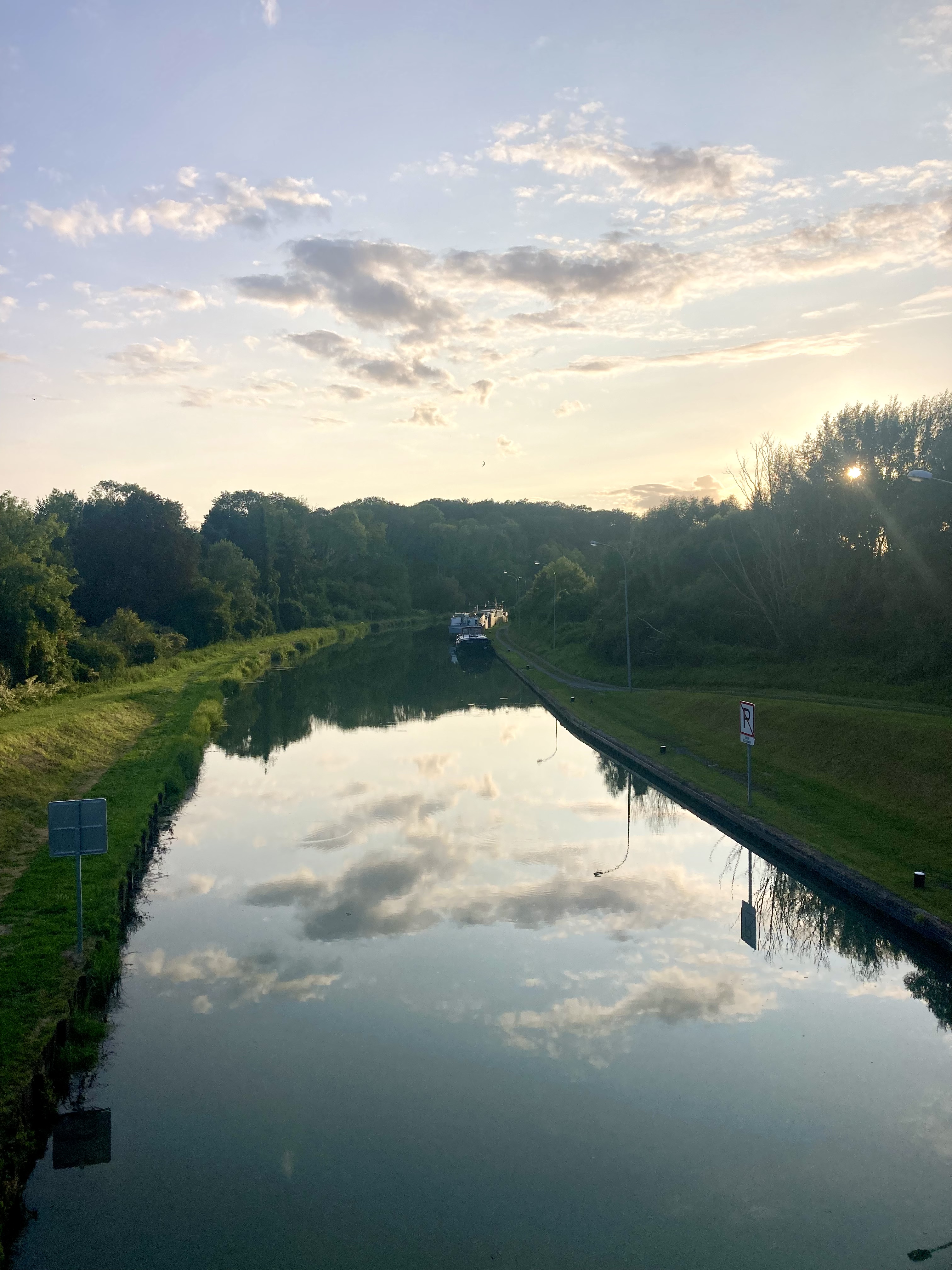
The next blog post, Hivernage Bound – Part 2, will tell how our plans were disrupted!
The Leie, the Schelde, and the Canal Bossuit-Kortrijk
August 8th to 17th 2024
It had been an interesting summer, cruising north from Saint-Jean-de-Losne in France to Diksmuide in northern Belgium in order to get our hull repainted, followed by a two week holiday by the sea at Nieuwpoort.
Now we had come about 75kms south to the small town of Deinze on the river Leie. Here we were to be ‘invaded’ by the first of two family groups – daughter Hollie, with husband Richard and granddaughter Sofia.
So a slight warning to those who read the blog to hear about boats and cruising; this post also includes a fair amount of us having fun at the places where we stop.
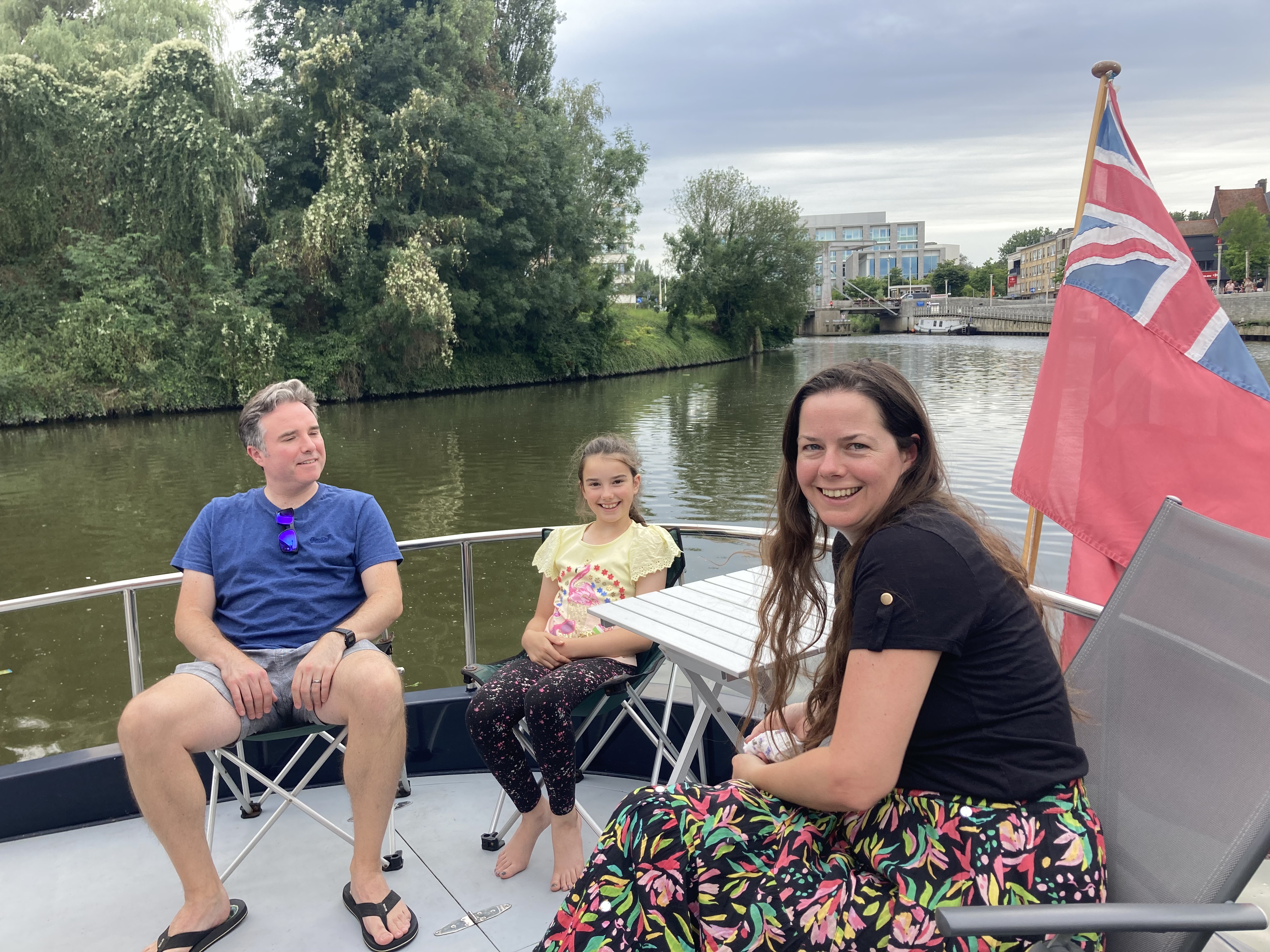
It was so good to have them with its on Calliope again.

For our first meal together we ate out at one of the many restaurants in Deinze – it was called tapas, but was far bigger than we expected.
Very tasty!
Although they were only with us for 3 nights, and had to be back in Deinze to pick up their car, we were determined to go for a mini-cruise. So next morning we set off down the Leie towards Gent in the hope that the little Sint-Martens-Latem mooring would be free.
The weather was perfect for the winding way through the country to Saint-Marten. In fact it was so lovely, and with such good crew, that I clean forgot to take any photos until we got there!
The river has so many twists and turns, some almost hairpin in shape, and runs past some of the most expensive and individual houses in Belgium, each with a big lawn down to the river. The gardens are adorned with sculptures, sophisticated seating areas, private pontoons and carefully cut shrubs, so always something to see.

Our arrival at Sint-Marten was a golden moment – a totally empty pontoon! We were soon moored up and able to enjoy our lunch.
After eating it was ‘walk-round-the-village’ time. Stu and I have been here before, a couple off times, and know that it is quite an arty place. Apparently it developed as a bit of a bohemian commune in the last century as artists escaped the smoke and noise of the city.
Now it is part of the rich folk’s commuter belt for Gent, retaining its artistic connections through beautiful (and expensive) art galleries.

We walked to see the well preserved old windmill, and then spent quite some time in one of the galleries. If you like modern style art it is well worth a visit.
By then we were all quite hot and thirsty so a stop at a shady table in the bar was inevitable, and enjoyable!

All too soon we were walking back down to Calliope …..
… who was just poking her bow into view!
Look closely!
The rest of the lazy afternoon and evening was spent aboard, feeding ducks, buying ice cream from a nearby van, and simply being together in this beautiful tranquil place.
Although there were moments when it was not quite so tranquil and the family fun took over!
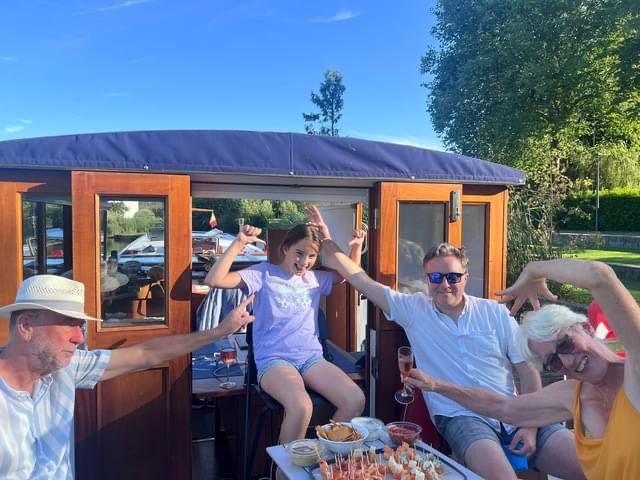
Next morning we were greeted by another clear blue sky. We soon took down the front windscreen in preparation for the journey, and after breakfast we were ready to go.
The cruise back to Deinze was an opportunity for all trainee helms-people to get in some practise!
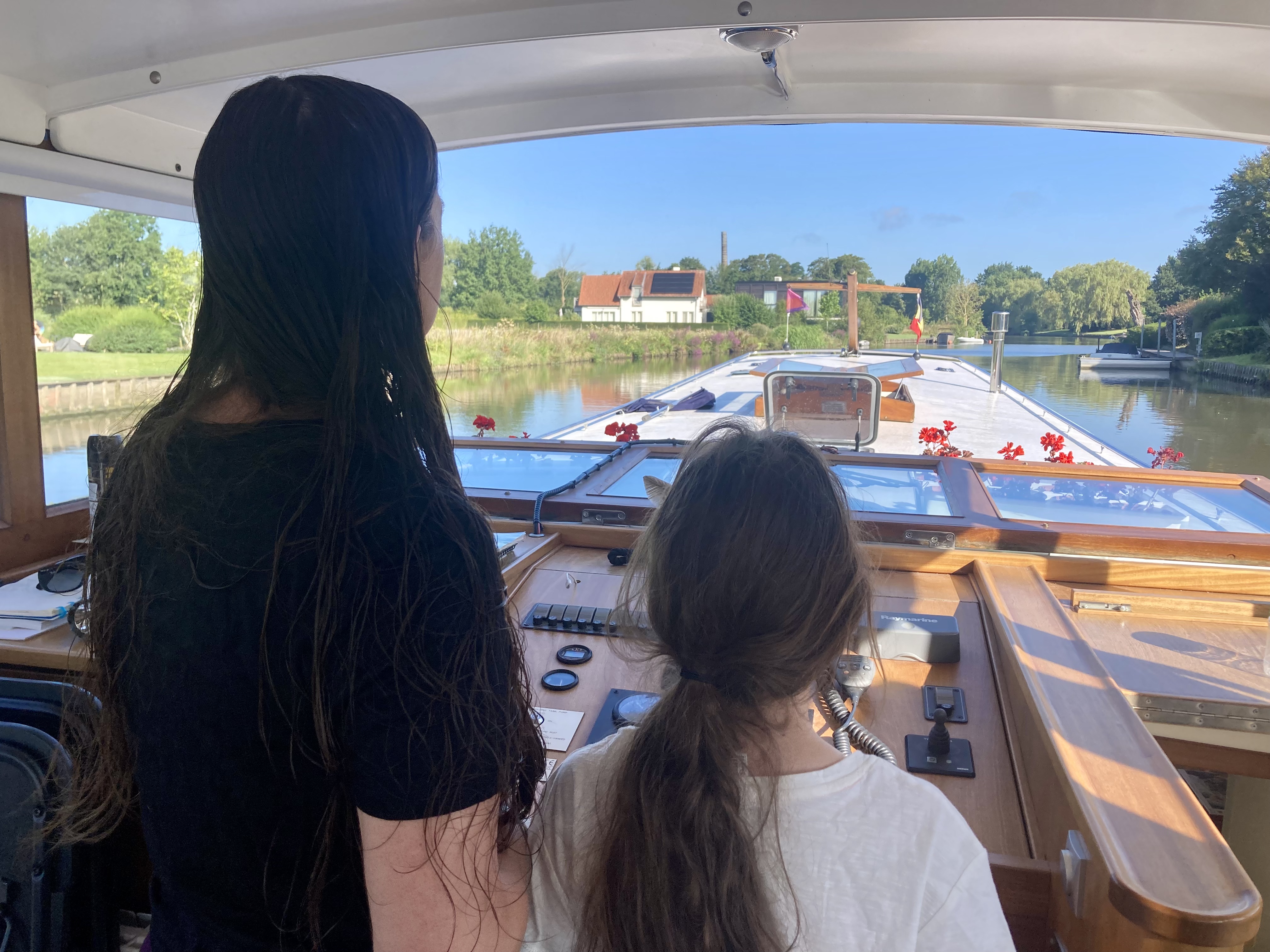

…. or relax on the fore-deck! This is our peaceful spot; sitting here almost the only sound is the swish of the water parting around the bow.

The perfect spot to watch the river unwind ahead.

We spotted the usual ducks and herons, the occasional moorhen or coot, and the very special jewelled flight of a kingfisher.

Not far out of Deinze is the one ‘obstacle’ of the trip – going through an old, unused, lock.
It is at Astene, towards the Eastern edge of Deinze.
Although the lock is now not in action, the lift bridge at one end still needs to be raised for boats of Calliope’s height.
It is still manually raised; a phone call to the ‘Bridgman’ brings him to his crank handle. You can just see him at work, in his red shirt.
We were back in Deinze in time for lunch aboard, and then a walk in the town’s interesting park – part playground, part arboretum, part menagerie.
There is such a mix of things to see and do. It was another quite hot day so we sought out the shade of the trees as much as possible.

Stu and I have been to the park a couple of times before and all the photos I wanted have been taken already. But I did get a couple of family shots. This one of daughter Hollie enjoying a view out across the park.
A couple of days before, we had found out that there was to be a hot air balloon festival that evening, apparently with 27 balloons all taking off from one car park on the edge of the river.
It seems a bit unlikely – had something got lost in the translation from the Flemish? We left the park, found a pop-up bar, and then a fritterie for our early evening refreshments, and finally a place to sit on the grass across the river from the car park.
And then it began!!!! All I can do is provide a few photos of a most surreal experience that went on for about an hour and a half.


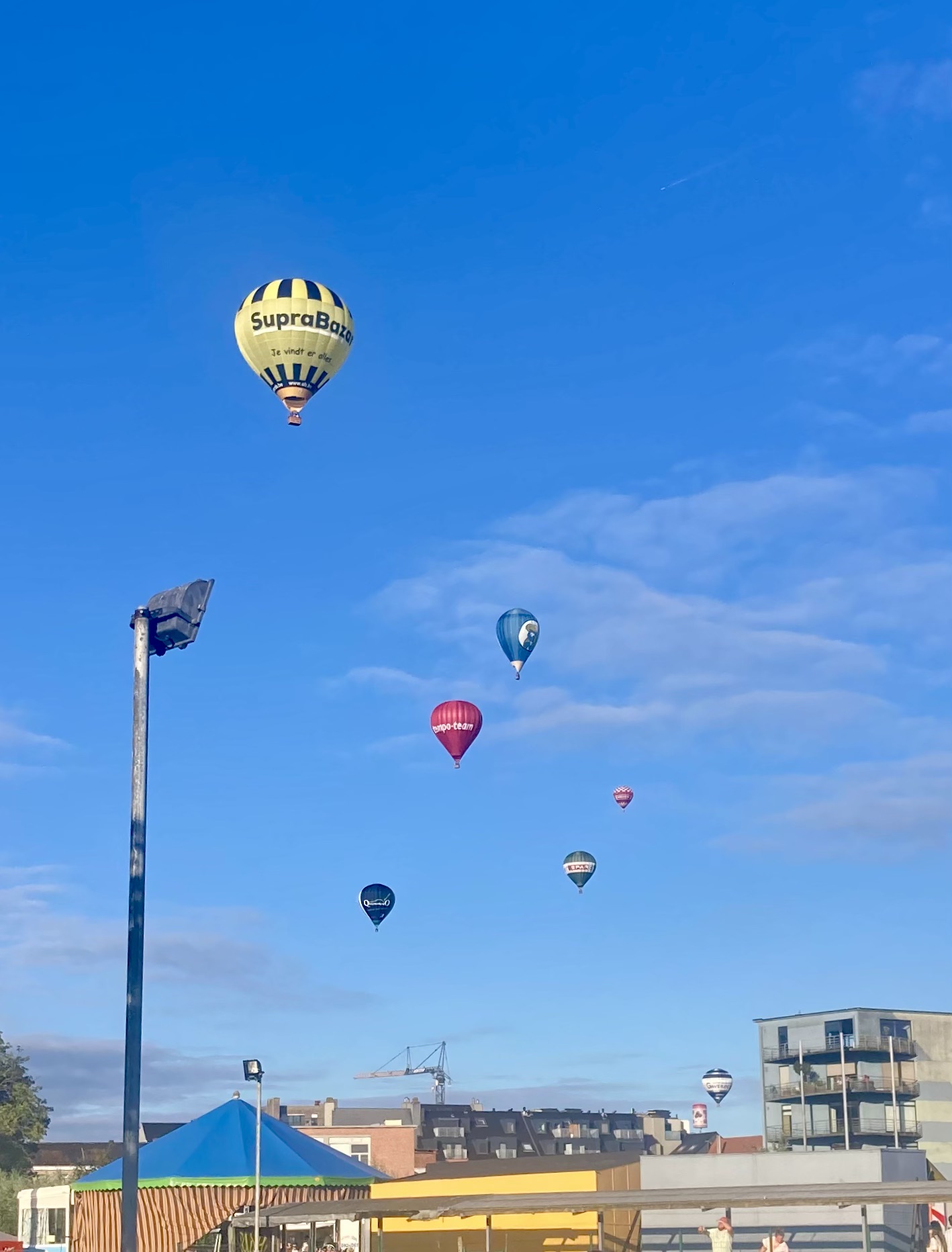

After the relatively normal shaped balloons came the cartoon characters!
This is nothing to do with boating, except to show what unusual scenes we come across as we go.
It was a wonderful way to spend our last evening with Hollie, Richard and Sofia. And it was sad next morning to see them packing up their things after breakfast in order to go back to UK, but we had made lots of good barge memories with them.
Once they had set off to Dunkirk for the ferry we set off for Kortrijk.

This meant leaving the gently meandering ‘part of the ‘Toeristesche’ Leie and joining the Leie that has been widened, straightened and deepened for commercial traffic.
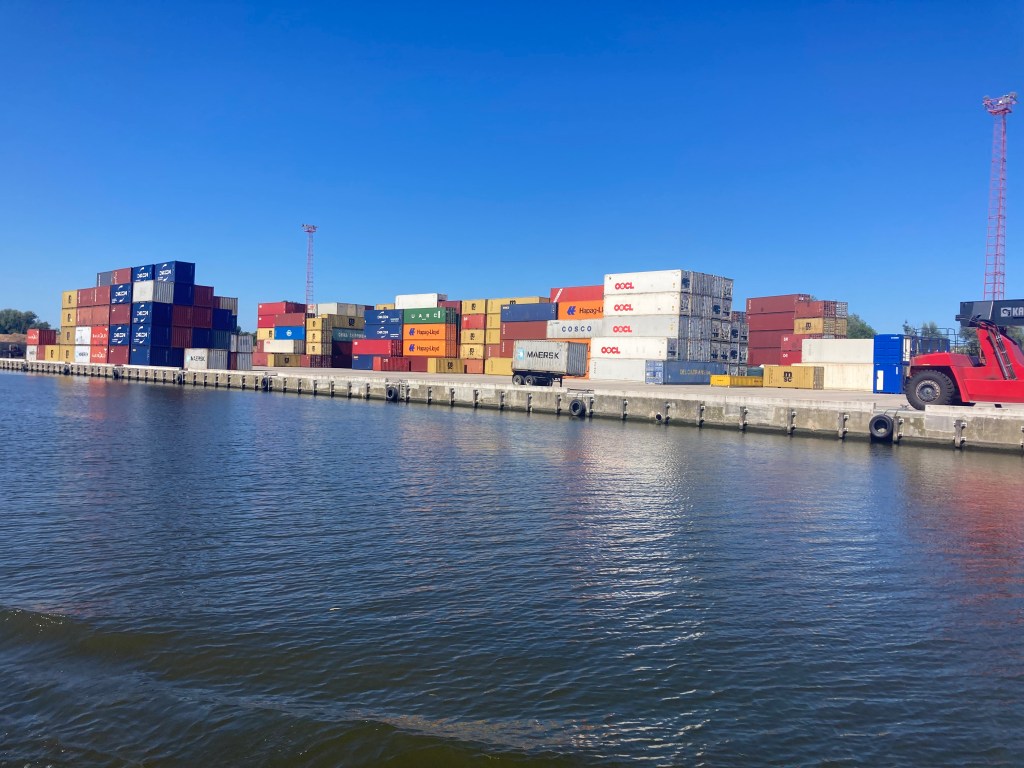
The 23kms to Kortrijk took us through two large sluisen (locks) at Saint-Baafs-Vijve and Herelbeke – the latter being 185m long and 11.4m wide!
Passing by the quays at Wielsbeke was a good reminder of how important cargo is to the Belgian canal system in 2024.
Kortrijk is a very familiar port to us. Calliope spent 3 winters there and we have been in and out, under the low bridge, many times. So once we arrived it did not take long to come in and moor up to the floating pontoon in sight of the historic Broel Towers.
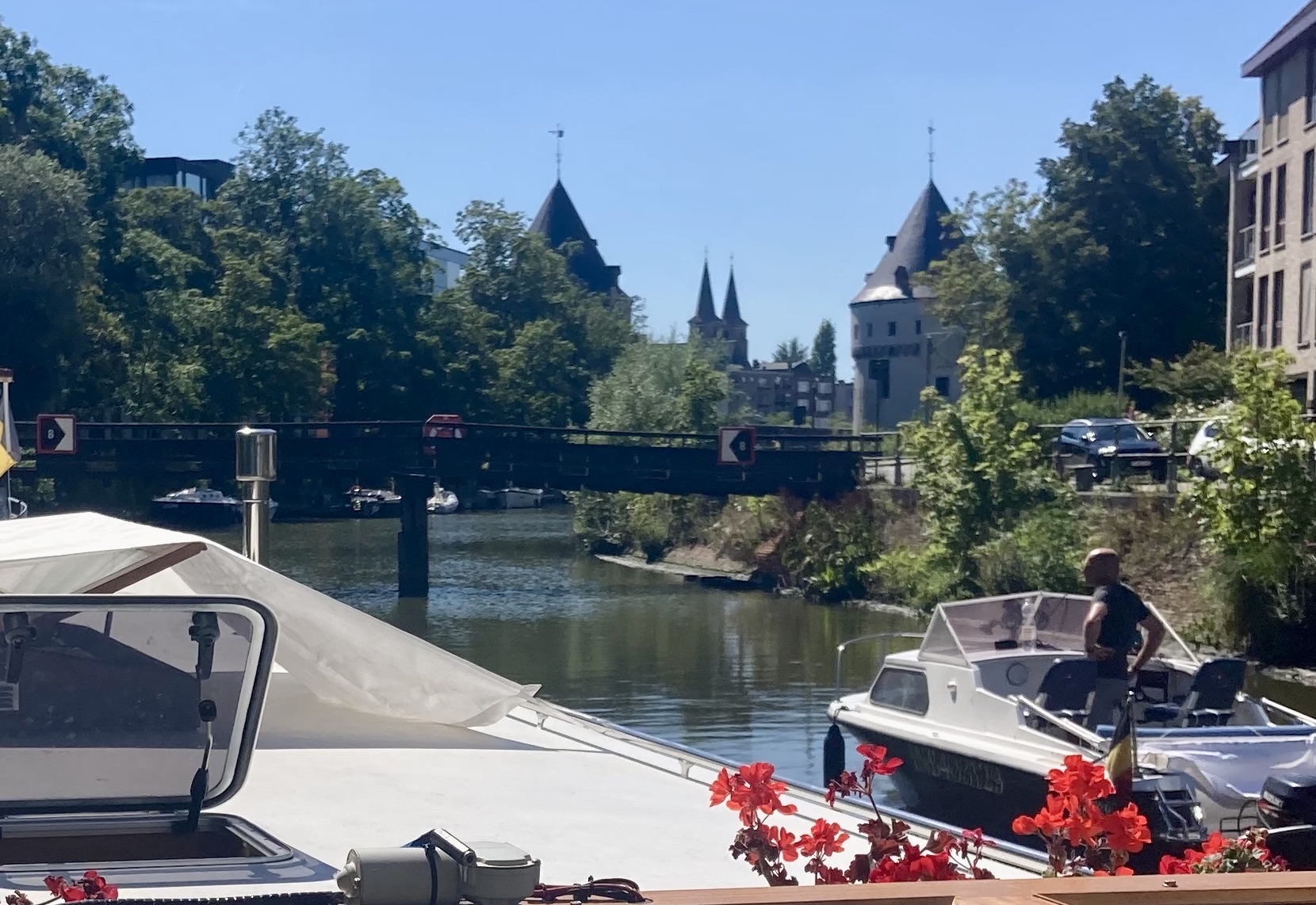

In fact we were mooring up in Kortrijk at at about the same time as Sofia was looking out at the White Cliffs of Dover from the cross channel ferry!
While we waited for son Ashley and partner Theresa to arrive two days later we enjoyed more hot blue-sky days.

Things had changed a bit around the port. Where we had watched foundations being laid there is now a modern apartment block
At night rainbow lights shine down.
But this lovely small city was still the same and I had the chance to share it for a day with my very good Belgian WOB (Women on Barges) friend Mieke. Although she is a top tourist guide in her own city of Gent, she knows Kortrijk less well so I was able to do a bit of a tour with her as we walked back from the station.

Part of the walk included a visit to the local bakery where, in addition to some bread, I asked Mieke to choose us a cake for dessert.
A good choice!; we can pretend it is really healthy with all that fruit on top.
Next day was doubly special. First Ashley and Theresa were arriving and second I had booked a tour of a Belgian brewery for us all. Stewart’s favourite Belgian beer is the Kortijk brewed Omer, and as I had recently broken his special Omer glass I thought a trip to the brewery might make amends.
But first Ashley needed to take his car to the place where we would be at the end of his visit, in three days time. This meant driving to Tournai, finding a free car park for 3 days, and getting the train back to meet us win time for the bus to the brewery!
Somehow it all came together.
Three of had lunch on board, and Theresa made up a sandwich for Ashley to eat after we met him at the station.
I had already bought the bus tickets and before long we had reached the brewery.
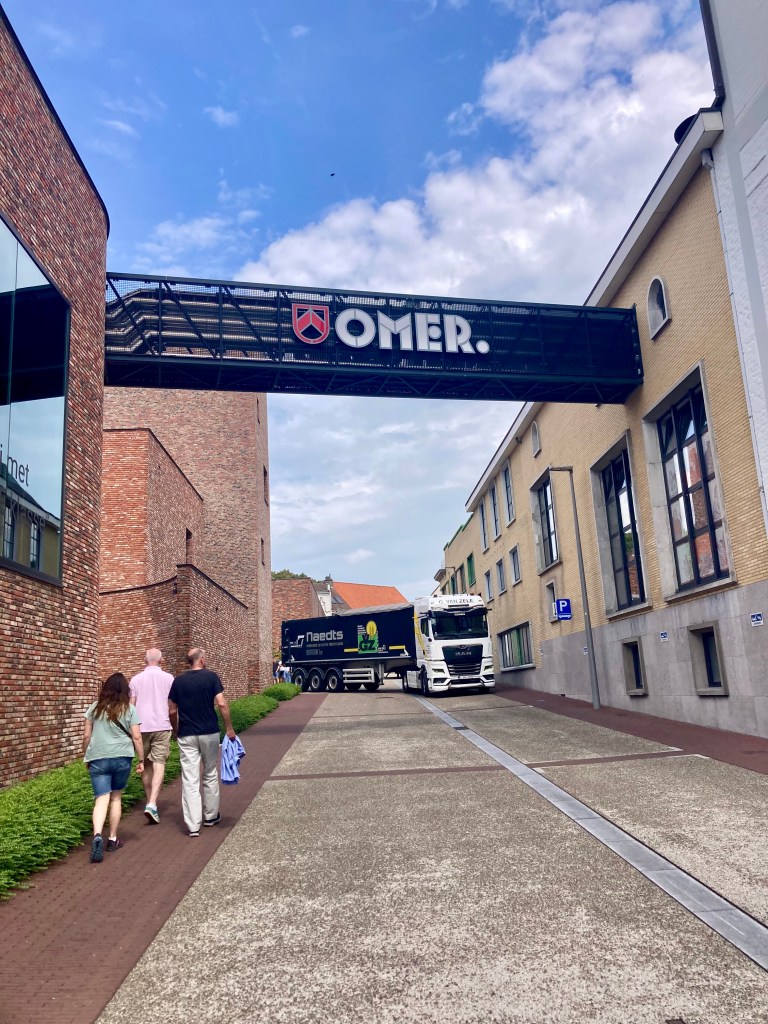
Here are just a few photos of the Brewery tour. There are tours in English, but not on the day we wanted to go, so all our fellow visitors were Belgian, or Dutch. Luckily we had an excellent guide who spoke good English and gave us a quick potted version of all the information as we went.



We were shown the old brewhouse and also the current, high tech, modern one – but asked not to take photos in the latter in case we were industrial spies! The old brewhouse is beautifully preserved, all the copper gleaming.
After one more beer in the local pub, courtesy of Omer, we jumped on the bus back into the city centre.
Supper was booked in the Gros Markt – the Ribs ‘n’ Beer restaurant where you can have as many ribs as you can eat!
Obviously this is not us eating ribs! But was part of our outlook in the Gros Markt that night, a crazy tunnel installation!
Stu and I had been hanging on in Northern Belgium until the two sets of family had been to see us, but then needed to be cruising south towards our winter mooring. So next day was to be farewell to Kortrijk, taking Ashley and Theresa towards their car in Tournai.
The journey times are so different by car and by boat! It took Ashley about half an hour to drive to Tournai. We would take two days on the boat, although it could be done in one if you wanted a long day cruising.


Part of the reason was the decision not to leave Kortrijk until after lunch so that Theresa could see a bit of the city. We were there during the art Triennial and managed to see some of the exhibits.
To be honest the bronze sculpture of drinkers falling about was not part of the Triennial, but a favourite permanent part of the Kortrijk city-scape.
The first 3 narrow locks in the Kanal Bossuit-Kortrijk are manually operated by an ‘itinerant’ lock keeper, so we had to book our time to leave.

It was a change from the big locks on the Leie; these three are freycinet size; 38.5m long and just 5.1m wide. Calliope is 4.2m wide, so judicious steering required!
Here we are at the 3rd lock, with Ashley securing the bow rope and – look closely – Theresa helping the lock keeper to open the gates.
The canals widens out after that third sluis (lock), as we left the suburbs of Kortrijk behind and entered the countryside.
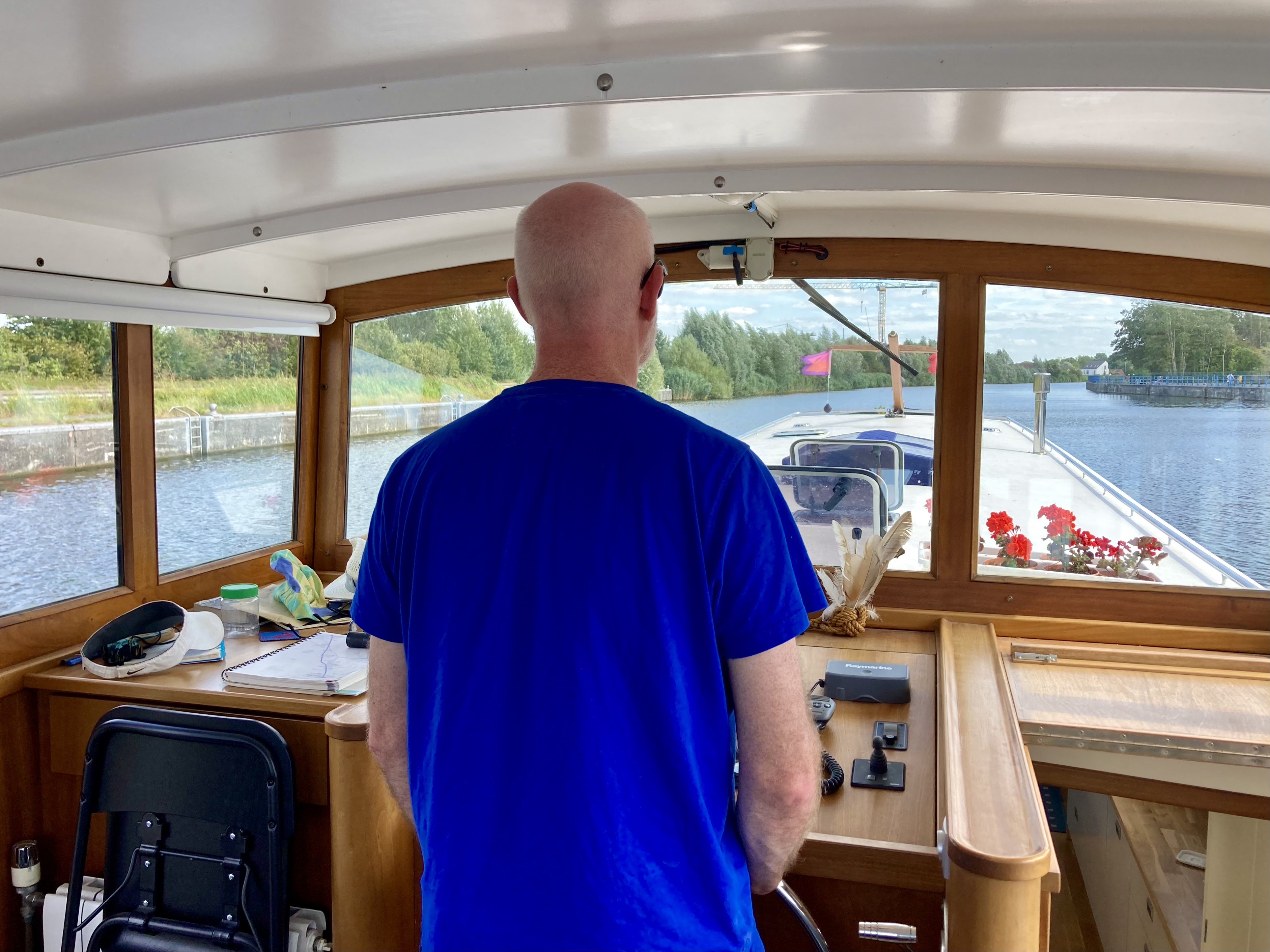
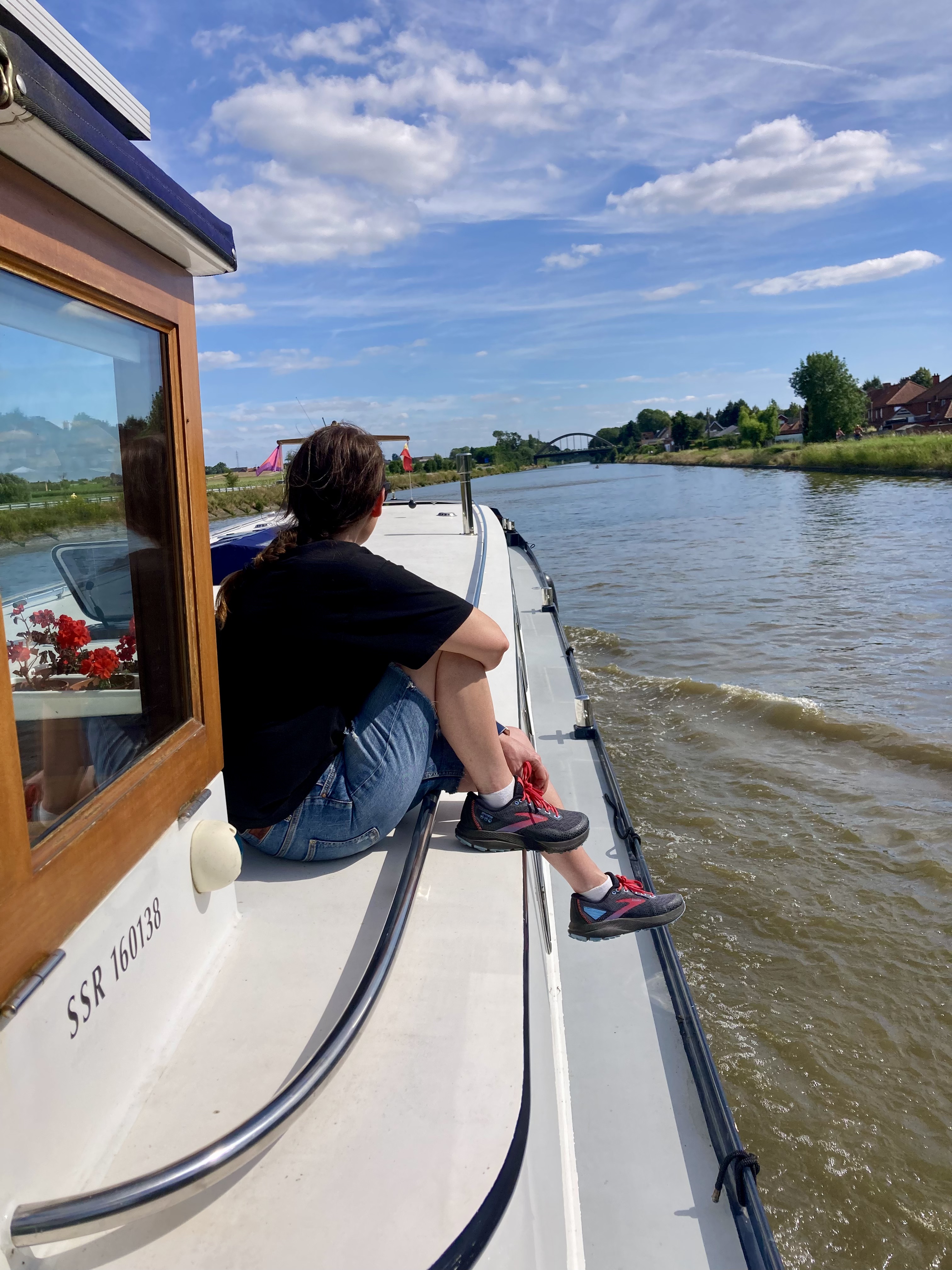
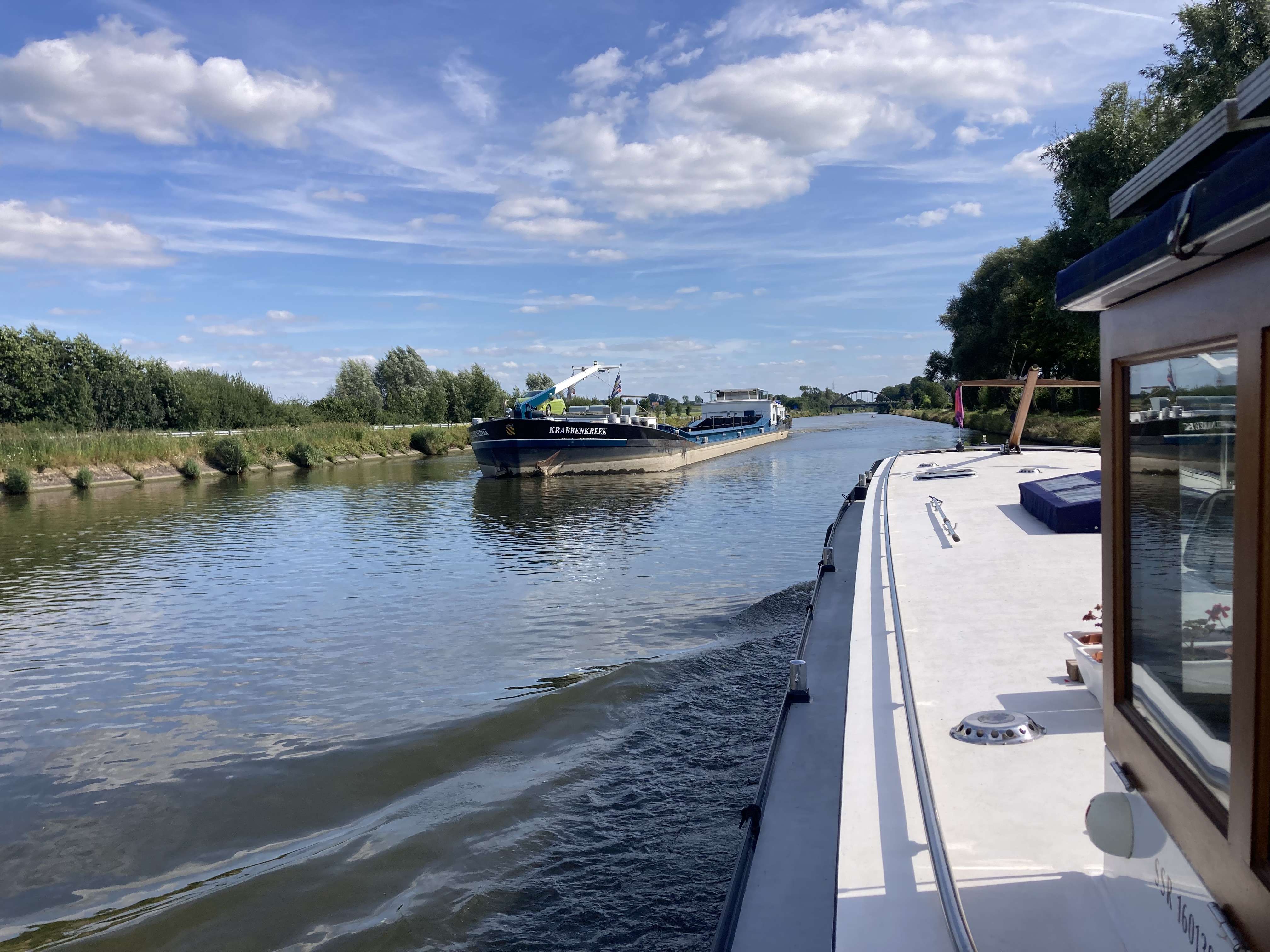
The new crew changed roles, with Ashley at the helm and Theresa as lookout! This section of the canal is used by commercial barges too, and it was not long before we were passing the first one.
The second trio of locks on this canal are much bigger, designed for the modern working barges.
This one, at Moen, is back to Leie dimensions; 110m long and 11.5m wide.
It is also deeper than the earlier locks, with bollards in the wall that allow you to move your ropes up/down with the movement of the water.
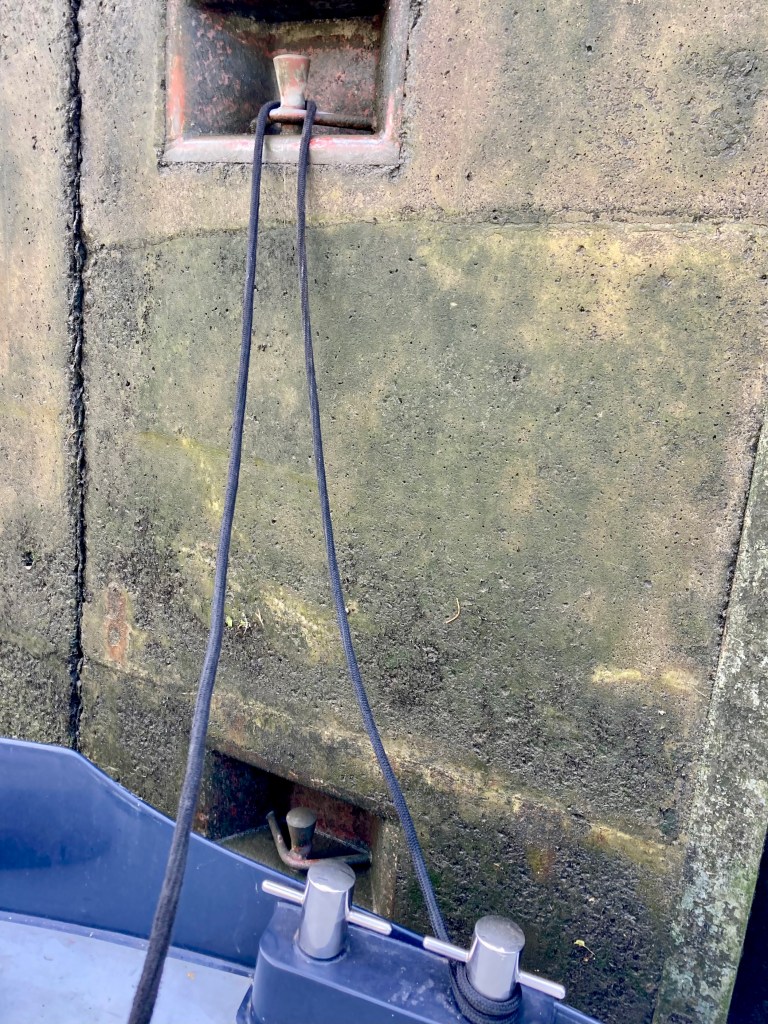
Just 4kms to go until the end of the canal. Our plan was to stay above the final lock for the night – a nice rural mooring – and drop down onto the Bovenschelde river the next day.
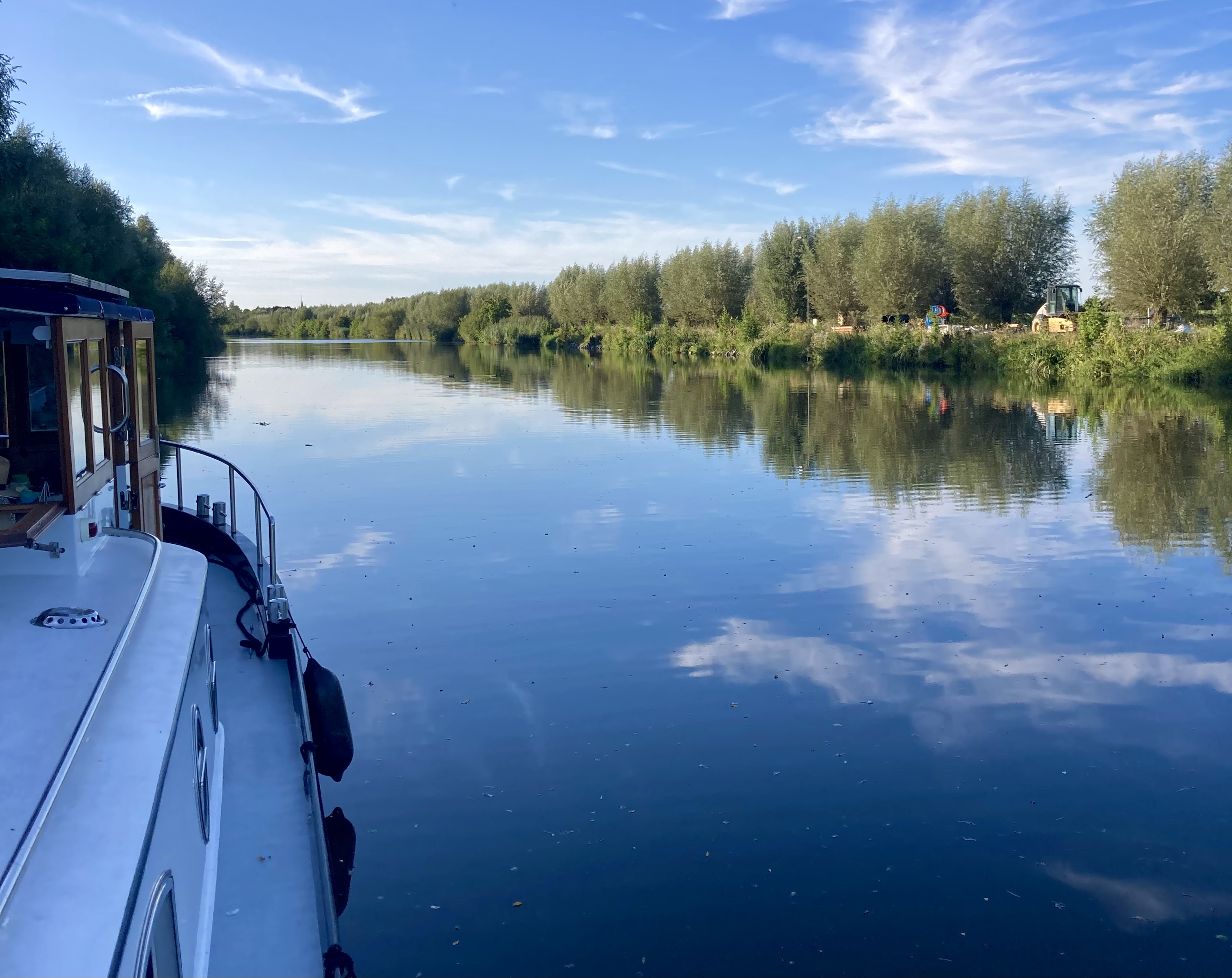
We had always moored on the port side of the canal when going in this direction, mainly because the pontoon to starboard has always been full. But today there was space on the right and we glided in, tied up, and sat back to enjoy a peaceful end to the day in the shade; it had been quite warm earlier.
Stewart and I have always loved the funky Vespa bar just below the final Bossuit lock, so sent Ashley off to see if it was open – and it was.
It is a delightful mix of Vespa hire, good beer, and very variable outdoor seating.
After a couple of beers it was nice to get back to Calliope’s back deck for aperos and supper. [Note Stewart using his NEW Omer glass that I bought for his at the brewery!]

And then to watch the sun go down.

Considering the blue of the sky the night before not was rather disappointing to wake up to greyness and drizzle. We needed to cruise on to Antoing, closer to Tournai where Ashley had left his car, so there was nothing for it but to don wet weather gear and get going.

The lock at Bossuit would take us down 11m to join the river and uses floating bollards to make the crew’s work easier.
Just get a rope round a bollard when at the top of the lock and keep an eye on it as the boat slowly descends – more fun in the sun than in the rain!
Readers of this blog will know that I am amused by small things! In this case it was being able to see into the lock keeper’s control tower and Calliope on his screen. 😌

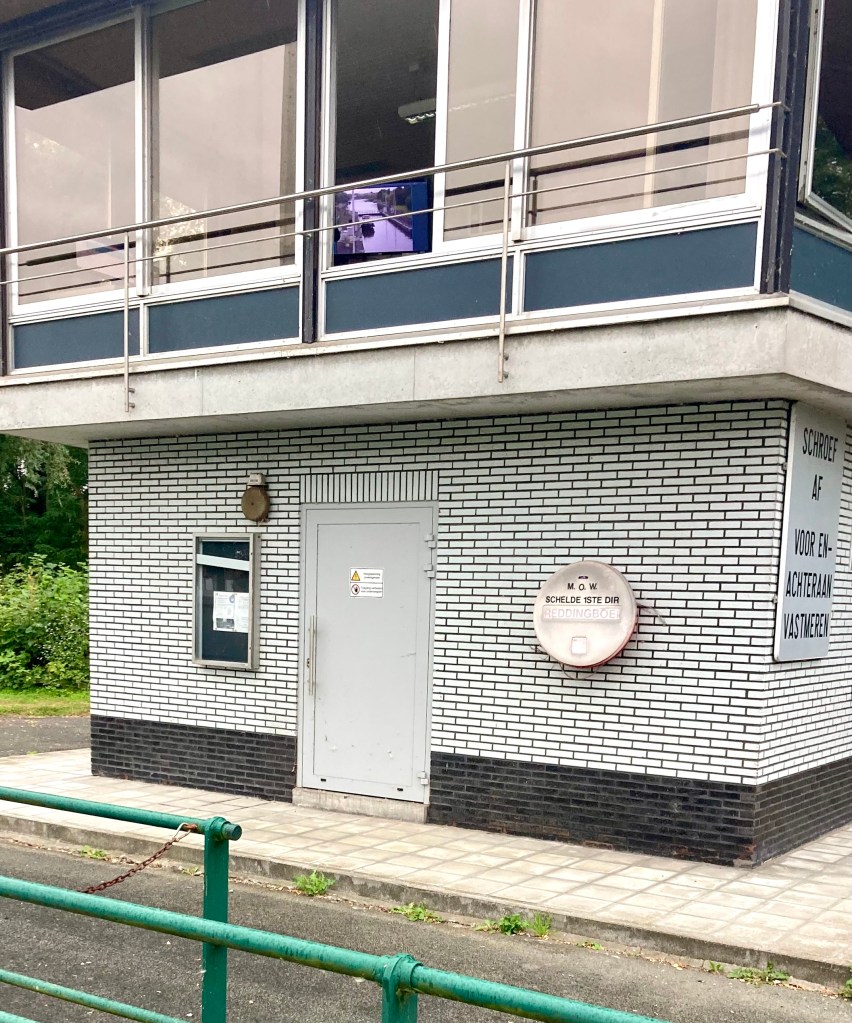

Finally we arrived at the bottom of the lock and the gates opened for us to join the Bovenschelt – known as the Escaut in France.
You can see the mid-way lock doors here, which allow just half of the lock to be used when there is a small boat using the lock and a shortage of water.
The cruise to Antoing was not too far and only involved another two locks – long, wide commercial barge locks, but easy enough to navigate.
We also went through Tournai, which is a “one way at a time” system with huge traffic lights at each end. We were lucky and only had to wait a few minutes for a barge to come through before we had the green light to proceed.
There was an interesting manoeuvre as we went through the city! Ashley’s car was parked by the canal near the Port des Trous, the old medieval bridge that has recently been ‘adapted’ to allow the passage of giant modern barges.

Ashley’s idea was that by slowing down next to the new pontoon built but the bridge he could jump out, get his car, and bring it the few kilometres to the port at Antoing. (this is not my photo of the bridge – it’s from Wikipedia)
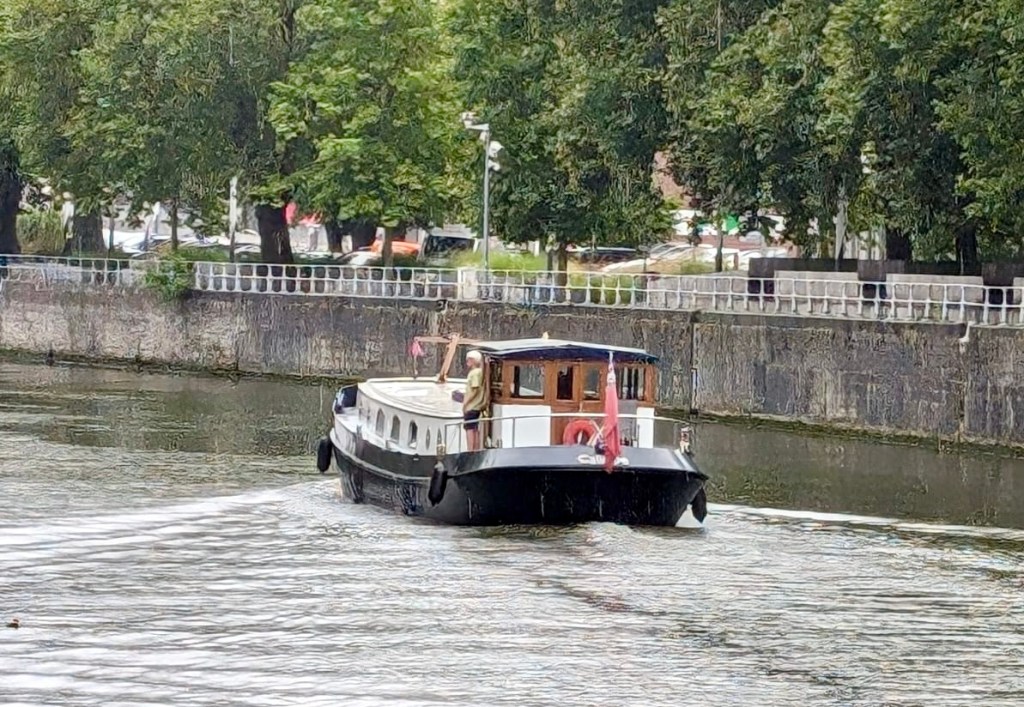
It worked. He jumped ashore, avoiding falling in, and after clambering up onto the land he was able to take this photo of the rest of us continuing upstream.
We soon met up at Antoing, a little port that we rather like. The afternoon was a chance for Captain and ‘old’ crew to put their feet up, and let ‘new’ crew go ashore to look round the town and find a place for supper on our last evening together.

An Italian restaurant seemed the best choice, and after an aperitif drink on board we went off to eat.
We set off in high spirits by the look of it!
All too soon, as with the Hollie team, it was drawing near time to say good-bye.
The weather was good enough for a ‘digestif’ on the back deck, and then to early to bed to be ready for their departure on the morning.
(It looks rather a functional black deck, with bucket, life belt, mosquito coil etc!)

So Calliope’s family fun was over for another year. One of the reasons that we bought the barge was for family and friends to come and enjoy life on the water with us. 2024 has been another year full of visitors!
Now it was time for Stewart and I to turn Calliope’s bow southwards and head for our winter mooring at Saint Usage at the Saône end of the canal du Bourgogne. The next blog post will track that homeward bound voyage.
22th July to 7th August 2024
Calliope and crew proudly left Diksmuide with a newly painted hull and headed for the coast down the River Yser (Iser).
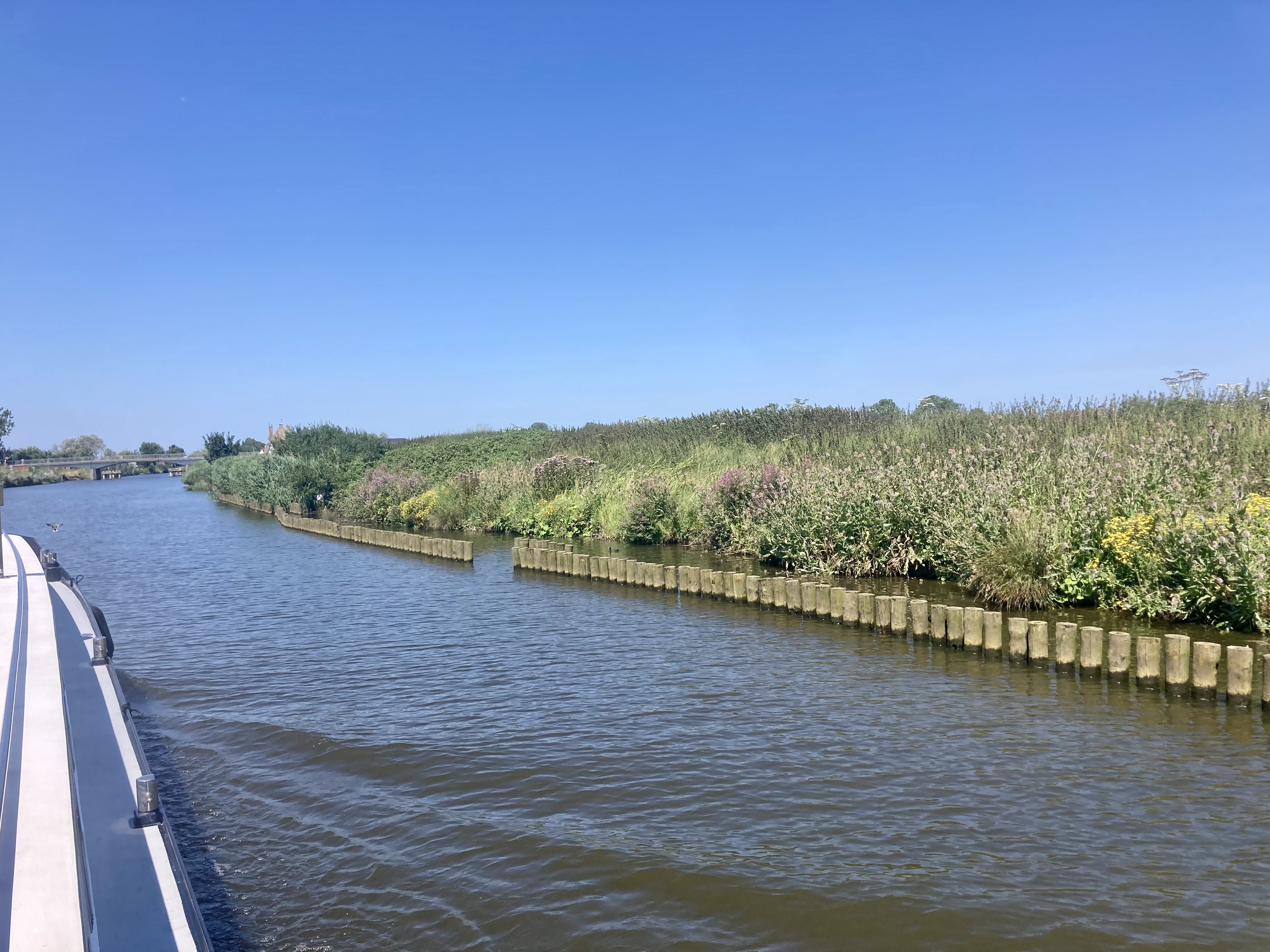
The cruise is pleasant, through wide flat plains of farmland – no locks until Sint-Joris, Nieuwpoort. Areas such as these are know as polders – areas of land, close to or below sea level and that have been reclaimed from the sea. They are protected from the sea by a series of dykes and sluices.
[At the Yser Tower Museum we learned how the flooding of the polders along the Yser River was used during during World War I. Opening the sluices at high tide and closing them at low tide turned the polders into an inaccessible swamp, which allowed the Allied armies to stop the German army.]
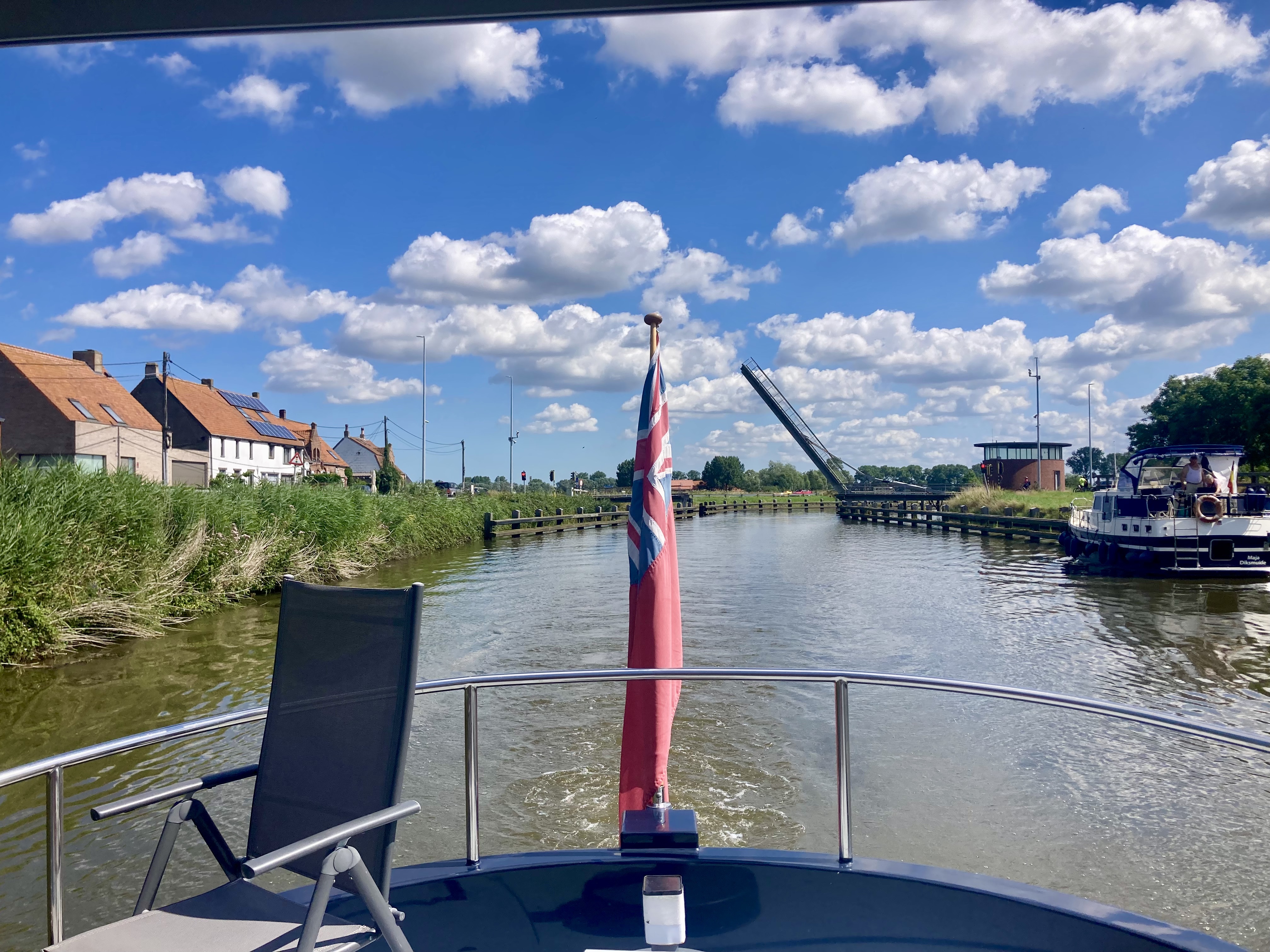
There is just one lift bridge, Tervaetebrug, to go under, and a call to the Saint Joris lock keeper sets that in motion. The bridge used to be operated from a building on the adding bank, but modern technology in the form of cameras, phones and remote control means that another job on the canals has gone. This photo os actually from us going in the other direction a few days later.
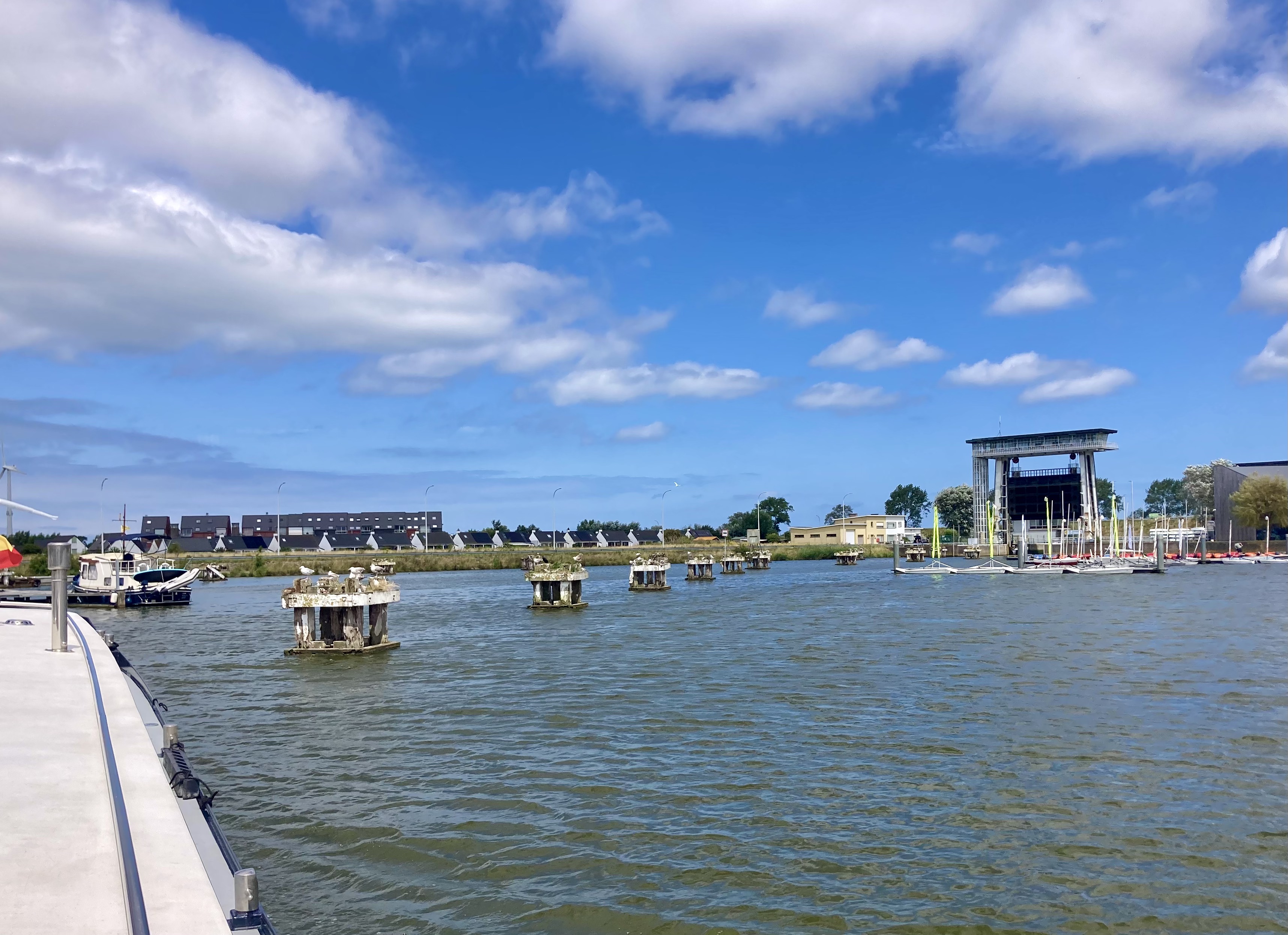
As the Yser reaches Nieupoort it opens out into a big (presumably man made) basin. Coming in at the southwest corner we make our way to the Saint Jorisa lock in the north east corner, following the channel past activity centres and a marina.
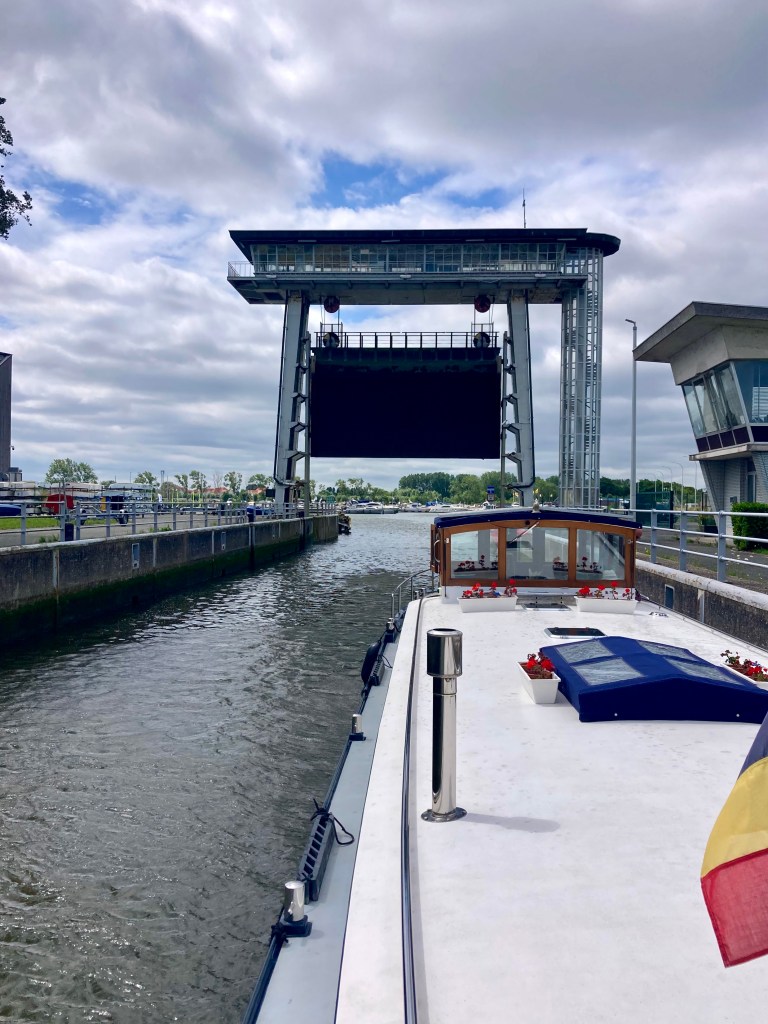
The lock has a rise/fall of only about a metre, but is still equipped with huge ‘guillotine’ style doors at each end. These allow water management during periods of flood, weather or the sea or the river.
Like the Dutch, the Belgians, with their huge areas of flat ‘sea-level’ land have learnt to manage the water levels.
Nieuwpoort
We had arranged to moor up at the Boterdijk part of the Westhoek Marina. This rather unusual mooring has no electricity or water, and the shore is only accessible easily if you can moor next to one of the 8 platforms along its c200m length.

But we love it for its general tranquility and quirkiness,
Just as well we like it because we had decided to stay here for two weeks and have a seaside holiday!
This blog is mostly about barging and boating, but I will give a quick idea of our stay on Nieuwpoort.
One day we went to the see the sea.

It was a beautiful day – in fact the whole two weeks had blue skies and warm, sometimes hot, sunshine. The beach is clean sand and the North Sea was warm! We also caught up with a couple of the art installations that were part of the Beaufort Triennial . The one showing here is a giant keyboard, with the buttons missing.
Another time we took the coastal tram to Ostend for a day.




Again the beach was a magnet, though no paddling this time. We enjoyed lunch in a local salad and sandwich bar, and then, the highlight of the day, went to the Japanese Garden.


It was cool and green in there, and also had an interesting series of sculptures.
We wandered the streets of Nieuwpoort and cooled down with good Belgian beer.
We struggled a bit to get a beer on this particular day, sitting outside one bar for a while and getting no service, until I realised it didn’t open for 15 minutes – so we moved up the road to this one.
Luckily it had Stewart’s favourite Belgian beer!

Overall it’s a nice place to spend a couple of summer weeks. Although it is an unusual mooring we still could use the facilities of the main marina (a 10-15 minute walk) which include the usual rubbish disposal, water and a pump out.
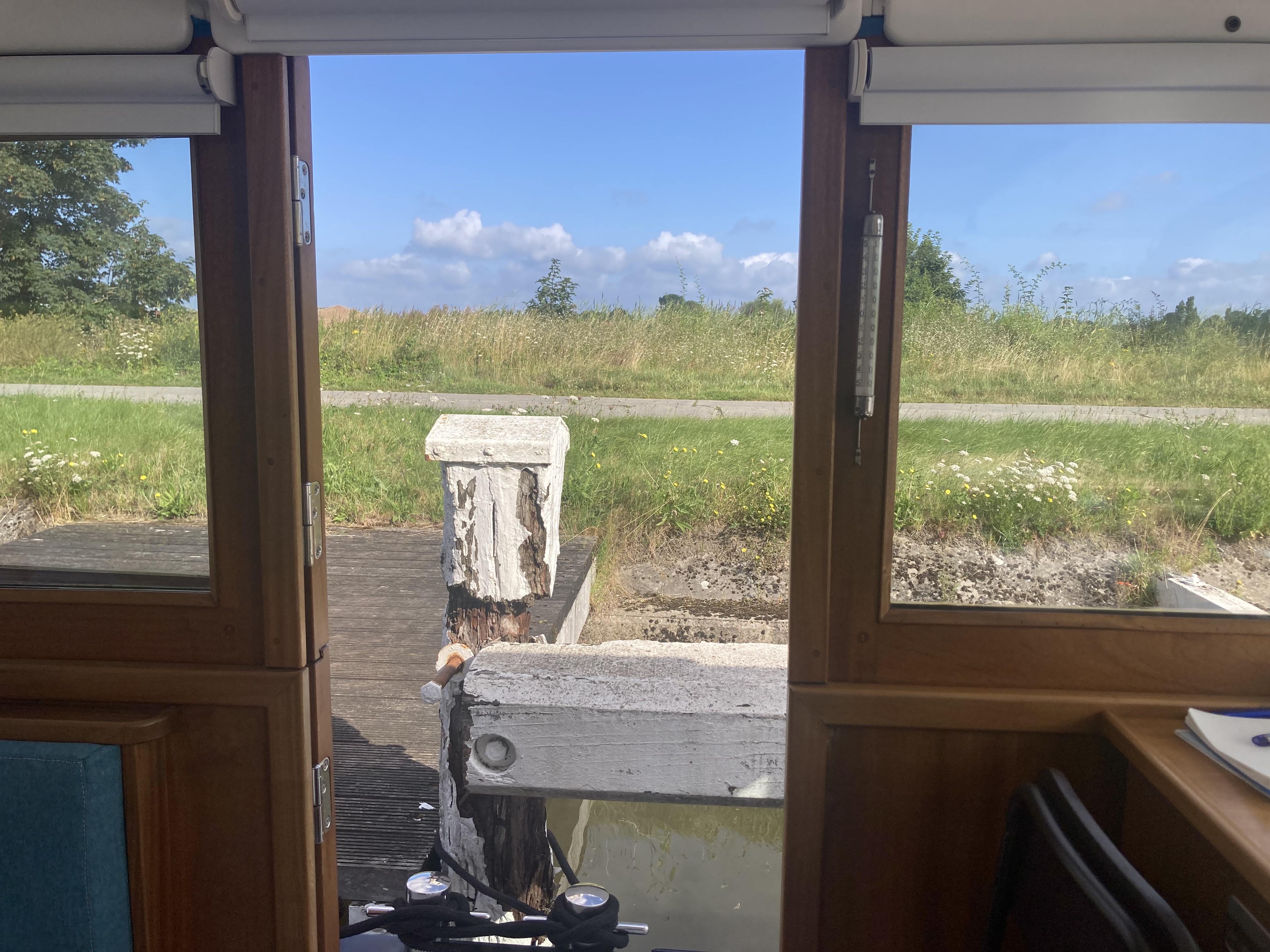


It felt like the countryside, but we were close to the town. There were wide open skies, mostly blue, and glorious sunsets.

and from the other side of the canal I was able to get a decent side view shot of Calliope – something I had been trying to do for ages! Just wish we had had the mast up.
At the end of our holiday it was time to set off for Deinze where we were to meet some of our family for a few days of their holiday.
Plassendale
We had another beautiful day for our passage to Plassendale, just 20 kms away with one small, unusual shaped lock at the end. There are specific times to start off so that boats travel in convoy and bridges are only opened at certain times. We chose to go with the 11.00 group; it turned out to be a group of 1!
The journey is through the flat polder land of North East Belgium, mainly farmland with a few small villages along the way.


Each village has its own bridge. They are almost all lift bridges and once you set off at your allotted time your progress is tracked along the canal with each bridge lifting as you arrive.
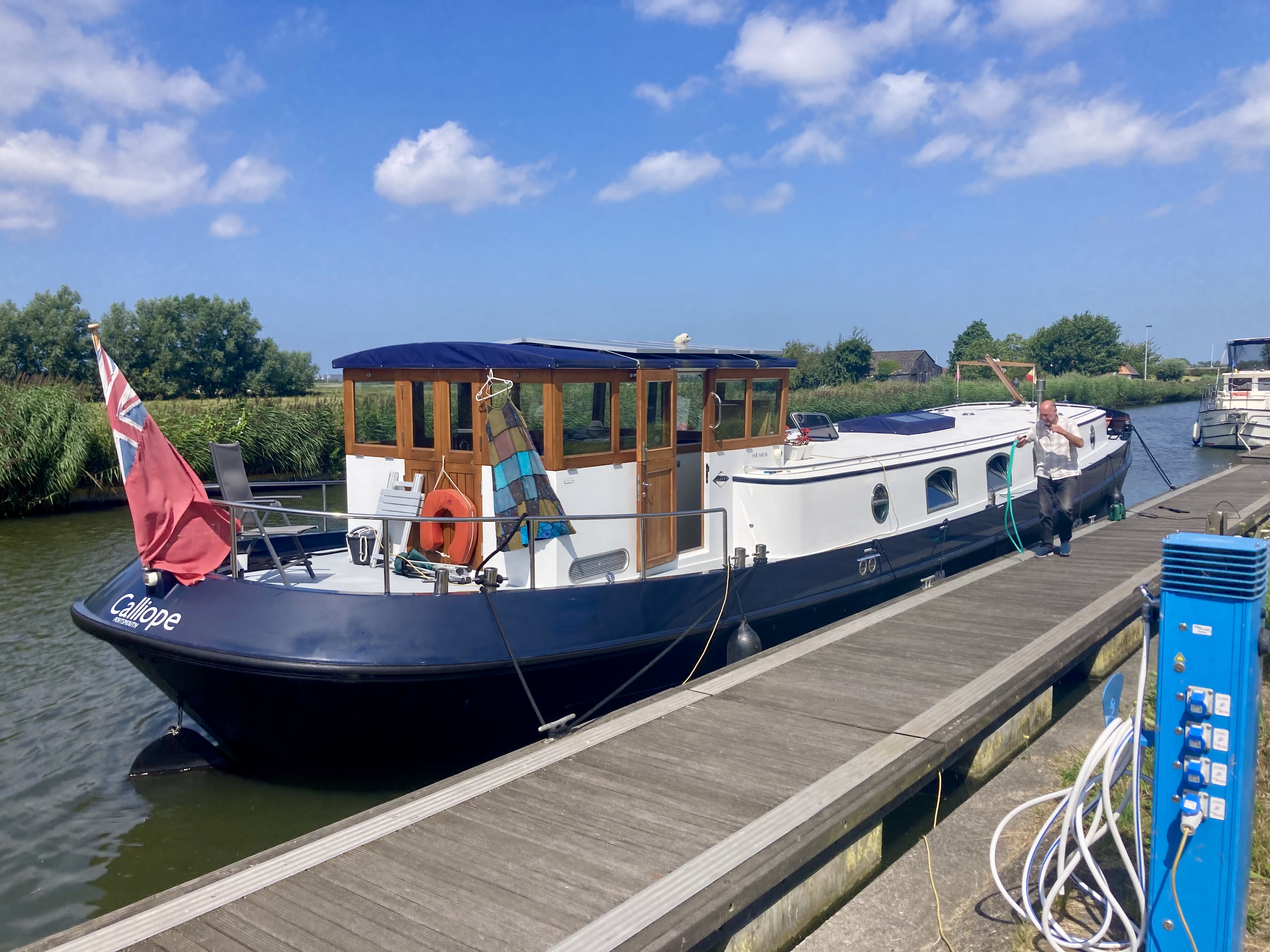
We had decided to stop at Oudenburg, just 2 kms from the end, for lunch and to take advantage of the water and electricity points there. I could put on the washing machine, using electricity and water, while we had lunch and then we could top out fresh water tank up as well before we left.
Obviously I had hand-washed my patchwork dress earlier!

Payment for the water and electricity at Oudenburg is an interesting modern method.
You download the AanUit app and follow the easy instructions. It knows where you are, measures your usage, and sends you a bill at the end of the month.
You can see how much you are taking and how much ot os costing as you go, so no surprises later!
After lunch Calliope was off for her last 2 kms of the day, with increasingly near views of Ostend across the fields.
And a bridge on a bend in the canal; no wonder we are not to overtake here.


Soon we were at the lock between Plassendale-Nieuwpoort canal and the Gent – Ostend canal. As mentioned before, it is small (in depth) and unusual.
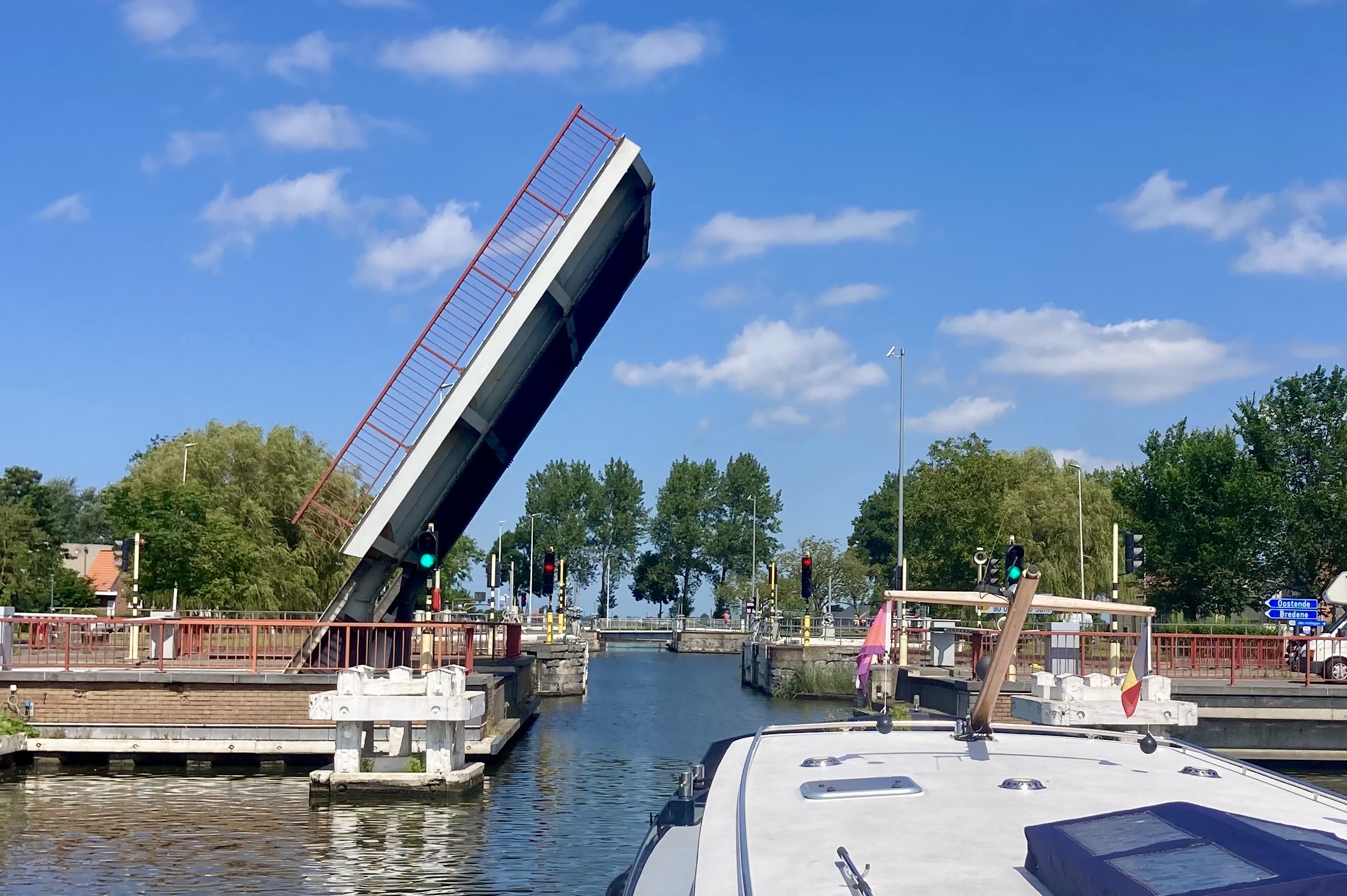
It was extra small and unusual this time! As the bridge in front of the lock lifted we could see that the lock gates at both ends were open! There was no difference in depth between the two canals and we drove straight through.

We were soon tied up, the washing hung out, and the rest of the day off.
This is another slightly different mooring, and another one that we like.
We love it for the views and for the quietness, once cyclists and walkers have gone for their evening rest. It is right next to a historic building. It was apparently a Spanish toll house from the days when they had a fort here. The Spanish occupied and ruled this area during the 17th century, having besieged and gained Ostend in 1601.
But its the views ….


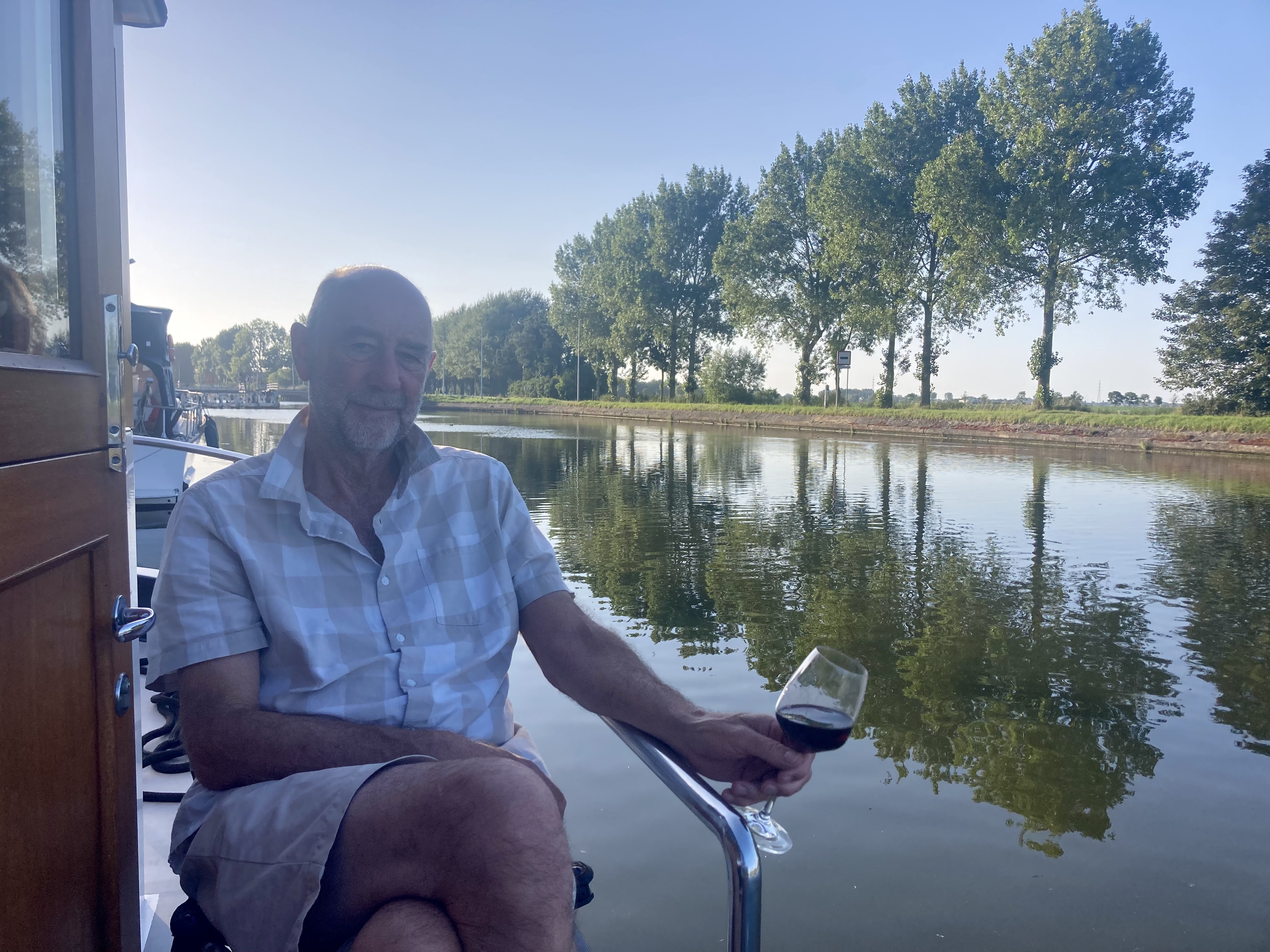
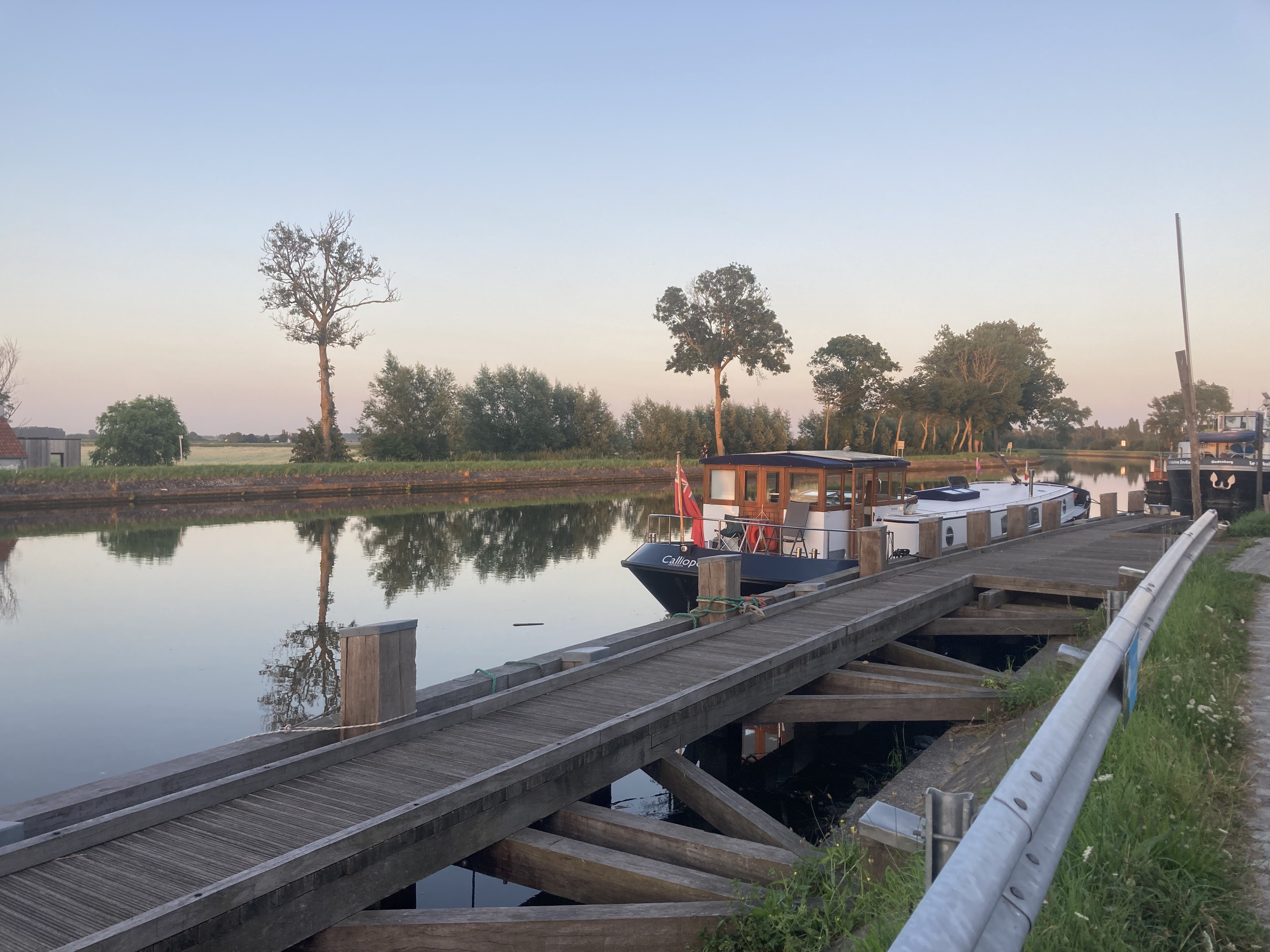
A peaceful night was passed almost without incident. As it got close to bedtime and I went for a stroll I discovered a small yacht moored behind us, out of sight at the end of the quay.

I noticed a WOB (Women on Barges) flag and hailed the boat.
My new friend Isabelle appeared and we spent half an hour getting to know each other before retiring for the night.
Beernhem Gard Sluis
Both boats were off in their same direction next morning. We were headed for Bruges where Isabelle and partner would stop for a few days, and we would continue.

Although there set off first we soon caught them up.
They asked if we would lead the way, calling up the Brugge control centre who would lift the many bridges around the city for us. both.
It begins with a bridge a few kilometres north of Brugge and once contact has been made here the control centre watches your progress through a series of cameras, making each bridge ready as you approach.
We soon met a convoy of small boats heading north.
They had obviously travelled round Brugge together and were off to Nieuwpoort or Ostende.

One of the nice things about travelling in the company of another boat is that they often take photos of Calliope from angles that we can never get.

This time Isabelle took a photo of us going under my favourite modern bridge. It is at Brugge and fascinates me every time with its ‘rotation’. The road rotates skyward, becoming almost vertical; the road traffic stops and the water traffic passes beneath.
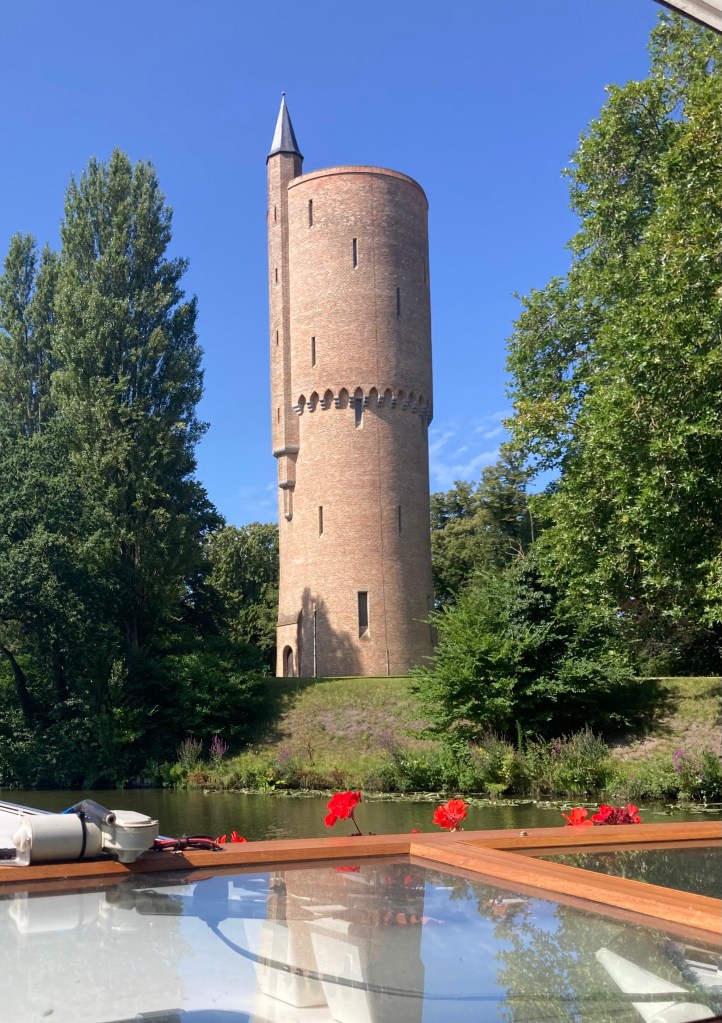
Brugge is a nice city to cruise round. There are several old buildings and city gates, gardens and windmills en route. Here are just two.
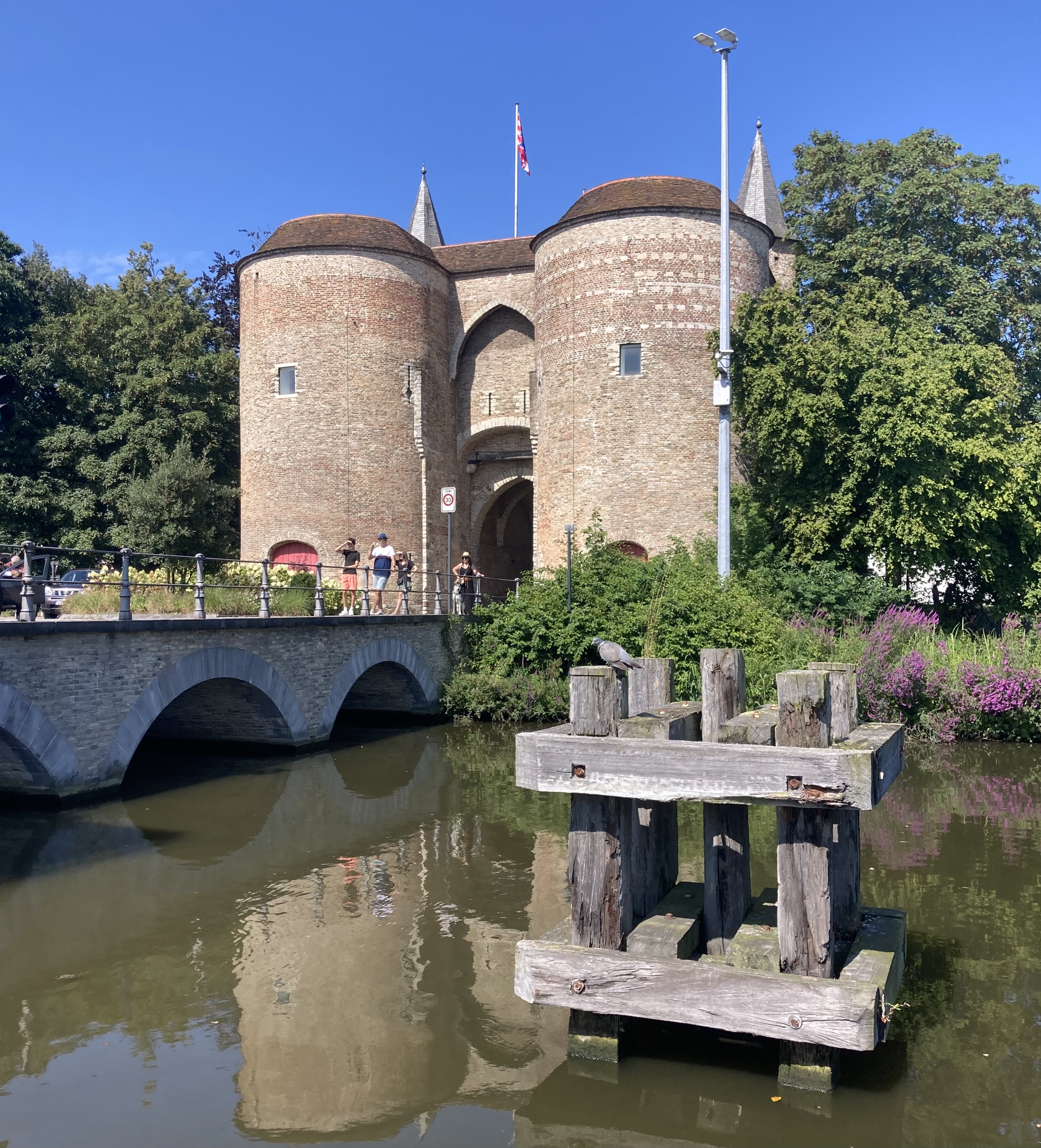
There is also one lock which, bizarrely to me, is operated by a different office to all the bridges. It’s also rather nice, because here an actual person, a lock-keeper, is in attendance and we get to have a nice chat as we go through.
At the Coupure marina in Brugge we waved good bye to our new friends and continued to the next bridge – Saint-Kathelijnepoortbrug, a swing bridge – which initially did not swing for us.
I got on the phone and soon ascertained that they were waiting for a commercial barge coming in the opposite direction to come through first; then it would be our turn while it was still open. This would save the road traffic being disturbed twice. So we found a bollard and some railings to tie up to and waited, trying to grab a quick lunch at the same time!.
The comercial bagre arrived, the bridge opened, the commercial passed through and we cast off to make our way. But the bridge started to close! Another quick call and we found out that there had been a change of staff and the new person dd not know we were there waiting!
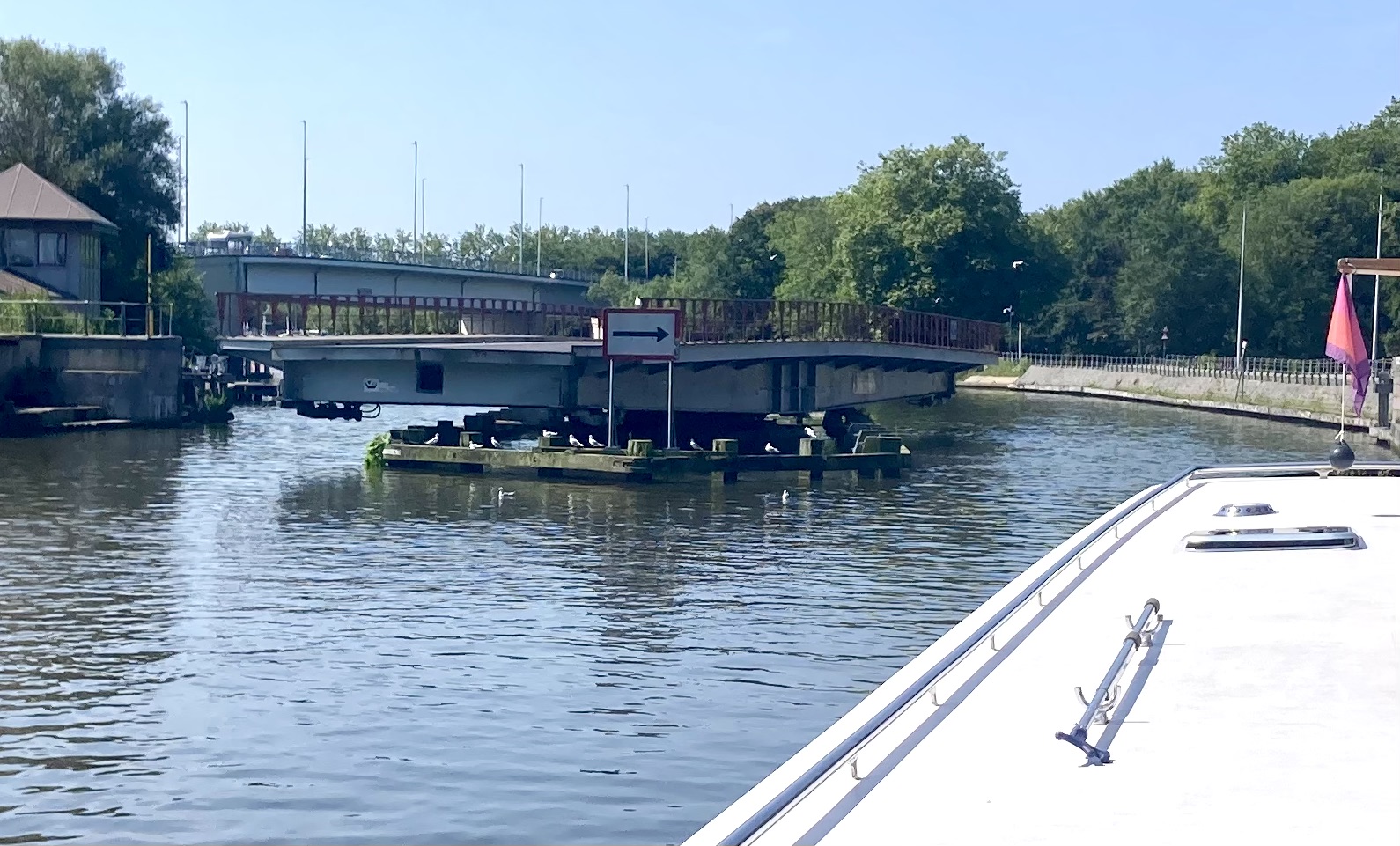
Ahh well, it just meant an extra 10 minute wait until they felt they could stop the traffic again! The photo is slightly confusing but shows the swing bridge turning to be parallel to the canal, and beyond it a big high modern bridge.
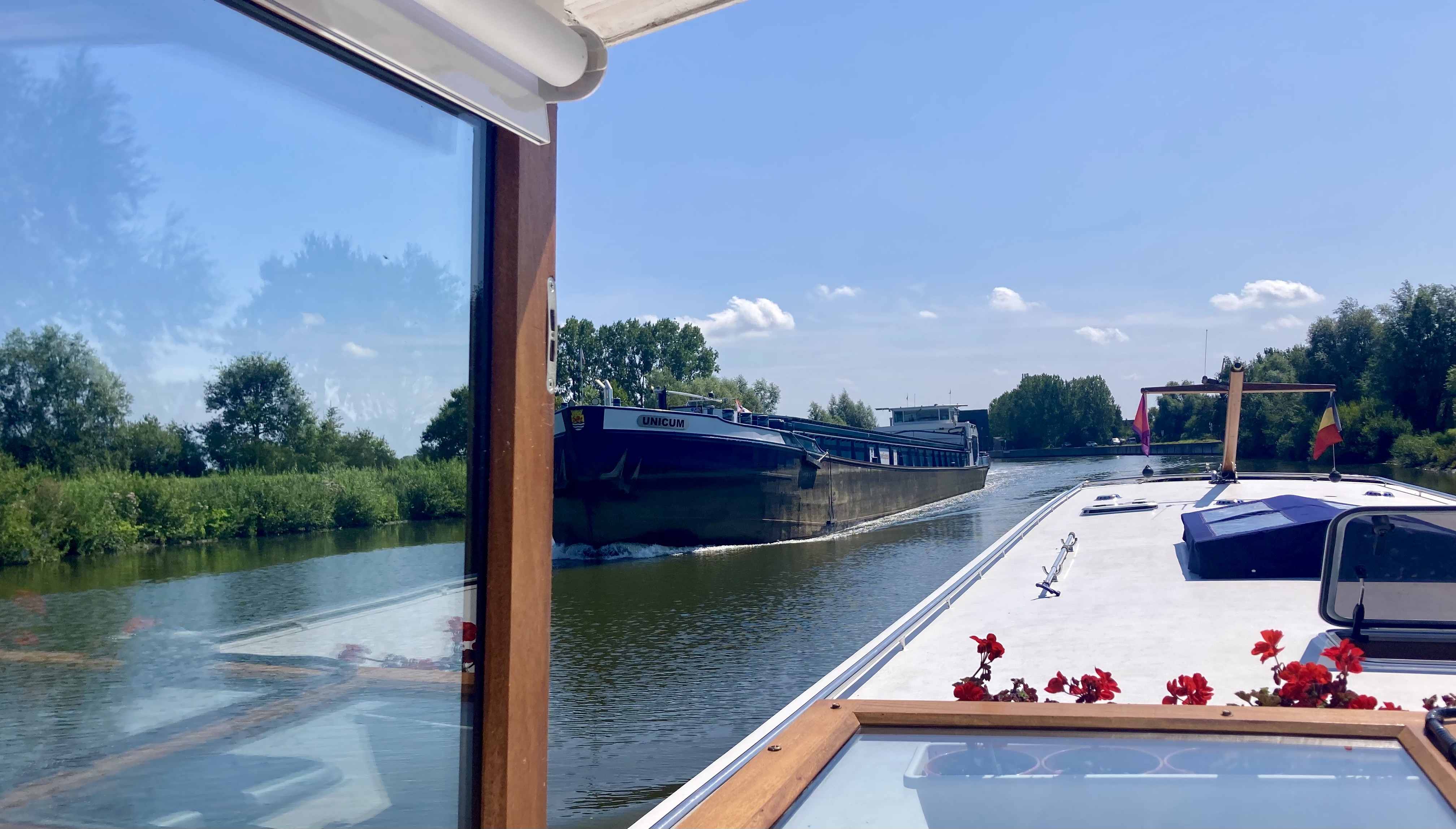
After that we were on our way, leaving Brugge in our wake and heading for a rural mooring we had spotted a few weeks earlier when going the other way. The sky was blue, the windscreen down, and both countryside and commercial traffic passing by.

Beernham Gard Sluis is a narrowing of the canal with a big gate than can be lowered in the case of flood on one side or the other. Next to it is a good long quay with plenty of bollards to moor up against.
Soon we were settled, had walked round to see our surroundings, and had a pleasant evening in the country whee Stewart made a new friend.


Deinze
Next morning arrived with another blue sky and scurrying clouds. It was our turn to go through the Gard Sluis.
From this angle it is easier to appreciate its design and structure.
The ‘Gard’ is partly visible through the slit; it drops down into the canal when necessary.
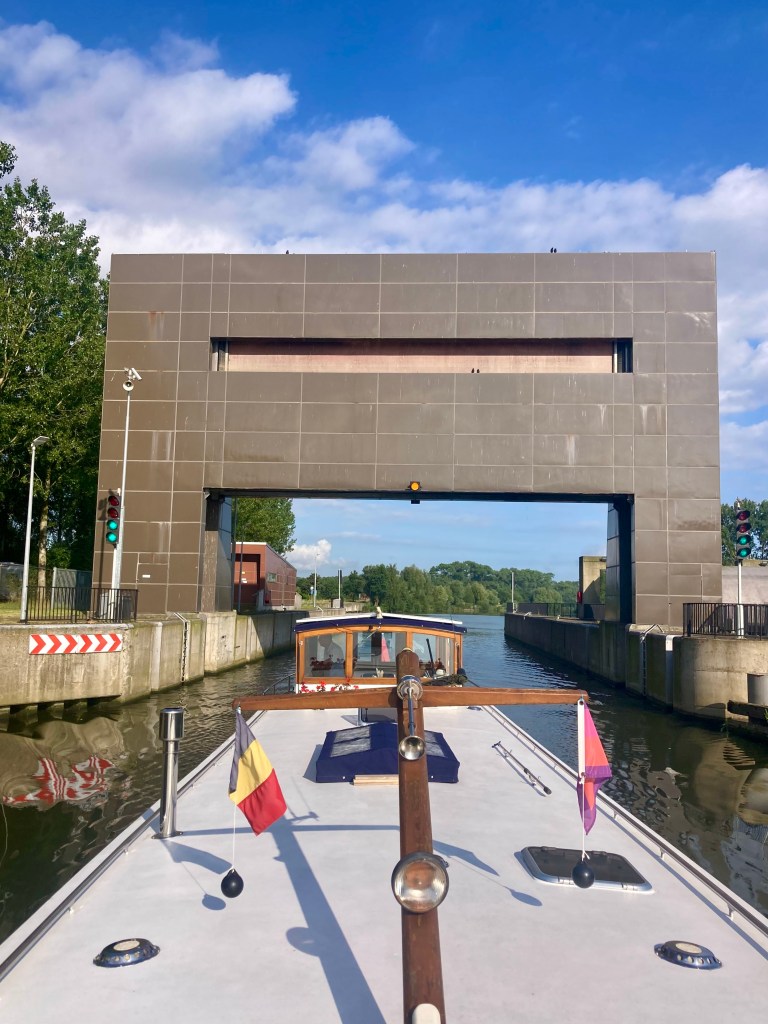
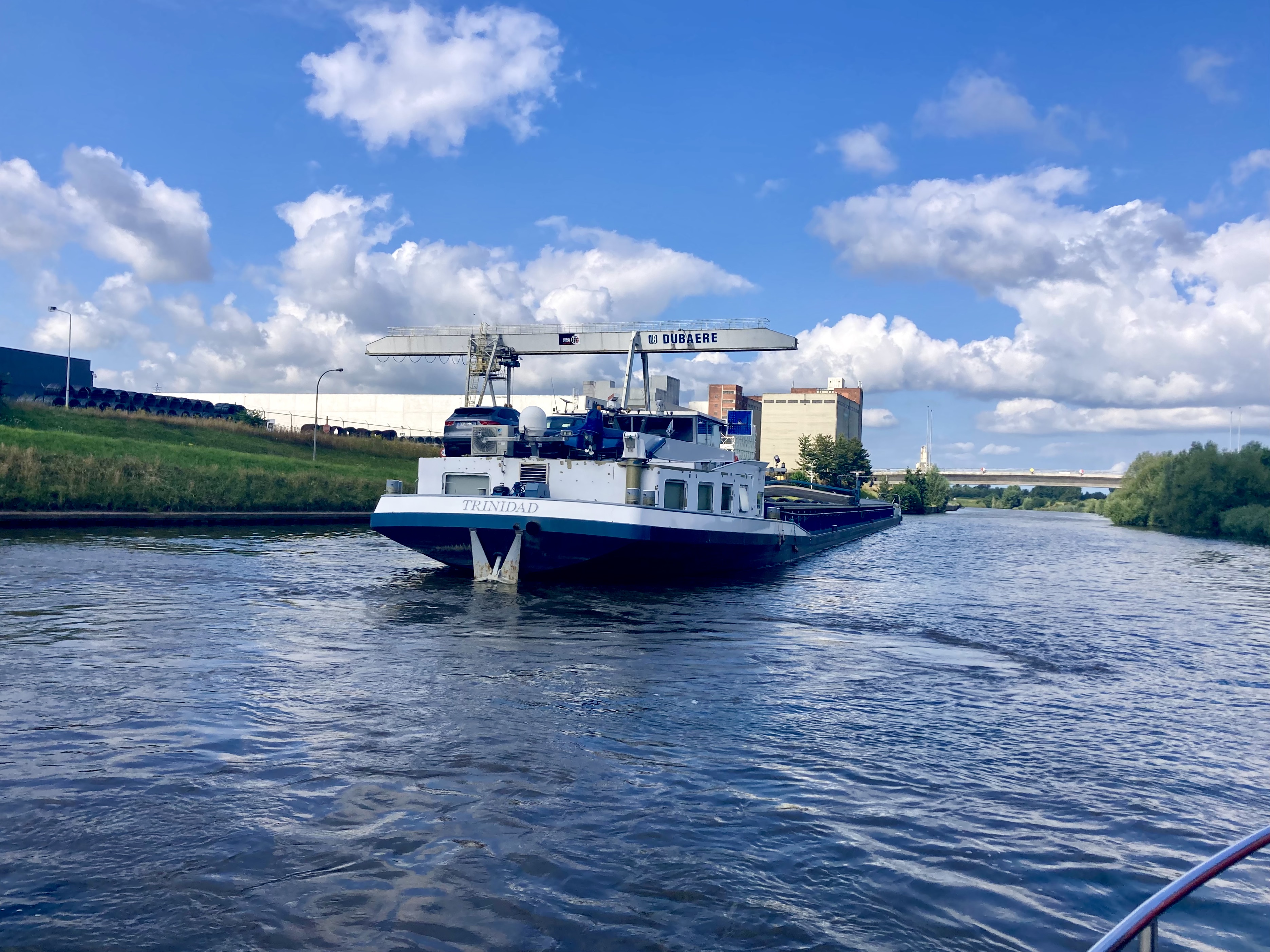
Now we were on the last stretch to Deinze and the meet up with daughter next day. We were getting excited! It is a fairly straight and wide canal, built for the many working barges that ply up and down between Gent and Ostend.

Part way down we turned right onto the Schipdonk kanaal. This would take us through to Deinze.
It is another straight and wide waterway, with no locks along the 14 kilometres we moved along, and with every bridge high enough to let us and the biggest of working barges through.

At the end there is a widening as it meets the Leie river at Deinze. We got caught out here!
A series of chunky navigation markers are set out along the centre of the channel. Our Maps and apps did not mention them and even with binoculars it was impossible to see any words or colours that would indicate to us which side we should pass.
The normal rule is to keep to starboard, so we did …. and ran aground! Not a total disaster, but but did mean that for 20 minutes or so we were looking for ways to free Calliope from the sand beneath her.
Luckily a lock further upstream let out its water, causing the levels to rise just enough for the bow to float free and for us to carry on.

We turned into the old Leie, called up to pass under the new foot bridge and the old toll bridge – and there we were, at Deinze quay. Apart from a small day boat and a cabin cruiser that arrived later we were the only boat there; plenty of space, plenty of choice.
And plenty of time to have the boat cleaned up and re-stocked ready for the next day when the Family Fun would begin – the title of the next blog post!
Calliope’s lift-out for hull cleaning and repainting.
July 10th to 22nd 2024
Boats like Calliope should have their hulls repainted with good black ‘stuff’ as part of regular maintenance. We were 6 months away from her 10th birthday, and thought she should be treated her to her new bottom early.
Over the past 9 weeks we had made our way North from Saint-Jean-de-Losne on the Saône river in France to Diksmuide in Belgium; previous blogs document this lovely journey. We were booked in with the highly recommended Thijs at Buitenbeentje.

On the morning of July 10th we were waiting a few hundred yards down river in Diksmuide port, waiting for our call from Thijs to say he was ready – and the call came at 0830. It was not long before we were by his quay and driving into the crane harness.
Then the grand lift out. This crane can lift up to 50 tons. Calliope is a mere 35 tons, so an easy lift. She went up, then a swing round, somewhat slower than the video and settled down onto the cradle that was to be her resting place for a while.
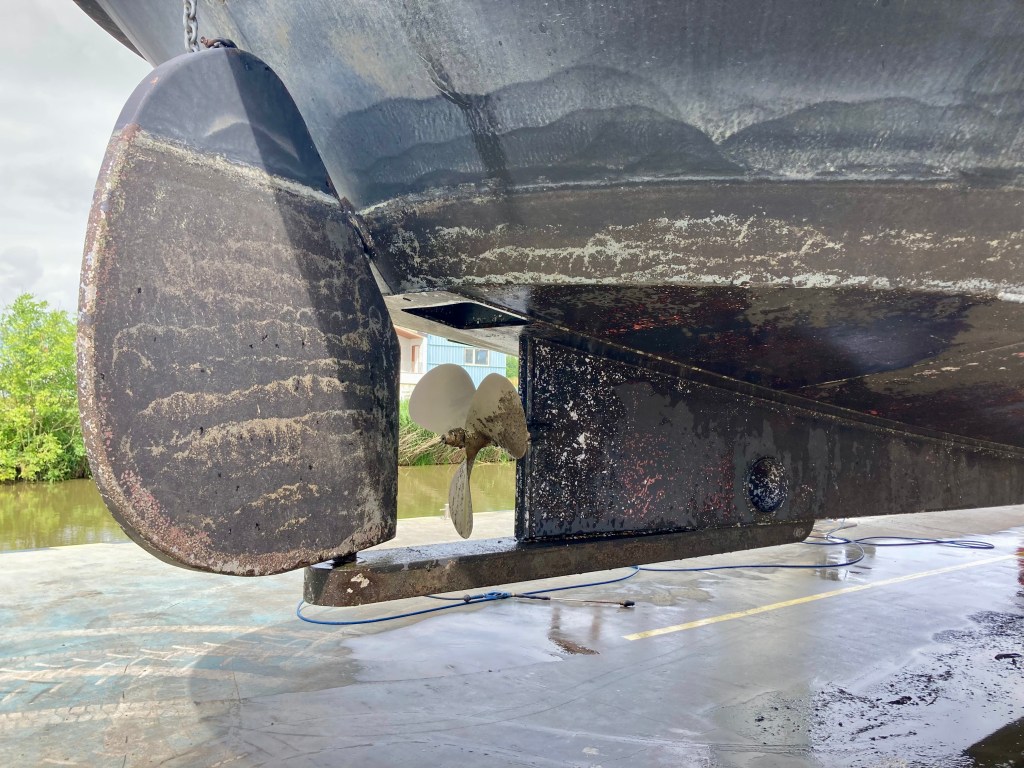
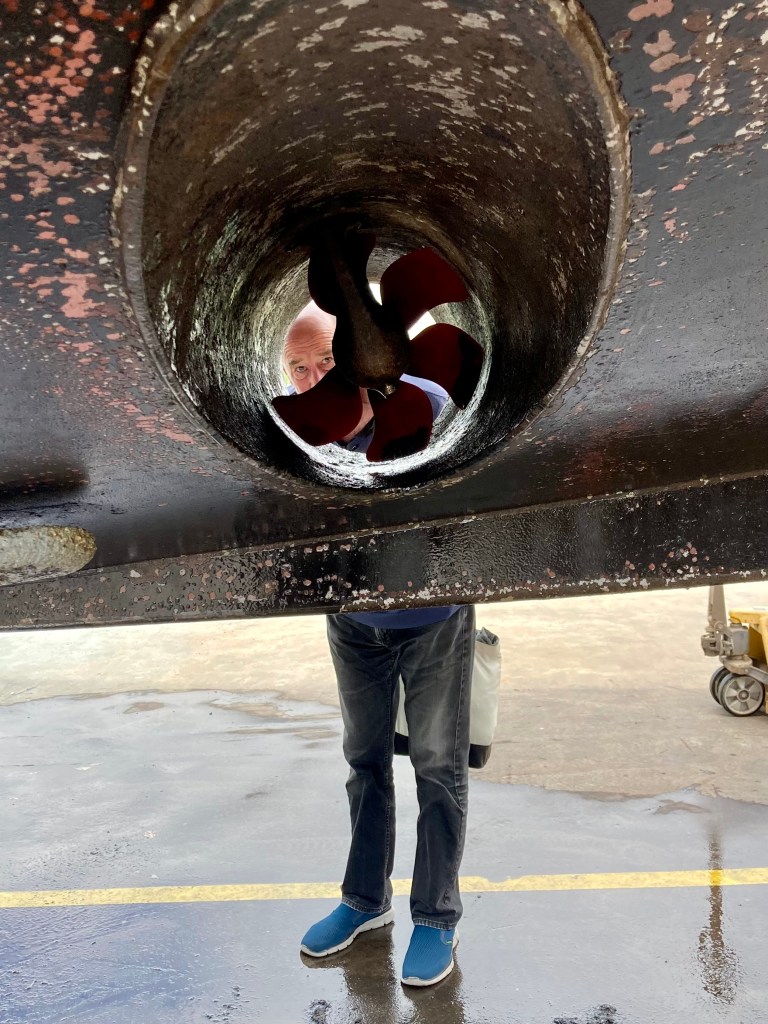
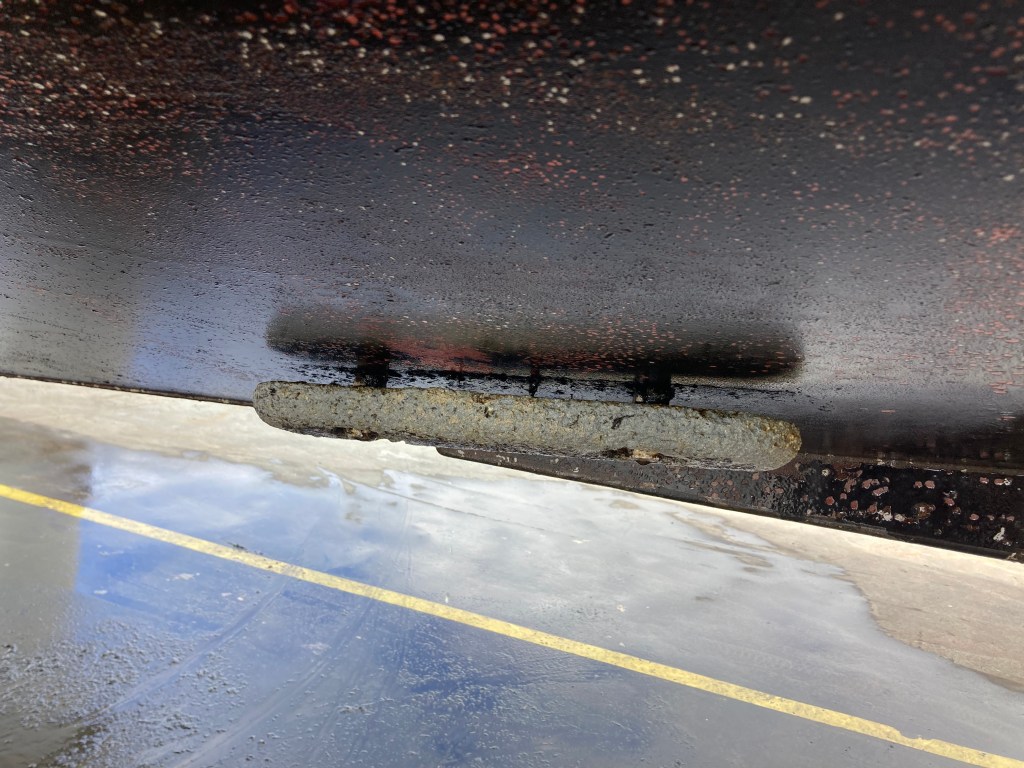
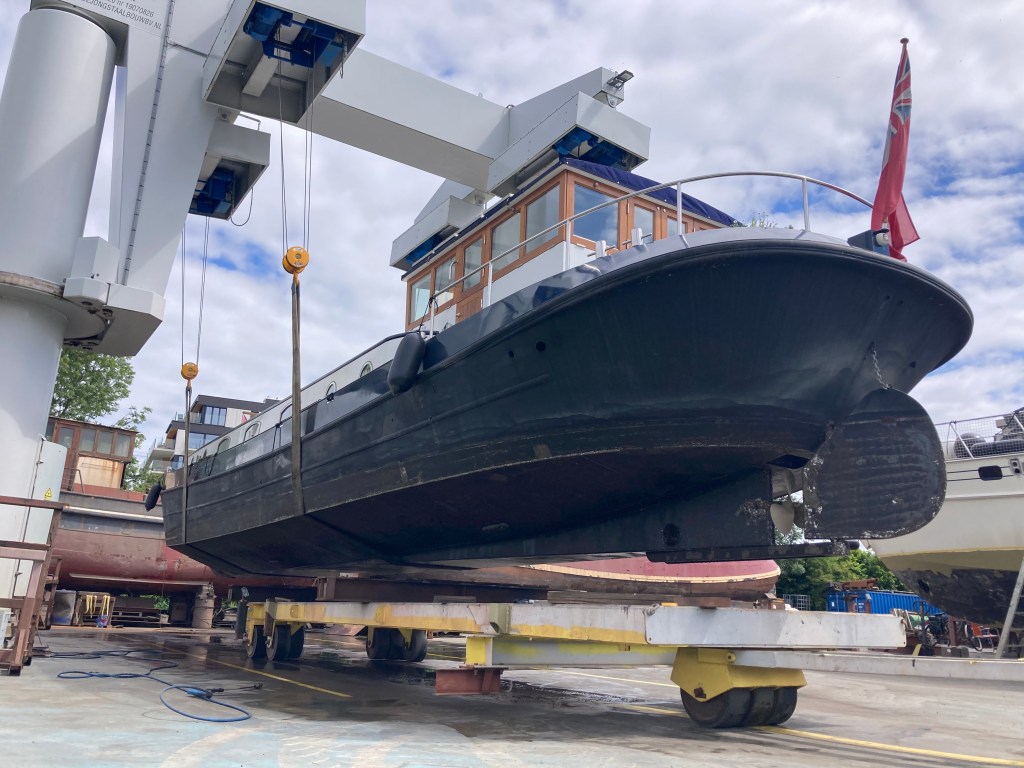
As soon as the sand blast cleaning finished we were walking round the all important hull, invisible most of the time. She was looking good for her 10 years; all the anodes were ok, propeller and rudder looking good. The only part showing wear was the bow thruster propellor, with just one blade missing. A new part was soon on order.
Small areas of surface rust were to be rubbed down and treated before priming, so they were not a worry to us.
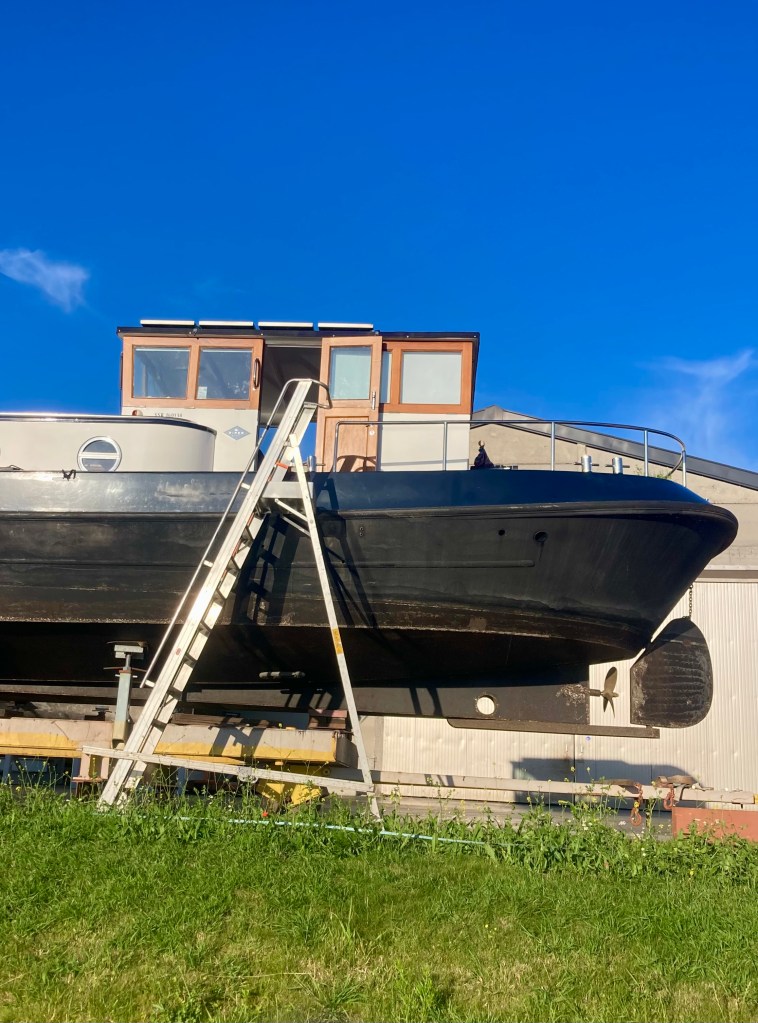
A ladder was soon set up for us to use throughout the stay.
Our high rise living had begun!
The following days had us watching with interest the various stages of the work.
High pressure washing and sanding and had been done already, so on to the next stage.

Surface rust treatment (nothing serious here!).

Two coats of primer.
Looking smart already.
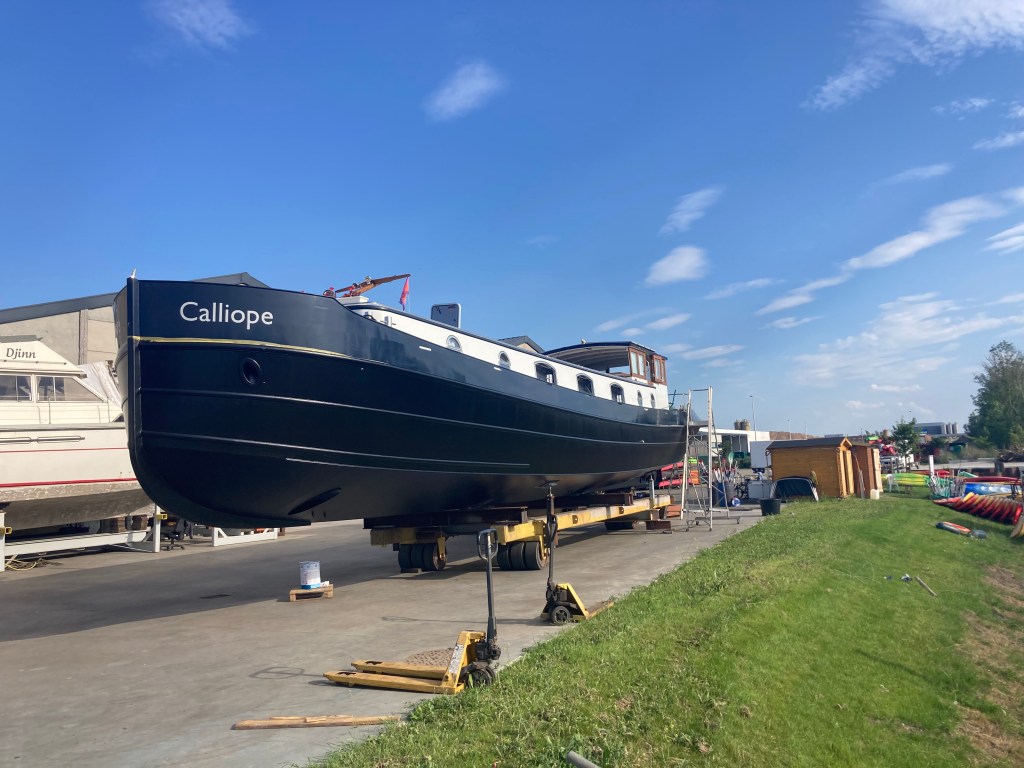
Top coat of Vikote 42 high build flexible vinyl, in black!

The half way stage was interesting.
And while Calliope was brought back to top condition we used our time to explore Diksmuide.
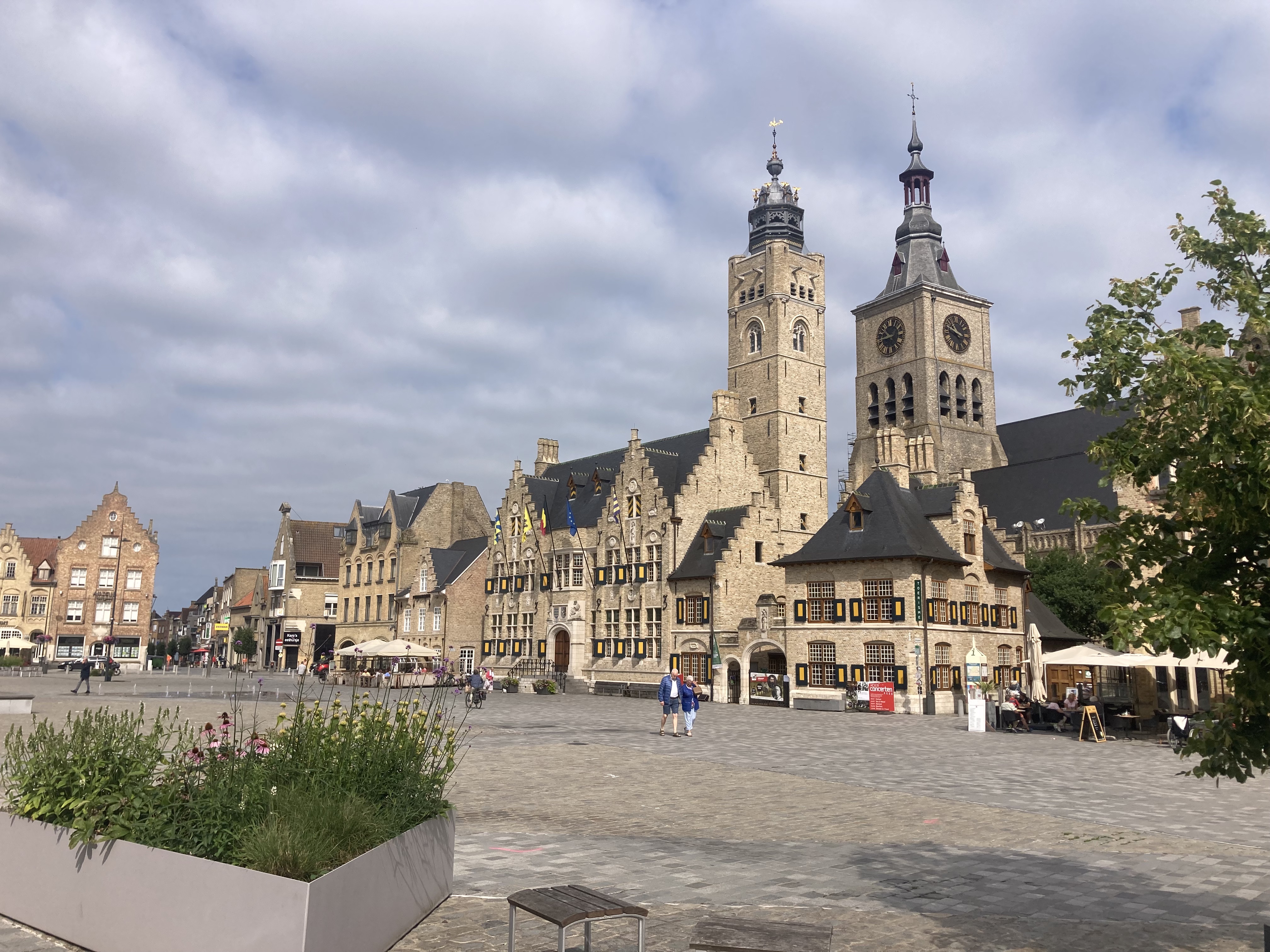
The Grote Markt (main square) is surrounded by wonderful buildings – some original and some re-built after WW1, when much was left in ruins. Once a week on a Monday it is covered in a good food market. The cheese stall is to be particularly recommended!

We went to some of the bars.
One was in the Grote Markt, with the church in the background – showing how early we were out for a beer – but it was a hot day.
On a walk through the commercial estate adjacent to the boatyard I came across a pleasantly funky pop-up summer bar; we enjoyed our El Dorado moments.


But it was mostly pleasant to stay on board in the evening, looking down at the river and across to the Iser Tower.
Sometimes it was just Stu and I; other times we invited boaters who were also temporarily living in the boatyard.
On this occasion we rather pushed the boat out, so to speak. Often its just crisps and nuts!

One of the other places we visited was the Begijnhof – a place of refuge for single women of all ages in earlier centuries, and a regular sight in many Belgian towns. They always have a feeling of tranquility.

This begijinhof is now home to people with learning disabilities, providing secure semi-independent living for them all. It seems a very happy place, and during the day os open for all to wander in.
There is also the Iser Tower, and its museum of war and peace. It describes much of the local area’s involvement in WW1. It is Interesting, harrowing, inspiring and exhausting! The latter description, exhausting, is because the museum is laid out over the 26 floors off the tower and although a lift takes you to the top and you walk down through the layers, it is still quite a journey.
In fact there are two towers. The first tower was built in 1928–30 to commemorate the Belgian soldiers killed on the surrounding Iser Front during WW1, and as a monument to pacifism. However, it became an important political symbol for the Flemish Movement and, as a result of its association with Flemish nationalist collaboration during WW2, was destroyed in 1946 .
The current tower was rebuilt alongside the remains of the original and copied its design.
Just walking up to it is an experience; a shame it was covered in scaffold when we were there.
Installations made of metal remnants from the war line the path.

Once the lift has taken you up 26 floors and you have walked up the last stairs to the roof you have an amazing view out across the Belgian landscape. We made sure we went on a clear day to get the full benefit of this panorama.


I didn’t take photos within the museum – there is so much to take in and learn.
Meanwhile, back to the boatyard…..
The boatyard is not only a place for repair and maintenance of boats. This family business includes many other water based activities – kayaks, motor launches, paddle boards etc – and, away from the water, paint balling.


Then there was the normal river traffic too – including in this photo on the left the trials of an AI driven barge! There were always goings on to watch from our vantage point above it all while at at Buitenbeentje.
The 10 days sped by.


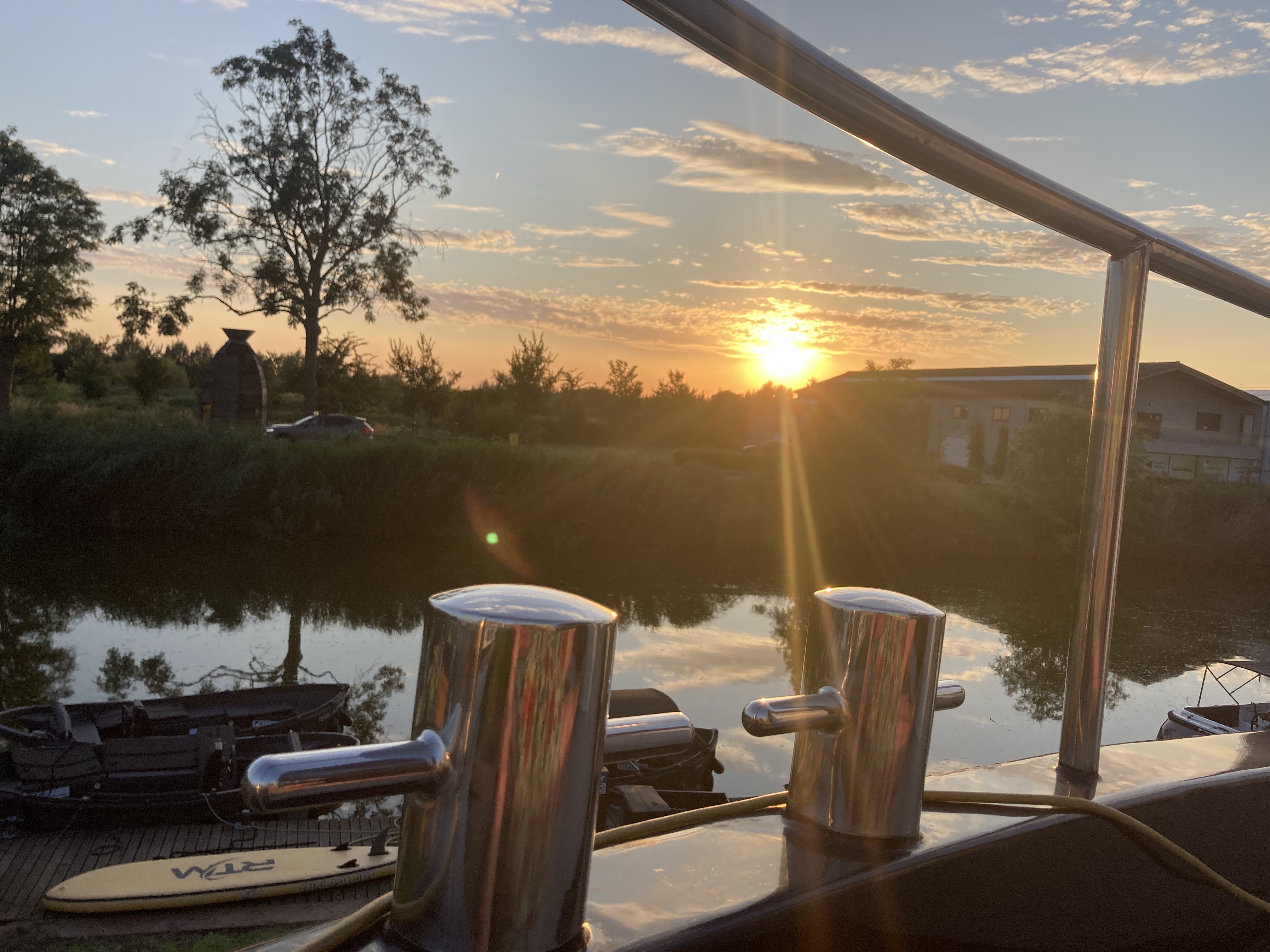
One beautiful sunset after another.
And then it was time to inspect Thijs’s finished work.
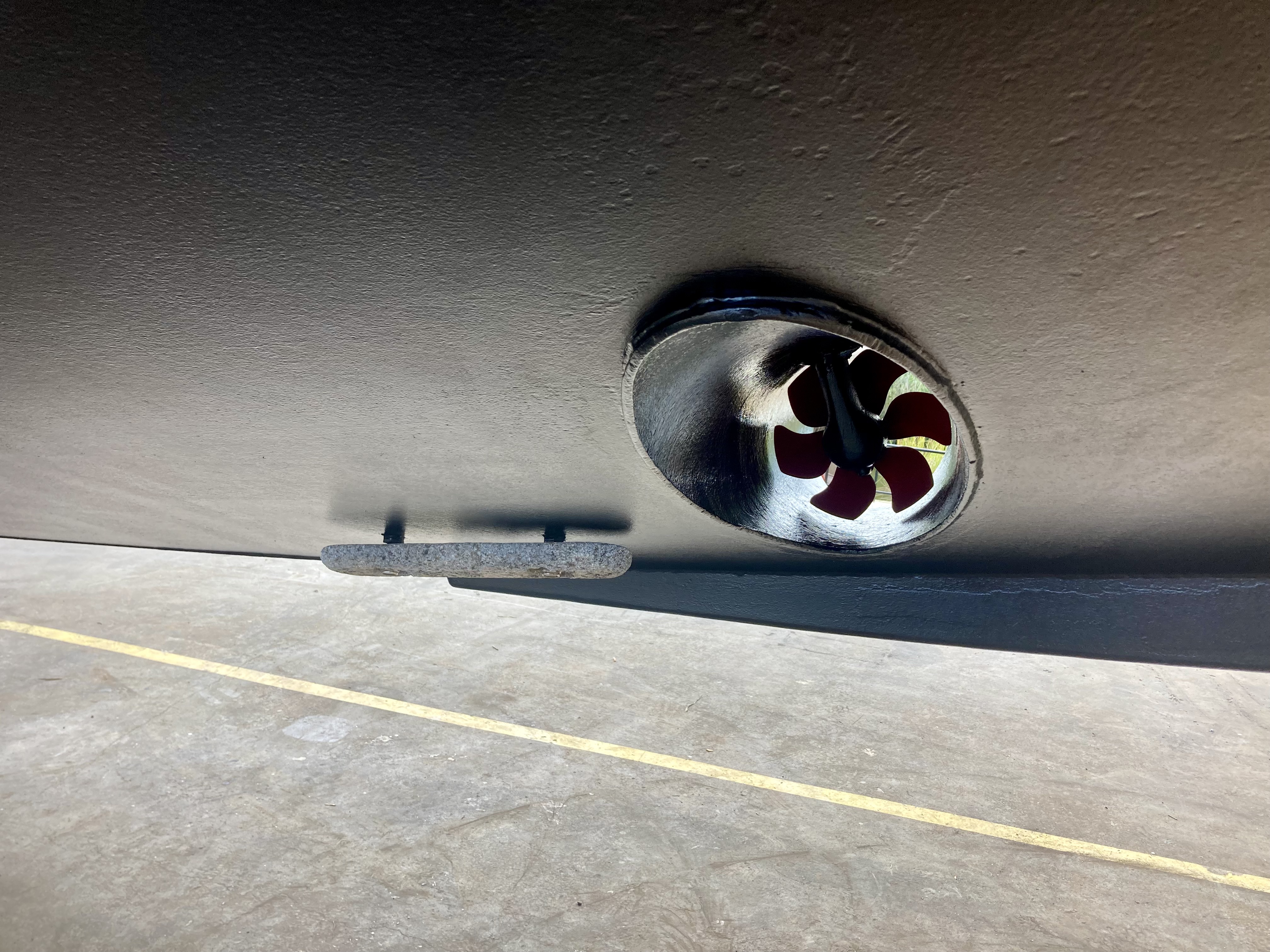

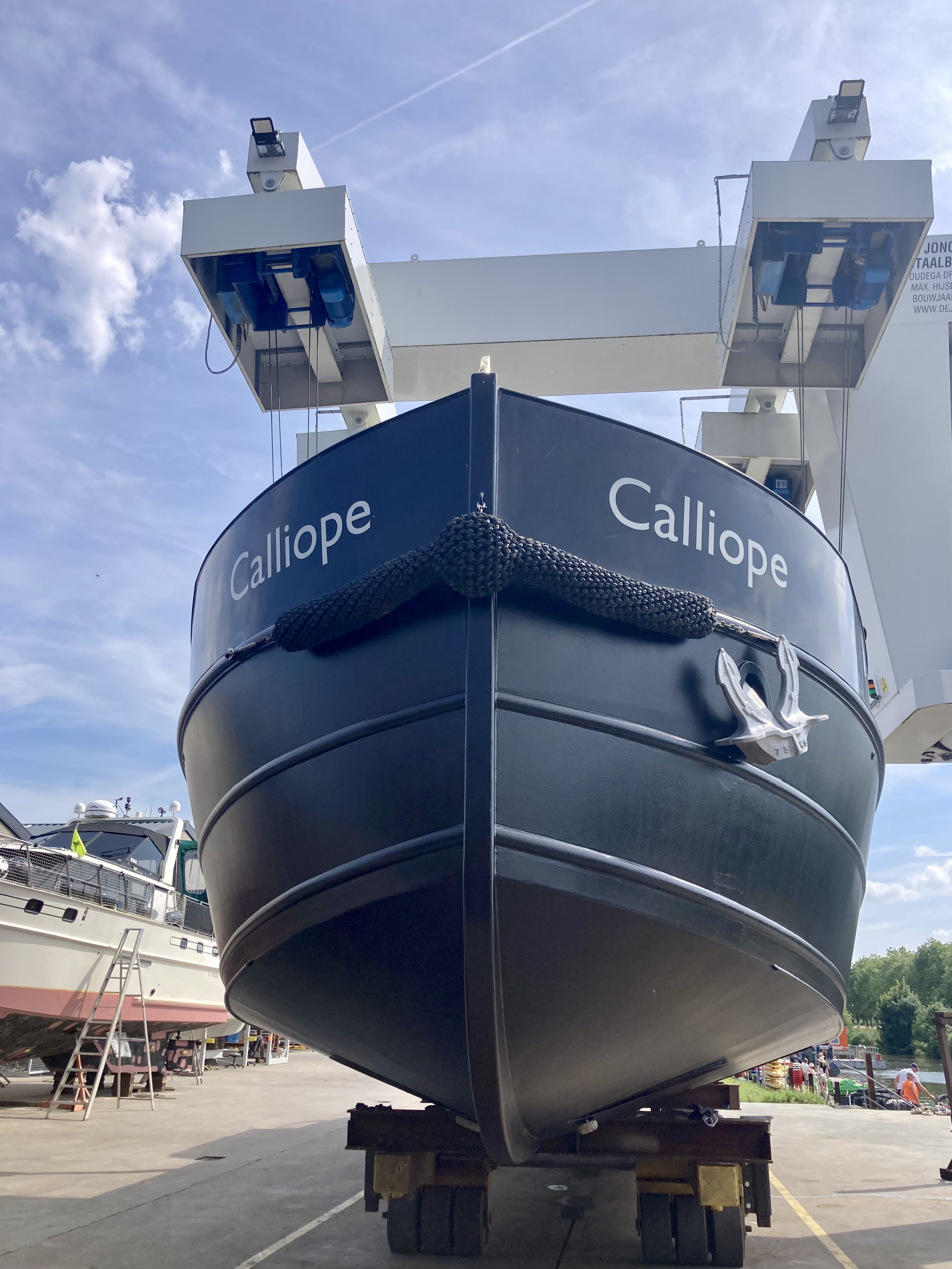
The anchor was back in place; the rope fender round the bow was fixed on again; the new bow thruster propellor had been installed; the patches where we had been held aloft on the cradle had been fully treated through all rust, priming and top coat stages.
It seemed that our high rise living was coming to an end.
And so it was, on a Sunday morning 11 days later, that Calliope was swinging back around to be set back into the waters of the Iser river.
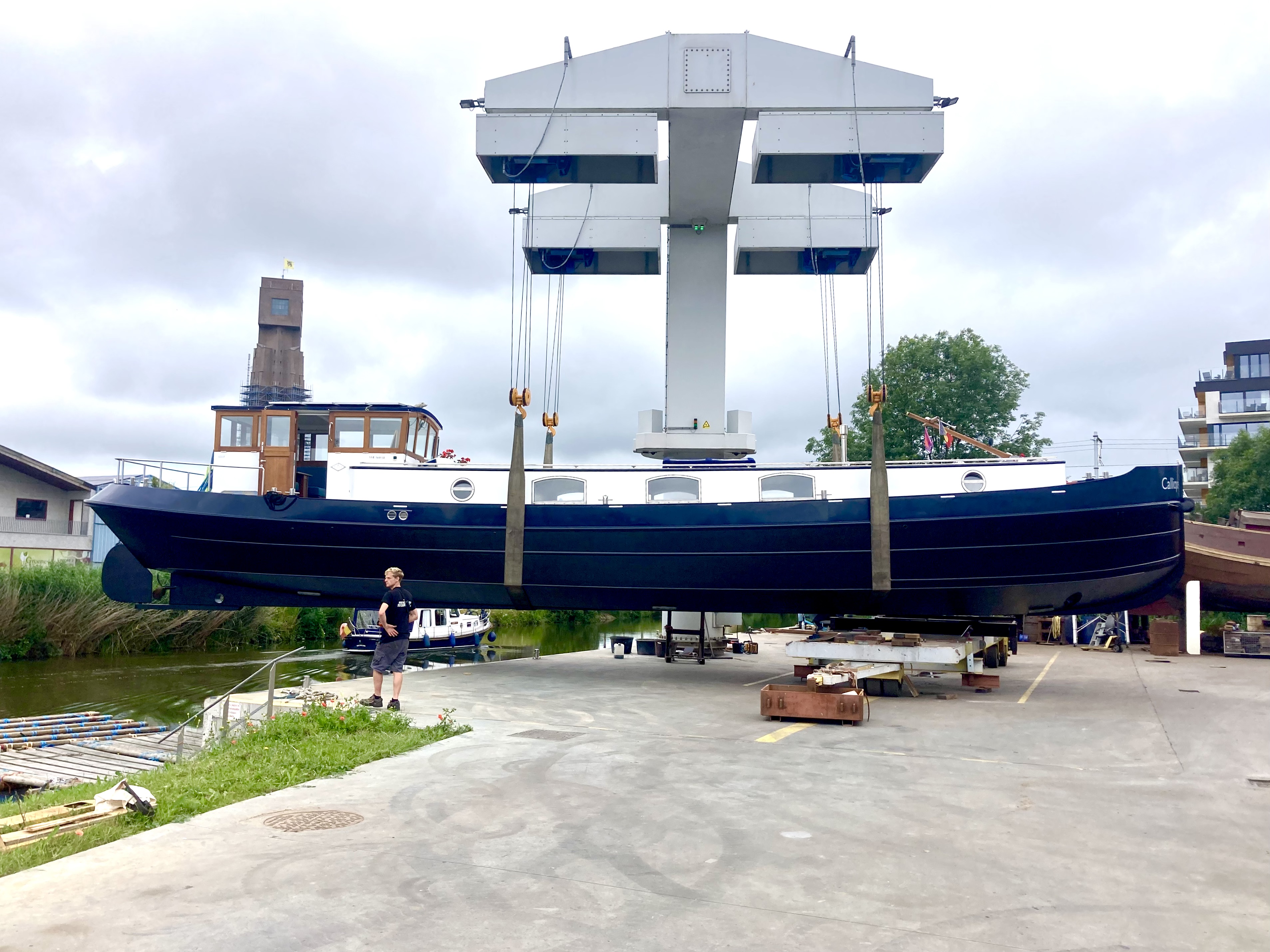
A memorable sight, with Thijs in the foreground and the Iser Tower in the background – hopefully not really leaning to one side!
I know there’s a lot of photos etc of Calliope, but if you want to see the splashdown, with some applause from on-lookers, and Captain Stu helping move a raft, its here.
We stayed alongside at the quay for one night and after a short journey upstream to a turning point we came back, temporarily, to the Diksmuide port where we filled up with fuel and with fresh water.
This is rather a nice filling point.
The gazoil (diesel) pump and the water are almost adjacent so filling is easily accomplished.
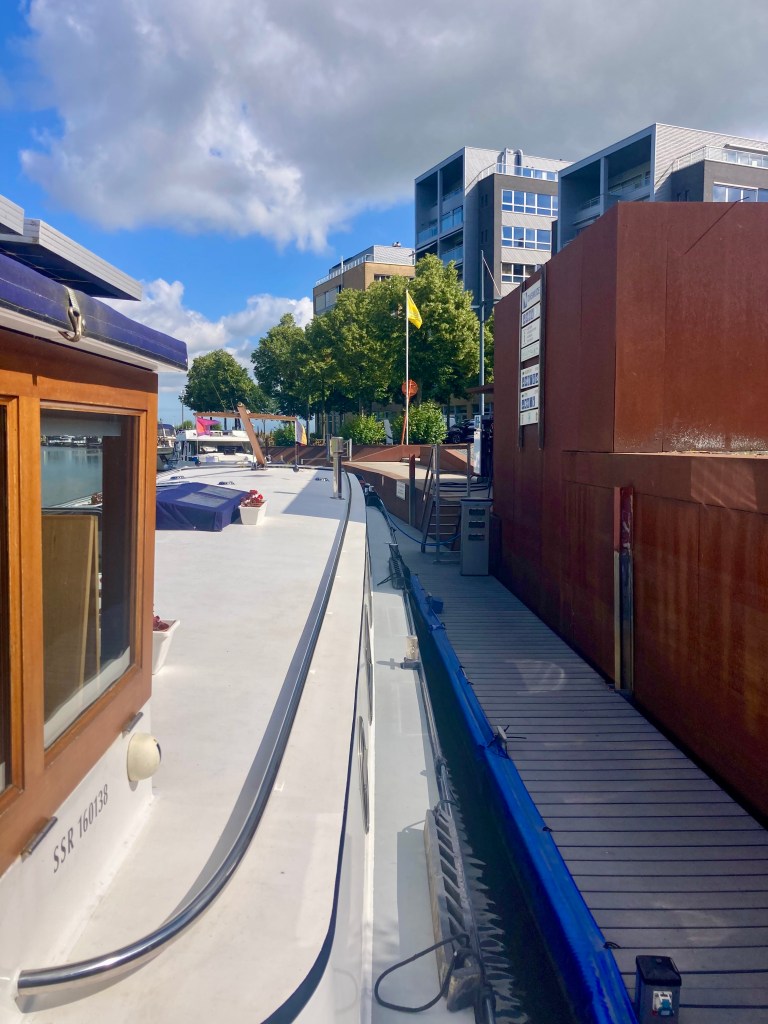
This blog post has been all about our time lifted out at Diksmuide and if any reader has questions about it please send a message.
We were off for a two week holiday, aboard Calliope, at Nieuwpoort on the Belgian coast – less than three hours away.
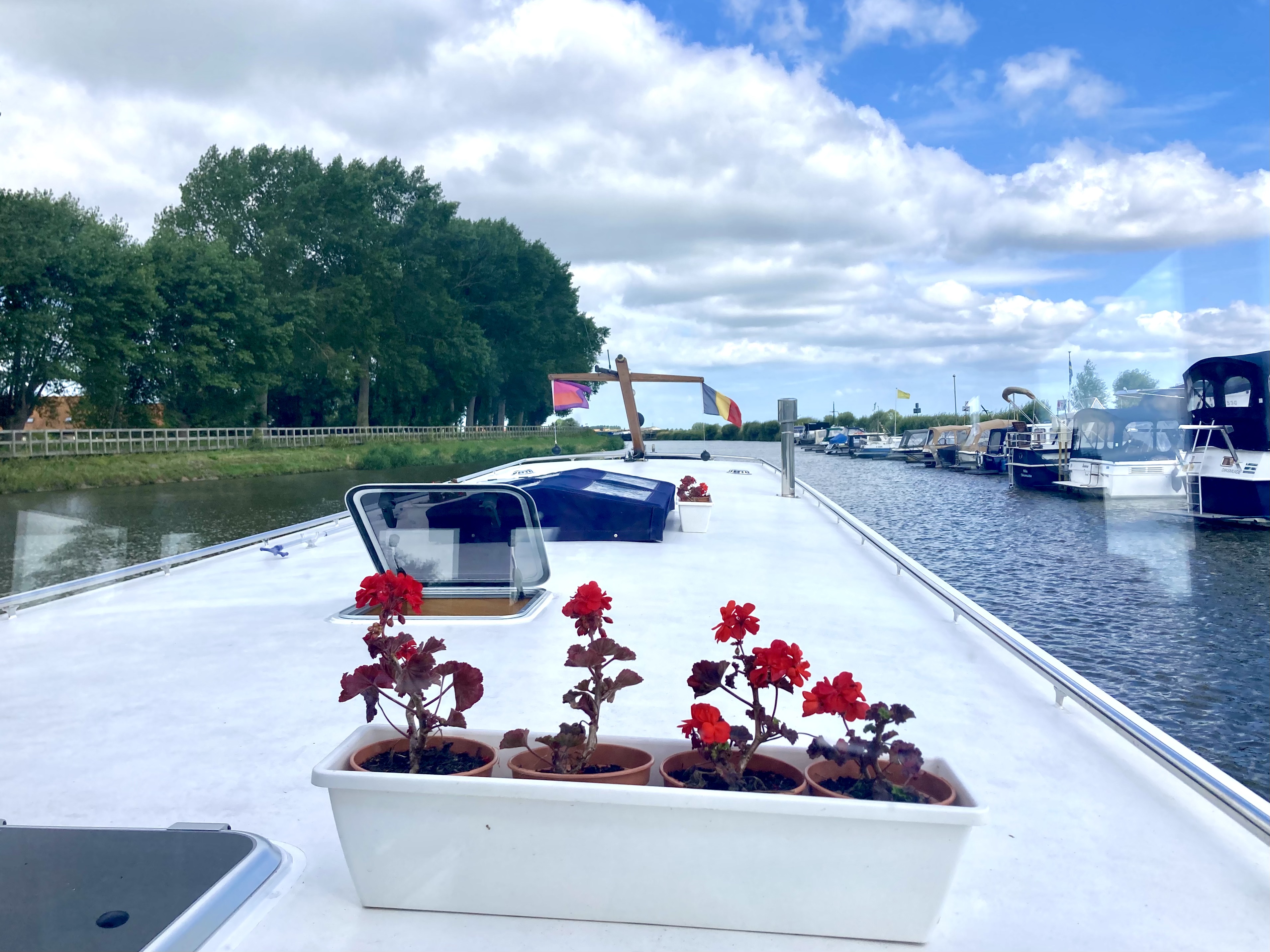
So it was off down the Iser for us, past the moored boats of Diksmuide Port. Maybe the next blog post will include a little of that holiday. 😌
Gent to Diksmuide
July 1st to 10th 2024
Gent, on the Scheldt
This was one of several special family weeks during 2024. Calliope had to be in Diksmuide, North Belgium, on July 10th to be lifted out for her quinquennial (5-yearly) hull clean and re-paint. We had been travelling up from Saint-Jean-de-Losne in France for the past 2 months, and had an appointment to keep in Gent on July 3rd with eldest granddaughter, partner and first great grandson.
We arrived in Gent a couple of days before to get organised , and catch up with boating friends on Dreamer. All of that journey is already posted, including the last two episodes, one in Belgium and one on the Meuse.

Here we are moored up against Dreamer on Portus Ganda, the largest of several ports/marinas in Gent.
As well as spending time with Mieke and Frans Stewart and I also had to get shopping in and prepare the boat for visitors, including a 16 month old! Luckily Mieke has several grandchildren and had put together a wonderful pile of toys, books, life jackets, travel cot and bedding. Thank goodness for friends like this!


Dreamer’s quay is almost entirely full of big barges with people living aboard. Between them they have planted climbers along the wall, making it extra colourful in summer. I cannot resist photos of flowers like these.

Stu and I had time for our own wander round Gent to re-aquaint ourselves with one of Belgium’s gem cities.
It was rather a grey day, and my photos are not worth sharing – well maybe just this one of the castle.
This is a barging blog, not a family blog, but because the two sometimes intertwine I will give a quick view of us all together in Gent.
On 3rd July I went off to Brussels airport on the train to meet Keeva, Cameron and little Marlow. After a long days work and travel for them we got back to Calliope at about 10pm. With a bit of food and wine everyone was ready for bed. Luckily they all settled down in their new quarters for the night.
Next day was designated as Explore Gent Day. Exploring Gent meant exploring some of their food and drink as well – waffles, chocolate, Gentse Kopf (a kind of tasty brawn), frites, bitterballen and naturally beer.


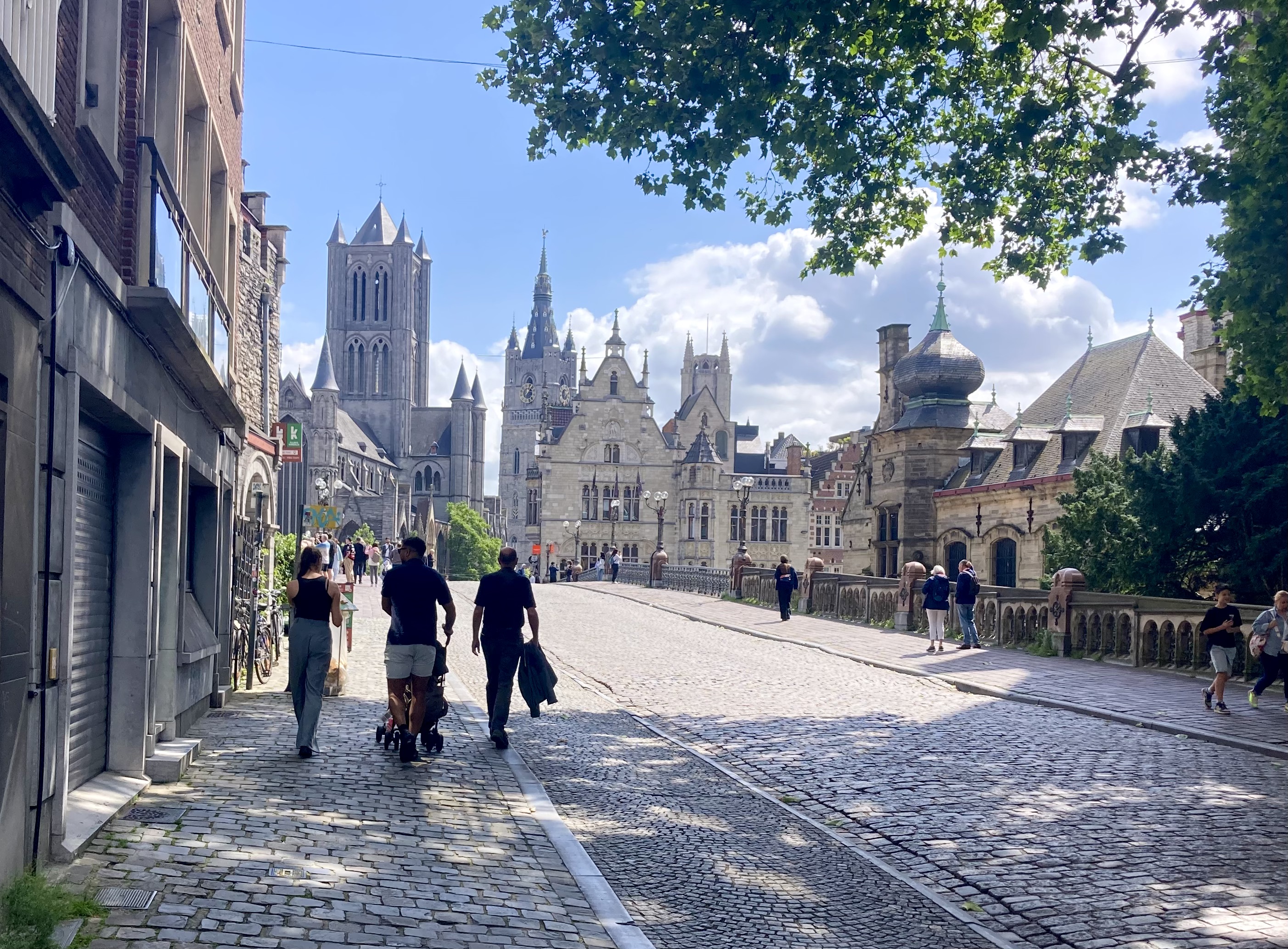

A bit daft I suppose, but as I was not the tourist on this occasion I did not take many photos of this fascinating, beautiful, full-of-histories city. Keeva took loads!
With a child on board we also spent time in parks and sand pits, squares with fountains and simply on Calliope with toys and books. Keeva liked the play parks too!


Before we leave Gent I just want to add a nature note. I have long loved grebes and often try to photograph them, but they always catch sight of me and dive under water.
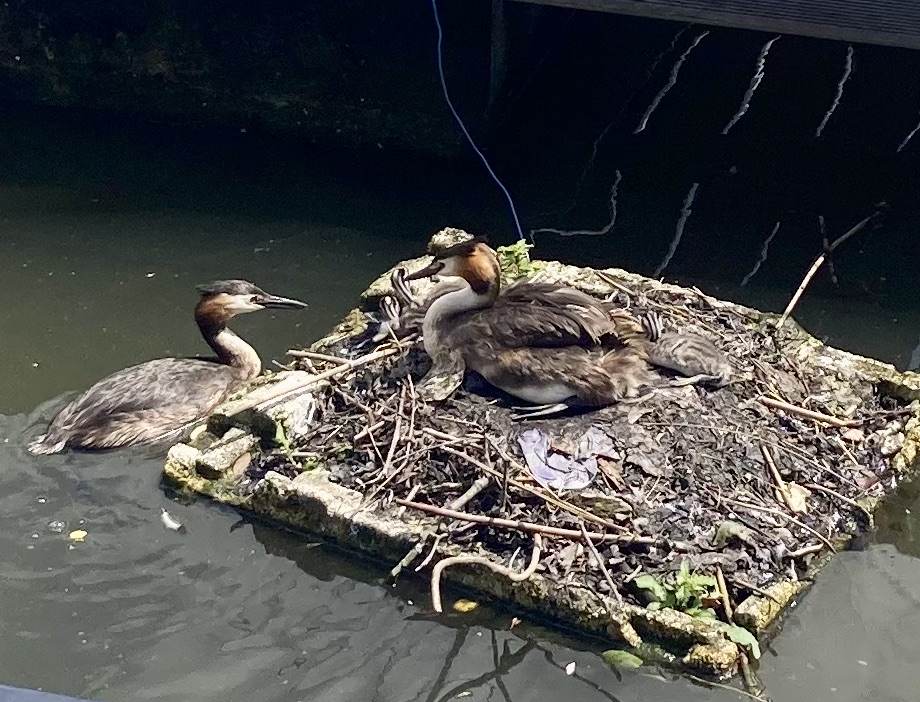
I was so lucky at Portus Ganda. A brood of grebe chicks had only just hatched. Their nest was right alongside a pontoon and the chicks were too small to swim far so mother grebe had to stay put.
Look carefully for the zebra striped chicks – I think 3 are visible.
Not only that, but I got a little video of father grebe bringing a fish back for one of the chicks to swallow – if you like nature and birds its worth a quick look; only 15 seconds. This is part of barging life; you get close up to the flora and fauna of the waterways. (Try to ignore my excited voce!)
We only had two nights in Gent with Keeva and Co. because of our date on Diksmuide. So on the second evening, after some time on the back beck with Mieke and Frans, The youngsters went for a stroll round the city to see it lit up at night while great- grandparents babysat.
From our mooring there was a beautiful view of the cathedral, especially at night.

Keeva and Cameron got up close.

Ringvaart and Kanaal Gent-Ostende
After our nights at Gent it was time to say tot ziens (goodbye) to our Belgian friends and set off north, initially to Brugge. There was a definite end goal in sight – to get there in time to watch England play in the quarter final of the Euros – we are all football fans.
The journey began up through Handelsdok (the Trade Dock), and on towards the Grootdok, or Big Dock, where most of the ships are of ocean going size. We would have preferred to go through Verbindingskanaal and joined the Bruges Vaart(Brugge Way) near the middle of Gent, but the lock connecting to it was closed for modernisation work.
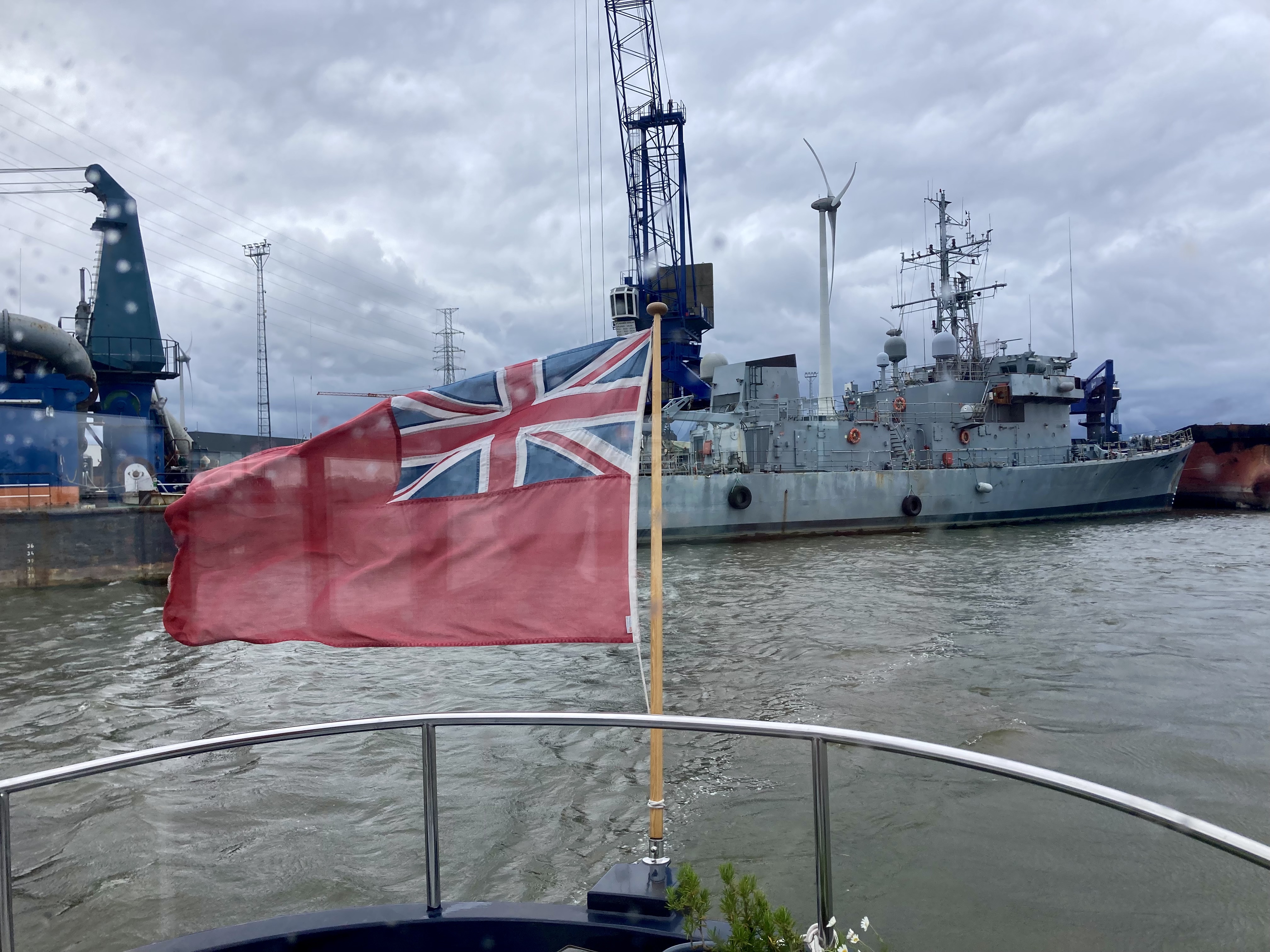
We felt quite small alongside some of these!
Then we joined the Ring Vaart, or canal ring around Gent, and waited for our turn through the big Evergem lock – all very calm and controlled. Once through the lock we were at the junction with the Brugge Vaart; a turn to starboard had us heading out on the Kanaal Gent-Ostend. Just 37kms to go to reach Brugge.
The first part of this canal is wide and busy but once some commercial barges turned off we had the waterway mostly to ourselves.
With the youngest crew member having a midday nap Keeva and Cameron were able to enjoy the front deck position – always a favourite with guests!
It’s quiet and peaceful there, with just the swish of the bow wave for company.
[Football allegiances are clear!]
There is a friendliness on the canals and rivers between the crew on vessels of all sizes. Captains of the biggest commercial barges will normally acknowledge us as they pass by, and leisure craft always enjoy a quick wave.
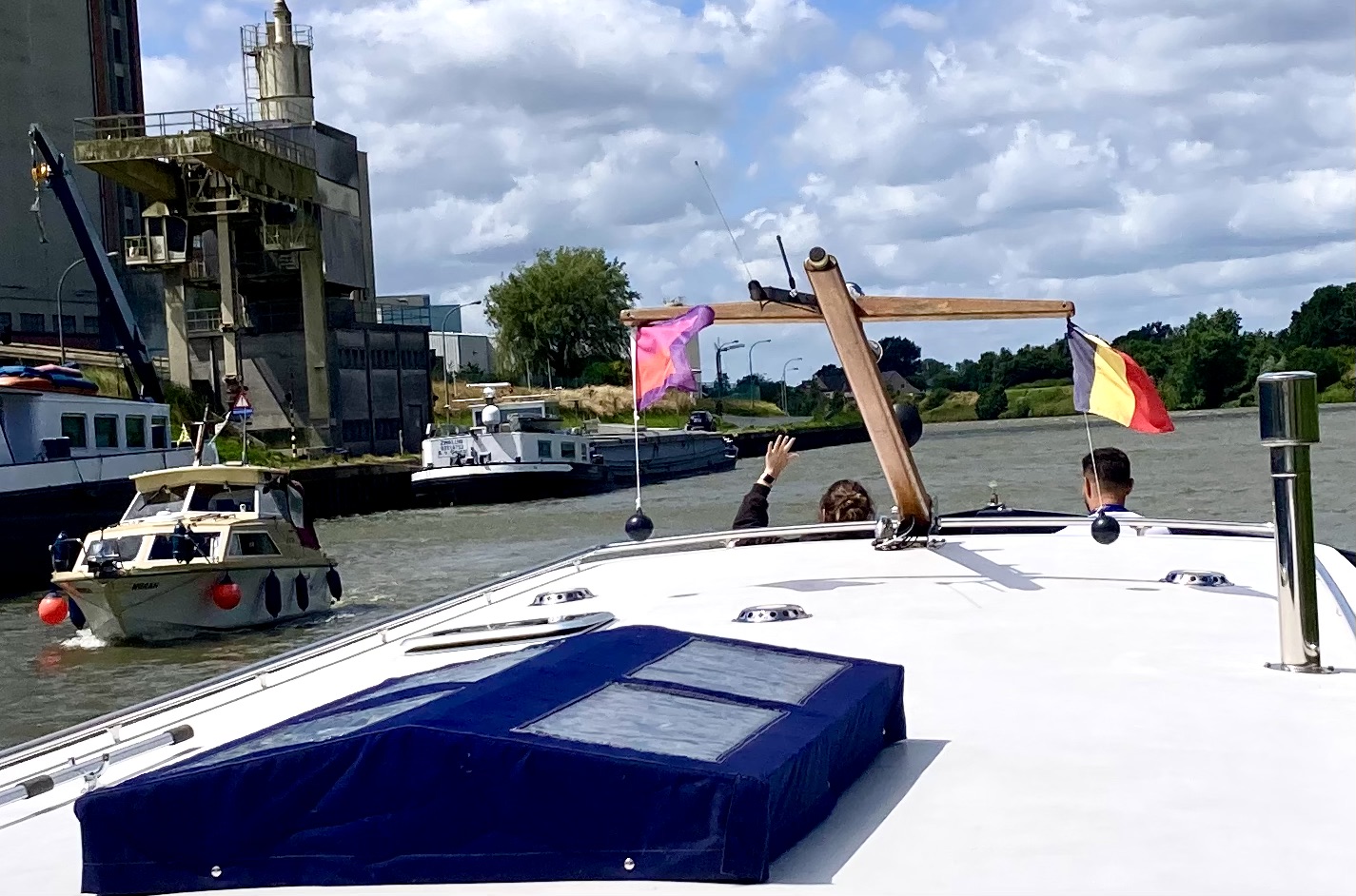
Keeva has been on board Calliope a few times before and has learnt the ropes!

There are not many landmarks between Gent and Brugge to photograph.
But there is one nice looking marina at Beernem, mainly for cabin cruisers. Here it is.
As we got closer to Brugge we called up the control centre there which sees boats through the succession of bridges from the outskirts of the city right through to the other side.
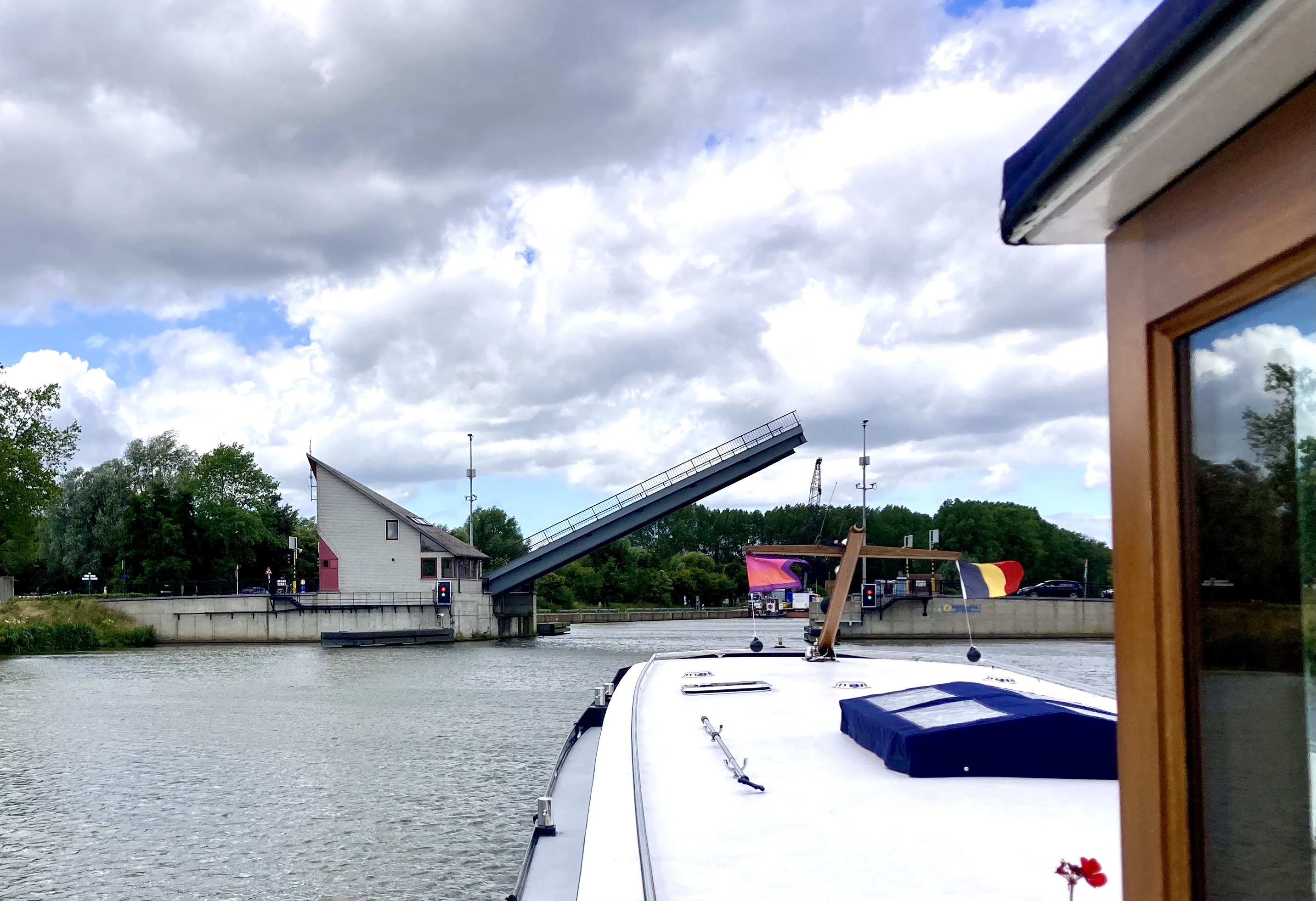
The first is called Moerbrugge. Soon after our call the bridge lifted for us. We explained where we were going to that day and knew we would be seen on the cameras as we neared each following bridge. They would open without the need for more calls, apart from the one at the entrance to Coupure Marina.
Brugge
We have not stayed at Coupure before. The map told us that there was a bridge across the entrance which had to lift for us to enter. A call to the harbourmaster ensured it would happen.
If you saw the Red Ensign blowing on Calliope as we left Gent you will know that this was rather a windy day! Turning into Coupure was not an easy manoeuvre for Captain Stu. As there is not enough space to turn Calliope inside the marina, we had to go in astern, with the wind threatening to blow her sideways along the canal. But as usual Stu brought his ship into her mooring steadily and surely.

Here we are tied up securely. The bridge can be seen in the distance, back in its lowered position.
Apart from the entry, Coupure is a good mooring from which to see Brugge. It is just a 5 minute walk to the centre and all its beautiful buildings.
But first we had the football.

We found a convenient, very friendly, sports bar. And England won!
(If you are worried about Marlow being in the bar, he was very happy and I took him outside for a chunk of the match)
Our guests had less than 24 hours in Brugge. Next morning we set off to have a good look around the centre. Keeva took all the photos! I just have a tiny taste of the city.


But we did explore lots of the little streets and backwaters that make Brugge so attractive. And we found somewhere else to have waffles!
Back to the boat for luggage to be packed and a pizza restaurant to be found between us and the station! We enjoyed a good lunch together and then walked to the station to find the Brussels airport train, and say goodbye.
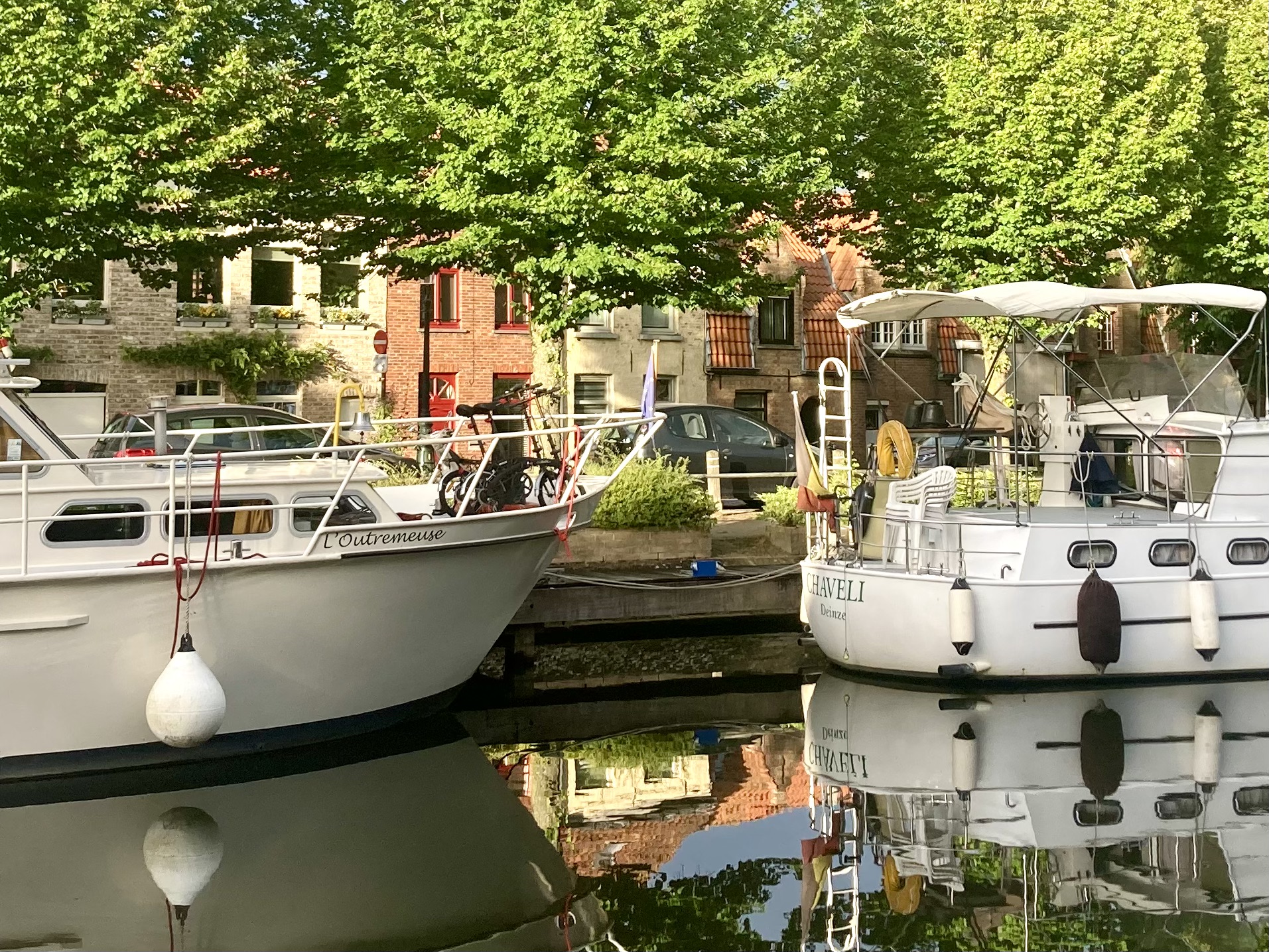
It always seems a bit empty when family have gone again; calm and quiet, with a lonely edge. But Stu and I had something to focus on. We would be leaving again in the morning. We had two days to reach Diksmuide and our lift out; I booked our Coupure exit for 9am.
We discovered in the morning that our exit would be with about 7 other boats, who had also booked to go. We were happy to be last in the queue and once on the canal we turned to the left with 4 boats, whilst 3 others turned to the right.
As we set off I was ready with my camera to make amends for the scarcity of photos the day before. The cruise around the edge of Bruges is full of photographic opportunities from locks and bridges to old city gates and windmills.
We were in a convoy with five of the other leisure boats, all destined to go through the one lock and four bridges together. Things were made easier by the Coupure harbour master who had informed the control centre that we were on our way; no need for calls or radio. I could concentrate on photos!


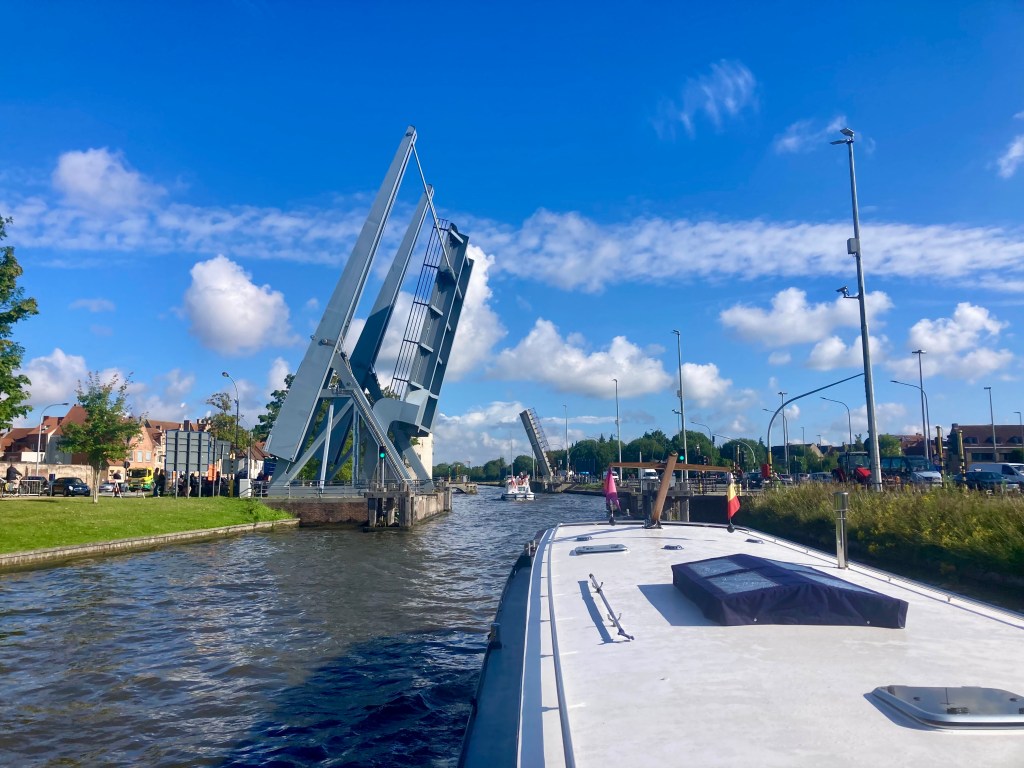


The one lock is rather interesting as it is a semi-circular in shape, and has three entry gates. The extra gate is not now in use but was the way to the Damse Vaart canal, built under the orders of Napoleon to transport troops. It was later used to service an old industrial area of Bruges.

The best way yo show the shape and size of the lock is using Google maps. Our route is shown buy the blue arrows.
You can see the old, unused, Damse Vaart going off at an angle on the right.
The convoy continued around Bruges, under the various bridges, on of which is my favourite. Its method of opening is just so amazing; the bridge turns upwards through a quarter of a circle, leaving the road on its side in mid air.
Here is is coming back down to its horizontal position after we had gone through.
The canal continues a mainly straight path towards Ostend, often through long tree-lined stretches looking out over farmland.
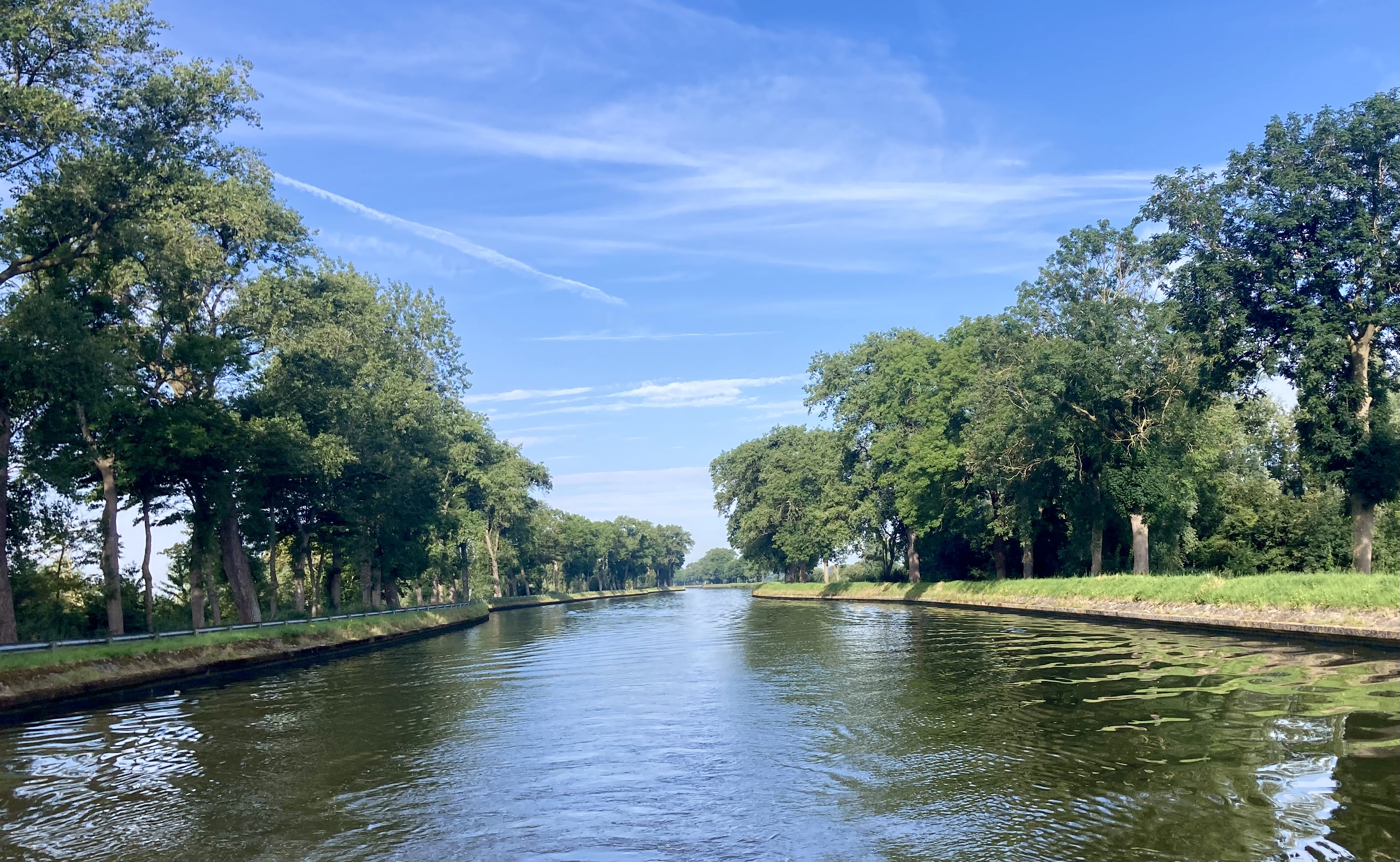
It is a very pleasant, if unexciting, trip; no more locks for a while, and only one more bridge to be lifted.
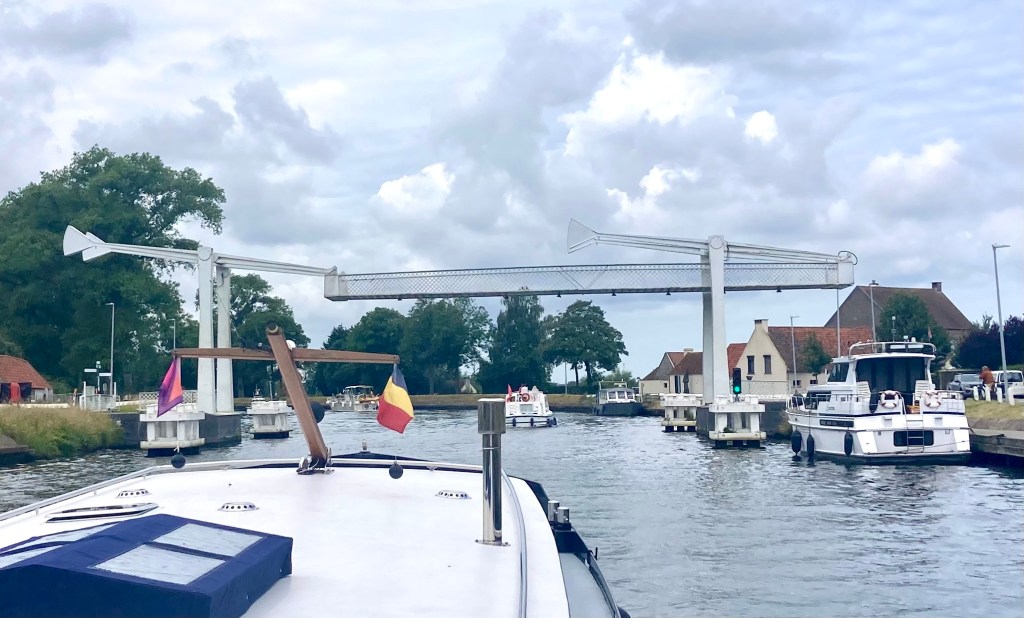
Actually that is also an interesting bridge, this time swinging the road like a swing boat!
So here is a photo of Stalhillebrug.
Kanaal Plassendale-Nieuwpoort
Eventually we reached the point where the canal to Nieuwpoort leaves the canal to Ostende. This is where we turned left, with all the other boats in our little convoy.
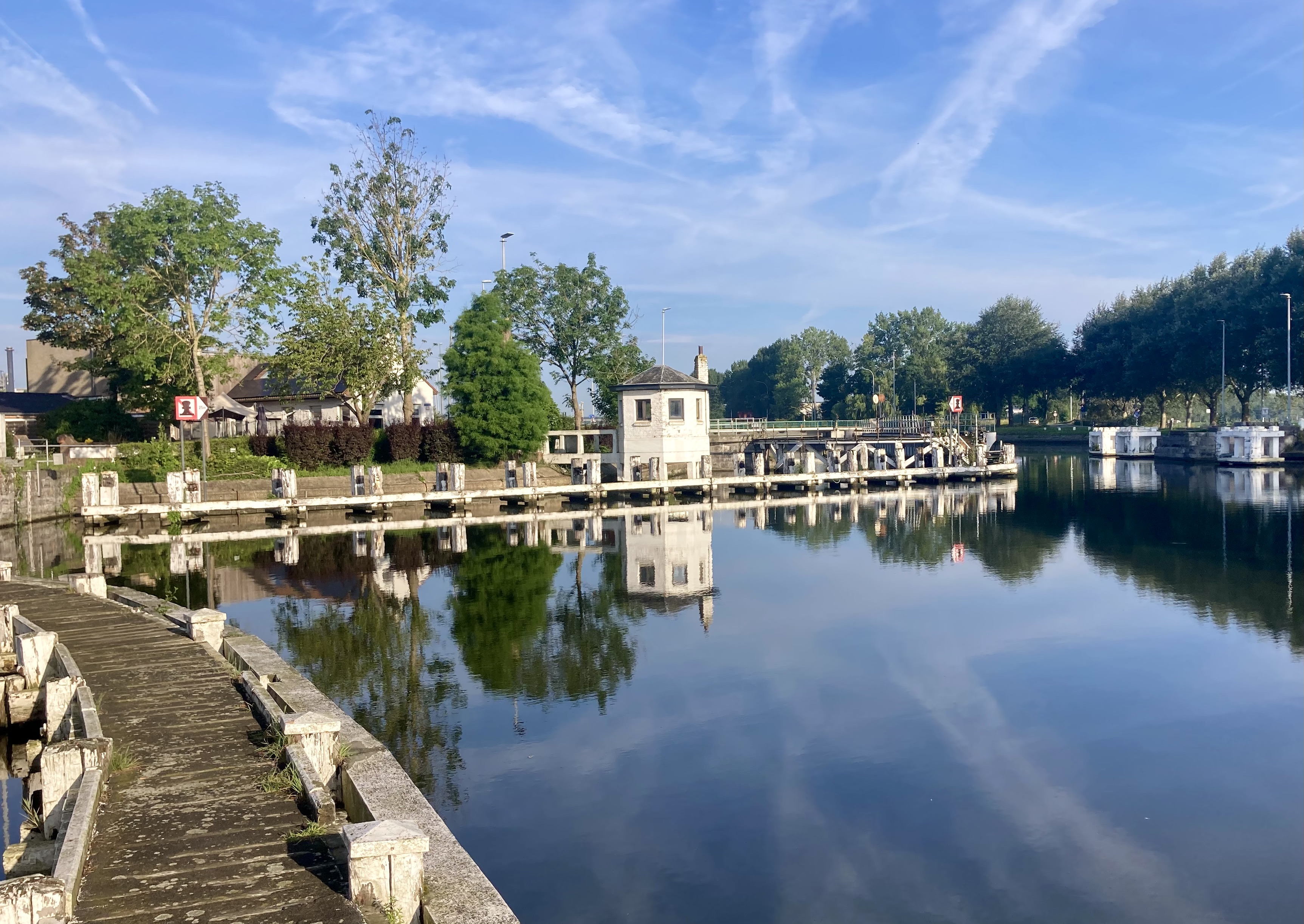
This whole area was a place for tolls to be paid to the Spanish, about 400 years ago and still has remnants of the historical past – not these wooden pontoons though!

With the other boats we turned into the lock that took us through to the Plassendale- Nieuwpoort Canal. Yes, it seemed that we were all going the same way!
It is an unusual lock both in shape (it is much wider than the canal) and in having two sets of doors at the far end.

As our little flotilla sailed on you can see the two sets of white doors – and a lift bridge to allow us out.
This bridge is on quite a busy road; the traffic queued back several hundred metres each side.
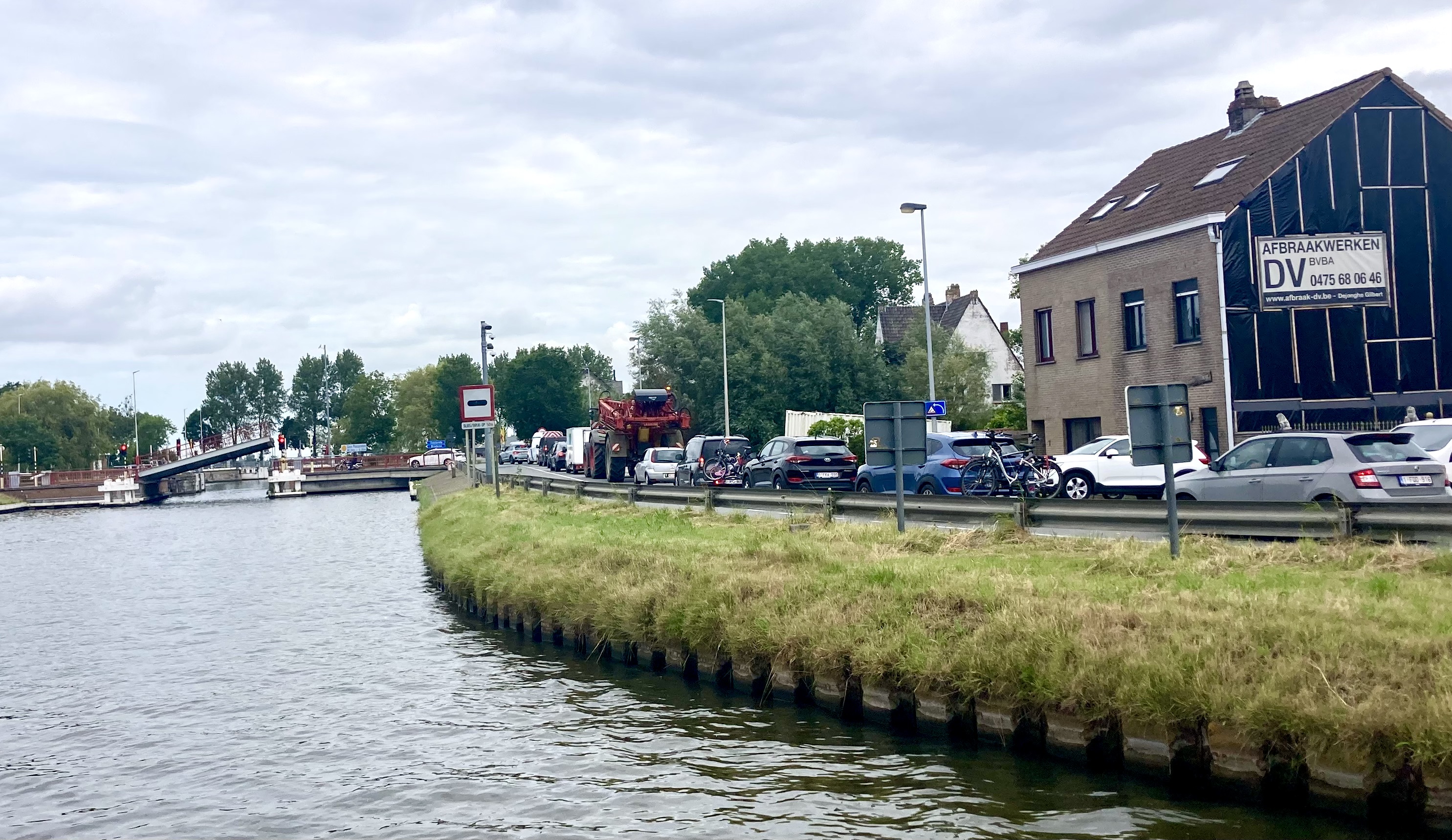
All the other boats continued to Nieuwpoort, or beyond, the same day, but we like to take things steady and had a stop in mind at Oudenburg.
It is a mooring just outside of town, and opposite a nature reserve, fields, and flat rural land across to the sea, a few kilometres away.
I would imagine that in the winter, with the wind blowing straight on from the North Sea, it could be quite cold and desolate.
But on this day in July it was lovely, despite the cloudy skies.

Oudenburg also has an Aanuit borne for electricity and water. This was a new system to us, but works well. We downloaded the Aanuit app which finds the closest electricity and water borne to you, and ‘connects’ you to it. Then you can take as much water and electricity as you need, and carry on. An invoice is sent to you at the start of the next month.

But of course you have to moor close enough to the borne!
Luckily the cap to our water tank is at Calliope’s bow, and we have a long hose!
Voila, job done!
Before we left Oudenburg we had a very new experience! It seems that this canal, and the Iser, are being used to test out an AI driven barge – the Watertruck.
It came by us and I got a quick video – it is initially alarming to see a big barge with no obvious wheelhouse or Captain bearing down on you! But we saw it several times in different places and situations, and it was always amazingly safe.
Then it was our turn to be off. This was the last day of our odyssey to Diksmuide!
The Plassendale canal seems to be all sky! It has polders surrounded by dykes on both sides, with occasional farm houses and small villages – a certain eerie beauty under grey skies.

By noon we had reached Nieuwpoort and the Sint-Joris lock that takes us from the canal onto the Iser, via the big Spaarbekken basin.
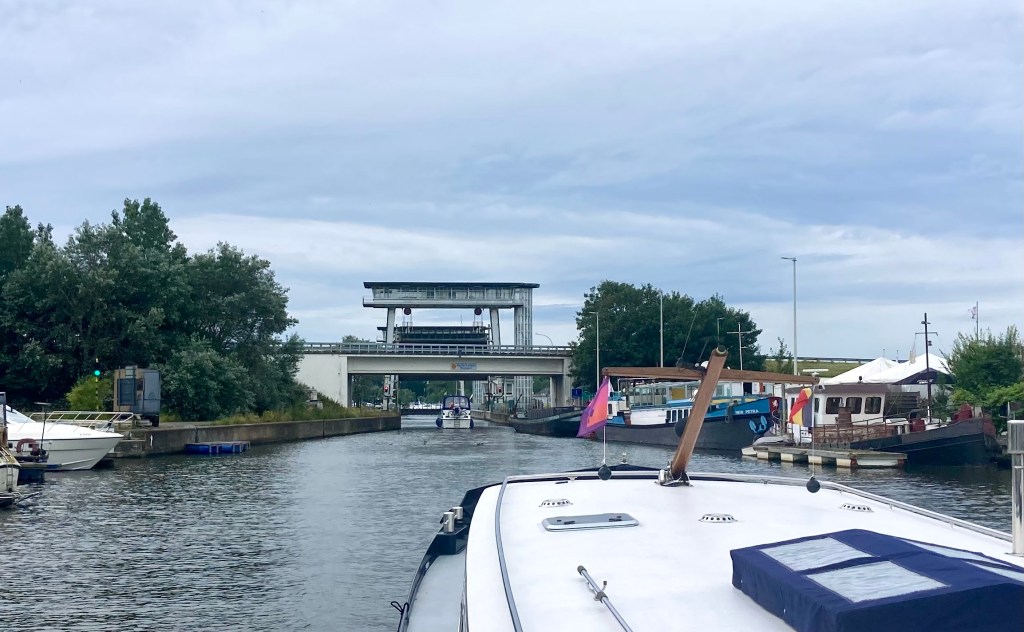

This basin is home to a marina and many water sports – a busy place in July. But as you get closer to the river it becomes quiet and rural.

River Ijzer (Iser)
We followed the channel set out by red and green buoys, which kept us out of the way of the sailing school, the kayaks, paddle boarders etc!
Southwards we cruised, between more polders and big skies, for 16 kilometres.
Its is a very gentle journey, with just one lift bridge along the way

Diksmuide
Two hours later and we were mooring up at the Port of Diksmuide. We were not able to moor next to the boatyard that night – their quay was busy – so had booked a mooring at the port.
And a lovely mooring it was too !!

We were on an end pontoon, sort of sideways on to the river, looking back towards Nieuwpoort.
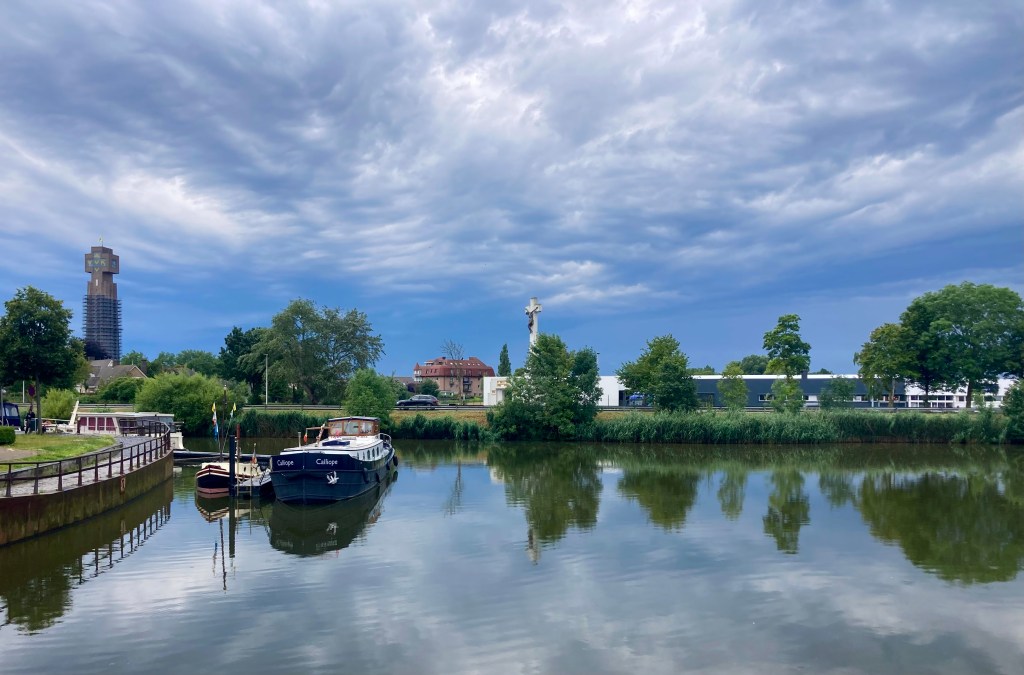
Having checked in and paid our mooring fee we went for a walk, coming back to catch a different view of the mooring, once more under great Flemish skies!
It was to be our last night afloat for ten days or so.
The peaceful Iser river ensured a tranquil scene as we prepared to turn in.
This was at 9pm – such soft dusk colours.

Next morning, the 10th July, and right on time, we were awake early and waiting for the call to our lift out, just 500m up stream.
We were called around 9, and less than an hour later we came out of the water, just like this, but slower!
We had a new style of high life living for a while, with great views across the river the the Iser Tower.
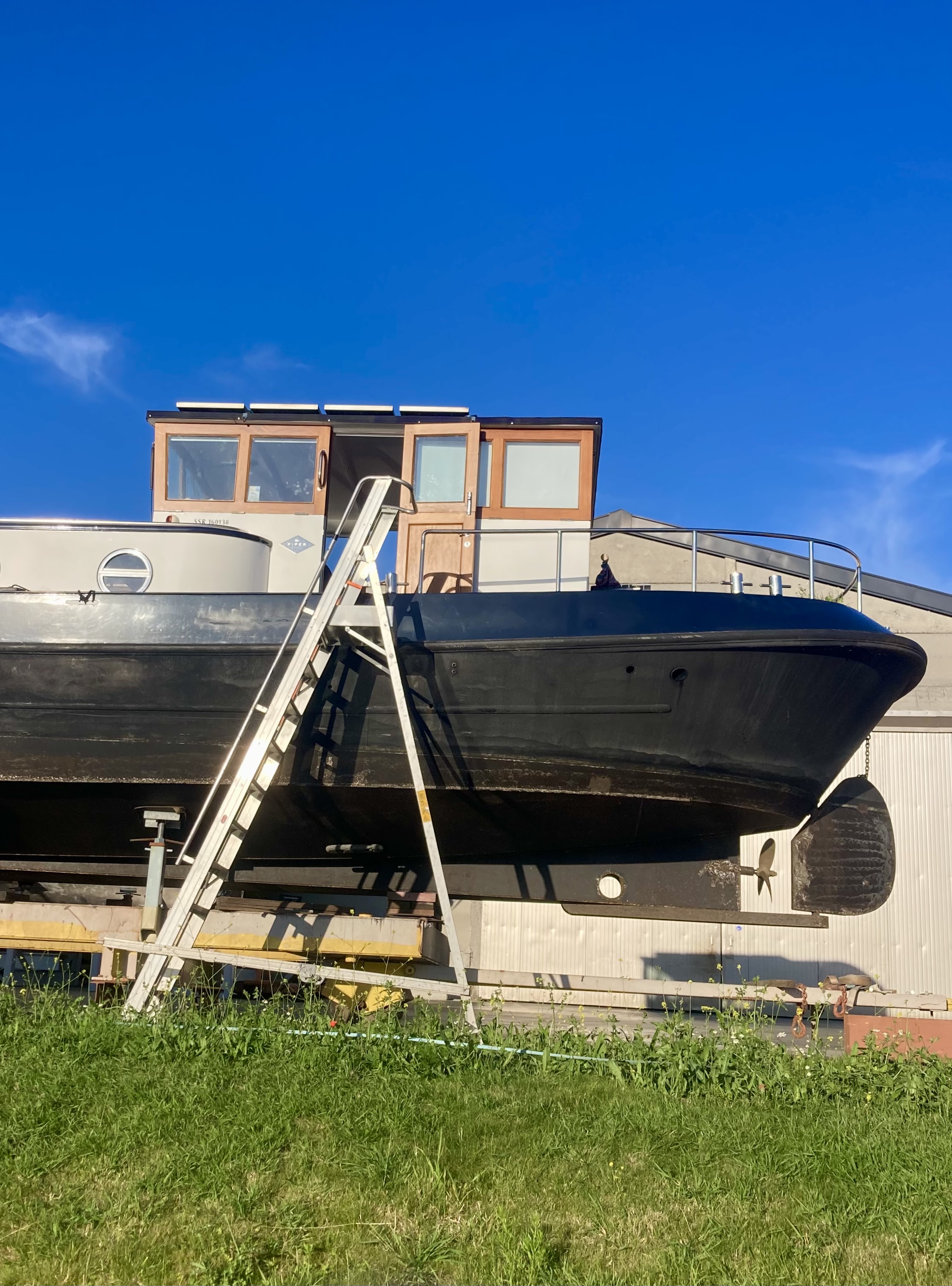

And that is where we leave Calliope and crew for this blog episode.
I will write a short one later of our (excellent) experiences at the Buitenbeentje shipyard and the cleaning and repainting of Calliope’s hull.
Namur to Gent
22 June to 1st July 2024
Calliope began the summer in France, down on the Saone at Saint-Jean-de-Losne, and we were taking her on a special trip to Belgium for her five-yearly hull repainting. Following recommendations from lots of people we had booked her in at Buitenbeentje in Diksmuide; we needed to be there by July 10th, with a family visit booked in along the way!
Having had a lovely time on Canal Entre Champagne et Borgogne, Canal Des Ardennes, and the Meuse we were now onto the next stage.
The Sambre

[We actually entered Belgium whilst still on the Muese, between Givet and Hastière. That little section is included in the Meuse blog. I am starting this new post as we leave the Meuse and enter the Sambre.]
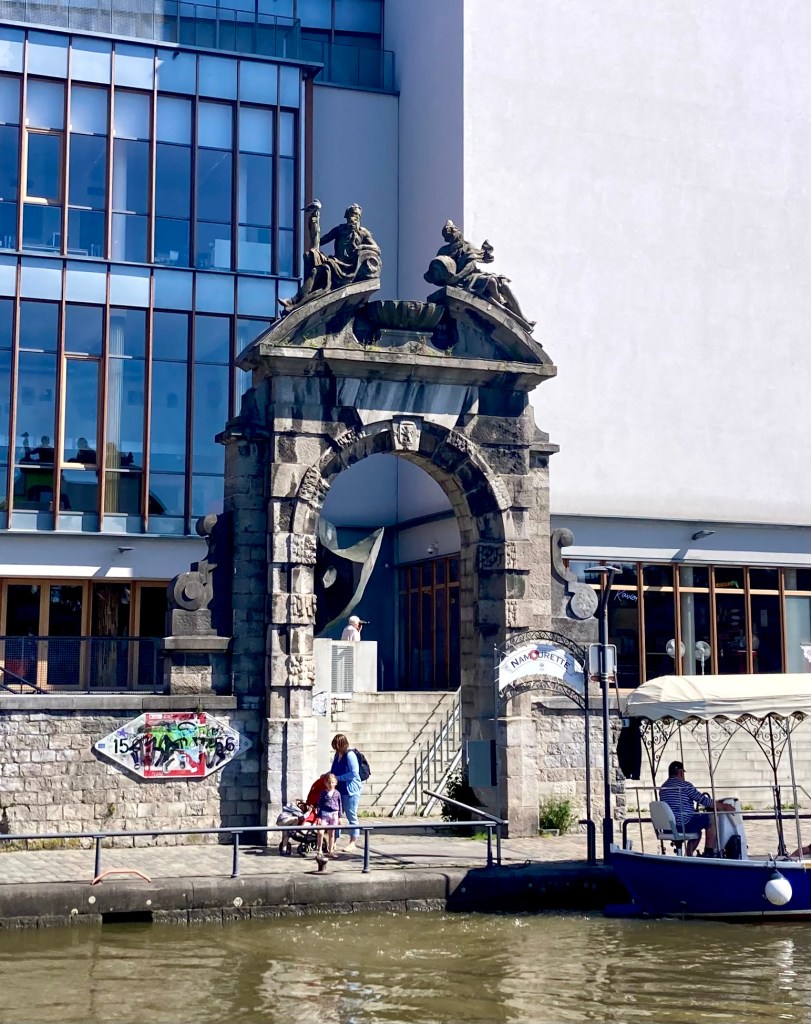
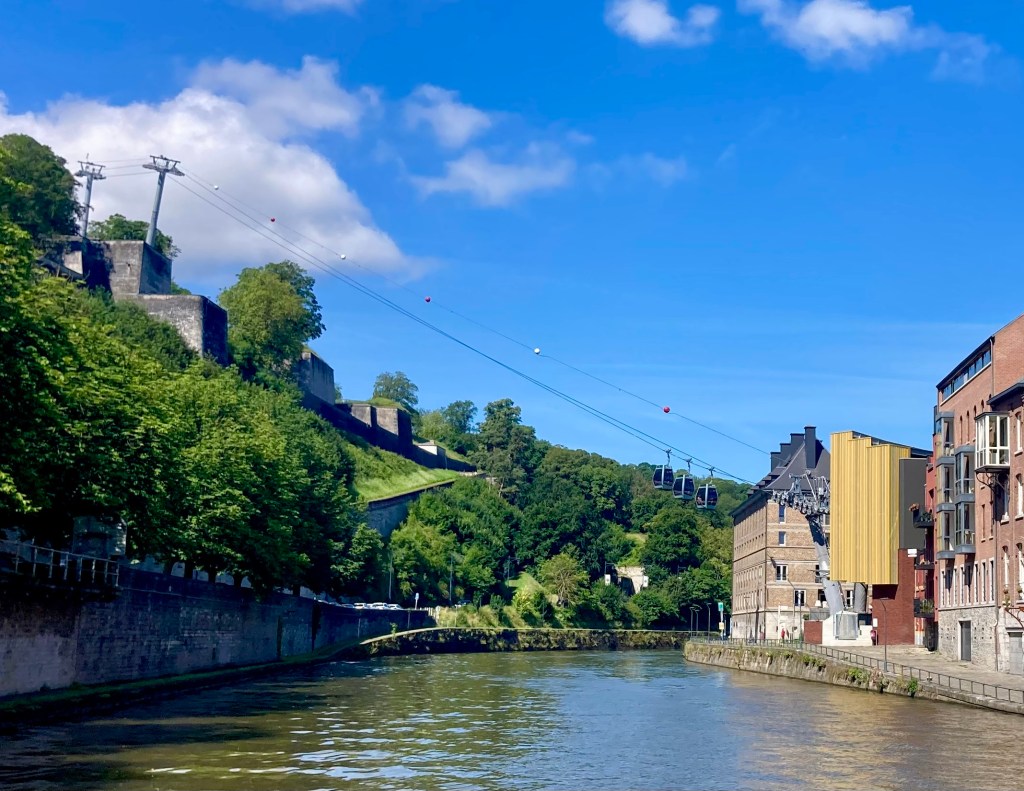


We had beautiful blue skies as we went under the bridges at the start of the Sambre in Namur, past the old Watergate with its Naurette tourist boat stop, and under the funicular that goes up to the Citadell. The walk up there is interesting, but not for the faint hearted, though we have done it in the past.

A few minutes later we were at our first Sambre lock, Salzinnes, with a nice bright green light to welcome us in.
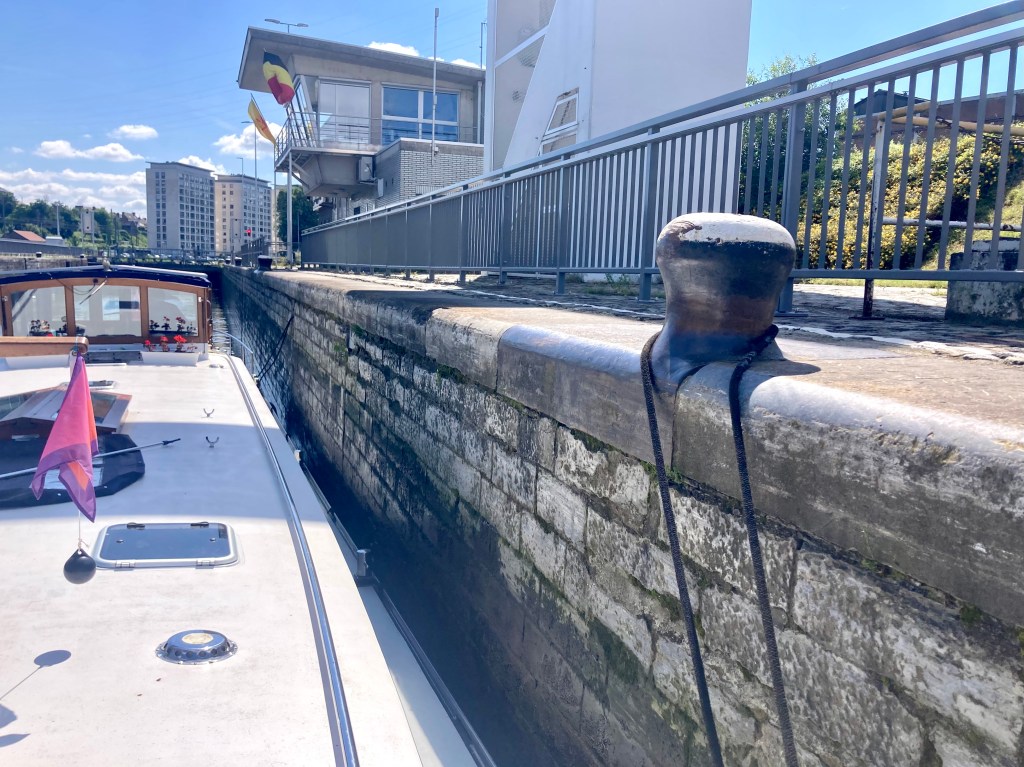
There were lovely big bollards to tie up to – something that captain and crew rather enjoy.

And within the walls of the lock were the old, less easy to rope, mini bollards.
All in all a gentle upstream transition from one river level to the next.

Soon we were on our way past some surprisingly industrial areas before making headway towards the much more rural Floreffe – our next stop.
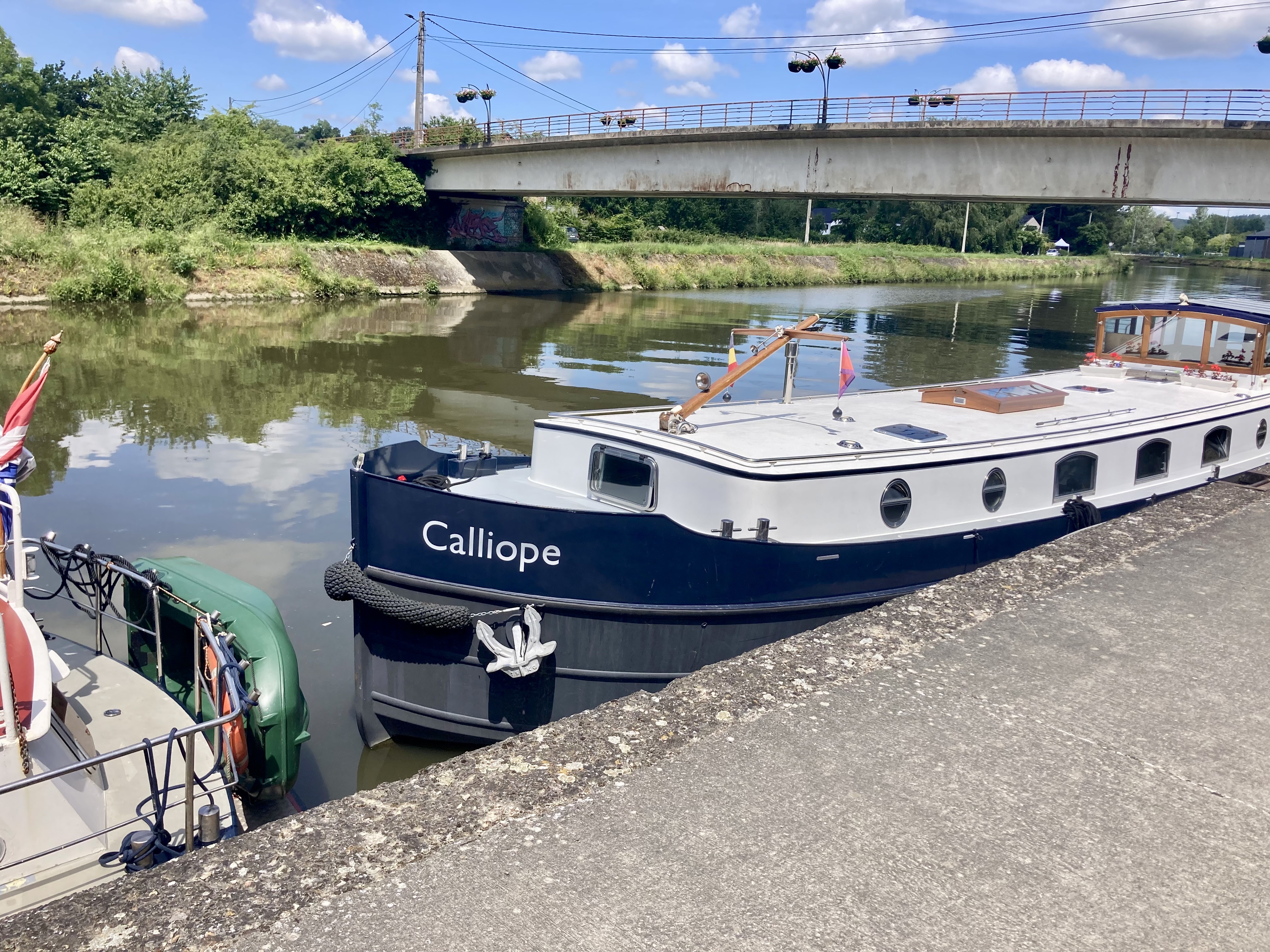
The quay there is supposedly 40 m long so we had some hope of finding space. And yes, when we arrived, we found one other boat already moored there, with just space enough for Calliope behind.
We only planned to stay for one night, but that night was definitely going to include a walk up the hill to the old Abbey at the top. We have been there before and had a proper look round but this time the mission was the beer garden!
They still brew their own beer and make their own cheese at the Abbey, even though it is now mostly a school. It is tasty stuff.
And a shady spot overlooking the lower courtyard in which to enjoy it.
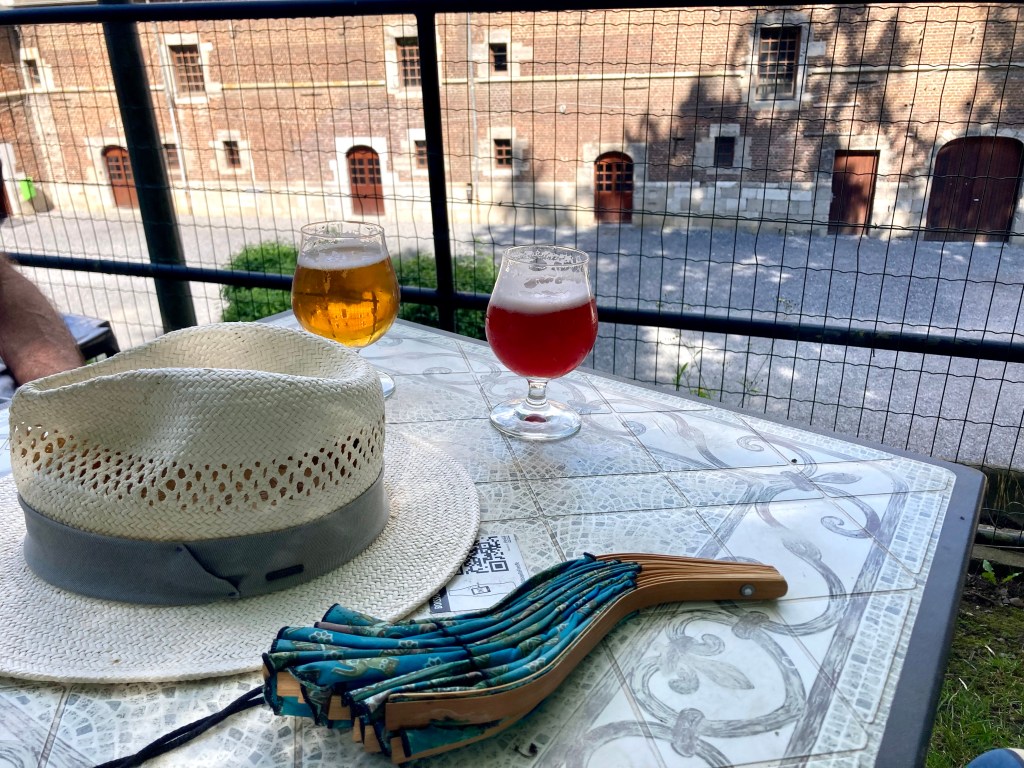

We were greatly entertained by the resident goose, and his friend the Muscovy duck, who were fairly determined to get some snacks from anybody in the area.
Later, after an easier walk downhill from the abbey and village, and back with Calliope, we were able to enjoy rosé wine in the evening sun. Chilled rosé wine tastes so much better out of doors on a warm sunny evening!

In the morning, we continued on up the Sambre to Auvelais where we had a special mission! We had recently, and rather belatedly, realised that we could order things from Amazon and have them delivered to Amazon lockers in towns that we would be visiting. This time we were picking up a new handheld VHF radio set, as an addition, to the one built-in to the boat.

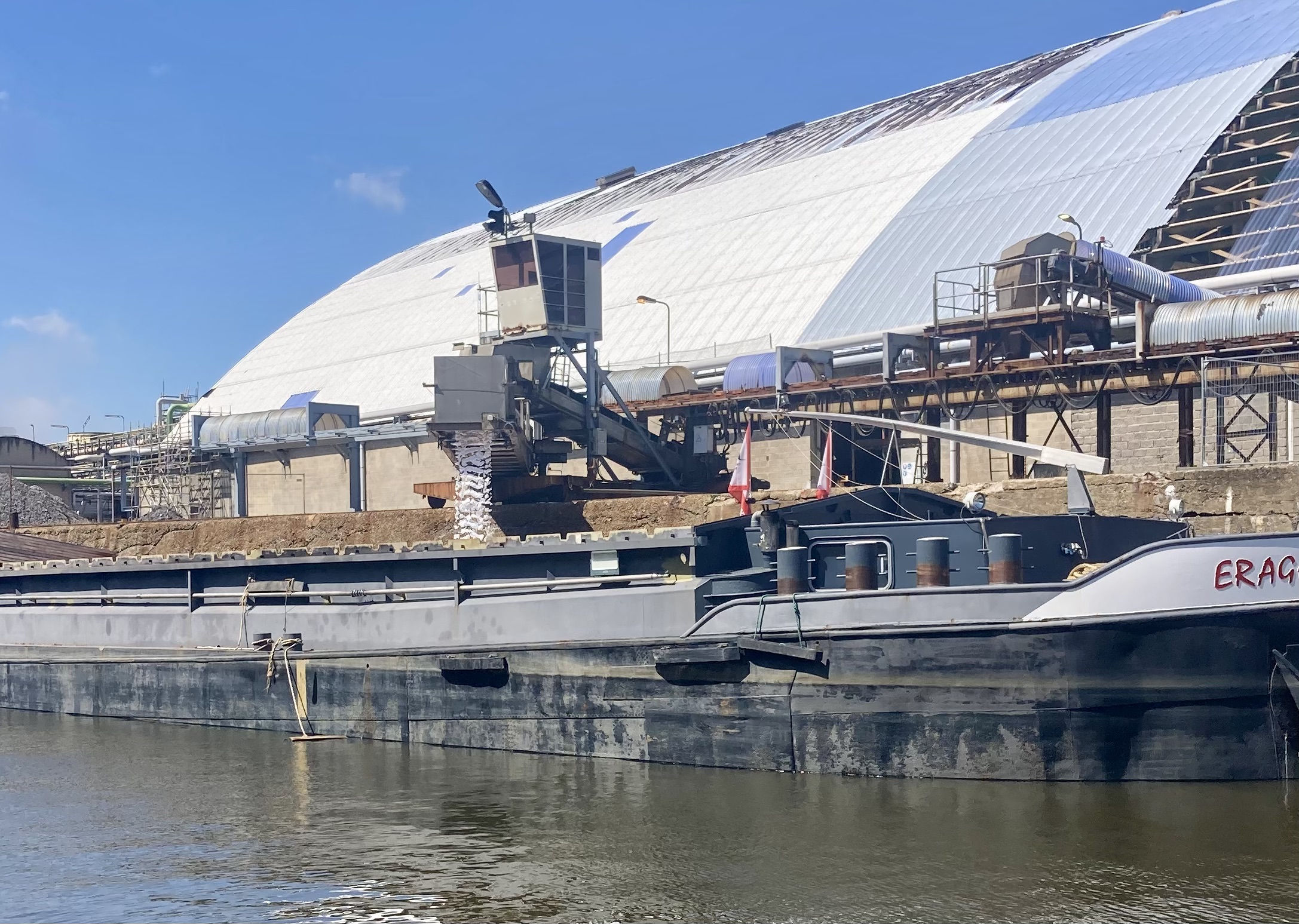
Along the way. We saw more industry, and barges being loaded and unloaded – good proof of the continuing use of the canals and rivers for commercial purposes.

The cormarants made good use of the overhead infrastructure to dry off their wings.
I should be used to seeing cormorants so far from the sea by now, but I am constantly surprised by the sheer numbers of them.
There were The big locks on this river have a different way of opening and closing lock gates. Sometimes they act like guillotines going up in the air; other times they drop down below the waterline. And here at, Mornimont, they glide sideways.
In addition to the big barges we were passing we also saw a couple of interesting smaller craft and passed under a striking modernistic bridge, all worth a quick mention and photo.
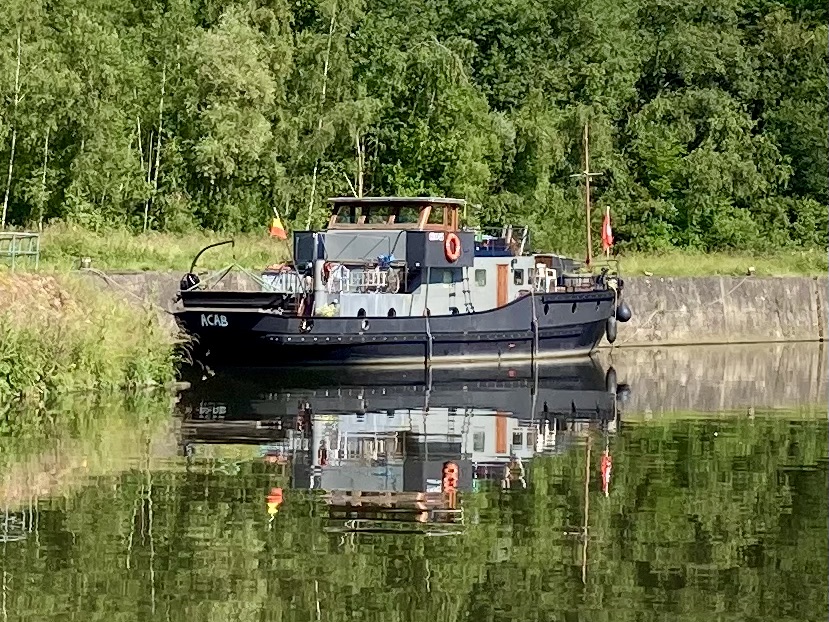


Before long, we arrived at the rather unusual mooring at Auvelais . A wooden pontoon has been built into a slight indentation on the river. I guess it was originally a commercial quay.
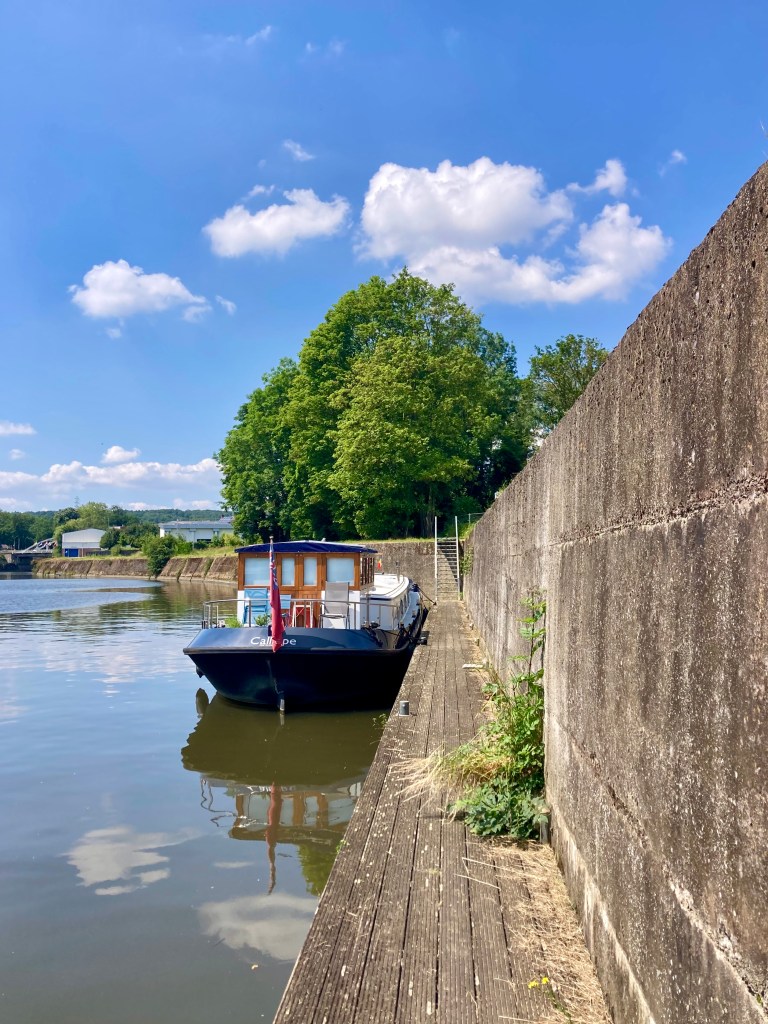
If you don’t mind the sound of the trains going over the adjacent railway bridge from time to time, it is quite a nice place to stop.
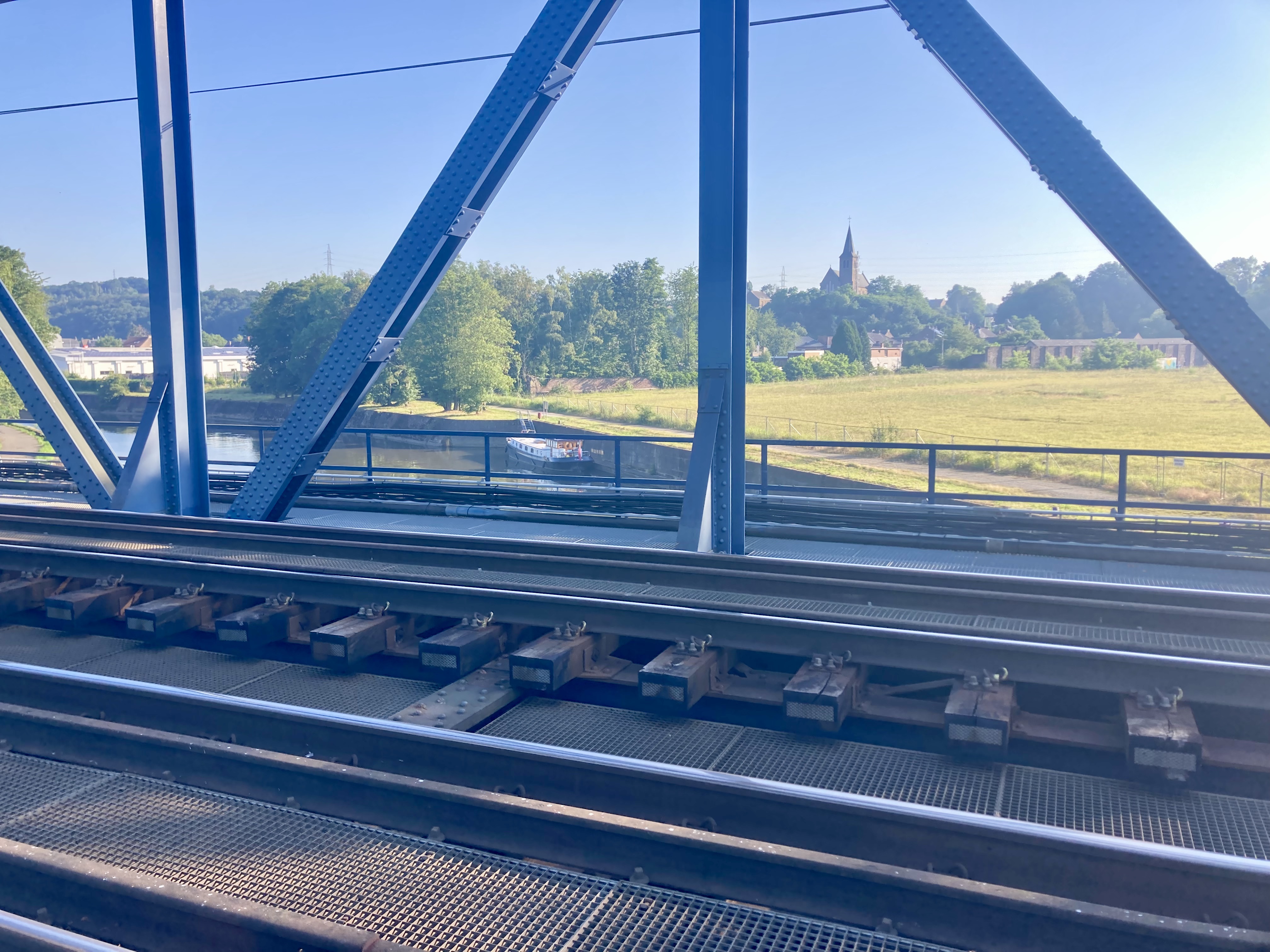
Did you spot Calliope through the railway bridge girders??
We went into town to collect our handset, did some shopping, and came back to settle down and enjoy another sunny evening on the boat ………..
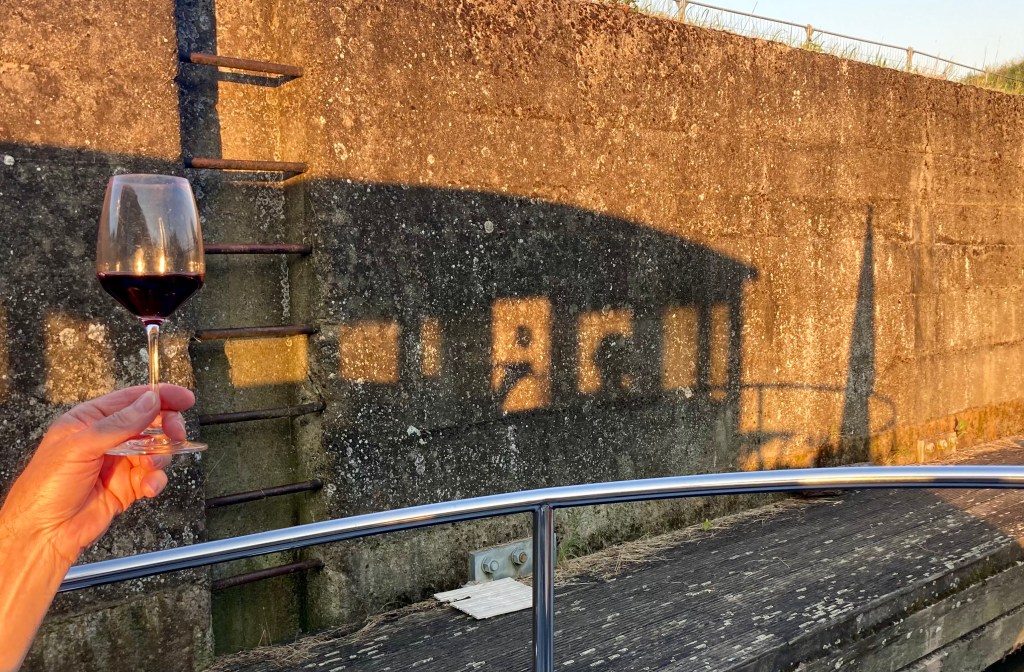
….. where the Captain became creative with the shadows!
In the morning, I did a quick scurry across the railway bridge and into town to get some bread before we left Auvelais behind.

Then on to the first lock of the day, one of only three before we would be turning off onto a new canal.
We are using our two-way radio headsets for these locks. Although they are not particularly difficult locks, it can be interesting deciding where to tie up; the spacing of bollards can be different from one lock to the next.
The headsets mean we can look quite professional, talking quietly to each other as we arrive!

We had a couple of hours of quite pleasant countryside and small towns, but as we got closer to Charleroi the signs of industry, in this case the scrap metal industry, re-emerged.

Charleroi is one of the main industrial cities of Belgium, famed for its steelworks in the past. Now it is more famed for dealing with the metal remains of previously valued commodities.
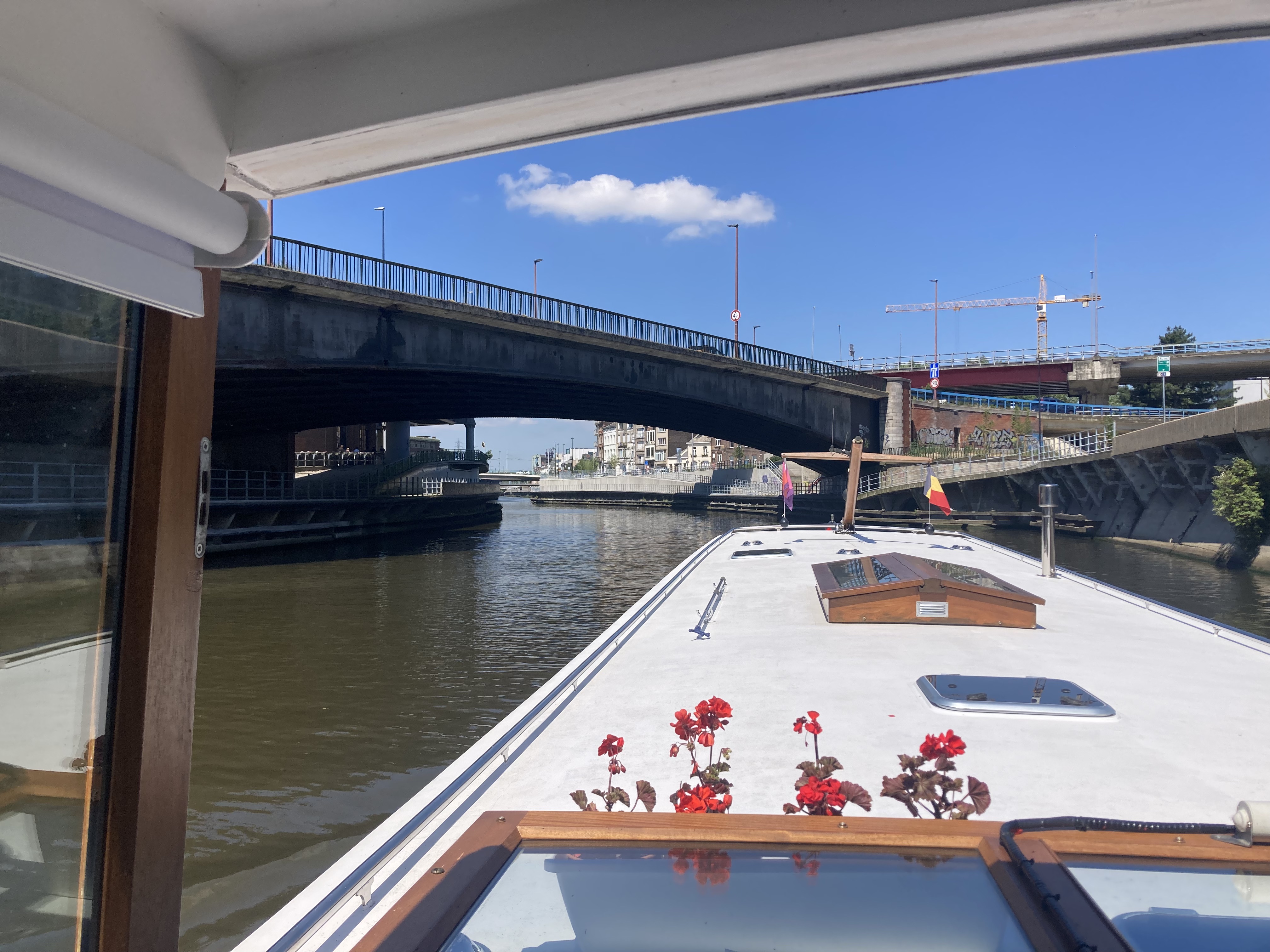
As Calliope passed under the various road bridges of the city, we were surprised and delighted with the lack of commercial traffic around us. Usually it is very busy and the Captain has to be ready for large barges appearing round the bends.
It was only when we reached Charleroi lock and spoke to the lock-keeper that we discovered the reason for the empty waterway and found out what was going on.
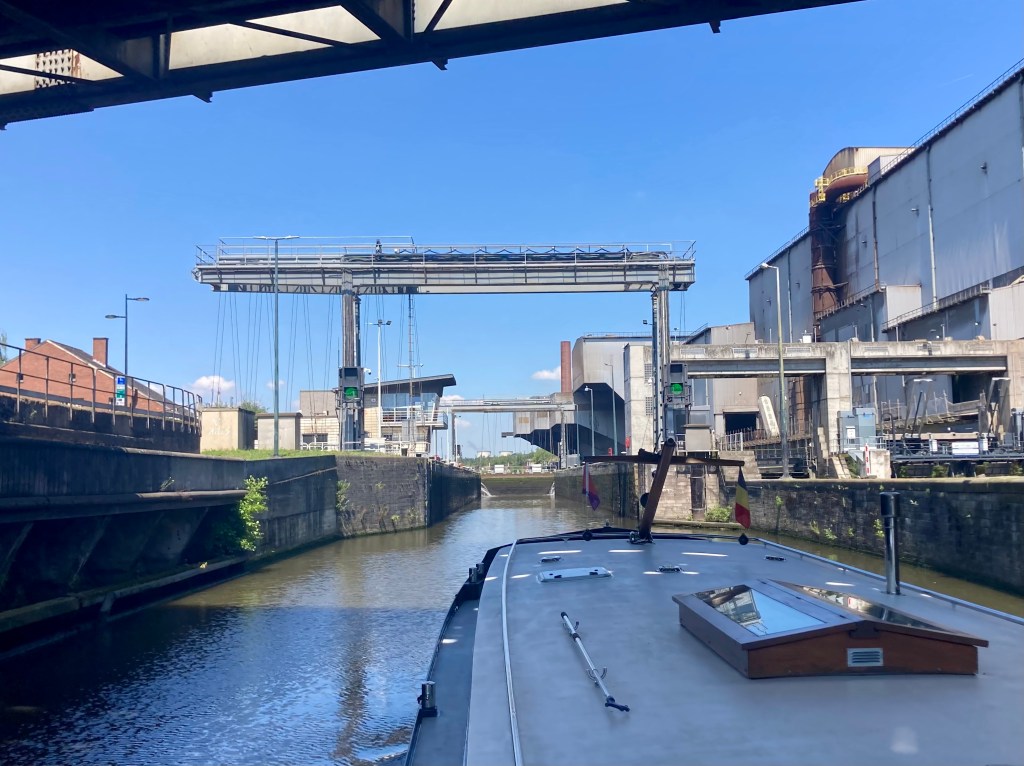
After this lock we planned to turn starboard into the Charleroi – Brussels Canal. It turned out that one of the locks a bit further up this canal required major work and had been closed for 3 days.
At first it seemed that we might not be able to continue but after some discussion between the guys working at the different locks, it was decided that we could carry on and just take our turn along with the commercials barges; great news.
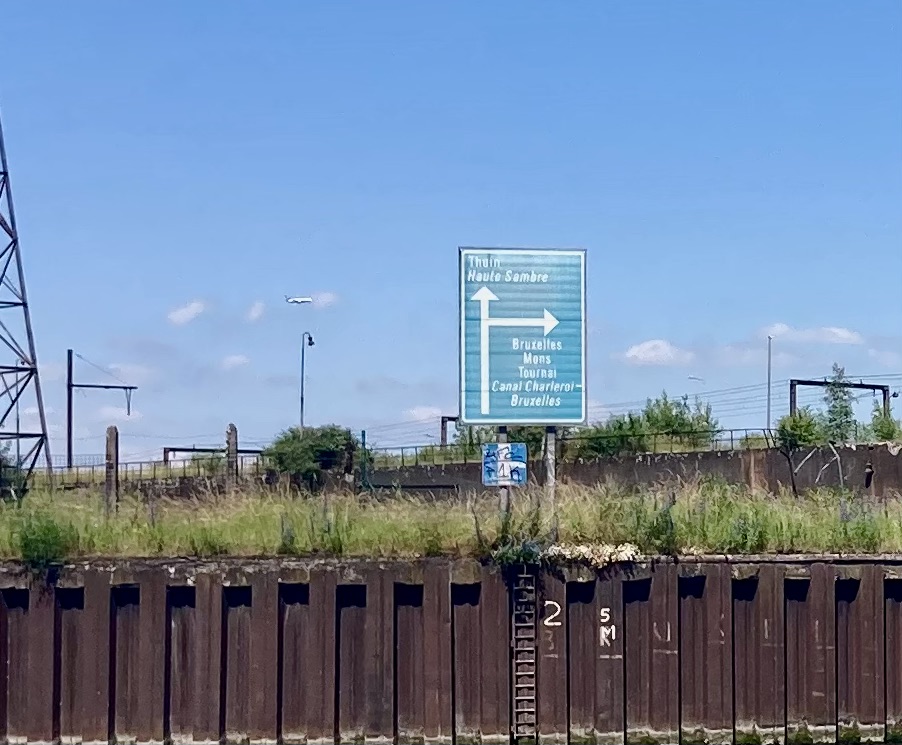
So through the Lock and past the ‘turn right here’ sign.
Canal Bruxelles-Charleroi
Then, through the slightly awkward Charleroi wiggle. You go under a bridge into a basin where we turn left (wiggle 1) and then immediately right (wiggle 2) to leave the basin.
This little time-lapse video makes it look easy!
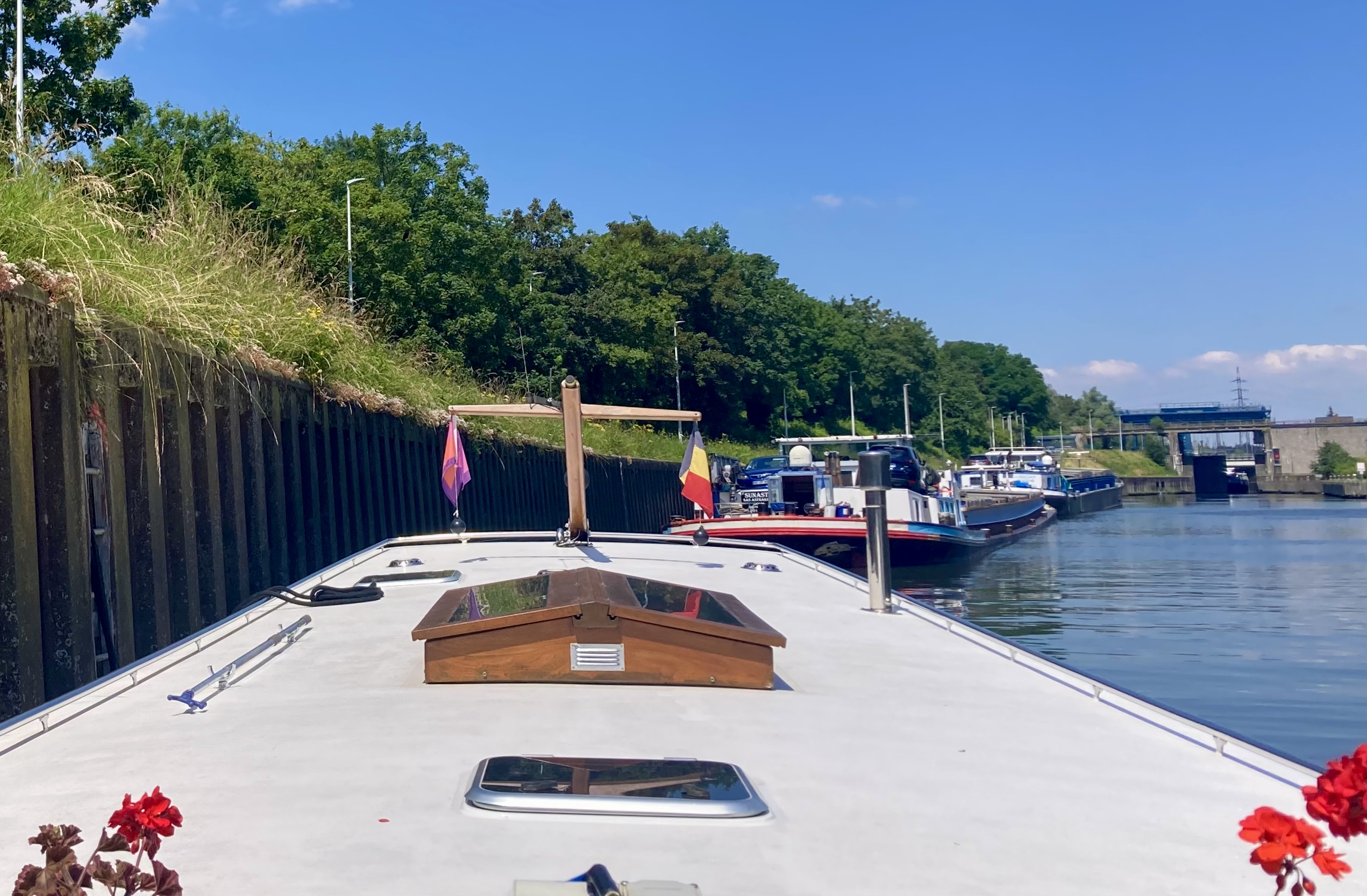
Before long, we had taken our place in the queue for the next lock; the tailback from the problem further up had reached here.
It was an interesting but safe mooring situation. Stewart found the metal hook that we have not needed to use for years!

Whilst the bow was more conventionally attached to a ladder!

We waited about four hours until it was our turn – a lot quicker than the 3 days we had been warned about.
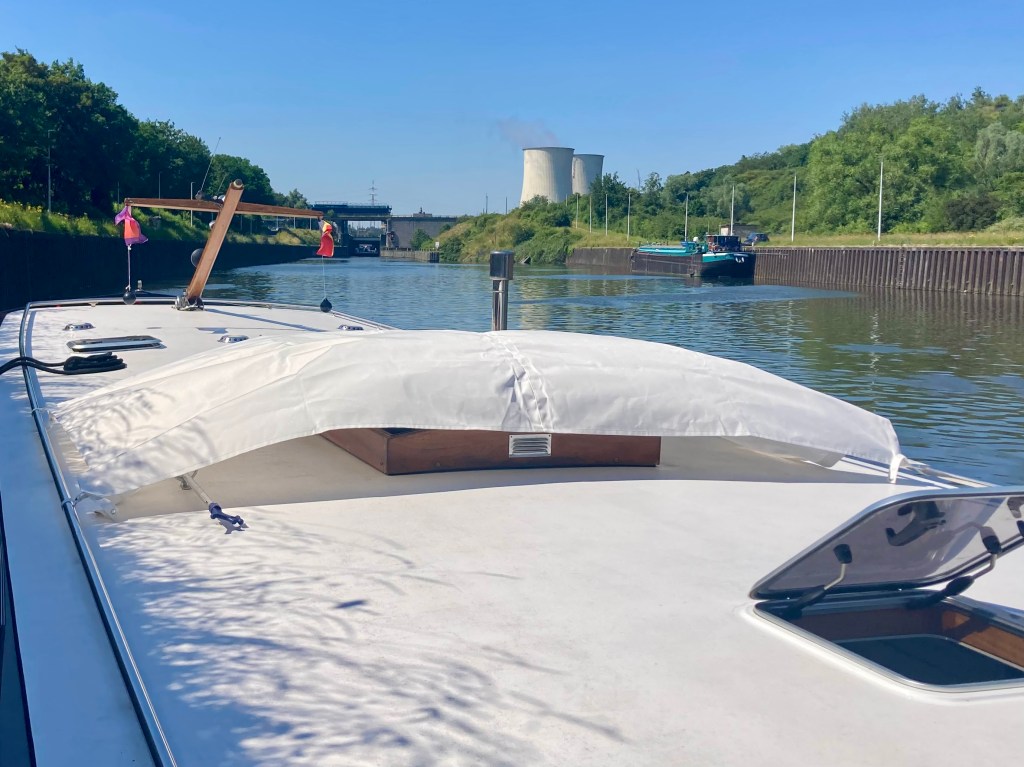
It was a warm day, so I tried out our new dog box* cover. It works well, providing shade within yet still allowing the breeze in.

( * In case you are wondering, a dog box on a boat is the raised glazed hatch on the cabin roof – I have no idea of the original of the term!)
Eventually I was our turn to go up through Marchienne lock, and we felt hopeful that we would reach the same over night mooring as we had planned, despite the delay.

We shared the lock with a pretty Tjalk that had been waiting almost as long as Calliope. It is quite a deep lock and we had managed to line up to two floating bollards, fore and aft. It was more difficult for the Tjalk as it is a different length, but they found a method using the bollards in the wall.
(For the detail conscious among you, the super new dogbox cover was removed for cruising as it was quite a windy day, as well as hot, and the constant billowing was a bit distracting for the helmsman)
We had a short wait at the next lock as well, then we were through and onto the night’s stopping place.

The original plan had been to moor above Viesville lock. We were just too late for that; they close at 7pm, so moored below instead. This photo ws taken at 7.33, by which time we had tied up and poured some cooling beer! The Captain took a mouthful, then walked back to help the Tjalk get tied up too.
I was glad we had planned a salad supper that evening!
The locks opened at 0700 and the Tjalk took the opportunity to go early. We had a more leisurely start; I was on the radio at 0805 to ask the lock keeper if when could go up. He already had a commercial barge coming down, but we were next in and by 0815 on our way.
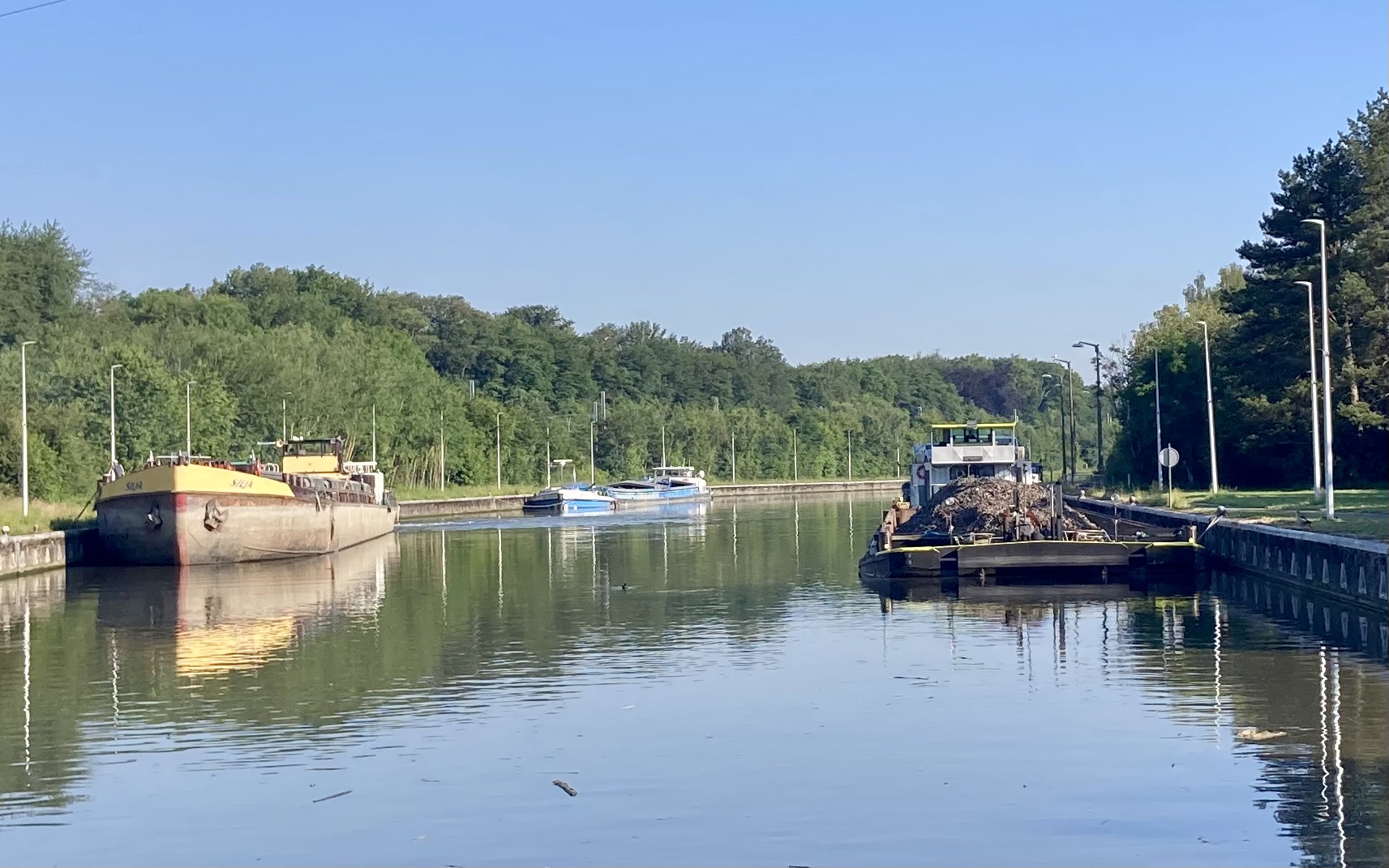
We came out of the lock to see another four commercial barges waiting – on is hidden on the right. There are often a few commercial barges ‘overnighting’ here above Viesville lock, all keen to get away and continue their working day.

I began my working day too! I took advantage of the dew on the roof and the cooler morning hours to have a bit of a cleaning session.
Boats always pick up a bit of dust and grime coming through Charleroi!
Not too far to go now on the Bruxelles-Charleroi canal. It is very much a commercial barge canal, but it is not devoid of rural beauty.

Canal du Centre
The junction with the Canal du Centre is wide and open! Sometimes it is hard to spot the waterway into which you want to turn, but here there is a sense of spaciousness and calm .

This canal is part of the waterway to connect the Meuse and the Scheldt rivers. As the height difference between the two is 315 ft about 32 locks would have been needed, so a series of boats lifts were deigned and built between 1885 and 1917.
In the 1950s it was recognised that far larger barges were needed for modern transportation and a new canal was built, partly alongside the old. This increased the size of boats from those with a displacement 350 tons to almost 1500 tons.
A defining feature of the enlarged canal is the Strépy-Thieu boat lift, which we were soon to descend, one of my favourite Belgian canal exp[eriences.
The lifts on the old parallel canal remain in position and I have included a link as they are rather magnificent.

Before we went down the lift we went under the ‘barrage’. There is a long, high aqueduct leading to the lift, and if there were to be a leak from the canal in this area it would cause quite a catastrophic flood as water poured from the canal. This barrage would be quickly lowered, sealing off the rest of the canal and minimising the damage.
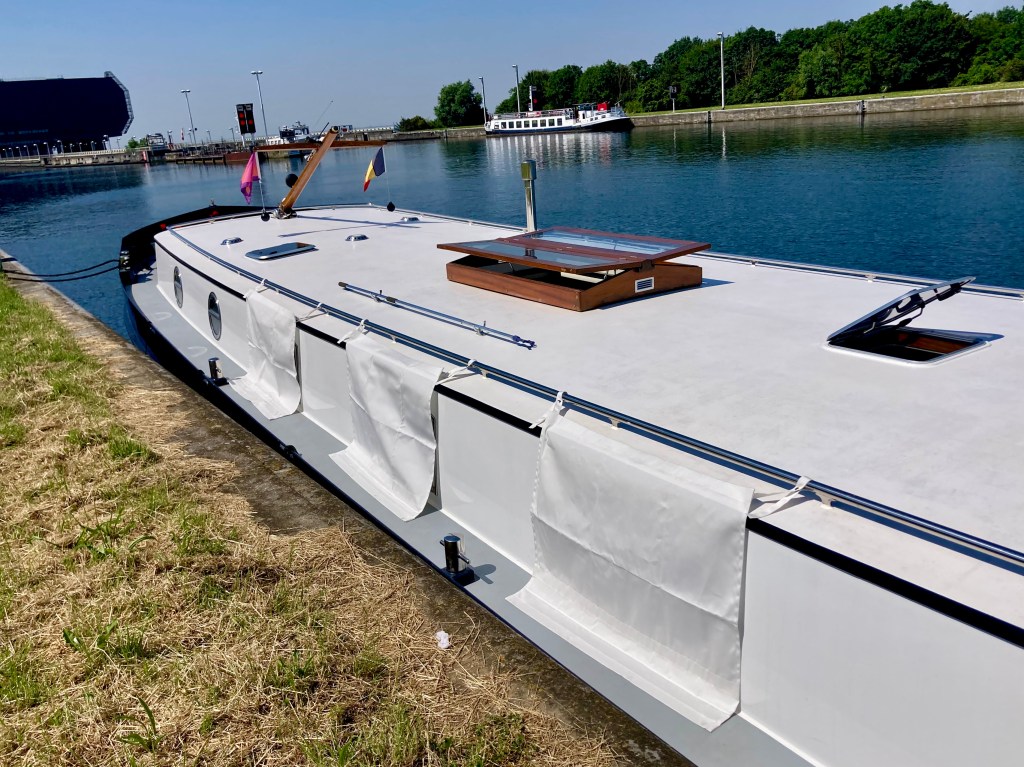
We reached the top of the lift just on noon, and a quick chat to the operators let us know we had time for lunch before we would be descending.
It was another warm day, so I brought out the new window sun shades to keep out some of the heat, and enjoyed a summery lunch.
Forty minutes later and we are on our way into the lift basin, following a commercial barge and our new friend, the Tjalk, coming in behind.

If you have clicked on the above link to the Strèpy-Thieu boat lift you will know that each side is essentially a big caisson (watertight chamber) measuring 112 m × 12 m. We measure almost 20m x 4.2m, so I guess 10 Calliopes could fit in at the same time!

Here we are part way down. The 3 open sides of the lift have fabulous views of the surrounding area, and also of the sky!
In front of us, to the right, is the commercial barge, complete with a car on the roof!
We had unexpected visitors on our way down.
Two very pleasant men from the Belgian radio authority, came to check our radio paperwork.
We were surprised to find that we were not fully compliant with 2024 regulations, but this was not a problem. The necessary changes were easy to fix – and were fixed within half an hour! Thank goodness for the internet!

Just under an hour after entering at the top we were exiting at the bottom, and round a bend to find the long Thieu quay almost empty.
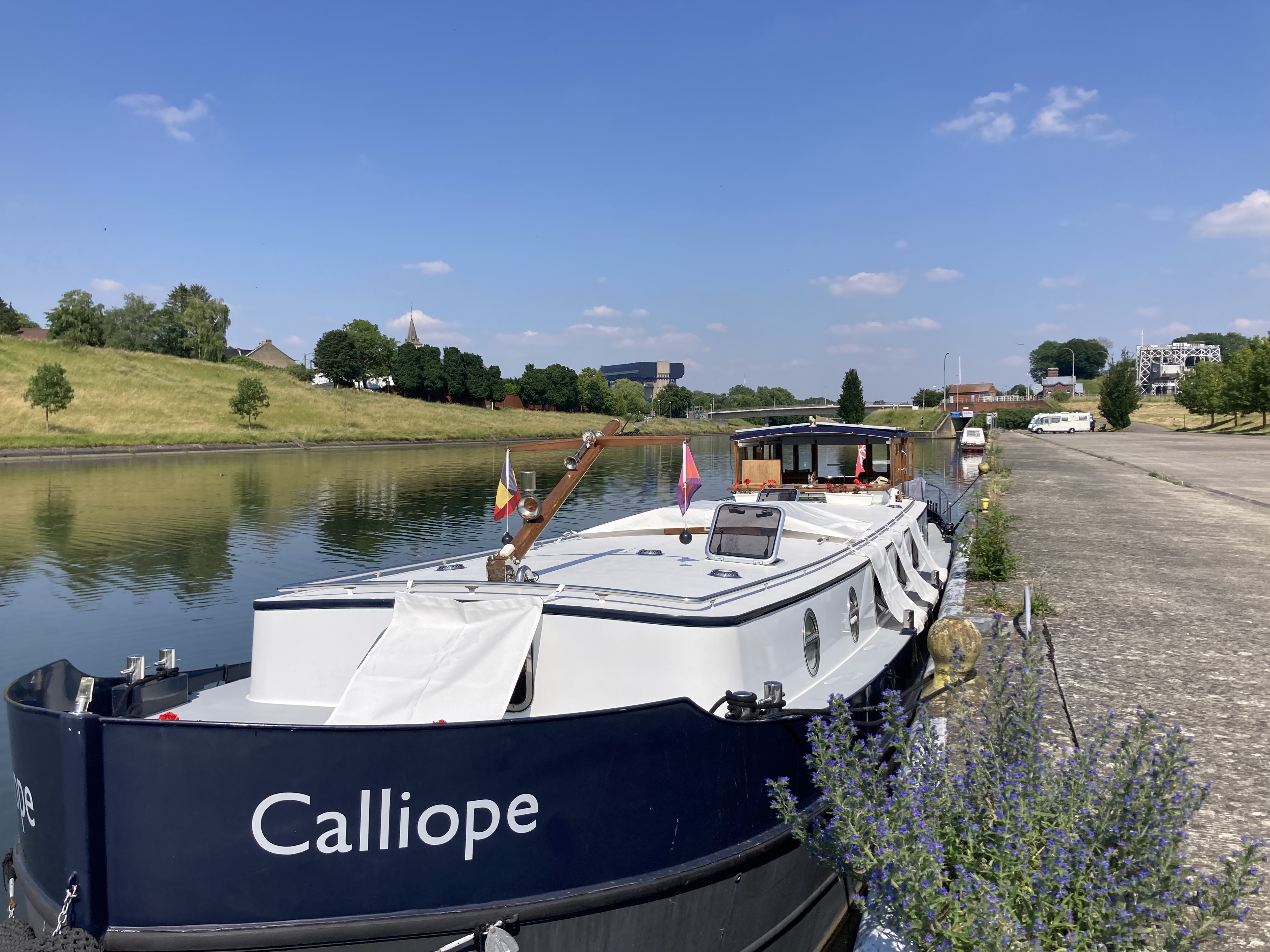
It was still rather warm, so all the window and dog box sun covers were deployed. They are new this year and we are loving having windows open, sun reflected away, and any breeze that is around able to come in at the sides!
This is another place we quite like to be.

Seven hours later, still daylight at 9pm, we watched the last of the hot sun disappear.
The cool of the evening took over; just wonderful on board!
Next morning at 0800 I was off in the cool off the morning!
Just over the canal is the small village of Thieu, complete with a good bakery. I was off to get fresh bread for our midday meal.
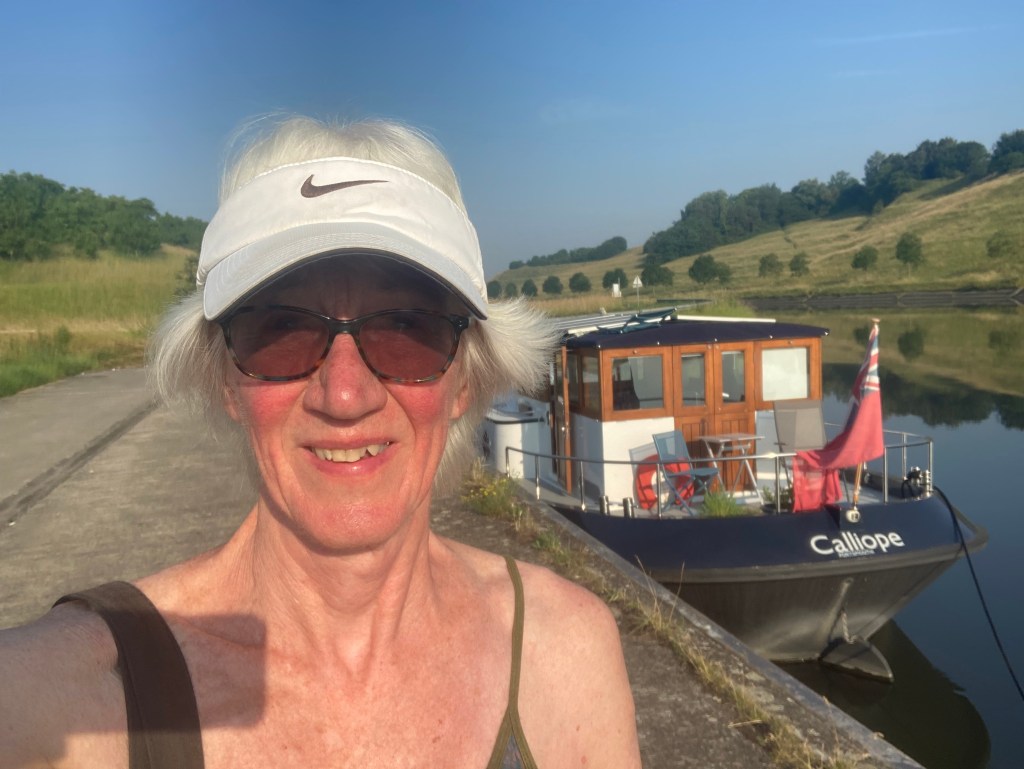
The walk also gave me a chance to photograph some of the wild flowers I had been noticing along the banks, and Calliope (in the distance) from across the water.


I was back aboard by 0830 and we left Thieu soon after, enjoying the morning sun.
There were just a couple of locks today – both going down, and both fairly deep.


At the first we caught up with Calvi – a heavily loaded commercial barge – following her out onto the canal. We traveled a little slower than normal behind her for quite few kilometres…..

The area became increasingly industrial, explaining not only Calvi, but the other working boats passing by. This strangely shaped panoramic view gives an idea of the canalside on this stretch – not so many trees here!
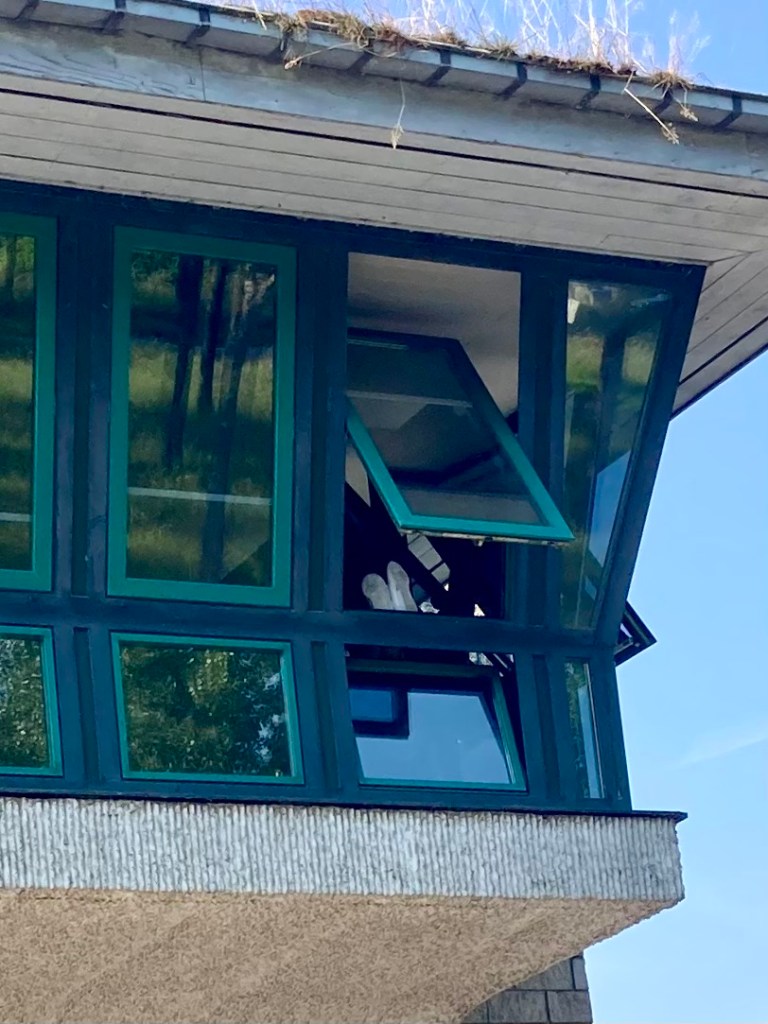
We came to our second lock, the last on Canal du Centre, and it seemed that the lock keeper was taking a relaxed attitude to his work, feet up comfortably on the window sill.
This was one of the locks where we move our ropes gradually down using the bollards in the wall.
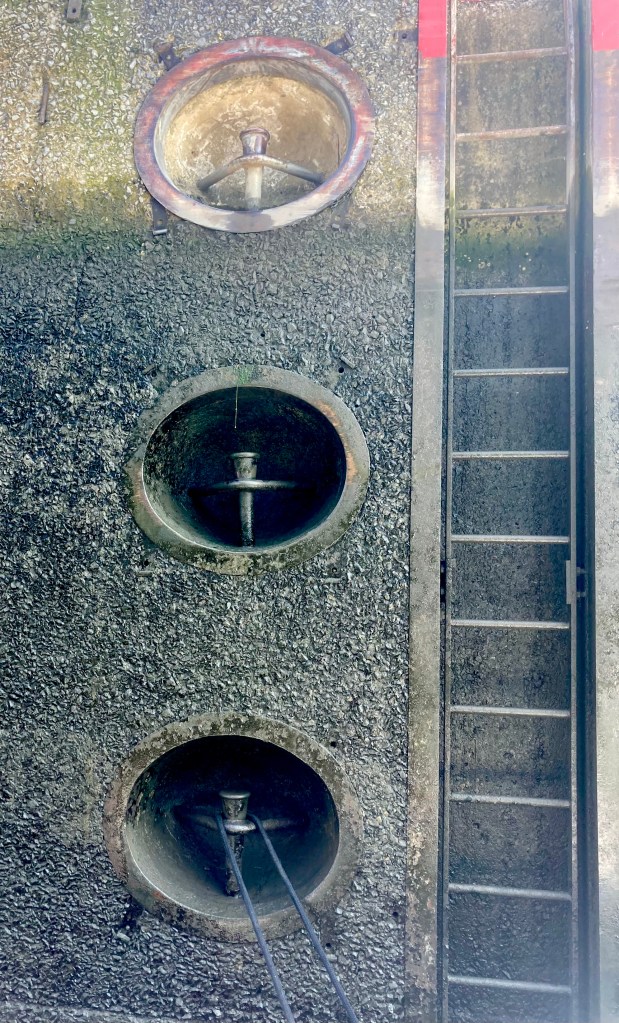
Not much later we were at the amusingly (to me) named Le Grand Large at Mons. It also marks the junction of the Canal du Centre and the Canal Nimy-Blaton-Péronnes.

Canal Nimy-Blaton-Péronnes
We were still pottering along behind Calvi, and decided to use the VHF radio to ask if we could pass her. The reply, in French, was a cheery ‘oui’ and he pulled over to starboard to help ease the manoeuvre.
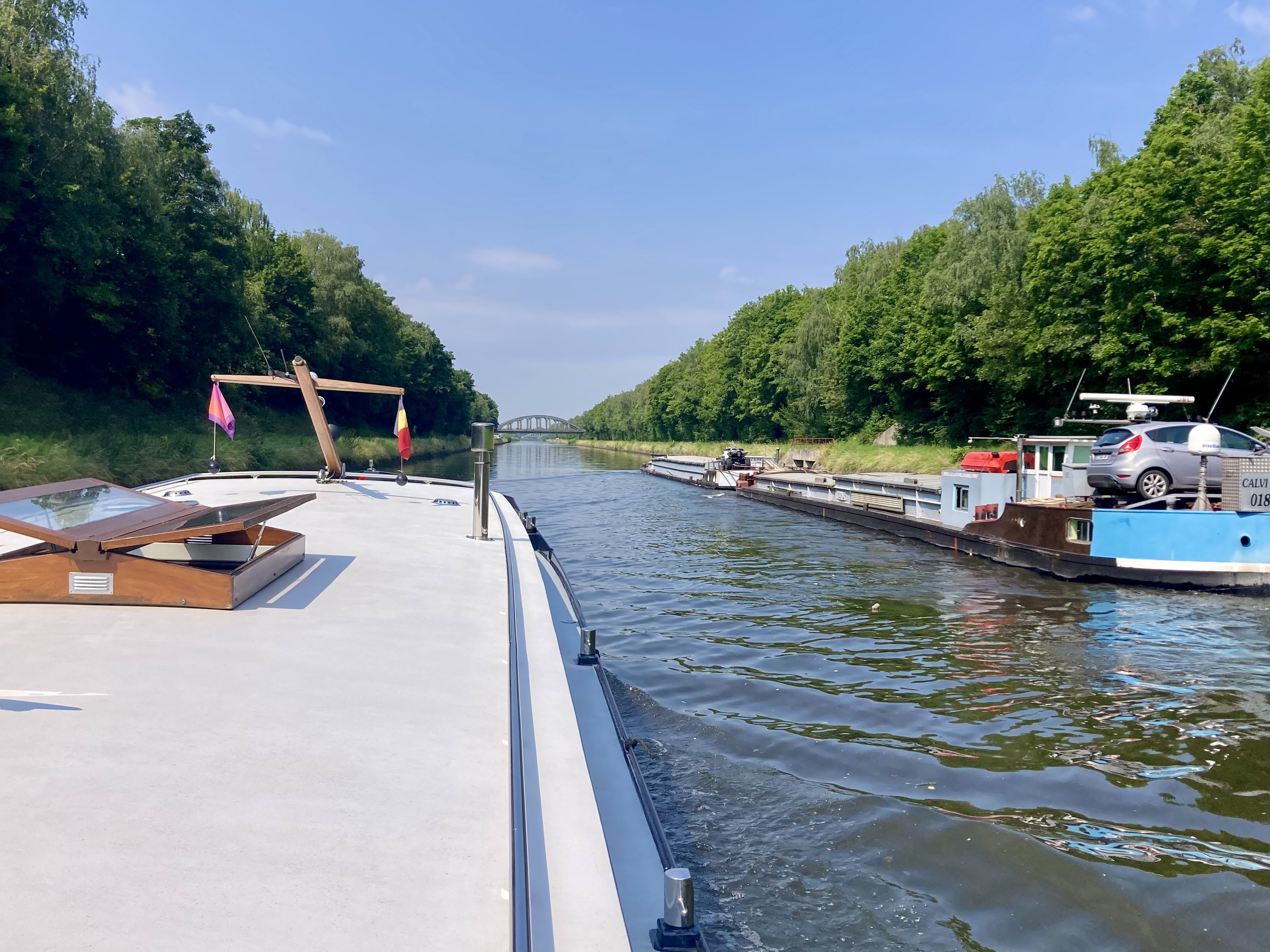

So waiting until another barge had gone by in the other direction we made our move – and at that point discovered one of the reasons Calvi was so slow! She was one 37m barge pushing another 37m barge – both full!
We progressed a bit faster after this, not that we were in a rush. Our normal speed is only around 8kph on these canals, and slower than that had seemed a bit too slow.
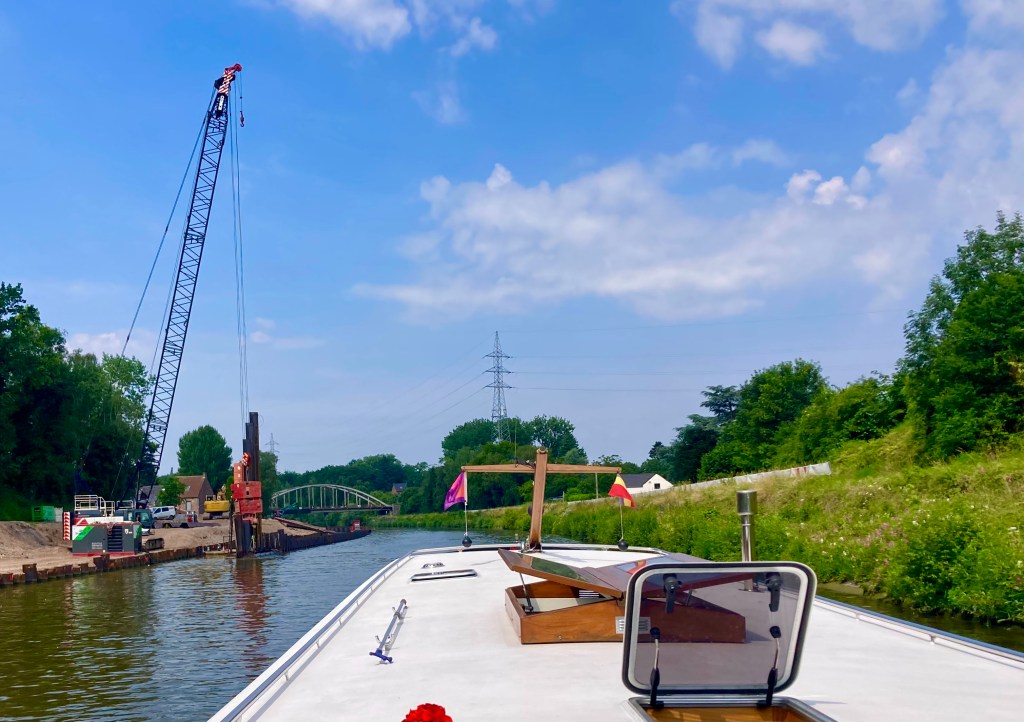
We were soon slowed down again – this time due to major works on the canal.
It seems that they are ‘re-piling’ the edge of the canal in quite a long section.
An hour beyond this is another huge basin. I am including it because of its European waterway interest.
It is the entrance to the Pommeroeul (Belgium) to Condé (France) canal – but as you can see from the double red lights by the lock it is not open.
Originally opened in 1982 to provide a major link between the two countries it closed 10 years later due to siltration.
It reopened in 2023 after massive investment and work – only to close again as new silt was discovered. 🙁

Prior to its potential re-use we liked to moor there on the big long lock lead in quays, but we are a bit loathe to do so now, in case it suddenly re-opens. So we were carrying on to Peruwelz.

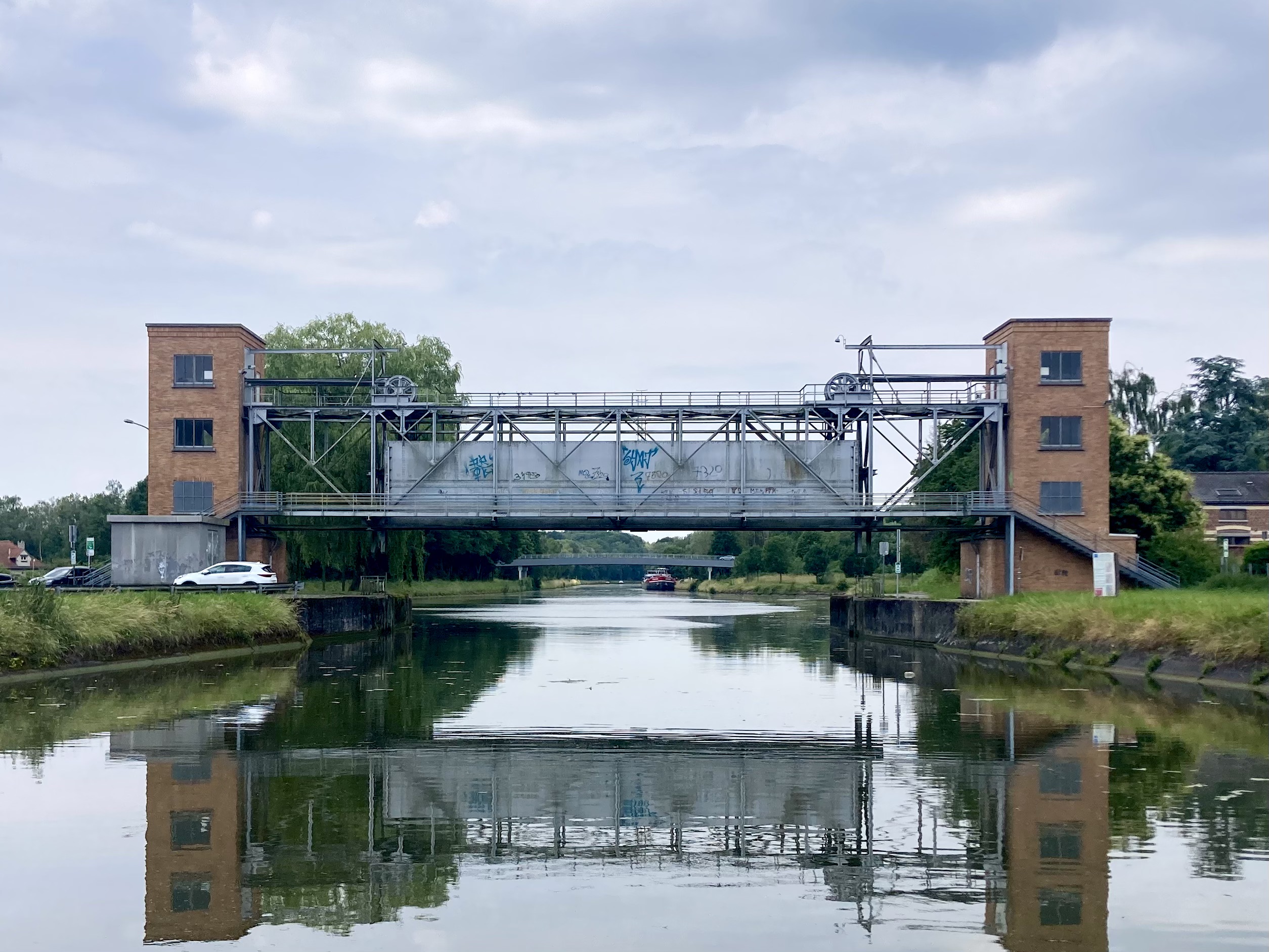
A couple of interesting artefacts along the way – the remains of an old windmill (others, more complete, were seen in the distance) and an old lift bridge, now permanently ‘lifted’.
You can see from the car on the left the level of the road, and thereby the level that the bridge would be at when down.
We had eaten lunch, with the morning’s fresh bread, as we cruised, taking it in turns at the helm. Now we were on the lookout for the Port at Peruwelz …. and there it was.
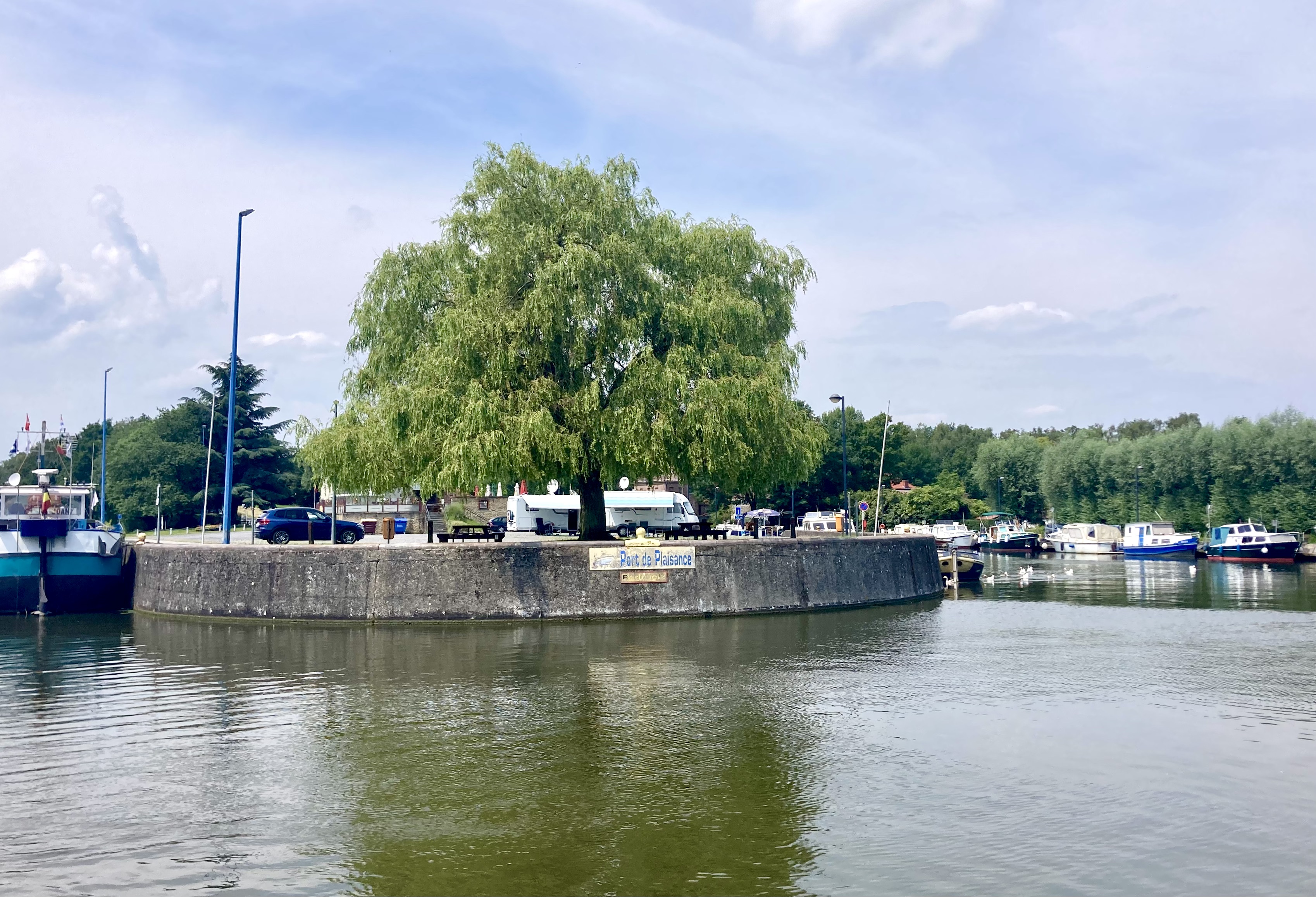
I had called ahead and checked that there was a space for us, knowing that the marina was mainly for smaller boats, and been told we would fit in. So Captain steered into the marina and we slowly moved along, looking for a non-existent 20m space!
As Stu reversed back out I was helped by another boater who, understanding the situation, phoned the Capitaine of the port. It was quickly explained that our space was on the external quay of the port – good news.

It wasn’t immediately obvious where we were to go, but friendly waving arms on the quay guided us to a space about 3m longer than Calliope. In we went, and almost disappeared beneath the high wall of the quay!
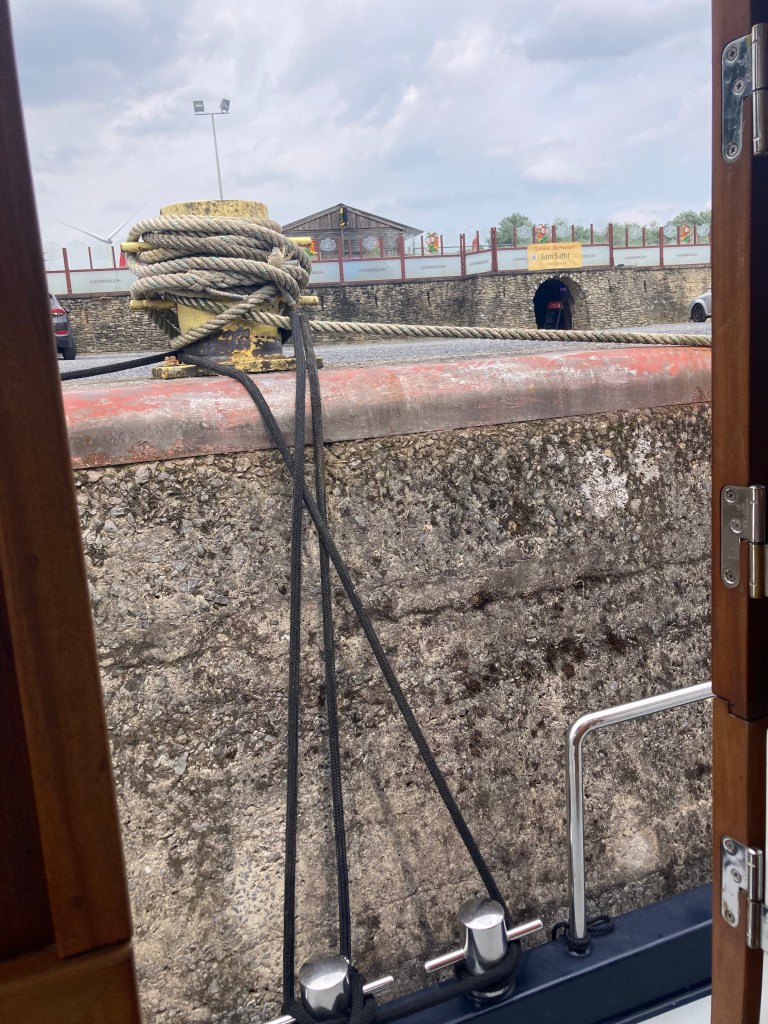
The mooring might have been a bit different to normal, but everything worked fine.
And the bollards had more than one use!
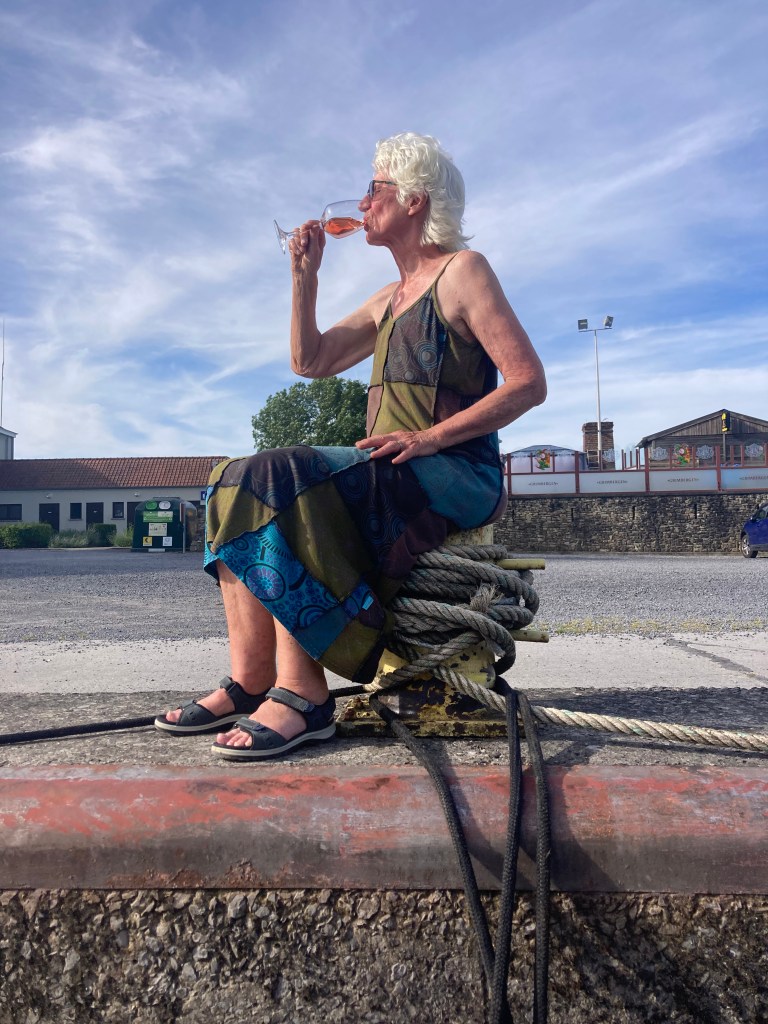
The port has an interesting bar and restaurant, of which we made good use.


After all it was our one and only night on the Nimy-Blatant-Péronnes Canal!
There was still another 13kms of the canal to go in the morning, with two big locks to drop us down to the Scheldt river; about two hours cruising then.

Along the 13 kms were 7 bridges of various shapes, sizes and purposes. This first one is the Pont de Grosmont; if you zoom in you will see the name on the bridge. Most Belgian bridges have their name on them and it really helps you to pinpoint where you are along a fairly uniform canal.
Soon we reached our next Grand Large – Le Grand Large de Peronnes.
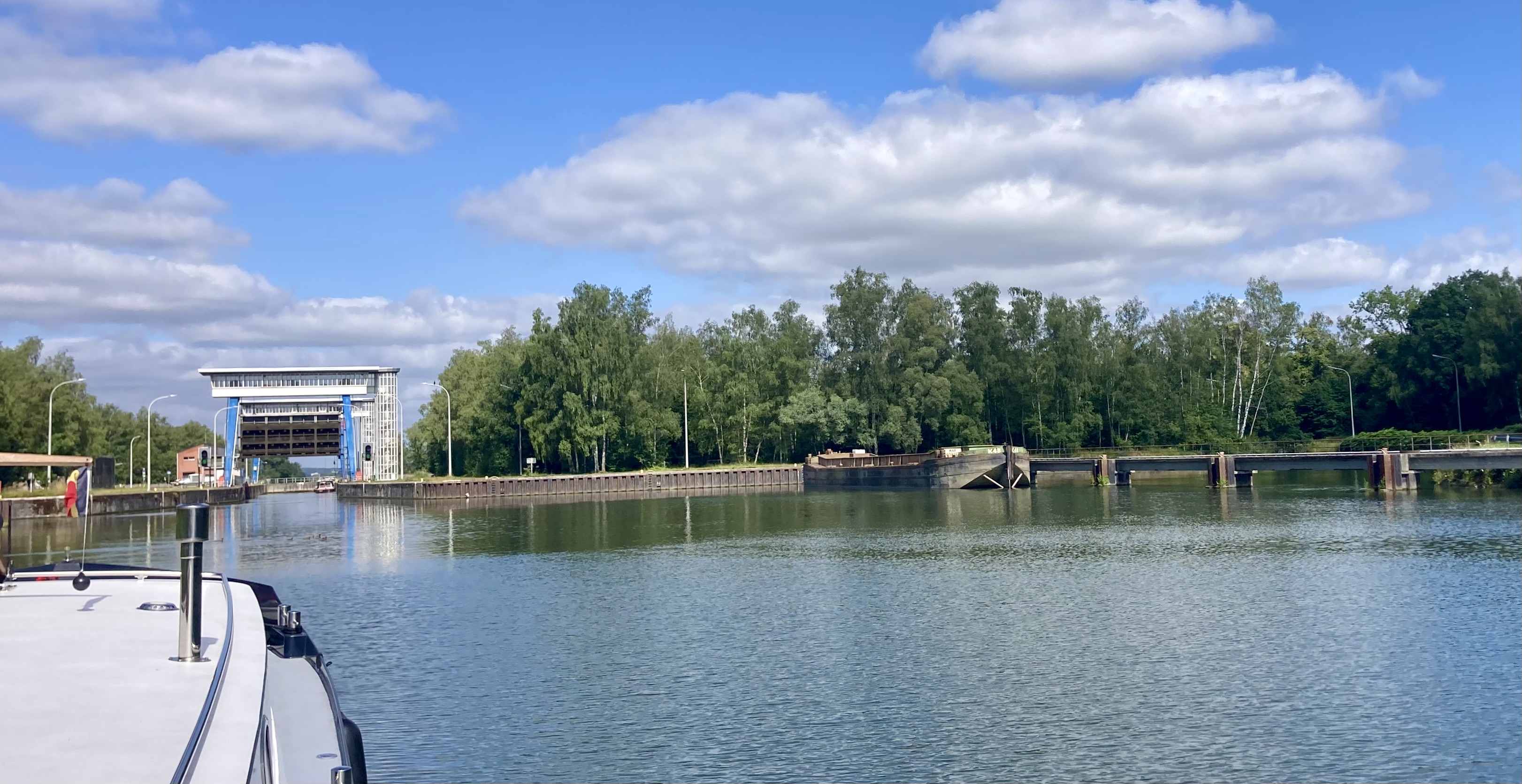
Boats enter this huge lake-cum-basin through Lock 1 – Maubray-Péronnes – and leave through Lock 2 – Péronnes. Here we are arriving at Lock 1.
We once spent the night attached to the wooden dolphins on the right, arriving there in darkness having been warned by another boat that we should be there ready for the first lock down of the morning. That is a whole other tale from 6 years before, laid out in this old blog post, when my photos were not so good!
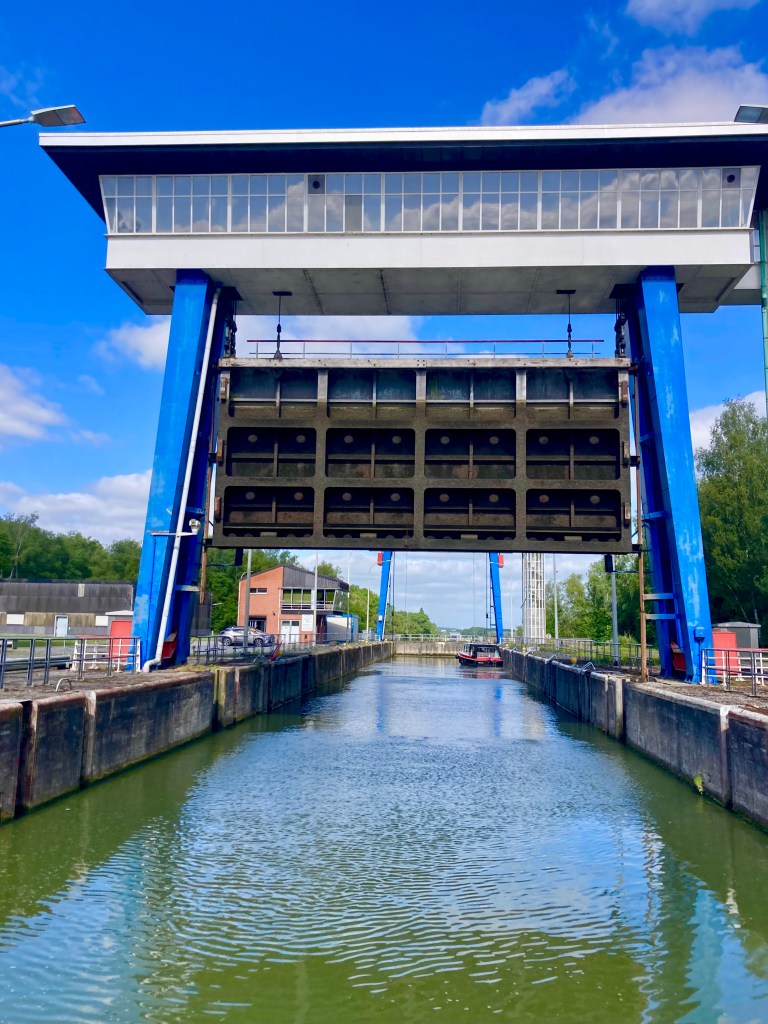
We went into the lock to join a small cabin cruiser that had been waiting to share the lock with us.
Plenty of room for us both!
The drop in this lock is 12.5m, one of the deeper locks in Belgium.
Down both boats went, gently and steadily.
We love for floating bollards!
Once you have tied to one of these bollards you can sit back and let the barge go slowly down as the water leaves the lock.

For fun I took one of the time-lapse videos of the gates opening. This lock has the ‘guillotine’ gates at each end. It’s a 7 second bit of fun.
At the end of the video you can see the Péronne Grand Large in front of us – almost 2 kms to cross to reach Lock 2 at the other side. A commercial barge was steaming across to meet us, to take Lock 1 up towards Peruwelz.

For Calliope, and also the cruiser we had now paired up with, it was another 5m down through Lock 2 with its ‘bollards in the wall’ method. Then onto the Scheldt, a big and busy river that goes on until it reaches the sea at Antwerp.
The Scheldt (known in France as the Escaut)
Calliope had a shorter trip, especially for that day. We were only a few minutes from the small harbour at Antoing so had fingers crossed for empty quay space there for a night.
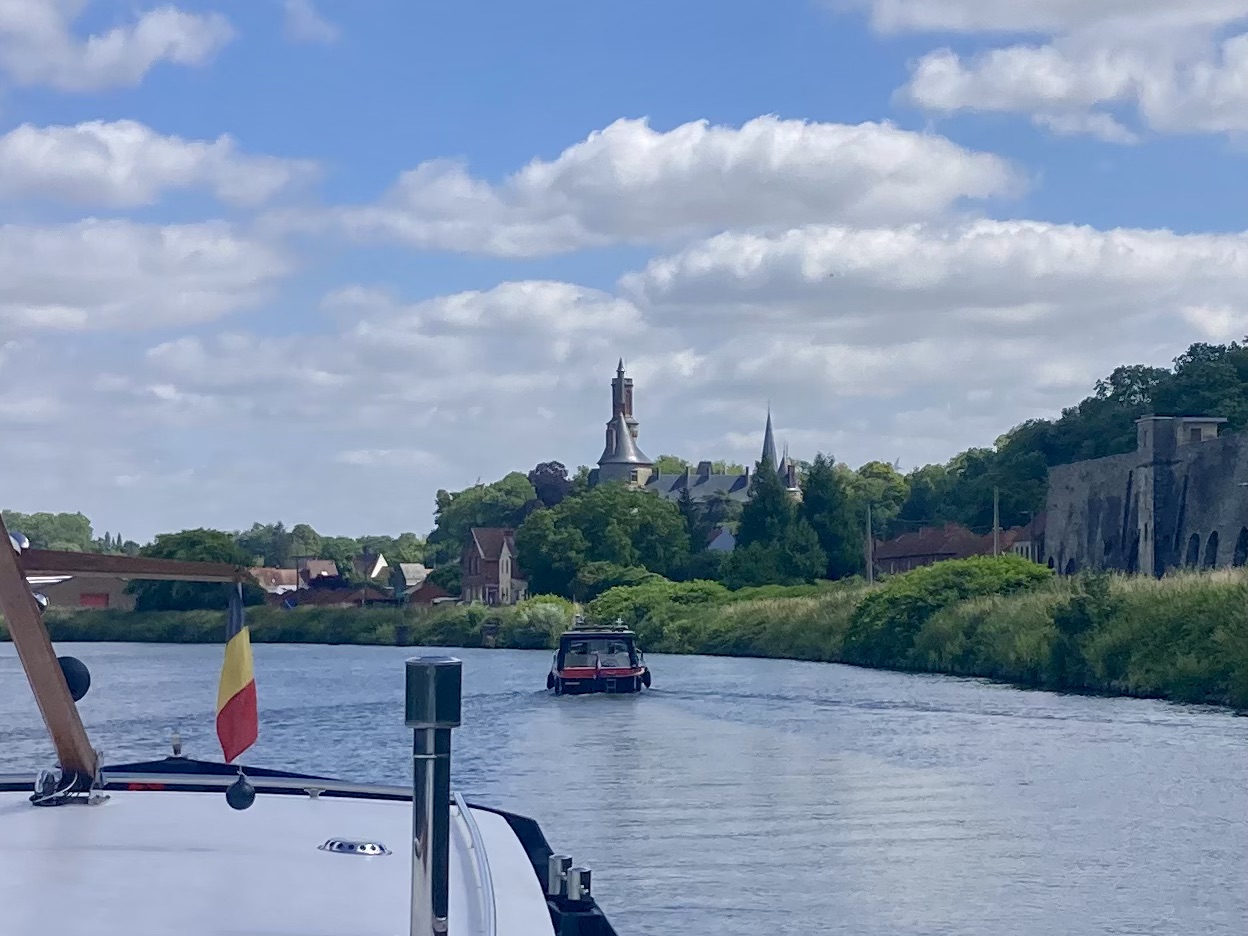
Antoing is dominated by its castle – a real fairy-tale shape. It dates from the 12th and 13th centuries, but its present Neo-Gothic style is due to a 19th century redesign. The lucky owners, since 1634, are the Princes of Ligne.. It is open to visitors at certain times, but despite mooring here three times we have never coincided with an open day!


The Princes may have been there for almost 400 years, but for us it was an overnight stop. Granddaughter and family were arriving in Gent in 5 days time and we wanted to get there a couple of days before in order to see friends, to shop, and generally prepare.
The Scheldt flows into the heart of Gent; we would be there in time.
After a quick shop at the almost adjacent Aldi supermarket our cupboards were full to see us thorough the next few days.
We spent a quiet night in the little port with our new lock friends, the cruiser, tucked up behind.

Leaving Antoing takes you almost immediately into Tournai – a city of history and some narrow bridges!

We came to a red light on the outskirts, and realised we would need to wait for a boat or two to come through from the opposite direction.
Then it was green and our turn.
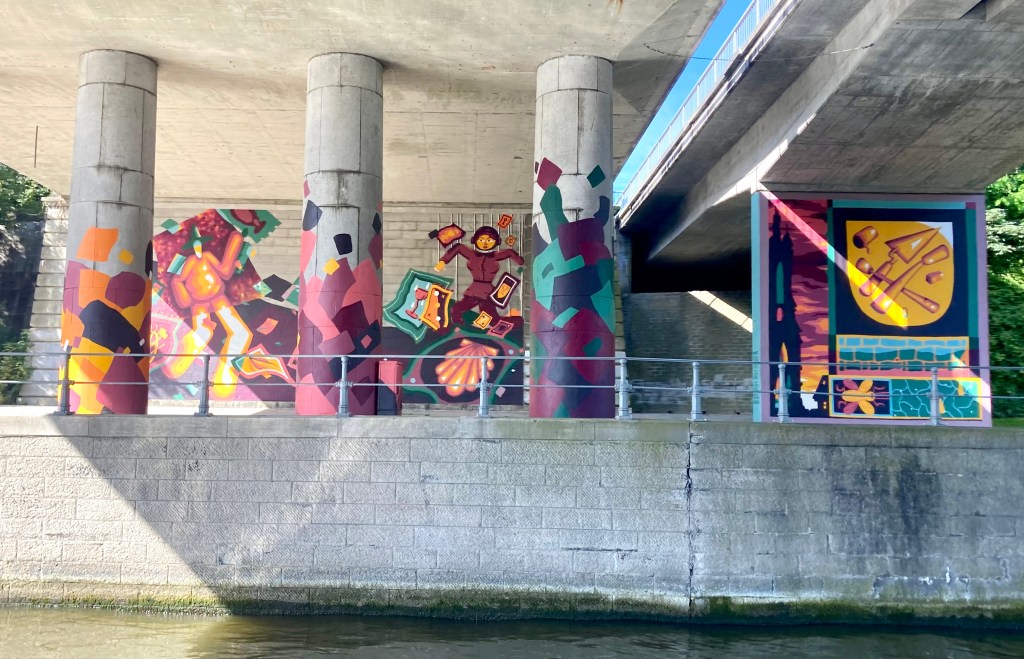
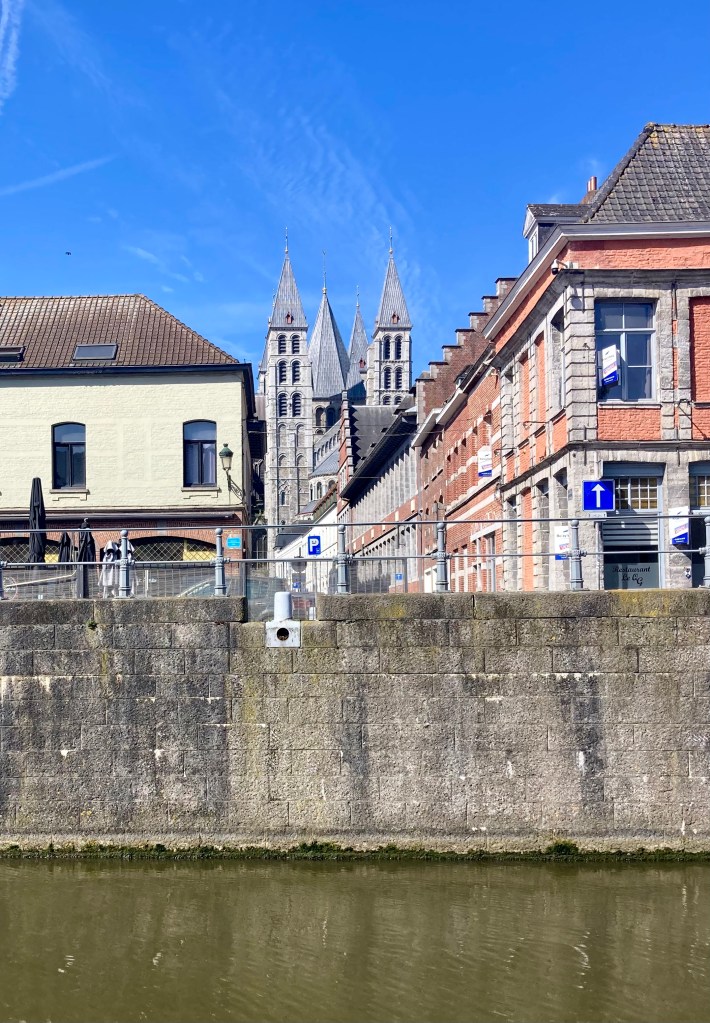

Here is a glimpse of Tournai from the river with its modern street arted bridges, its old houses lining the quays, the cathedral seen up a narrow side road, and the new, rather unusual, port of journal. It is a long pontoon separated from the rest of the river by an equally long floating pontoon. The outside of the latter is sometimes used by overnighting commercial barges.
Over the past few years a massive amount of work has been down on Tournai’s medieval bridge, Pont des Trous. The central arch has been widened and heightened to allow the passage of modern commercial barges.

As you can imagine there was a lot of protest about this work. It is now finished, using the original bricks in the re-construction. Here it is.
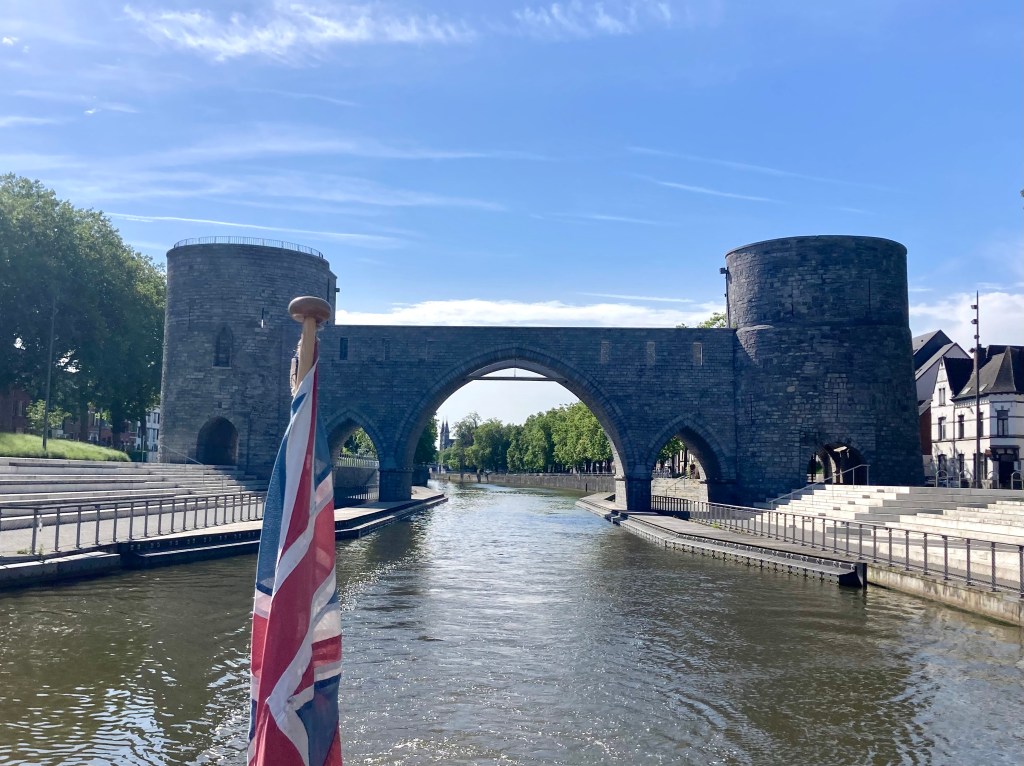
Unusually it is (and always has been) flat fronted facing the city, and with rounded towers facing ‘the enemy’.
There were not many locks between us and the next hoped for empty quay.

The first, Kain, and welcomed us with a green light. We went down 1.7m and out into the country.
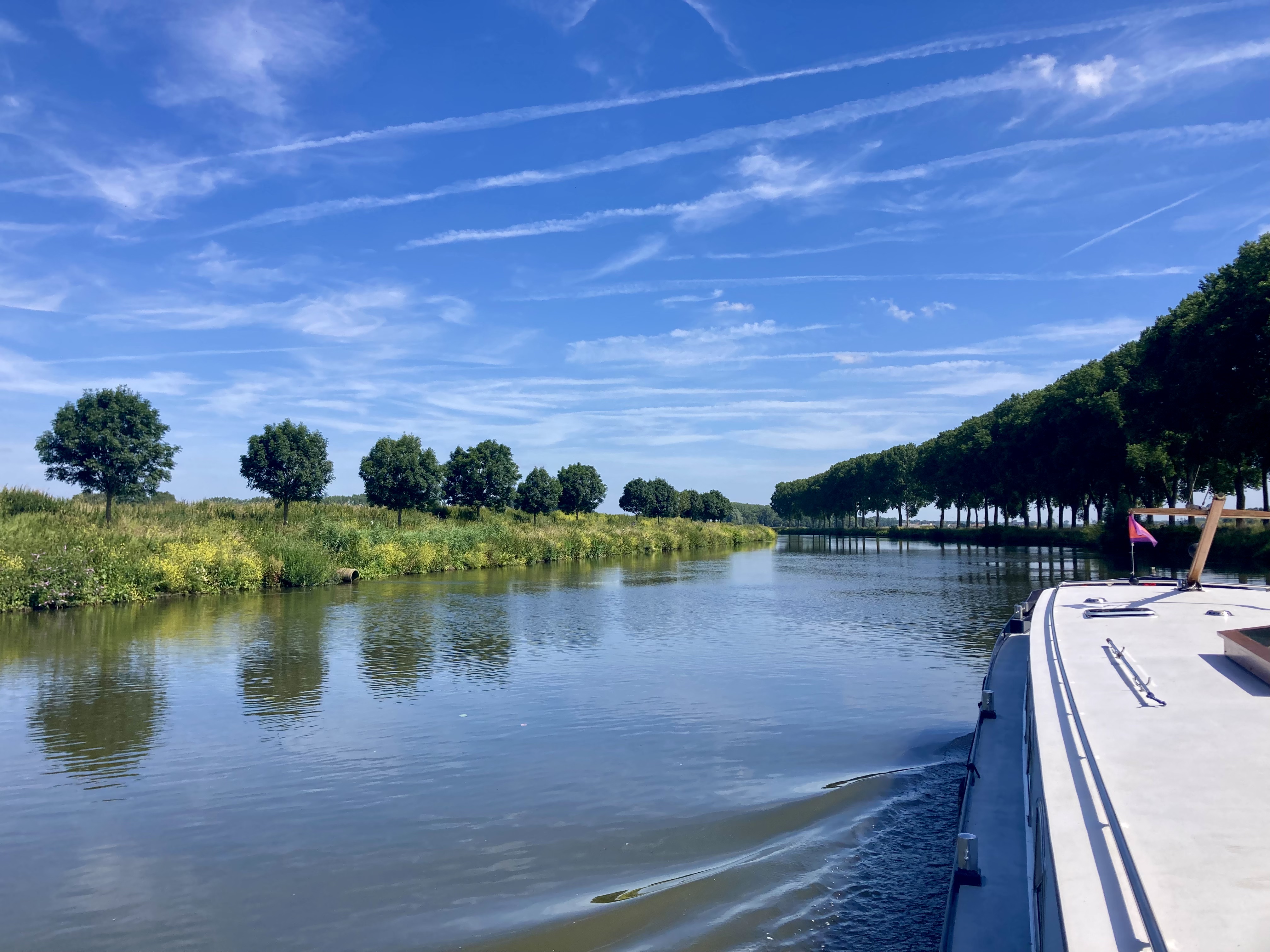
We arrived at Bossuit, below the deep lock that leads up into the Bossuit-Kortijk Canal, to find ourselves lucky again – an empty quay sitting at the bottom of a grassy bank. We did feel lucky to find this space waiting for us as although the quay is long enough for two or three boats quite a few of the cleats have broken, making it only usable by one largish boat like us, or a couple of smaller ones.

Even though ot had begun to cloud over a bit it’s a lovely place to moor, with great views across the Scheldt and over farmland in one direction, and a funky bar-cum-Vespa-Hire place on the other.

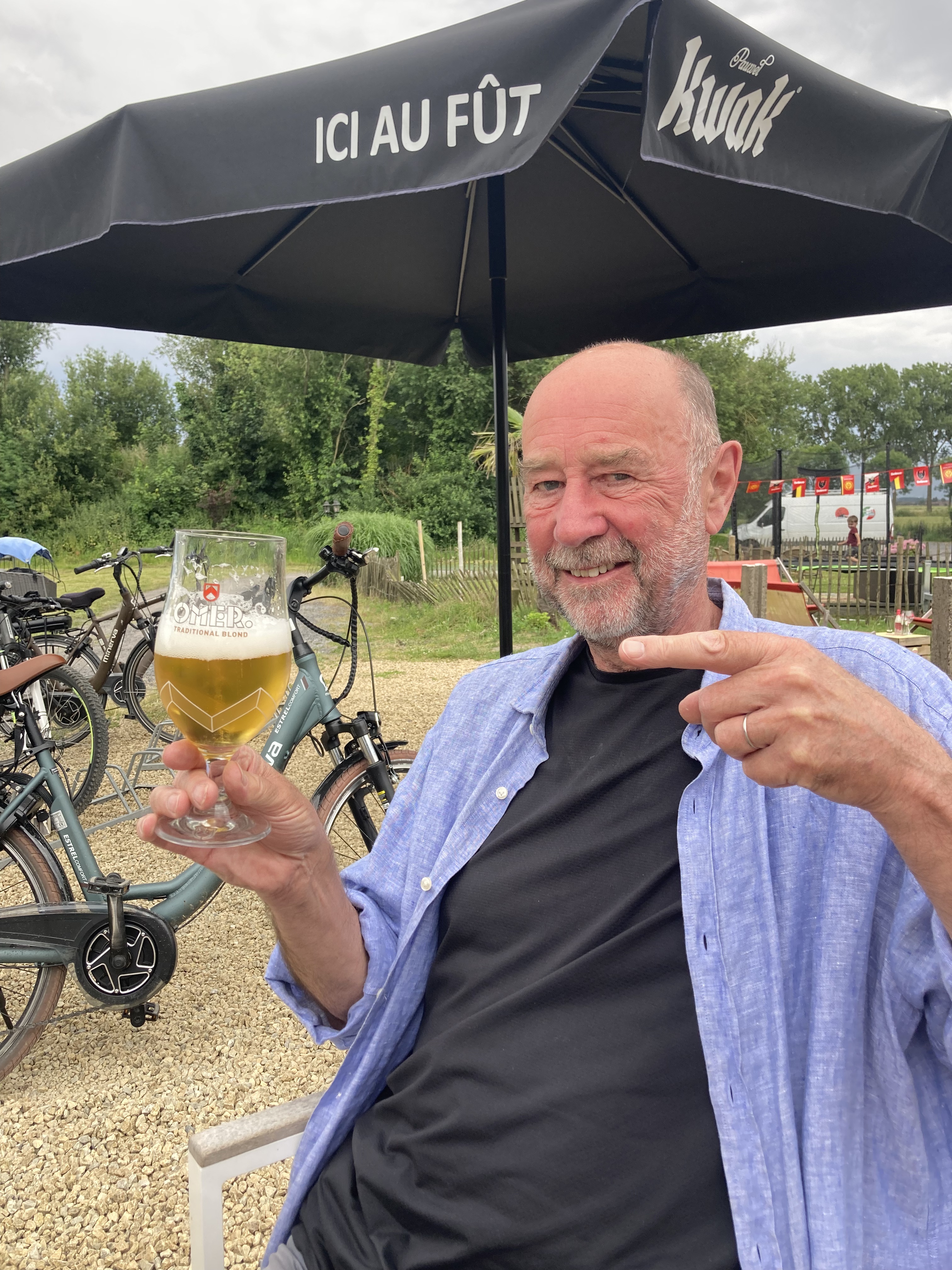
We enjoyed both, despite some unexpected rain suddenly cutting short the time at the bar – a bar where the Captain found his favourite Belgian beer – Omer!
The rain left us with some beautiful almost stormy skies.

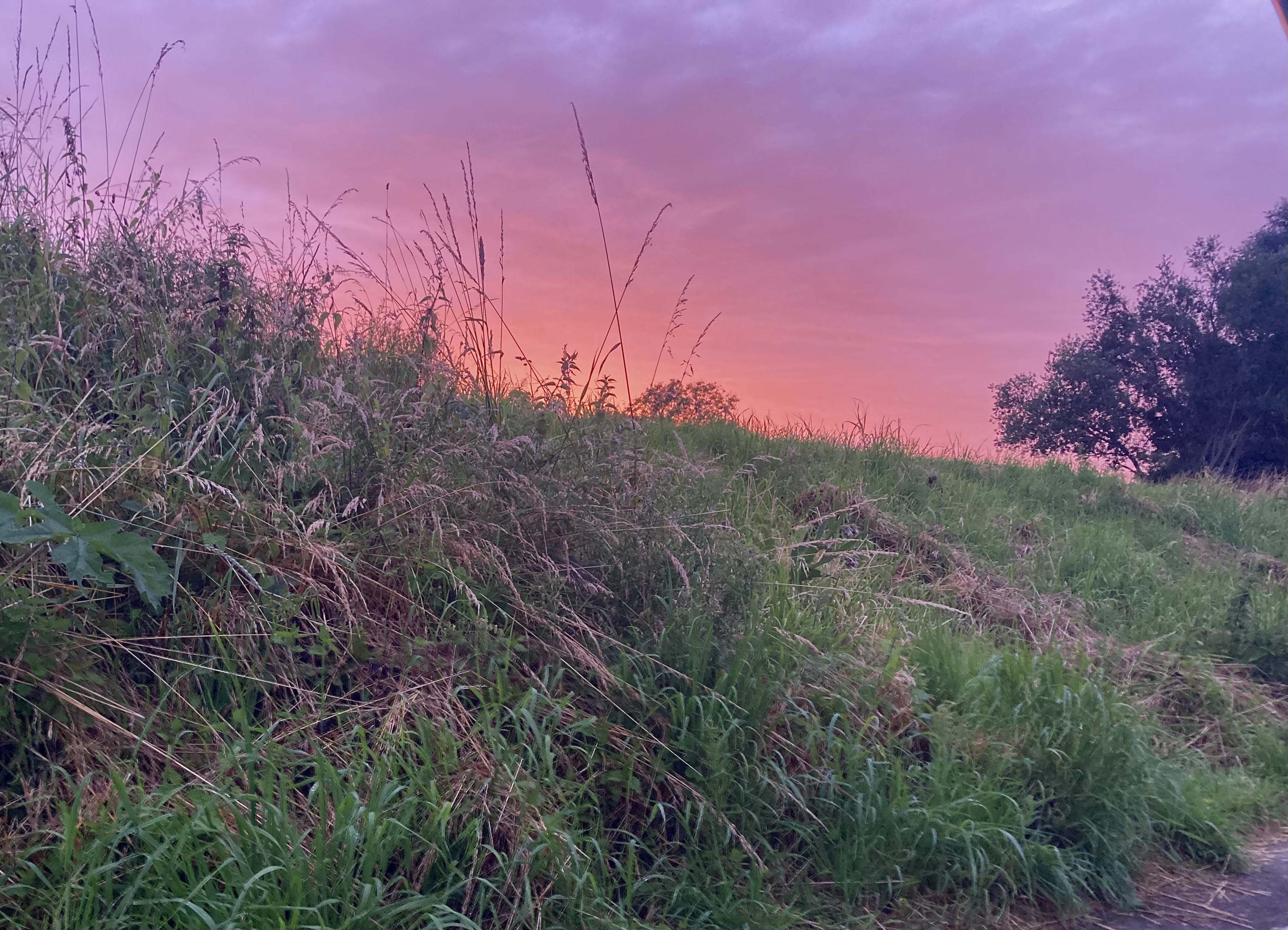
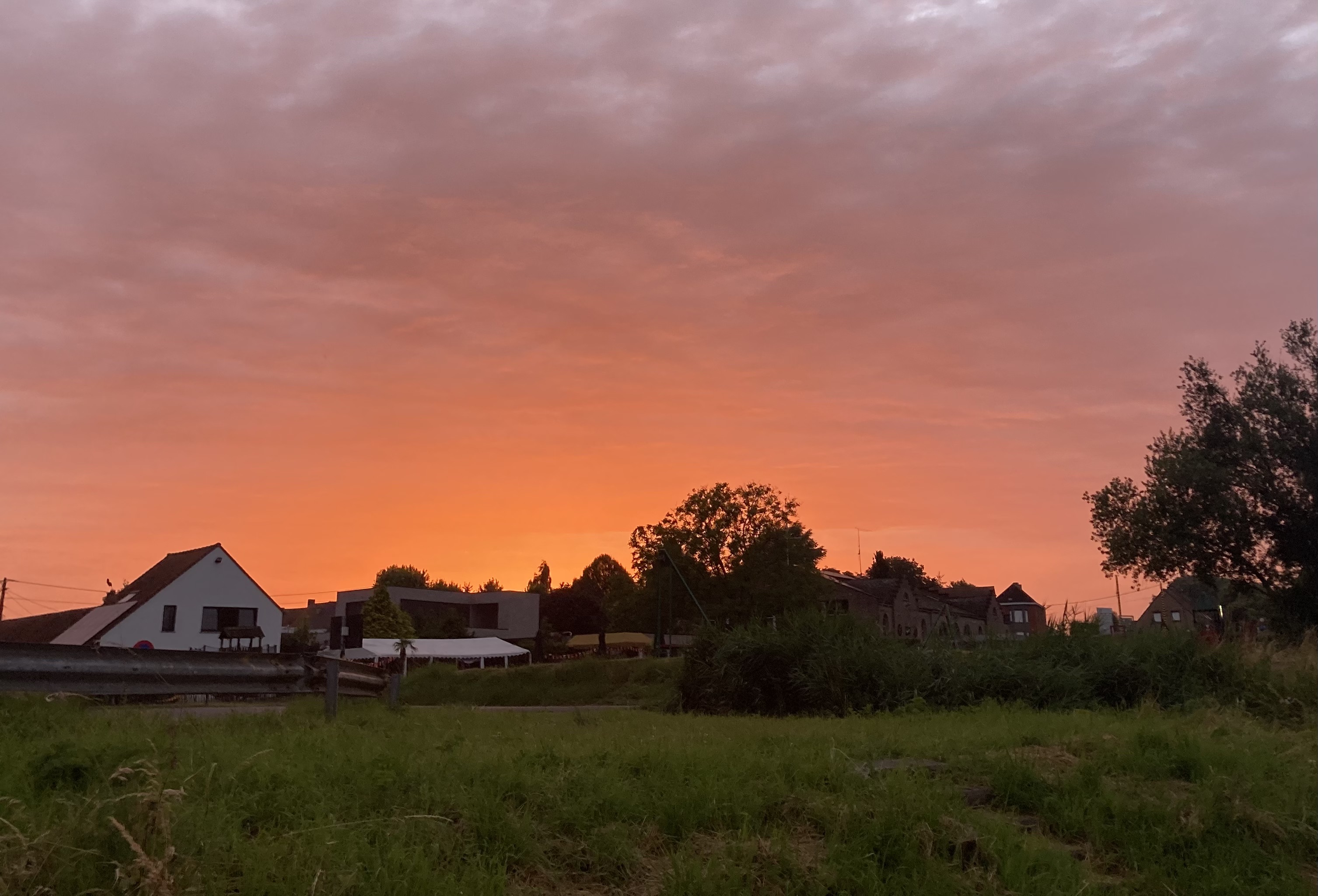
One more stop before Gent and that was at Oudenaarde – just under 20 kms away. And it is on this section that we passed from Belgium’s Wallonia (French speaking) region in the South into the Flandres (Dutch speaking) region in the North. This would become a bit more of a challenge linguistically! Thank good ness for DuoLingo and Google Translate.
It was a gentle Sunday cruise, with not too much other river traffic, even though the Scheldt is now a major transporter of containers, bringing them inland from around the world, via Antwerp.

The marina at Oudenaarde has been closed for redevelopment, and anyway it is not that easy for us to get in and out of it. Also we prefer mooring right on the river when we can.
A place next to the Pamela Kerk was picked out from the options in the DBA (Dutch Barge Association) Waterway’s Guide, and once again we had plenty of choice.
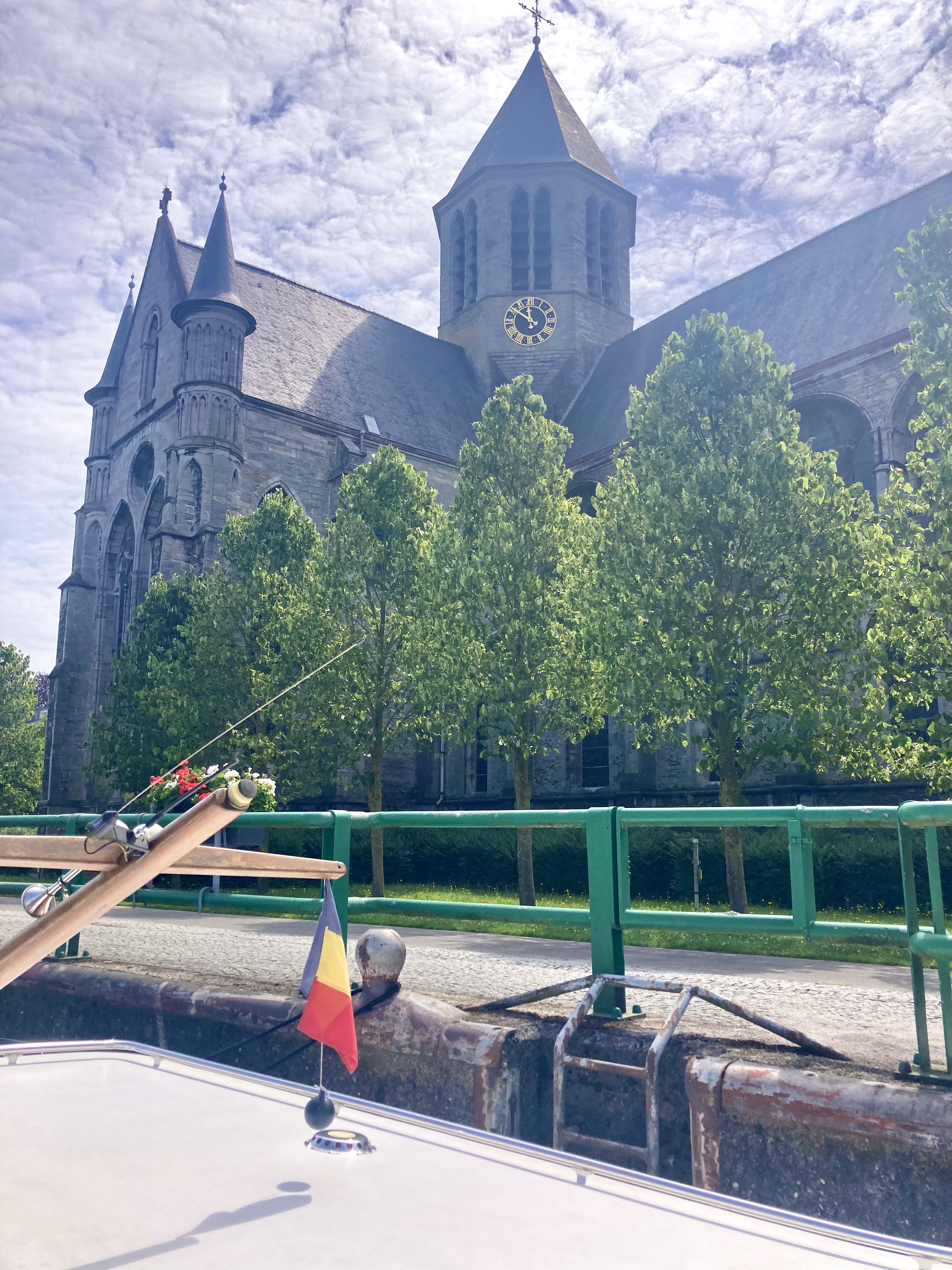
By noon we had tied up to a good size bollard and some strong railings, and were preparing our lunch. It is a quiet mooring, only disturbed by the ringing of the Pamela Kirk bells ….. and on this occasion live outdoor music!
I looked up the source of the music and discovered we had arrived in Oudenaarde on a festival weekend. That looked like something worth wandering round, so we did.

The entire big central square was filled by a stage, seats, bars, food stalls and umbrellas – all the trappings of a good festival in the rain.
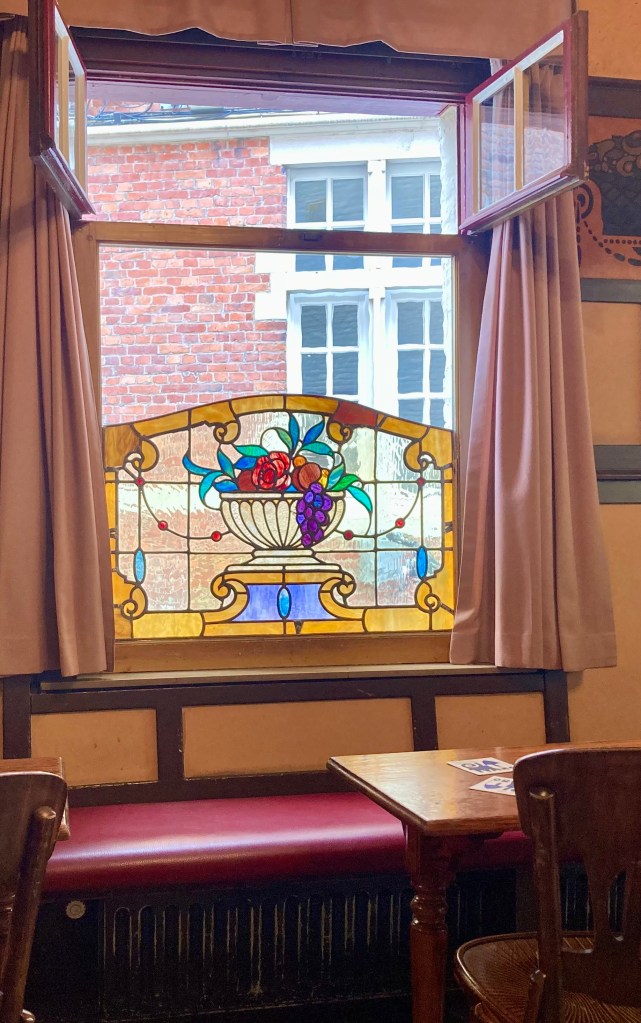
There was a great atmosphere, but rather loud for older ears so we found a historic bar at the edge where we could sit inside and enjoy it all from a distance!

For us it was not to be a late night. The final part of the Scheldt voyage into Gent is slightly convoluted, and in addition I was ‘attending’ a dear friend’s funeral service on line as we went along, so we wanted to get a good start in the morning.

We wandered back to Calliope under dry, but still threatening skies, and listened to the music from there.
Oudenaarde is a place worth visiting and spending a couple of days at – we only touched the surface.
Just ahead of us in the centre for Oudenaarde is a lift bridge carrying lots of traffic across there Scheldt. We knew it was important to get our timing right for this and not get to the bridge before it was our turn to go under.
I got the radio channel ready, called up the bridge and following lock, and understood we were being asked to wait. Then we saw the bridge lifting an d began to manoeuvre into place. As it went up we could see a commercial barge the other side waiting to come upstream , yet we had a green light – was there room for us both to go under at the same time?
The answer is yes – plenty of room!
Captain Stu took us through as we passed by another huge great container barge.


We got within sight of the lock and understood that we would be waiting for another barge to come up before we were to follow Juno in.
Juno was a ‘pusher’, a smaller tug size boat employed pushing non-motorised barges. along
About 45 minutes from my first radio call we were through the lock, and following Juno downstream.
The trip from Oudenaarde into Gent is mainly rural. I could enjoy the first few hours, helping us through locks with Juno and making coffee and sandwiches.

Then I was ‘off duty’ watching my friends funeral from afar. Always a sad event, but her family made it an incredible happy memory of her life.
We reached the Ring Vaart (the waterway ring road of Gent) and things are suddenly much more urban. At the ‘cross roads’ Juno turned off and we continued straight on into the much smaller part of the Scheldt – the part that runs into the centre of Gent.

There are various forks in the way and it is important ot keep an eye on the map and on the signs to make sure you end up where you hope to be!
Not difficult; just need to pay attention.
There is one little lock before the centre and we called up to ask if we could go through. We arrived there concentration on the lights, the gates, the mooring bollards – and then suddenly noticed waving people from the road above. Our mates had come to meet us!
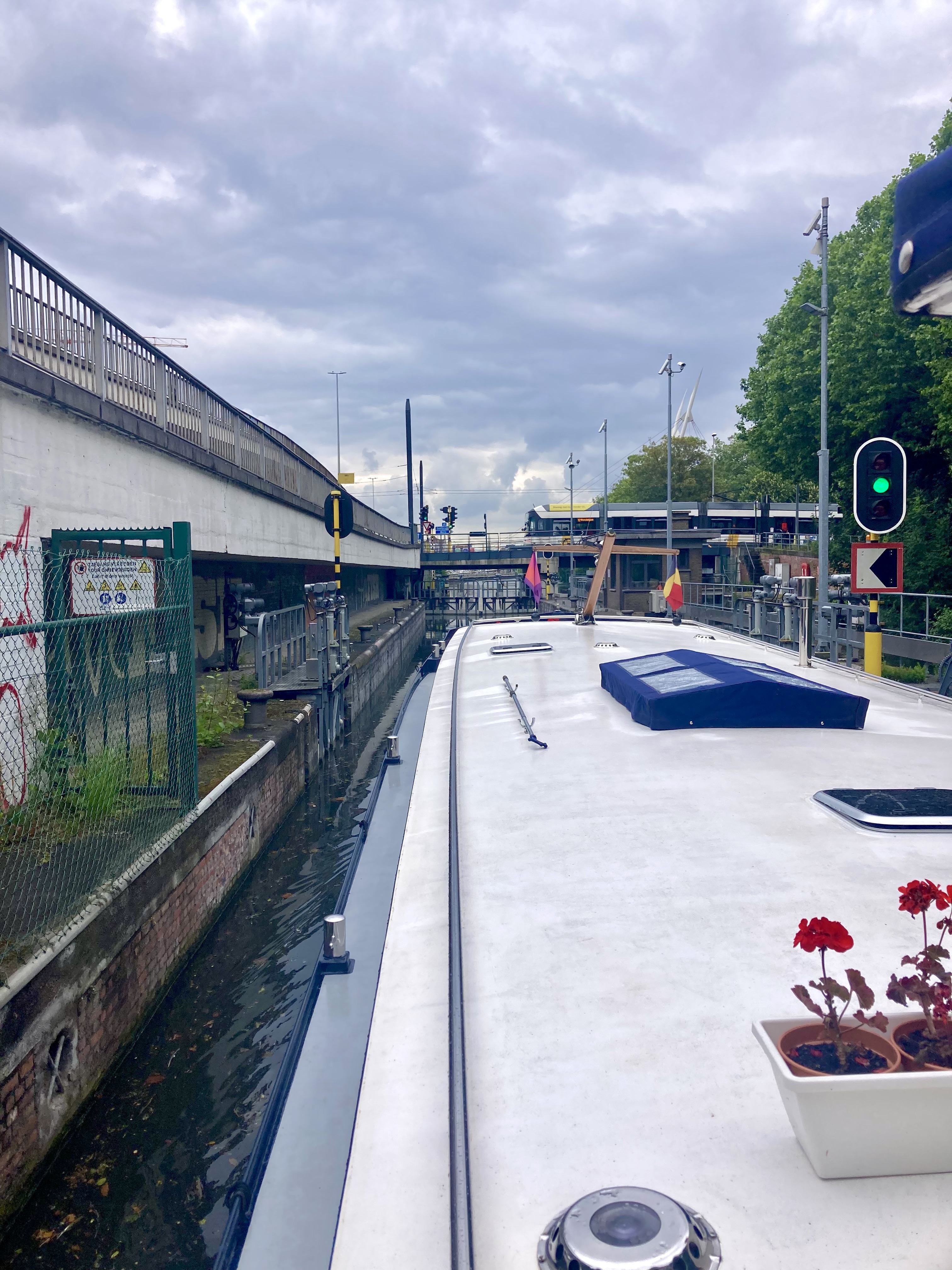

What a lovely welcome; Mieke, on the right, is owner (with husband Frans) of Dreamer, the barge we were to moor up against in Portus Ganda, Gent. Her daughter had come too, rushed out of her work during her lunch break just to wave us in!

Twenty minutes later we came under the last bridge of the day’s journey, and into the port.
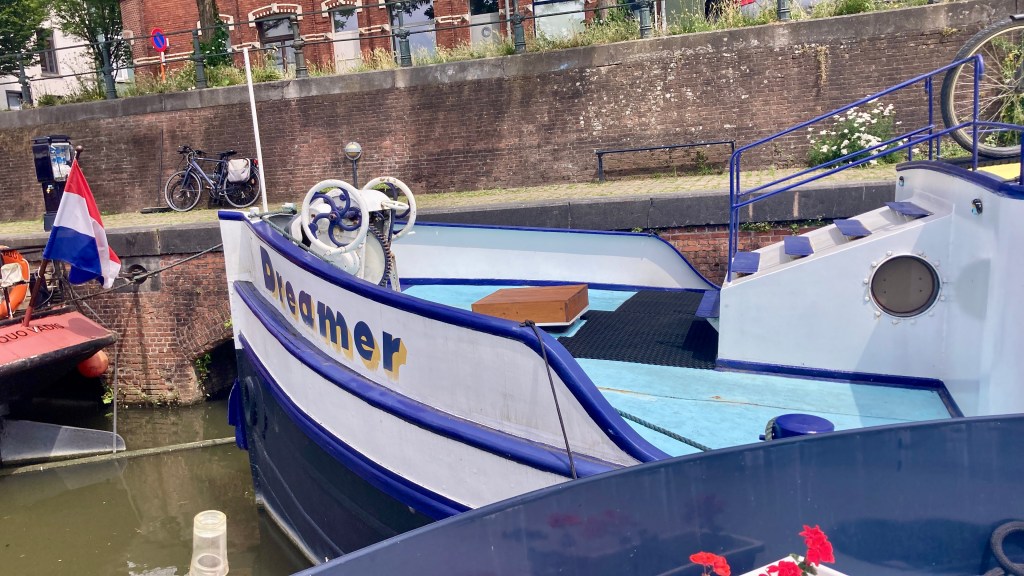
And just a few. minutes after that we were rafted up against Dreamer – our home for the next 5 nights.
We had made it, not only in time, but a day earlier than necessary. That would give us time to spend with Mieke, Frans, Ciska and the rest lf the family before our family arrived.
Gent is great, and we had such a good time there with the family; more about that in the next blog post!
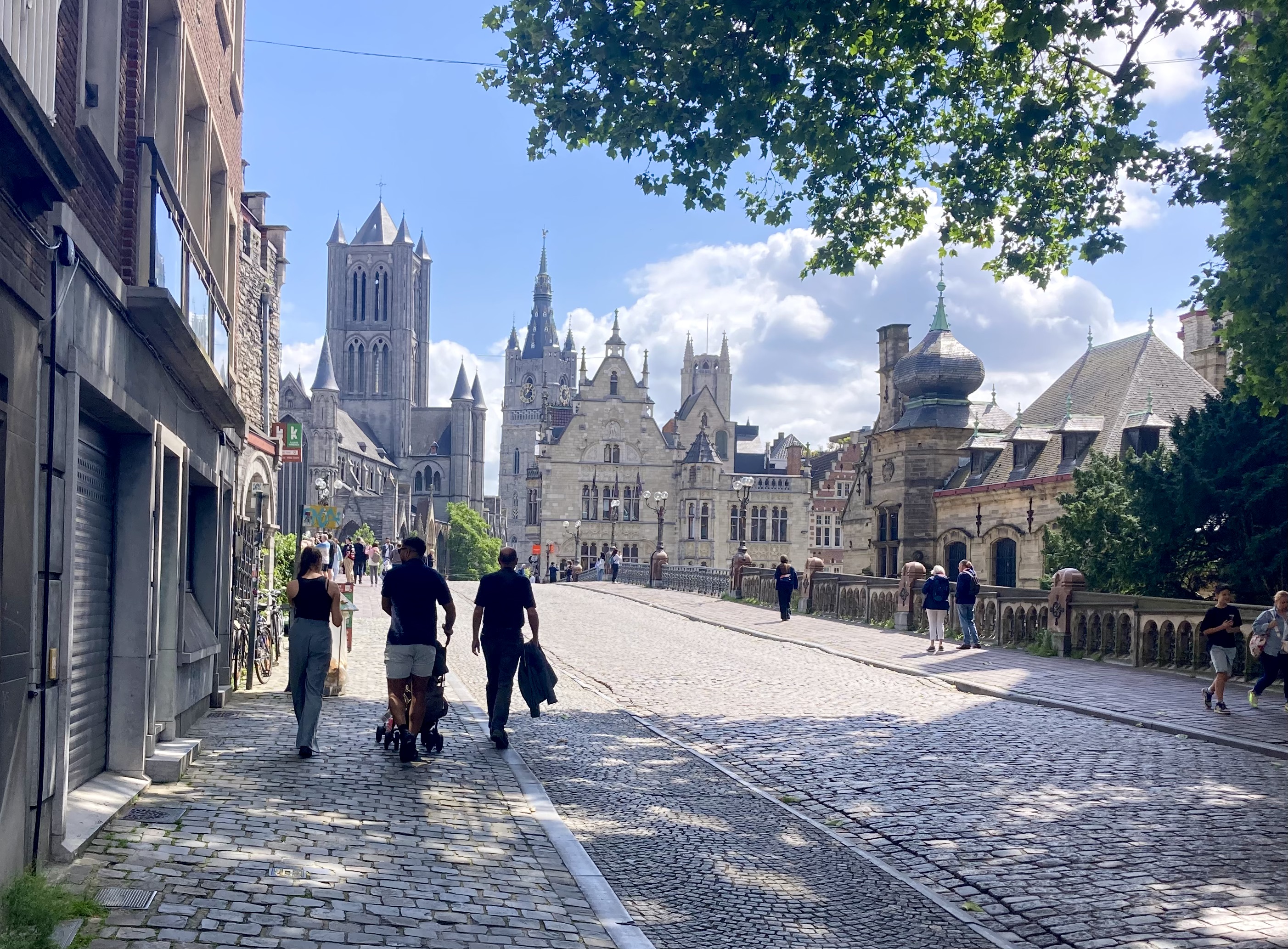

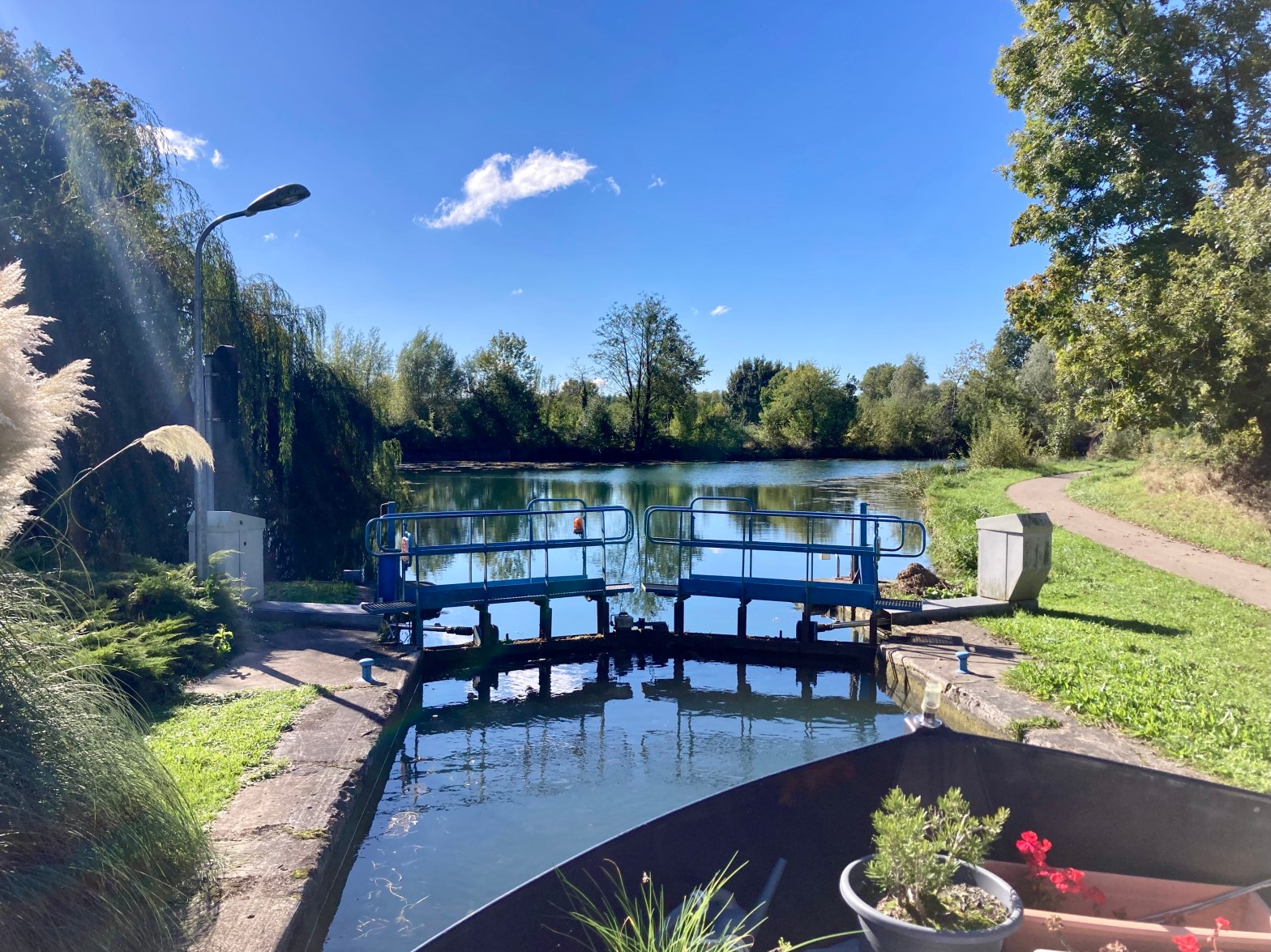


 goodshipcalliope